
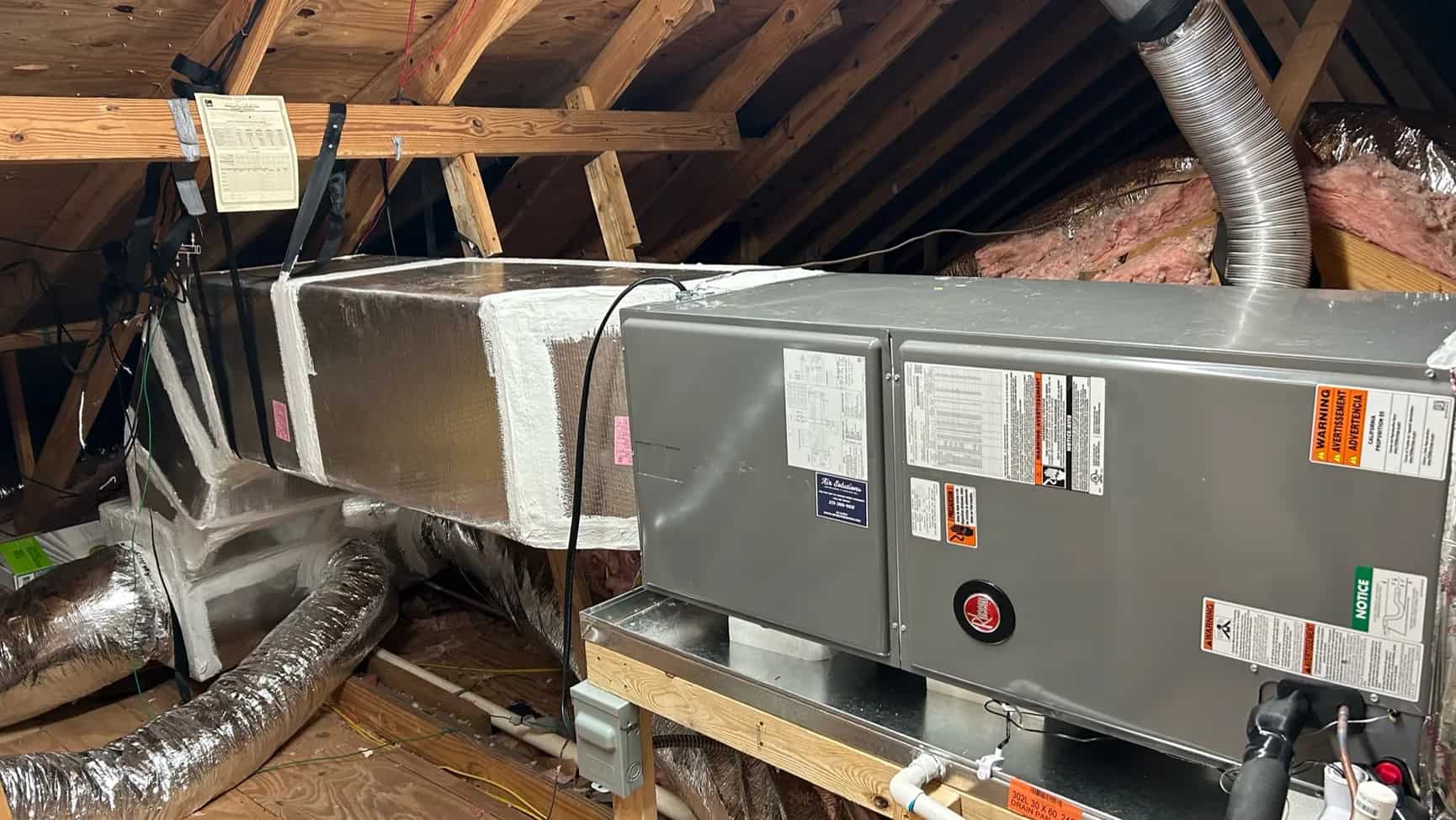
Emergency HVAC in Magnolia Springs.
Local emergency HVAC in Magnolia Springs, Alabama and surrounding Baldwin County. 24/7 emergency response across Baldwin County. Licensed AL#23194. 353+ five-star reviews. Call (251) 300-9817.
AC Not Cooling? Not Blowing Cold Air? Start Here.
Most Magnolia Springs calls start with one of these symptoms. Same-day weekday diagnostic, written estimate before any work — call (251) 300-9817.
- AC running but not cooling the house — usually a refrigerant leak, dirty condenser coil, or weak capacitor
- AC not blowing cold air — warm air from the vents means the compressor isn't engaging or refrigerant is low; we test both and explain what we find
- Weak airflow or nothing from the vents — blower motor, clogged filter, or a collapsed duct run
- Ice on the copper lines or evaporator coil — switch the system off before we arrive; running it frozen risks compressor damage
- AC short-cycling — starting and stopping every few minutes signals an electrical, thermostat, or refrigerant problem that worsens if ignored
- House cools but stays humid and clammy — in Baldwin County that often points to an oversized system, not a broken one
What emergency HVAC looks like in this climate.
An emergency-HVAC call out of Magnolia Springs sits inside a microclimate envelope you cannot quite read off the headline degree-day totals. The Open-Meteo ERA5-Land grid cell that resolves to the town puts annual cooling load near 3,002 degree days against a heating load of roughly 1,053 — a long humid cooling season paired with a modest but real winter at the 21-meter river-corridor elevation, with July averaging an 89.5 degree daily high and January overnight lows hovering at the 50 degree mark. Those numbers place the town in the same general bracket as Foley or Elberta, but they understate what actually generates the calls. The operative climate facts here are two: a mature live-oak canopy that shades most of the historic district and the lots along the Magnolia River corridor, and river-floodplain humidity that stays elevated through nearly every month of the cooling season because the Magnolia River, the Fish River, and the Weeks Bay watershed all push moisture into the air around town faster than the canopy can dry it back out.
Both of those microclimate facts feed the emergency-call mix in specific ways. Outdoor condensers sitting under deep live-oak canopy accumulate a continuous debris stream that an open-sun subdivision unit never sees — live oak does not shed leaves on a single fall cycle the way deciduous canopy does, and Spanish moss fragments drift onto unit tops year-round, with a heavier load in late winter and early spring. A coil starved for airflow under that loading runs head pressure into marginal territory earlier in the season than a clean coil would, and a marginal compressor tips into high-pressure lockout on the first sustained week above 95 degrees. The latent side feeds a separate failure pattern: condensate-drain biological growth that the river-humidity envelope keeps active nearly year-round, where biofilm in the drain trap finally reaches the secondary-float-switch threshold on a Sunday afternoon and the system shuts itself down to prevent overflow. Both patterns are predictable. Neither is convenient on a midnight call from thirty road minutes north.
Storm, freeze, and heat events that have driven emergency HVAC dispatch into Magnolia Springs.
- Sep 16, 2020 — Hurricane Sally: Sally tracked north out of Gulf Shores as a Category 2, with Magnolia Springs sitting inside the sustained-wind footprint and downstream of the live-oak canopy's debris loading. The dominant Magnolia Springs HVAC impact was less about salt-water surge than about wind-driven mechanical damage: live-oak limbs and Spanish moss masses came down onto outdoor condenser tops across the historic district and along the river corridor, debris collected against coil fins on units that had been due for cleaning anyway, and several months of restoration-cycle voltage events drove a slow-burn wave of contactor pitting and capacitor microfracture failures that didn't surface until the following summer. Outdoor disconnect cabinets that took wind-driven rain and never got resealed afterward became multi-year corrosion problems in the electrical compartment. River-corridor parcels saw a separate concern: outdoor units on FEMA AE-zone frontage lots took standing water in some cases, and any unit that sat submerged at the electrical compartment is a replacement conversation, not a service one.
- Sep 2004 — Hurricane Ivan — reference replacement-wave event: Ivan is the older reference storm for long-tenure Magnolia Springs homeowners, and most pre-Ivan outdoor equipment in town has already cycled out. The replacement wave that ran 2005 through 2008 produced the cohort of equipment we see on most emergency calls today — units now in years 18 through 21 of their service life, well past the original parts-warranty horizon and inside the bracket where compressor end-of-life, refrigerant transition decisions, and full-system replacement conversations cluster. A meaningful share of the current emergency-call population in town traces back to that single replacement wave, and the post-emergency conversation often involves whether the next round goes the same direction.
- Jan 2024 — Multi-night Eastern Shore freeze: Three consecutive sub-freezing overnight lows with daytime highs that struggled to clear 40°F — rare enough at the Magnolia Springs latitude that a lot of installed heat pumps had not exercised reverse cycle in months going in. The freeze hit the historic-district housing stock hardest. The town's 1983 median build year means most addresses run retrofit ductwork that was never designed for the modern higher-CFM equipment now feeding it, and during a multi-night freeze those systems lock into continuous auxiliary-strip operation, the strips read open at the contactor in the early morning hours, and the no-heat calls cluster at 5 and 6 AM on the coldest mornings. A parallel pattern surfaced on newer-replacement equipment: reversing valves that had not been tested under load in months stuck mid-changeover, and a meaningful number of defrost boards drifted out of timing spec under the unusual sustained cold. Emergency call volume across south Baldwin during that stretch ran well above a normal winter week.
- Aug 2023 — Extended heat-advisory week: Six straight days of triple-digit heat-index afternoons with overnight humidity that never broke below 70 percent. The Magnolia Springs call mix during that run leaned on three patterns that hit the town disproportionately given the demographic and the housing stock: a cluster of no-cool calls from households with elderly residents in the historic district where the life-safety priority tier was the determining dispatch factor; condensate-overflow trips on homes with attic air handlers running continuous latent load through the river-humidity peak; and a small but real wave of compressors on live-oak-shaded condensers that had been audibly straining for weeks under debris-loaded coils and finally quit on the hottest afternoon. The 30-minute drive from the Daphne shop was the difference between an hour-class response and a longer one on the worst days, when every south-county truck was already routed.
What we see on calls in Magnolia Springs.
Calling for emergency service on a Magnolia Springs address is a different decision than scheduling a normal visit, and being straight on the dispatch call about which tier your situation actually crosses helps us route the right truck against a 30-minute drive. Treat it as an emergency when one of these is true: no cooling under an active NWS heat advisory, particularly in a household with an elderly resident or anyone medically dependent on temperature control; no heating during a freeze warning with exposed plumbing at risk; a refrigerant leak audible at the line set or strong enough to smell at the indoor coil; visible arcing at the outdoor disconnect, a breaker that will not hold after one clean reset, or smoke or burning-plastic odor from the equipment. Those situations route to the 24/7 line at (251) 300-9817. The town's demographic skews older than the matrix average — median resident age 48.6 per the 2022 ACS, with 87.9 percent owner-occupancy on 481 occupied units, much of it long-tenure primary residency — so a higher-than-average share of no-cool and no-heat calls here come from households where the homeowner or a family member sits in the life-safety priority tier the published service framing supports. Be specific on the phone if vulnerable residents are at risk; we route accordingly. A system running but undershooting setpoint by a few degrees or developing a new noise you want a tech to listen to is a normal scheduled call.
The Magnolia Springs emergency-call book breaks across four operationally distinct threads. First, the elder-care life-safety thread on heat-advisory and freeze-warning days — a no-cool Saturday afternoon call from a historic-district home with an elderly resident in place is the highest-priority dispatch the published WP framing supports, and we treat it that way. Second, the flood-risk outdoor-unit thread on river-corridor lots. The FEMA point check at the town-center coordinate returns Zone X, which simplifies most dispatch math, but parcel-level FEMA queries on Magnolia River frontage, Fish River frontage, and the Weeks Bay watershed routinely surface AE or VE zone pockets the town-center designation doesn't catch. During a tropical-system or hard-rain event, outdoor condenser submersion on those parcels is a real risk — a unit that took standing water at the electrical compartment is a kill-power-first conversation, not a restart-and-see one, and we ask about standing water at the unit before any storm-adjacent dispatch. Third, the live-oak-canopy-loaded outdoor-coil thread on shaded properties — peak heat in mid-to-late July finds debris-loaded coils on units that haven't been cleaned in two or three seasons, head pressure runs into marginal territory, and a compressor that's been audibly straining for weeks finally locks out at 4 PM on a 96-degree afternoon. Fourth, the river-humidity condensate-drain thread — biofilm-clogged primary drains tripping the secondary float switch on Sunday afternoons during the latent-load peak of August. While the truck closes the 30-minute gap, the homeowner-safe moves are short: cut the thermostat off if a failed compressor is still trying to start, close blinds on the sun side, run ceiling fans only in occupied rooms, get cool water in front of vulnerable residents if cooling is the failure, and at the first sign of burning smell or smoke, kill power at the disconnect or breaker panel.
- Older housing stock typical here (median build year suggests 39+ year systems are common). Duct leakage and undersized returns are the recurring finds.
- Long cooling season means compressors run heavy May through October. Annual maintenance pays for itself in compressor lifespan.
- Mild winters mean heat pumps cover the season comfortably without backup runtime in normal years. Cold-snap weeks expose undersized units.
Emergency HVAC in Magnolia Springs — the questions that come up.
- What actually qualifies as an HVAC emergency on a Magnolia Springs address, especially given that the town has a lot of older residents?
- The threshold is whether the situation is unsafe to leave overnight. The 24/7 line at (251) 300-9817 routes for: no cooling under an active NWS heat advisory, particularly when the household includes an elderly resident or anyone medically dependent on temperature control; no heating during a freeze warning with exposed plumbing at risk; a refrigerant leak audible at the line set or strong enough to smell at the indoor coil; visible arcing at the outdoor disconnect, a breaker that will not hold after one clean reset, or smoke or burning-plastic odor from the equipment. Magnolia Springs skews older than the county average — the 2022 ACS puts the median resident age at 48.6 with 87.9 percent owner-occupancy on long-tenure primary residency — so a higher-than-average share of life-safety priority calls come from this town. Be specific on the phone if a vulnerable resident is at risk. The published service framing names priority for life-safety situations, and we route on that basis. A system that's running but undershooting setpoint, or one that's developed a new noise you want a tech to listen to, is a normal scheduled call — we'll be out quickly during business hours without after-hours overtime rates attached.
- Realistically, how long does it take to get a truck from your Daphne shop to a Magnolia Springs emergency? Is there a faster route than US-98?
- There is no faster route. The Daphne-to-Magnolia-Springs corridor is US-98 south through Foley to the Magnolia Springs turn-off, period — no I-10 cut-through, no Eastern Shore bayfront shortcut, no Beach Express bypass. OSRM puts the road time at 20.6 miles and just over 32 minutes door-to-door under normal weekday conditions, which makes a 30-minute floor the honest answer on a midnight call when the road is empty. The realistic ceiling looks different. On a peak-summer Saturday with Tanger Outlets and OWA traffic plugging the Foley stretch of US-98, the planning window is closer to 50 to 60 minutes than 30, and after a tropical system has cluttered the south-county routing all bets are off. We name the actual ETA on the phone when the call comes in rather than promise a tighter figure we would have to walk back later. If a tech is already working a south-Baldwin job in Foley, Elberta, or anywhere else along the corridor when the call lands, the response can be measurably faster — the small-town economics here mean we route opportunistically when the chance is there.
- Our property sits on the Magnolia River and we're in an AE flood zone. What happens to the outdoor unit during a flood event, and how should we handle a storm-recovery service call?
- This is the most distinctive emergency consideration on a Magnolia Springs river-corridor address and worth being clear about before a storm arrives. The Magnolia Springs town-center FEMA designation is Zone X (minimal flood hazard), but the town is wrapped by the Magnolia River, the Fish River, and the Weeks Bay watershed, and parcel-level FEMA queries on river-frontage lots routinely return AE-zone pockets with real flood exposure during a tropical system or sustained hard-rain event. If your outdoor condenser took standing water at the electrical compartment during a flood, the safest move is to kill power at the outdoor disconnect and at the main breaker immediately and leave it off until a technician can do a wet-system inspection. Do not attempt to restart the unit. Components that have been submerged in flood water are not always salvageable — the electrical compartment, the compressor windings, the fan motor bearings, and the control board all carry different recovery thresholds and the inspection has to confirm each one before any restart attempt. A unit that took partial submersion may be repairable; a unit that fully submerged at the contactor and compressor terminals is usually a replacement conversation. We ask about standing water at the unit before any storm-adjacent dispatch so we can route the right diagnostic equipment and avoid a wasted run.
- Our outdoor unit sits in deep live-oak canopy and the AC just quit on the hottest afternoon of the summer. Could the shade and the trees actually be part of the problem?
- Yes, in a counterintuitive way. The mature live-oak canopy across the Magnolia Springs historic district and along the Magnolia River corridor produces a year-round debris stream that an open-sun subdivision unit never sees. Live oak does not shed leaves on a single fall cycle the way deciduous canopy does — it cycles leaves continuously with a heavier drop in late winter and early spring, and Spanish moss fragments drift onto unit tops year-round. Pollen and dust settle into the coil fins from above. A condenser coil starved for airflow under that loading runs head pressure into marginal territory earlier in the season than a clean unit would, and a compressor that's been audibly straining for weeks under the elevated head pressure can finally lock out on the first 96-degree afternoon. The shade itself isn't the problem — the shade actually lowers the sensible cooling load on the rest of the system, which is a net benefit. The debris stream the shaded environment produces is what raises the failure-mode risk. A clean coil rinse on a documented bi-annual cadence catches most of this before it becomes a 4 PM Saturday emergency call. While you wait for a truck, cut the thermostat off rather than letting a failed compressor keep trying to start, and if you can safely access the outdoor unit, brush visible debris off the top of the cabinet — that's a homeowner-safe step that won't fix the lockout but won't make anything worse.
- How do after-hours and weekend overtime fees work for a Magnolia Springs emergency call, and does Cool Club membership change anything about the dispatch?
- After-hours, weekend, and holiday calls carry overtime rates — the Air Solutions site states this plainly (the published wording: "After-hours calls carry overtime rates, but for a total system failure in summer heat, it's worth the call"), and we state it plainly on the dispatch call before a truck is routed from the Daphne shop. The fee structure, the diagnostic fee, and what the visit will cover all get disclosed up front so there are no surprises at the door when the tech arrives 30 to 60 minutes later. If the situation can safely wait until normal business hours, we'll tell you that honestly and let you choose whether to proceed at overtime or schedule for the next business day. The 30-minute drive doesn't change the overtime policy — proximity affects the dispatch ETA, not the time-of-day premium. For Cool Club members, the published 15% off all AC repairs and 5% off new systems applies on emergency work the same as on scheduled work; the membership doesn't waive the overtime fee and doesn't buy a separate front-of-queue dispatch lane. The dispatch tier on an emergency call is set by the actual safety threshold of the failure — life-safety priority calls route first, regardless of membership status.
Every Magnolia Springs neighborhood, every zip.
Emergency coverage in Magnolia Springs spans the entire 36555 ZIP — Downtown Magnolia Springs and the historic core, the Magnolia River corridor where the live-oak canopy is densest, the Fish River area east of the historic district, the Weeks Bay frontage on the south, and the Magnolia Springs Historic District itself. The town's full-time population sits at 1,325 per the most recent Census ACS, and no HVAC contractor lives inside the town limits as a dedicated Magnolia Springs operation — every truck pulling into a driveway on Oak Street or along the river corridor at 11 PM on a Tuesday is coming from somewhere else in the county. The questions we ask on the phone reflect that reality: vintage of the structure, whether the property sits on river-frontage with possible FEMA AE-zone flood exposure, whether a vulnerable resident is in the home, which utility appears on the latest electric bill, and what the situation actually crossed to qualify as an emergency rather than a next-business-day call. Those answers let us route the right truck with the right parts against the 30-minute drive.
From the Daphne shop, a Magnolia Springs emergency address sits at 20.6 miles by road — about half an hour on a normal weekday evening down US-98 through Foley with no faster alternate routing available, and closer to an hour on a peak-summer Saturday when Tanger and OWA traffic plug the Foley stretch of the corridor. The (251) 300-9817 line carries emergency dispatch around the clock; live pickup is what we work toward first, and missed calls land on the on-call rotation's next outbound queue with the dispatch ETA and the after-hours overtime structure disclosed before any truck moves. We aim for same-evening response on weekday emergencies when the schedule and the routing allow, and we'd rather quote a realistic 45-minute window we can keep than promise a 20-minute one we'd have to walk back. Coastal-corridor and freeze-event parts ride on the truck for the failure modes that dominate Magnolia Springs calls — capacitors and contactors in common sizes, control boards for the air-handler models most often installed in the 2005-2010 post-Ivan replacement wave, auxiliary heat-strip elements, condensate-pump replacements, and fittings for clean repairs at line-set penetrations on historic-district stock where the original siding doesn't patch back invisibly. There is no separate rural trip fee on Magnolia Springs emergency calls; the town sits in the same coverage tier as the rest of south Baldwin. Cool Club membership extends the bi-annual maintenance cadence that catches most of the failure modes before they become a 2 AM dispatch — the published 15% off all AC repairs and 5% off new systems applies against the repair total on emergency work, though membership does not waive the after-hours overtime rate and does not buy a separate dispatch tier.
- Downtown Magnolia Springs
- the Magnolia River corridor
- the Fish River area
- Weeks Bay
- the Magnolia Springs Historic District
What Magnolia Springs customers can claim.
- Most addresses inside the 36555 footprint that defines Magnolia Springs are on Riviera Utilities for both electricity and natural gas, with a smaller share of meters falling on Baldwin EMC depending on the specific subdivision. The dispatch-relevant detail on a storm-recovery emergency call is that Riviera's single-provider posture for electric and gas means a damaged service, a downed transformer, and a gas-safety concern at the same address can all be coordinated through one utility rather than across two — a small but real simplification on a complex post-storm night. Confirming which utility appears on the latest electric bill is the way to verify provider for any address before a post-emergency replacement conversation.
- Emergency repair work itself — a midnight capacitor swap, a Saturday contactor replacement, a defrost-board service on a freeze morning, a condensate-line clearing that finally trips a Sunday float-switch — does not generally qualify for utility rebates from either Riviera or Baldwin EMC. Both providers target rebates at qualifying full-system installations at high-efficiency tiers, not parts-and-labor repair tickets. What the emergency service report does provide is documented condition assessment that becomes load-bearing if the post-emergency conversation eventually pivots toward replacement rather than another round of repair.
- Both Riviera Utilities and Baldwin EMC publish residential efficiency rebate menus from time to time, keyed to qualifying high-SEER2 AC and heat-pump installations. The qualifying-equipment lists and dollar amounts revise on the providers' own program cycles, so verifying the current rebate sheet directly with whichever utility serves your address — rather than carrying a stale figure into a replacement budget after an emergency surfaces the need — is the responsible move.
- Cool Club membership covers a bi-annual tune-up cadence — spring before the cooling season and fall before the first cold front — that catches the failure modes most likely to develop into a 2 AM call. The published benefit is 15% off all AC repairs and 5% off new systems, with no long-term contract requirement. The repair-side discount applies on emergency work the same as on scheduled work. Membership does not waive the after-hours overtime rate and does not buy a separate front-of-queue dispatch lane — the dispatch tier is set by the actual safety threshold of the failure, not by membership status.
Emergency HVAC Coverage Map — Magnolia Springs, Alabama
Centered near Magnolia Springs for orientation. Air Solutions Heating & Cooling provides emergency HVAC throughout every Magnolia Springs neighborhood and zip code, plus the surrounding Baldwin County area. Same crew, same number — we travel the whole county.
353+ Five-Star Reviews. And Counting.
“We had an issue on a weekend at our office and Jacob with AirSolutions was quick to respond, kept me informed throughout the entire process and had it fixed same day! So thankful for reliable and efficient service. Never been disappointed with AirSolutions and recommend to anyone in need of repairs or preventative maintenance. They are the absolute BEST!”
“I can’t say enough good things about Air Solutions! Jesse was so kind and helpful, and came to my house within an hour of calling for a repair! Best ac repair service I’ve ever had!”
“Same day appointment during excessive heat. Very professional service from Jacob.”
When It Fails at 2 AM.
We answer the phone. Same-day diagnostic, same-day repair where parts allow. (251) 300-9817.
Schedule Emergency HVAC in Magnolia Springs.
24/7 emergency response across Baldwin County. Same-day appointments most weekdays in Magnolia Springs and surrounding Baldwin County. Tell us when works for you — we'll confirm by phone during weekday office hours (8 AM-4 PM).
Need someone right now? Call (251) 300-9817 — our 24/7 emergency line is answered live when we can and returned quickly when we can't.
Emergency HVAC in Magnolia Springs — FAQs
When should I call the emergency HVAC line?
Anytime your AC or heat is fully out and a return visit during normal hours is unworkable — a 95-degree afternoon, a sleeping infant, a vacation rental between renters. Call (251) 300-9817 and a technician routes to you.What's the after-hours emergency rate?
After-hours service includes a dispatch fee on top of standard repair pricing. We disclose the fee on the call before dispatching — no surprise charges. Cool Club members get 15% off the repair work.Do you respond on weekends and holidays?
Yes. The number is the same: (251) 300-9817. Answered live when we can, returned quickly when we can't.Do you service all of Magnolia Springs, AL?
Yes — Air Solutions Heating & Cooling covers every neighborhood and zip code in Magnolia Springs, Alabama — including Downtown Magnolia Springs, the Magnolia River corridor, the Fish River area, plus the surrounding subdivisions and rural roads. We handle AC repair, AC installation, AC maintenance, emergency HVAC, and commercial HVAC. Standard service hours weekdays, 24/7 emergency response, and same-day appointments most of the year. Call (251) 300-9817 to schedule.What HVAC issues are most common in Magnolia Springs?
Homes around the Magnolia River most commonly call us for refrigerant leaks (often salt-air or coil corrosion related on the Gulf Coast), undersized air conditioning systems struggling with Baldwin County summer humidity, and capacitor failures during peak load between June and September. A Cool Club bi-annual maintenance plan catches most of these issues before they cause a breakdown.
Emergency HVAC Near Magnolia Springs.
Right at the Magnolia Springs city limit? We service the surrounding Baldwin County communities on the same routes — same crew, same response times.
Related HVAC Guides.
Long-form articles about emergency HVAC and Baldwin County HVAC, with practical advice from our team.
 Seasonal
Holiday Weekend AC Prep for Magnolia Springs Cookout Hosts
Pre-holiday AC prep for Magnolia Springs, AL homeowners hosting cookouts and family gatherings — what to check, when to call, how to handle peak summer party loads.
September 21, 20264 min Maintenance
Why Your Outdoor AC Unit Is Buzzing But Not Cooling in Magnolia Springs
Outdoor AC unit humming or buzzing without cooling in Magnolia Springs, AL — what causes it, what to do immediately, and what each fix costs.
September 17, 20264 min Maintenance
AC Short-Cycling in Magnolia Springs: Causes, Costs, and the Right Fix
AC short-cycling in Magnolia Springs, AL — what's causing it, what drives the repair cost, and why ignoring it shortens your compressor life.
August 28, 20265 min
Other services in Magnolia Springs & this service across Baldwin County.
- All HVAC services in Magnolia Springs, AL
- Emergency HVAC across Baldwin County
- AC Repair in Magnolia Springs
- AC Installation in Magnolia Springs
- AC Maintenance in Magnolia Springs
- Commercial HVAC in Magnolia Springs
- Heating Repair in Magnolia Springs
- Heat Pump Services in Magnolia Springs
- Indoor Air Quality in Magnolia Springs
- Ductless Mini-Splits in Magnolia Springs
- Heating Installation in Magnolia Springs
Emergency HVAC in Magnolia Springs — Schedule Today.
Same-day appointments most weekdays. Cool Club members get prioritized scheduling.