
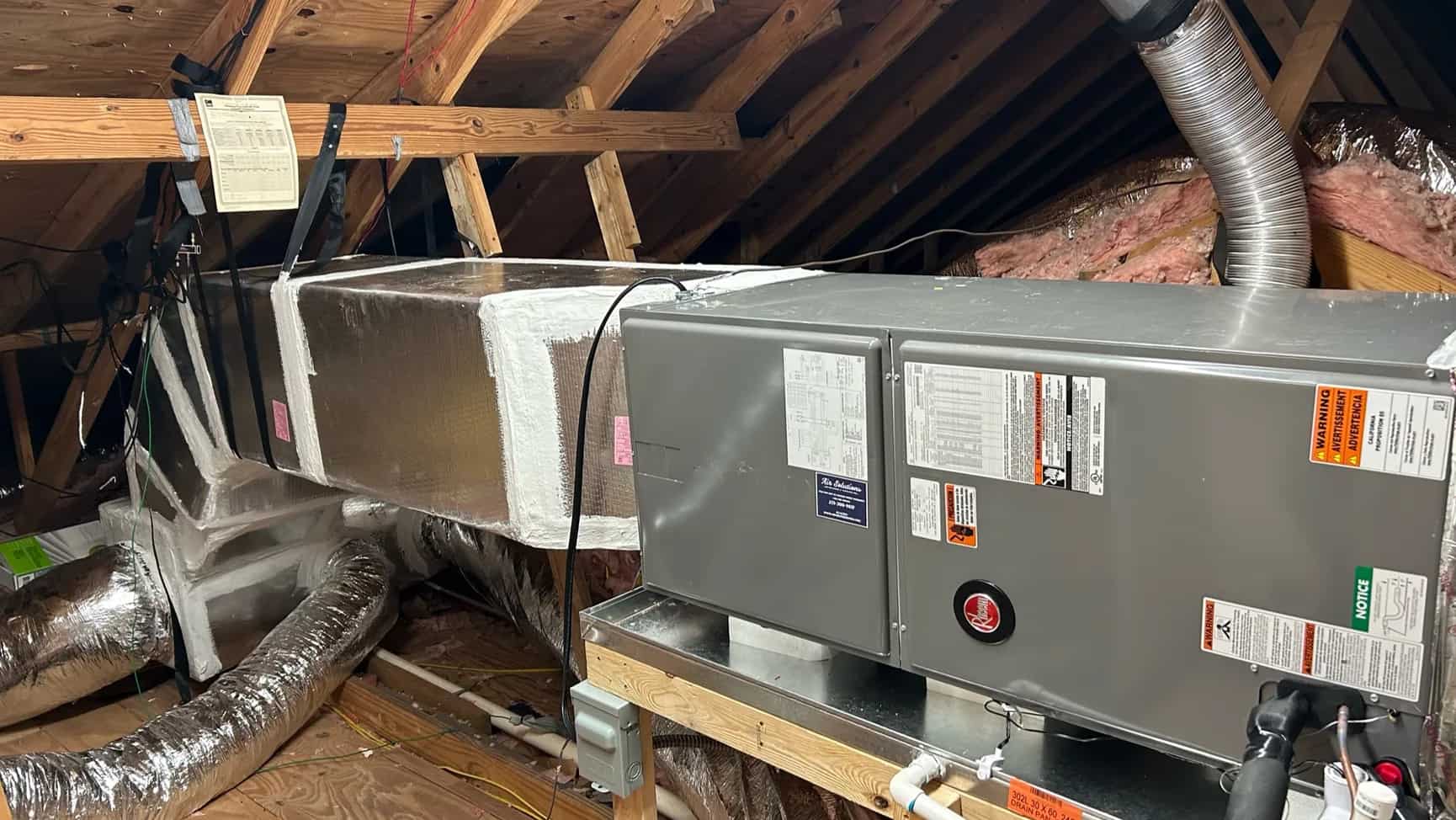
Commercial HVAC in Magnolia Springs.
Local commercial HVAC in Magnolia Springs, Alabama and surrounding Baldwin County. Restaurants, vacation rentals, property managers. Licensed AL#23194. 353+ five-star reviews. Call (251) 300-9817.
Get a Free Estimate
Name and phone is all we need to call you back. Takes ~20 seconds.
353+ five-star reviews · Same-day · 24/7 · Licensed AL#23194
What we see on calls in Magnolia Springs.
The Magnolia Springs commercial inventory is small enough to describe by typology rather than by count. The historic-village commercial mix is anchored by a handful of structures: the river-corridor restaurant property whose equipment pattern centers on kitchen makeup-air balance against an exhaust hood serving a dining room with windows opening to the water, the village general-store-and-post-office combination that anchors the year-round mail-by-boat route the town is known for, the bed-and-breakfast and inn properties tucked into the live-oak canopy where guest-room split systems carry the comfort load across an extended cooling season, and the occasional small professional office serving the village population. None of these were built around modern multi-ton rooftop-package HVAC delivery — the equipment is almost always split-system or small-footprint package work, often retrofitted into structures that started life as residential. Cutting modern return paths through the lath-and-plaster walls or original cypress siding of a converted-residence commercial structure is destructive and historically inappropriate, so the service approach that actually works selects equipment whose blower can move the design airflow through the return path the building already has rather than forcing the building to accommodate a high-static piece of equipment.
Three commercial-specific failure-pattern threads run alongside that base reality. First, the live-oak canopy on commercial outdoor units: the canopy that defines the historic district and the river corridor drops Spanish-moss fragments and leaf debris onto outdoor condenser tops year-round rather than on a single fall cycle, and the implications run harder on commercial equipment because commercial systems pull more amperage, run longer hours per day, and expose more coil-fin surface area per unit. A village-restaurant or inn condensing unit that has not had a coil-cleaning visit in two or three seasons runs head pressure into marginal territory earlier in the cooling season than its open-sun equivalent ever would. Second, the river-corridor flood-elevation reality on commercial outdoor pads: the FEMA point check at the town-center coordinate returns Zone X, but parcel-level queries on Magnolia River frontage, Fish River frontage, or properties adjacent to the Weeks Bay watershed routinely surface AE pockets the town-center designation misses. For a commercial restaurant or B&B with outdoor equipment near a river-side parcel boundary, the pad-elevation spec and the disconnect-cabinet height are load-bearing decisions rather than afterthoughts. Third, the small-inventory service-contract sizing reality: the total commercial-equipment count in Magnolia Springs is small enough that a service-contract account in town typically covers one or two systems rather than a multi-tenant office building's twelve or twenty RTUs, and templating a downtown-Fairhope or Foley-strip-mall service-contract scope onto a village B&B produces a misshapen agreement that overcharges the owner for unused capacity and underdocuments the equipment that actually matters.
- Older housing stock typical here (median build year suggests 39+ year systems are common). Duct leakage and undersized returns are the recurring finds.
- Long cooling season means compressors run heavy May through October. Annual maintenance pays for itself in compressor lifespan.
- Mild winters mean heat pumps cover the season comfortably without backup runtime in normal years. Cold-snap weeks expose undersized units.
Commercial HVAC in Magnolia Springs — the questions that come up.
- Our village restaurant on the river keeps losing dining-room comfort when the kitchen runs full hood on a busy weekend. What is that pattern usually telling us?
- Almost always one of three things, and the diagnostic order matters because guessing the wrong one wastes both money and guest comfort. First, kitchen makeup-air balance against the exhaust hood — when the hood pulls more air than the makeup unit delivers, the building goes into negative pressure, the dining-room system starts pulling makeup through every door and window seam, and the latent load on the dining-room equipment spikes past its design point right as the seating fills up. The river-corridor humidity baseline in Magnolia Springs makes that imbalance hit harder here than it would in an inland village. Second, condenser-coil fouling on the outdoor unit from a combination of grease-vapor migration from the kitchen exhaust and the year-round Spanish-moss-and-leaf debris stream coming off the live-oak canopy that shades most river-frontage commercial parcels. Third, an undersized or aging compressor that satisfies the thermostat reading at low ambient but cannot pull latent capacity once the outdoor deck temperature climbs above 95 degrees on a July afternoon. We diagnose all three with measurement on a documented walk-through rather than guessing, then quote the fix in writing before any work starts.
- We run a small inn property in the Historic District with guest-room split systems. Does your commercial service approach work for that scale, or is it built for bigger buildings?
- A village inn running guest-room split systems is genuinely one of the better fits for an independent local contractor like us — a national HVAC chain treats a four-to-twelve-room inn as too small for their commercial service-contract pricing, while a single-truck residential operation often lacks the documented-process discipline a hospitality property needs. We sit in the middle. The typical Magnolia Springs inn engagement covers bi-annual preventive maintenance across the guest-room split systems and any shared-space equipment, a documented per-unit checklist on every system in the property, walk-through with the owner or innkeeper on each visit, written service reports that go into the property's records and support the inevitable replacement-budget conversation when the older systems age out, and an emergency-response framework with the after-hours line at (251) 300-9817 covered around the clock. We do not promise a specific minute-window ETA on an after-hours guest-comfort call thirty road minutes south of Daphne, but the visit-cadence and the documentation are what the relationship is actually built on.
- Our commercial building started life as a residence and was converted decades ago. Are the retrofit constraints on that kind of structure a real factor in HVAC service cost?
- They are, and being honest about it up front saves money on every visit. A meaningful share of the Magnolia Springs commercial inventory consists of structures that were originally residential — the median Census build year for the town is 1983 and a significant portion of the commercial footprint predates even that figure, with lath-and-plaster interior walls, original cypress or heart-pine siding, and return-path geometry that was never sized for modern higher-CFM commercial-grade blowers. What that produces in practice is awkward ductwork through chases that were never intended to carry commercial-load airflow, condensate routing that has been re-routed multiple times around historic interior finishes, and outdoor-equipment placement that has to respect the streetscape character of the historic district. We do not charge for the historic-conversion tax as a separate line item, but we do build the realistic time into the visit so the work gets done properly rather than rushed into a fix that comes back in six weeks. The commercial accounts we hold long-term on these buildings tend to land on a service contract specifically because the predictable cadence beats the surprise emergency cost.
- Our commercial building sits close to the river. How does FEMA flood zoning affect where the outdoor equipment can sit, and what should we be doing about it before the next storm?
- The Magnolia Springs town-center FEMA designation is Zone X (area of minimal flood hazard), but the town is wrapped by the Magnolia River, the Fish River, and the Weeks Bay watershed, and parcel-level FEMA queries on river-adjacent commercial parcels routinely return AE-zone pockets the town-center designation does not catch. For any commercial property near the riverbank we pull the FEMA NFHL map for the specific parcel before specifying outdoor-pad height, electrical-disconnect placement, or condensate-pump elevation, because the difference between Zone X and Zone AE changes the pad spec materially. On a Zone AE river-frontage commercial lot the pad gets specified to the lot's actual base flood elevation requirement, electrical disconnects move up off potential standing-water height, and storm-recovery inspection cadence becomes part of the service-contract conversation rather than an afterthought. After a tropical system any commercial outdoor unit that may have taken standing water at the electrical compartment is a kill-power-first conversation, not a restart-and-see one.
- Does Cool Club apply to our commercial Magnolia Springs account, or is it really a residential program?
- Cool Club is structured as our residential maintenance membership — the bi-annual tune-up cadence and the published member benefits including 15% off all AC repairs and 5% off new systems are scoped around a single-family home with one or two residential systems. Commercial Magnolia Springs accounts almost always engage on a separate service-contract basis instead, because the scope needs to reflect actual commercial-equipment count, operating-hour profile, kitchen-ventilation balance where a restaurant tenant is in scope, and an emergency-response framework appropriate to the business-impact stakes of a failure during operating hours. If you own a Magnolia Springs residence and also operate a commercial space along the river corridor, in the Historic District, or anywhere else inside the 36555 ZIP, the residential side can sit on Cool Club while the commercial side runs on its own service contract — separate programs, separate scopes, sharing the same diagnostic and documentation standard on every visit.
What commercial HVAC looks like in this climate.
Translate the per-coordinate climate file at the Magnolia Springs grid cell into a commercial-runtime picture and the implications are direct. The ERA5 reanalysis numbers come in at roughly 3,002 cooling degree days against about 1,053 heating degree days for a typical year, with July highs averaging 89.5°F and January lows near 50°F at the 21-meter river-corridor elevation. For a village-restaurant condensing unit, a B&B split-system on the live-oak side of the property, or a small-commercial package unit serving the historic-district commercial frontage, that maps to roughly six months of continuous-duty cooling each year. Six months of steady-state load stacks compressor hours and condenser-fan-bearing hours onto commercial equipment substantially faster than the calendar suggests, and the lifecycle math on a commercial system inside the 36555 ZIP is paced by accumulated runtime rather than by install date — a property owner thinking in calendar years is usually undercounting where the equipment actually sits on its service curve.
The latent-load dimension matters as much as the dry-bulb temperature for any Magnolia Springs commercial building, and arguably more for a dining establishment serving the river-corridor traffic or for an inn property running guest rooms across a humid August weekend. The Magnolia River, the Fish River, and the Weeks Bay watershed all push moisture into the air around town faster than the live-oak canopy can dry it back out, and overnight dew points stay elevated through most of the cooling season. A commercial system holding setpoint on the thermostat but quietly losing dehumidification capacity through the afternoon produces a dining room or a guest room that reads sticky-cool rather than comfortable-cool — and on a hospitality property that is the complaint a manager hears about by the second course or the first morning of a guest's stay. The maintenance discipline that actually keeps these spaces comfortable measures supply-air enthalpy and dehumidification performance separately from the thermostat reading and trends those numbers across the service-contract calendar rather than against a one-off snapshot.
Weather events that have shaped commercial-HVAC service patterns in the Magnolia Springs commercial inventory.
- Sep 2020 — Hurricane Sally: Sally made landfall at Gulf Shores as a Category 2 and tracked north across south Baldwin with Magnolia Springs inside the sustained-wind envelope. The lasting commercial-HVAC consequence was less about salt-water surge (the town sits inland from the immediate Gulf) and more about wind-driven mechanical damage paired with river-corridor inundation on exposed parcels. Live-oak limbs and Spanish-moss masses came down across the historic district and along the river corridor, debris collected against commercial coil fins on units that were already due for cleaning, and several months of restoration-cycle voltage events drove a slow-burn wave of contactor pitting and capacitor failures across the village commercial inventory that did not surface until the following cooling season. Outdoor disconnect cabinets that took wind-driven rain and never got resealed developed internal corrosion over the next two seasons. Commercial outdoor units on Magnolia River frontage parcels were exposed to standing water in some cases, and any commercial system that sat submerged at the electrical compartment became a replacement conversation rather than a service one. Accounts on active maintenance contracts came back online substantially faster because the baseline documentation let us know what had changed.
- Sep 2004 — Hurricane Ivan: Ivan is the older reference event for long-tenure Magnolia Springs commercial-property owners. The 2005-2008 rebuild-era commercial installs that followed Ivan now sit at the 18-to-21-year mark, well inside the bracket where a service-contract intake visit becomes a candid repair-or-replace assessment rather than a routine tune-up. Documented service history on these systems is what supports an honest replacement-budget conversation with a village restaurant owner or inn operator planning capital expenditure against actual remaining useful life rather than against an optimistic install-date calculation. Ivan also rewrote the elevation conversation on river-corridor commercial outdoor pad placement — flood-elevation hardware specs on Magnolia River and Fish River frontage commercial parcels have not been the same since, and the structures that took surge damage during Ivan and again during Sally still inform the pad-height conversation on every new commercial-equipment install we quote in town.
- Jan 2024 — Multi-night hard-freeze stretch: The January 2024 cold snap put even the mildest-winter commercial inventory in the matrix through a stress test it had not seen in years. Magnolia Springs commercial heat-pump and gas-pack equipment that had not been exercised in heating mode since the prior winter exposed weak points across the village commercial corridor: reversing valves stuck mid-cycle on systems that had not seen heating-mode duty in eight months, auxiliary heat strips reading open at the contactor, defrost-board calibration drift on older equipment, and condensate traps backed up on units running high-humidity defrost cycles. Inn operators opening guest rooms across the freeze weekend found temperatures in the low 60s; restaurant owners opening for service found dining rooms that took until mid-afternoon to recover. Accounts on bi-annual service-contract maintenance had caught most of these failure points during the prior fall visit; accounts on break-fix only saw most of them as emergency calls during the freeze itself.
- Aug 2023 — Heat-advisory stretch: Multi-day heat-index readings above 105°F stacked the seasonal commercial-failure pattern on Magnolia Springs village commercial equipment. Capacitor swaps on outdoor units that had drifted out of spec, frozen indoor coils on systems marginally low on refrigerant, and a cluster of dining-room and guest-room latent-load failures where building cooling held dry-bulb temperature but could not pull humidity down fast enough during peak afternoon and evening occupancy. The heat-advisory pattern stacked on top of the chronic live-oak-canopy debris loading that already runs faster on commercial outdoor equipment than on residential gear of the same vintage, and the call cluster ran into early September before the seasonal load broke.
Every Magnolia Springs neighborhood, every zip.
On the commercial side the 36555 footprint we cover breaks into four pockets: the Downtown Magnolia Springs commercial frontage and the Historic District where the live-oak canopy is densest, the Magnolia River corridor where the restaurant and inn properties cluster against the water, the Fish River area on the east where a small share of commercial-adjacent inventory sits on tributary frontage, and the Weeks Bay frontage on the south. The southbound run from our Daphne shop covers twenty-and-change miles on US-98 through Foley and lands inside the half-hour window most weekday mornings — OSRM puts the routing at 20.6 road miles and 32 minutes door-to-door under normal traffic. For a commercial service-contract account in town the practical implication is that scheduled preventive visits can be stacked with adjacent Foley or Elberta commercial stops on the same routing day, which keeps the drive economics honest on a town the size of a single Daphne subdivision and lets the on-site hours go toward the equipment rather than the road. For an emergency commercial call during operating hours we don't stack — we drive directly, and the realistic ETA is what the actual drive will be rather than a window that sounds good in writing.
When a village-restaurant kitchen system drops out mid-dinner service on a Friday night, or when a river-corridor B&B loses cooling overnight with guest rooms occupied across a heat-advisory weekend, the line to use is (251) 300-9817 — coverage runs around the clock, live pickup happens when the on-call rotation can field it, and on a missed live call the return ranks at the top of the next outbound queue with a realistic ETA based on the actual drive rather than a generic minute-window promise. For commercial Magnolia Springs accounts specifically, the right structural fit is our service-contract scope rather than the Cool Club membership: Cool Club is built as the residential bi-annual maintenance program for a single-family home with one or two residential systems (with the published member discounts of 15% off all AC repairs and 5% off new systems on residential equipment), while a commercial Magnolia Springs account — even a single-system village restaurant or two-system inn property — needs a scope that reflects the actual equipment count, the operating-hour profile, the kitchen-ventilation balance where a restaurant tenant is in scope, and an emergency-response framework calibrated to the business-impact stakes of a failure during operating hours. If you own a Magnolia Springs residence and also operate a commercial space along the river corridor or in the historic district, the residential side can sit on Cool Club while the commercial side runs on its own service contract — separate programs, separate scopes, the same diagnostic and documentation discipline on every visit.
- Downtown Magnolia Springs
- the Magnolia River corridor
- the Fish River area
- Weeks Bay
- the Magnolia Springs Historic District
What Magnolia Springs customers can claim.
- Most commercial and residential addresses inside the 36555 footprint that defines Magnolia Springs are on Riviera Utilities for both electricity and natural gas, with a smaller share of meters falling on Baldwin EMC depending on the specific parcel. The dispatch-relevant detail on the commercial side is that Riviera's single-provider posture for electric and gas across most of the town simplifies the commercial-account conversation — a damaged electric service and a gas-service question at the same commercial property can be coordinated through one utility rather than across two. Confirming which utility appears on the most recent bill for the specific commercial parcel is the responsible first step before relying on either provider's commercial-program menu.
- Commercial energy-efficiency rebate availability on both Riviera Utilities (electric-side) and Baldwin EMC (where applicable) shifts year over year, and commercial-incentive structures typically target demand-reduction and qualifying full-system retrofit work rather than break-fix repairs or routine service tickets. Routine maintenance line items — split-system tune-ups, coil cleaning, contactor and capacitor replacement, refrigerant-pressure verification, condensate-pump replacement — do not generally qualify for rebate dollars from either provider. The pathways apply when a commercial property replaces existing equipment with qualifying high-efficiency units on a documented project basis.
- Verifying current commercial rebate posture directly with whichever provider serves the parcel — Riviera Utilities for electric and gas across most of town, Baldwin EMC where the meter falls on the cooperative — is the responsible step before counting a rebate figure into a commercial replacement quote. We surface the commissioning paperwork on any commercial install we complete; how that documentation gets used on the utility-rebate side is best handled by the property owner working directly with the utility's commercial-services group.
- Federal commercial tax-code provisions for HVAC capital equipment are independent of the utility-rebate path. Eligibility math on the commercial side depends on the building's tax structure, the specific equipment installed, and the placed-in-service date — the responsible move is to walk any tax-treatment question through the property's CPA before treating a generic figure on an equipment proposal as a final commitment. Commercial tax treatment runs through different code sections than residential energy credits, and we are not the right office to render the final number on that question.
Commercial HVAC Coverage Map — Magnolia Springs, Alabama
Centered near Magnolia Springs for orientation. Air Solutions Heating & Cooling provides commercial HVAC throughout every Magnolia Springs neighborhood and zip code, plus the surrounding Baldwin County area. Same crew, same number — we travel the whole county.
353+ Five-Star Reviews. And Counting.
“Jessie goes above and beyond, glad my friend referred him to my business.”
“Called at 2:30 this morning. They responded around 6:00 and arrived on time. HVAC repaired quickly. Very professional and polite. Immediately signed up for their maintenance plan. UPDATE! Follow up service and cleaning on time and further improved the system’s performance. Will continue to do business with them.”
“I can't say enough good things about Air Solutions. Not only are they honest, dependable and reasonably priced, but they genuinely care about their customers. Maria at the office is amazing to work with, and all of the guys in the field are so kind, professional and good at what they do. I've used them at properties that I manage for others as well as my own properties - HIGHLY recommend!!”
Schedule Commercial HVAC in Magnolia Springs.
Restaurants, vacation rentals, property managers. Same-day appointments most weekdays in Magnolia Springs and surrounding Baldwin County. Tell us when works for you — we'll confirm by phone during weekday office hours (8 AM-4 PM).
Need someone right now? Call (251) 300-9817 — our 24/7 emergency line is answered live when we can and returned quickly when we can't.
Commercial HVAC in Magnolia Springs — FAQs
Do you offer commercial HVAC service contracts in Baldwin County?
Yes. We work with restaurants, vacation rental properties, retail, and multi-unit operators across Baldwin County. Service contracts include scheduled preventative maintenance, prioritized response, and per-unit pricing for fleet accounts.What's your typical response time for commercial emergencies?
For service-contract customers, we respond same-day on weekdays and within hours on weekends. Restaurants and vacation rentals get prioritized routing — we know what a Friday afternoon failure costs you.Can you handle multi-unit vacation rental portfolios?
Yes. Many of the Gulf Shores and Orange Beach property managers we work with have 8 to 50+ units. We schedule turnover-aligned maintenance, document everything by unit, and bill at fleet rates.Do you service all of Magnolia Springs, AL?
Yes — Air Solutions Heating & Cooling covers every neighborhood and zip code in Magnolia Springs, Alabama — including Downtown Magnolia Springs, the Magnolia River corridor, the Fish River area, plus the surrounding subdivisions and rural roads. We handle AC repair, AC installation, AC maintenance, emergency HVAC, and commercial HVAC. Standard service hours weekdays, 24/7 emergency response, and same-day appointments most of the year. Call (251) 300-9817 to schedule.What HVAC issues are most common in Magnolia Springs?
Homes around the Magnolia River most commonly call us for refrigerant leaks (often salt-air or coil corrosion related on the Gulf Coast), undersized air conditioning systems struggling with Baldwin County summer humidity, and capacitor failures during peak load between June and September. A Cool Club bi-annual maintenance plan catches most of these issues before they cause a breakdown.
Commercial HVAC Near Magnolia Springs.
Right at the Magnolia Springs city limit? We service the surrounding Baldwin County communities on the same routes — same crew, same response times.
Related HVAC Guides.
Long-form articles about commercial HVAC and Baldwin County HVAC, with practical advice from our team.
 Commercial
AC Sizing for Vacation Rentals: Why Bigger Costs You Money
Why properly sized AC matters more in Gulf Coast vacation rentals than in primary residences — and how oversized systems quietly destroy your reviews and your equipment lifespan.
January 10, 20268 min Seasonal
Holiday Weekend AC Prep for Magnolia Springs Cookout Hosts
Pre-holiday AC prep for Magnolia Springs, AL homeowners hosting cookouts and family gatherings — what to check, when to call, how to handle peak summer party loads.
September 21, 20264 min Maintenance
Why Your Outdoor AC Unit Is Buzzing But Not Cooling in Magnolia Springs
Outdoor AC unit humming or buzzing without cooling in Magnolia Springs, AL — what causes it, what to do immediately, and what each fix costs.
September 17, 20264 min
Other services in Magnolia Springs & this service across Baldwin County.
- All HVAC services in Magnolia Springs, AL
- Commercial HVAC across Baldwin County
- AC Repair in Magnolia Springs
- AC Installation in Magnolia Springs
- AC Maintenance in Magnolia Springs
- Emergency HVAC in Magnolia Springs
- Heating Repair in Magnolia Springs
- Heat Pump Services in Magnolia Springs
- Indoor Air Quality in Magnolia Springs
- Ductless Mini-Splits in Magnolia Springs
- Heating Installation in Magnolia Springs
Commercial HVAC in Magnolia Springs — Schedule Today.
Same-day appointments most weekdays. Cool Club members get prioritized scheduling.