
AC Sizing for Vacation Rentals: Why Bigger Costs You Money
Why properly sized AC matters more in Gulf Coast vacation rentals than in primary residences — and how oversized systems quietly destroy your reviews and your equipment lifespan.

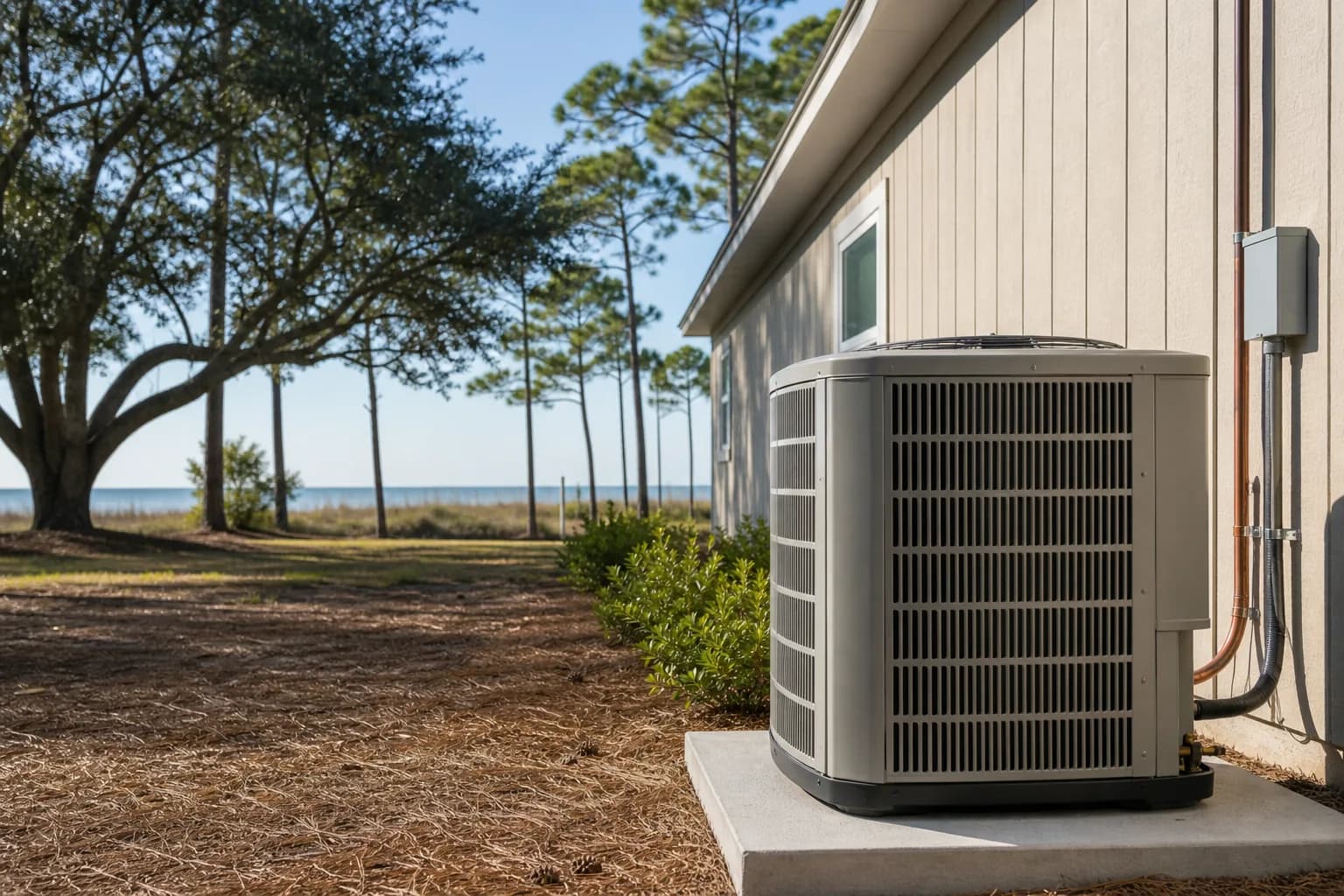
The rule of thumb at most HVAC contractors when sizing a new AC for a Gulf Shores or Orange Beach vacation rental: "go a half-ton bigger than you think you need so it definitely cools." That advice ruins Baldwin County vacation rentals systematically — and on a beach rental a block off Beach Boulevard, where the Gulf keeps the latent load high all season, it's especially costly. This guide explains why over-sized AC is the single most common — and most expensive — mistake we see in Gulf Coast rental properties, and what the right sizing approach looks like.
If you own rental property anywhere in the Gulf Shores market — Craft Farms, Cotton Creek Trace, the beachfront condos, or the canal homes around Oyster Bay — or in Orange Beach, Fort Morgan, Bon Secour, or Magnolia Springs, this is worth 8 minutes of your time before your next AC install or replacement. (The same right-sizing logic applies to owner-occupied homes too — see what size AC you need for a coastal home.)
Why over-sizing is the default in this market
Three reasons contractors install over-sized AC equipment in vacation rentals:
- It's safer for the contractor's reputation. An undersized system that struggles is a callback; an oversized system that "works" is forgotten. So contractors err toward bigger.
- Sizing requires actual measurement. A real Manual J load calculation takes 30-60 minutes per house and requires window orientation, insulation values, occupancy assumptions, and ductwork layout. Most contractors skip it and just match the existing tonnage or go up a half-ton.
- The customer rarely notices the cost. Over-sized equipment costs more than properly sized equipment, but the customer doesn't know what the right size was, so they pay it.
For a primary residence, oversizing causes problems but they're slow-motion: short-cycling, poor humidity control, premature compressor wear over 10+ years. For a vacation rental, the problems are sharper and they show up in your reviews.
The four ways oversized AC ruins vacation rental properties
1. Indoor humidity stays high — guests notice immediately
This is the killer. An oversized AC cools the air fast and shuts off before it has run long enough to remove much moisture. The room is 72°F but the indoor humidity is 65-70%. Guests describe this in reviews as:
- "The AC was on but it always felt sticky"
- "House felt damp the whole time"
- "Sheets felt clammy"
- "Bathroom never dried out properly"
These reviews don't say "the AC was too big" — they say "the house was uncomfortable." But the underlying problem is almost always oversized equipment in a Gulf Coast humid climate.
A properly sized AC runs longer cycles at the same total cooling output. Longer runtime = more dehumidification per hour. The same 72°F setpoint feels dramatically more comfortable at 50% humidity than at 65% humidity.
2. The compressor wears out faster
Air conditioner compressors are designed for a target cycle count over their useful life. Manufacturers rate equipment for ~600,000 starts over 12-15 years. An oversized system in a vacation rental hits the temperature setpoint quickly, shuts off, and starts again 10-15 minutes later — much more frequently than a properly sized system would.
Generally speaking, an oversized AC system in a Gulf Coast vacation rental will cycle several times more often per hour than a properly sized system in the same house. Over a decade of operation, those extra start-stop cycles accumulate fast — and compressor lifespan tracks total cycle count more closely than calendar age.
For vacation rentals where the AC runs harder than primary residences anyway, the cycle math matters.
3. Salt-air corrosion accelerates
This is specific to coastal Baldwin County properties — Gulf Shores, Orange Beach, Fort Morgan, parts of Daphne and Fairhope. Salt-air corrosion attacks outdoor condenser coils continuously. The longer the equipment runs each cycle, the more airflow passes over the coils, the faster the corrosion.
Oversized equipment paradoxically makes this worse: more frequent on-cycles mean more total fan-on hours over the year, even if individual cycles are shorter. The condenser sees more salt-laden airflow than a properly sized unit would.
For coastal vacation rentals, oversized equipment combined with salt-air exposure tends to shorten condenser life noticeably compared to a properly sized unit at the same property.
4. Utility bills are higher
Oversized AC uses more electricity to deliver the same comfort. Counter-intuitive but true:
- The compressor draws full inrush current at every start; more starts = more inrush losses
- Cooling output happens in shorter, harder bursts rather than steady moderate cycles
- The fan motor consumes electricity continuously during the longer per-cycle on-times that compensate for poor humidity removal
A vacation rental owner paying for the utilities sees this directly on the bill. A vacation rental owner who passes utility costs through to renters sees it in their booking competitiveness — guests notice the bill at properties where utilities are itemized.
An oversized system uses more electricity to deliver the same cooling result, and that delta is visible on the utility bill year over year.
What does "properly sized" actually mean for a beach rental?
A real AC sizing calculation accounts for:
- Square footage AND ceiling height (volume of air to cool, not just floor area)
- Window count, size, and orientation (south- and west-facing glass adds significant load)
- Insulation R-value (walls, ceiling, foundation)
- Air infiltration rate (how leaky the building envelope is)
- Internal heat sources (occupants, kitchen, lighting, electronics)
- Local climate data (Baldwin County's specific cooling design temperature)
- Latent load (humidity removal requirement, which is HUGE in our climate)
- Duct system characteristics (what airflow the existing ductwork can deliver)
The output is a number expressed in BTUs/hour or in tons (1 ton = 12,000 BTU/hr). A 3-bedroom 1,800 sq ft Gulf Shores rental properly calculated typically lands at 30,000-36,000 BTU/hr — a 2.5 to 3 ton system. The same house with the contractor-default "go big" approach gets a 4-ton system. That extra ton costs the owner thousands over the equipment lifecycle.
The three sizing scenarios we see in Baldwin County vacation rentals
Scenario A: Properly sized for full occupancy
Some rental properties are sized assuming 6-8 people are inside, the doors open frequently, and cooking is happening. This is real peak-load sizing. For a 2,000 sq ft beach house, that might be a 3.5-ton system. Runs efficiently when occupied; runs even more efficiently when vacant.
This is the right approach. Manual J calculations should explicitly model peak occupancy load.
Scenario B: Sized for "typical" occupancy then guests overload it
A system sized for 2-3 occupants gets overwhelmed during a 7-person family vacation. AC runs constantly, never quite catches up, indoor humidity climbs. Guests describe "AC couldn't keep up."
This is actually undersized for the use case, not just over-conservative. Solution: size for peak occupancy from the start.
Scenario C: Oversized "to be safe"
The default we see most often. A 2,000 sq ft Gulf Shores rental ends up with a 4-ton system that should have been 3 or 3.5 tons. All four problems above apply. This is the trap.
What we do differently
When Air Solutions installs AC at a vacation rental property, we run a Manual J load calculation that explicitly accounts for:
- The maximum occupancy the property is rented for (not "typical" occupancy)
- Door-opening behavior typical of vacation rentals (more frequent than primary residences)
- Coastal heat gain through windows (Gulf-facing glass differs from inland-facing glass)
- Latent humidity load specific to Baldwin County's climate
- The realistic AC duty cycle for the vacancy patterns the owner describes
We size for peak realistic load, then add a small safety margin (typically 10%, not 50%). The result is usually a system 0.5-1 ton smaller than what other contractors would have quoted.
For coastal properties, we also recommend coastal-grade outdoor units (corrosion-resistant fasteners, protected coil coatings) regardless of size. The lifespan benefit pays for the upcharge several times over.
What it means for your investment
A properly sized, coastal-grade variable-speed heat pump installed at a Gulf Shores vacation rental tends to compound several advantages over the typical oversized residential install:
- Lower upfront equipment cost (smaller tonnage, properly matched components)
- Lower year-over-year utility cost from longer, more efficient cycles
- Longer compressor life from fewer start-stop cycles
- For rental property held as a business, the cost may be recoverable through Section 179 expensing rather than slow depreciation — a CPA conversation, not something we file for you (note: the federal 25C residential credit ended December 31, 2025 and does not apply to systems installed in 2026 or later)
Plus the comfort wins that show up in guest reviews: better humidity control, no more "the house was sticky" complaints, and lower vacancy-period electricity bills.
When to schedule the consultation
If you're an absentee owner, we coordinate with your property manager or send updates by photo and phone — you don't need to be on-site. We provide written documentation suitable for property management records, owner statements, and tax filing (Section 179 for commercial install).
For a vacation rental portfolio (8+ units), we structure multi-property service contracts with per-unit billing, scheduled bi-annual maintenance, prioritized response during peak season, and capital equipment planning by unit age.
The free in-home (or in-rental) consultation is the first step. Whether it's a single beach house (AC installation) or a portfolio that needs a commercial HVAC service agreement, schedule it and we'll measure the property, evaluate existing equipment, and produce a written quote with the actual sizing math behind it.