
Commercial HVAC for Baldwin County Businesses
A plain-English overview of commercial HVAC in Baldwin County — how it differs from residential, what each business type needs, and what a service contract covers.

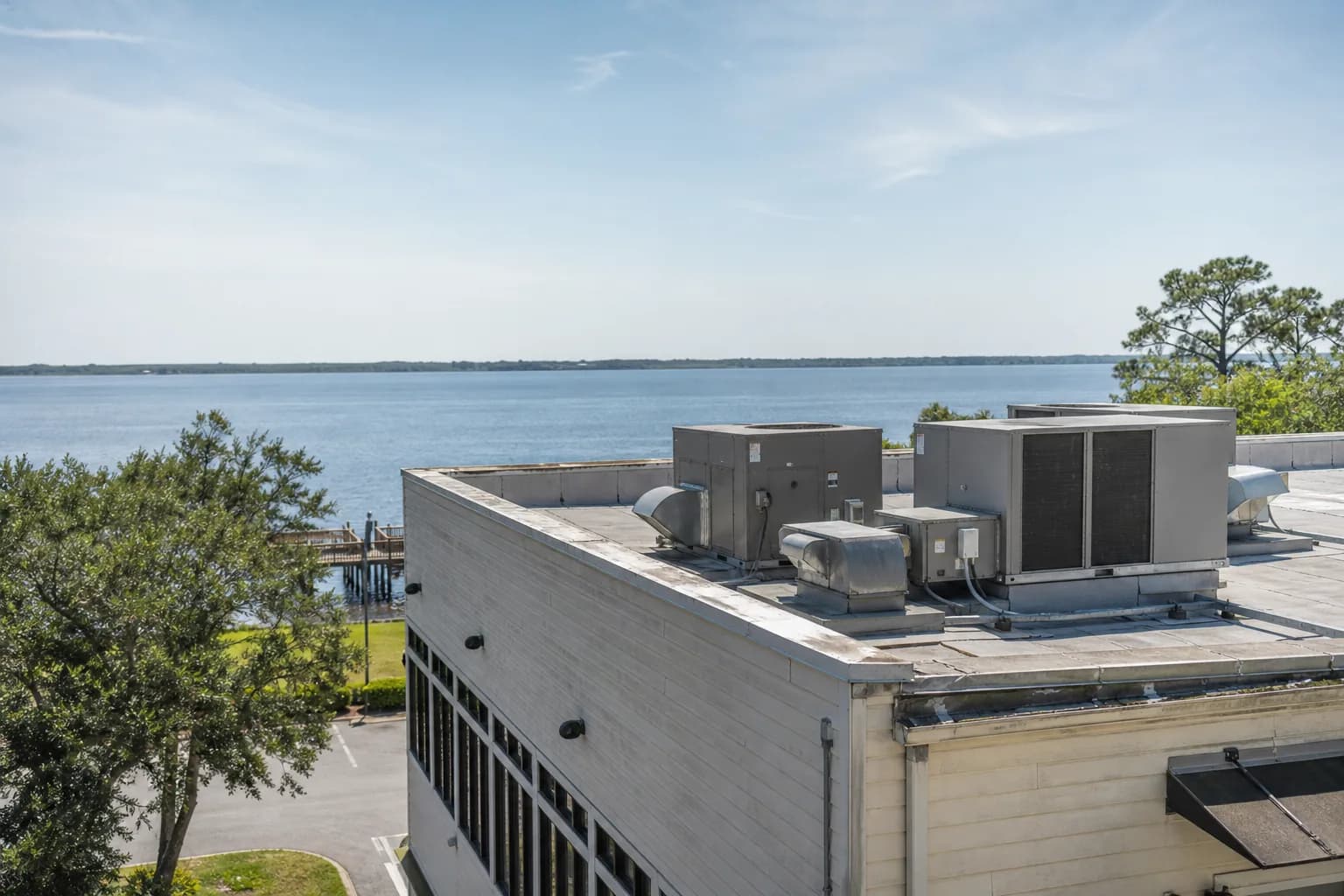
When the AC quits at your house, somebody's uncomfortable for a few hours. When it quits at your business, you're losing money by the clock. A Foley restaurant off Hwy 59 that loses cooling on a Friday night in tourist season doesn't push through — it closes early and turns away a full dining room. That's the difference to keep in mind here: commercial HVAC isn't residential HVAC with a bigger price tag. It's a different animal, and treating it like the unit on your house is how Baldwin County businesses get caught flat-footed in the worst possible week.
This is the county-wide overview — how commercial systems actually differ from residential, what the work looks like by business type, what belongs in a real maintenance contract, and how emergency response should run when a unit goes down mid-shift. I've kept specific dollar figures out of it on purpose, because a price with no equipment behind it is just a guess. Where pricing comes up, I'll point you to the posts that break it down properly.
What makes commercial HVAC different
Start with the equipment. Most homes run a single split system — an outdoor condenser, an indoor air handler, one thermostat on the wall. Commercial buildings are a different build entirely. A lot of them run rooftop units (RTUs) or packaged units that put the whole system in one cabinet up on the roof, sized for square footage and occupant loads a house never sees. Bigger spaces run several of these at once. Churches, medical buildings, and warehouses are often multi-system facilities — different zones, different units, different runtimes, all on one roof or in one mechanical room.
The controls are a step up too. Your house has a thermostat. A commercial building frequently runs building-automation controls — staging multiple units, scheduling by occupancy, managing economizers that pull in outside air when the weather allows. When something in that logic drifts, you don't get a dead system; you get a building that's quietly fighting itself and running your power bill up while it does.
Then there's the electrical side. Commercial gear pulls heavier amperage and often runs on three-phase power, which means commercial-rated tools, training, and parts — not the same service call as a residential tune-up. And the consequence of skipping maintenance is simply worse. On a house, a missed tune-up might shave some efficiency. On a commercial system, a loose connection on a rooftop unit nobody's looked at in two years is how a cheap part takes out an expensive compressor in the middle of your busy season. Maintenance isn't optional on this equipment, because the failure consequences aren't survivable the way they are at home.
Service by business type
The right HVAC plan depends on what you do under that roof. A restaurant kitchen and a church sanctuary are not the same problem, and a one-size schedule shortchanges both. Here's how the major business types around Baldwin County break down — and what each one actually needs from a service schedule.
| Business type | HVAC challenge | What the schedule needs |
|---|---|---|
| Restaurants & food service | Huge kitchen heat loads, strict ventilation/make-up-air codes, and salt-air corrosion eating rooftop units near the beach | Off-hours service so we never touch equipment mid-service; closer attention to exhaust/make-up-air balance; more frequent coil cleaning on coastal units |
| Offices & medical | Multiple zones to keep comfortable, indoor air quality and filtration standards, and server/IT rooms that need cooling around the clock | Multi-zone balancing, a real filtration plan, and dedicated attention to any server-room cooling that can't go down |
| Retail | Customer comfort drives sales, and the busiest tourist weekends are exactly when you can least afford a failure | Pre-season readiness so units are dialed in before peak traffic; fast priority response when a sales floor gets warm |
| Churches & community spaces | High ceilings and big rooms that swing from empty all week to packed on the weekend | Equipment sized and tuned to handle that swing without short-cycling, plus scheduling around services and events |
A few of those deserve a word more. Anywhere on the Gulf Coast, salt air is relentless on rooftop equipment, and a restaurant or shop near the water needs coils cleaned more often than the same business inland. Retail comfort is a sales lever, not a nicety: the outlet stores at Tanger and the shops at OWA in Foley, the storefronts along the Hwy 59 corridor, the medical and office tenants out toward Glenlakes — a warm floor on a peak Saturday costs real money, so the play is keeping units ready before the rush, not scrambling during it. And churches have a load profile most buildings don't, sitting nearly empty all week and then filling with hundreds of people on Sunday morning. Equipment has to handle that jump without short-cycling itself to death.
What does a commercial maintenance contract cover?
A commercial maintenance contract is the standing arrangement that keeps your equipment ahead of the season instead of reacting after it fails. It's not the same as the residential membership — our Cool Club is built for homeowners; commercial maintenance is scoped individually per facility, because no two buildings carry the same equipment count, runtime, or access. What a real contract includes:
Scheduled inspections on a set cadence
Quarterly or monthly visits, sized to how hard your equipment runs. A climate-controlled office may do fine on a lighter cadence; a kitchen rooftop unit or a warehouse running long hours needs to be touched more often, because the environment loads it faster.Priority emergency response
Contract customers move to the front of the line during the multi-call peak windows when everyone's system is straining at once. That standing priority is a big part of what you're actually buying.Filter and belt management
Filters pulled and replaced on schedule, and belt-driven blowers checked for tension and wear with the belt swapped before it strands you. On commercial equipment this is routine, not an afterthought.Electrical testing on higher-amperage gear
Capacitors and contactors checked, motor amperage read against spec, and terminals tightened — rooftop vibration loosens connections over time, and a loose connection is how a small problem becomes a burned-out compressor.Documentation for warranty, insurance, and code
A written service report after every visit. That record keeps manufacturer warranties valid, gives you evidence at insurance-claim time after a storm, and builds a history that tells you which unit is trending toward replacement before it leaves you stranded.
That documentation piece matters more in commercial than people expect. When you've got several units of different ages on one roof, the written history is what tells you, with evidence, which one to plan around next — instead of finding out the hard way in July. The same logic homeowners use on a single system carries over: a tracked unit lets us call the repair-or-replace decision honestly instead of guessing, and the cost picture for replacing coastal equipment is easier to plan for when you saw it coming. For how these agreements get scoped and priced, including per-unit versus flat-rate billing and what's worth negotiating, the pricing posts below go deep.
Emergency response for businesses
When commercial equipment goes down, the question isn't comfort — it's how fast you're back open. We run 24/7, and we prioritize business downtime, because we know what a closed floor or a sent-home staff costs you per hour. The order of operations matters: we get to you, we diagnose what failed, and we give you a clear quote before we start the work — no surprise invoice after the fact.
What I won't do is promise you a fixed number on the clock I can't honor every time. On commercial work, in a county this spread out, a hard response-time pledge is the kind of promise that gets broken the first busy week. What contract customers get instead is genuine priority response — first routing when the calls stack up — which is the commitment that actually holds. If your operation can't take a multi-hour gap, the move is a contract with priority language in writing, not a billboard slogan.
Bottom line
Commercial HVAC is its own discipline — bigger equipment, heavier electrical, multi-system buildings, and controls that go well past a thermostat — and the cost of getting it wrong is measured in lost revenue, not just a warm room. The businesses that stay open through the worst weeks are the ones that match their service schedule to how they actually operate, keep a real maintenance contract with priority response in writing, and don't wait for a failure to start thinking about the roof. Whether you run a restaurant on the beach, an office on the Eastern Shore, a retail floor in Foley, or a church anywhere in the county, the equipment will tell us what it needs — we just have to be looking before it fails. The bones of that habit are the same ones we preach to homeowners in our coastal spring tune-up routine: get eyes on the system before the season loads it.
- Schedule a commercial assessment — we'll scope your building and equipment and put a plan in writing
- Call (251) 300-9817 — the office answers during business hours; after hours, our 24/7 emergency dispatch routes your call
- Commercial HVAC service — the full overview, including multi-unit billing and coastal vacation-rental specifics
- HVAC service across Foley — every commercial and residential service we run in town
Related resources
- Commercial HVAC Maintenance Contract Pricing — per-unit vs. flat-rate, what's included, and what to negotiate
- Robertsdale Commercial HVAC Maintenance Agreements — scope, cadence, and quoting for warehouse and light-industrial buildings
- Ductless mini-splits in Baldwin County — when zoned ductless makes sense for an add-on, a server room, or a hard-to-cool space
Air Solutions Heating & Cooling — family-run, founded in Daphne, licensed AL#23194. Serving commercial and residential customers across Baldwin County.