
Commercial HVAC Maintenance Contract Pricing
How commercial HVAC maintenance contracts are priced in Baldwin County — per-unit vs. flat-rate, what's included, what isn't.

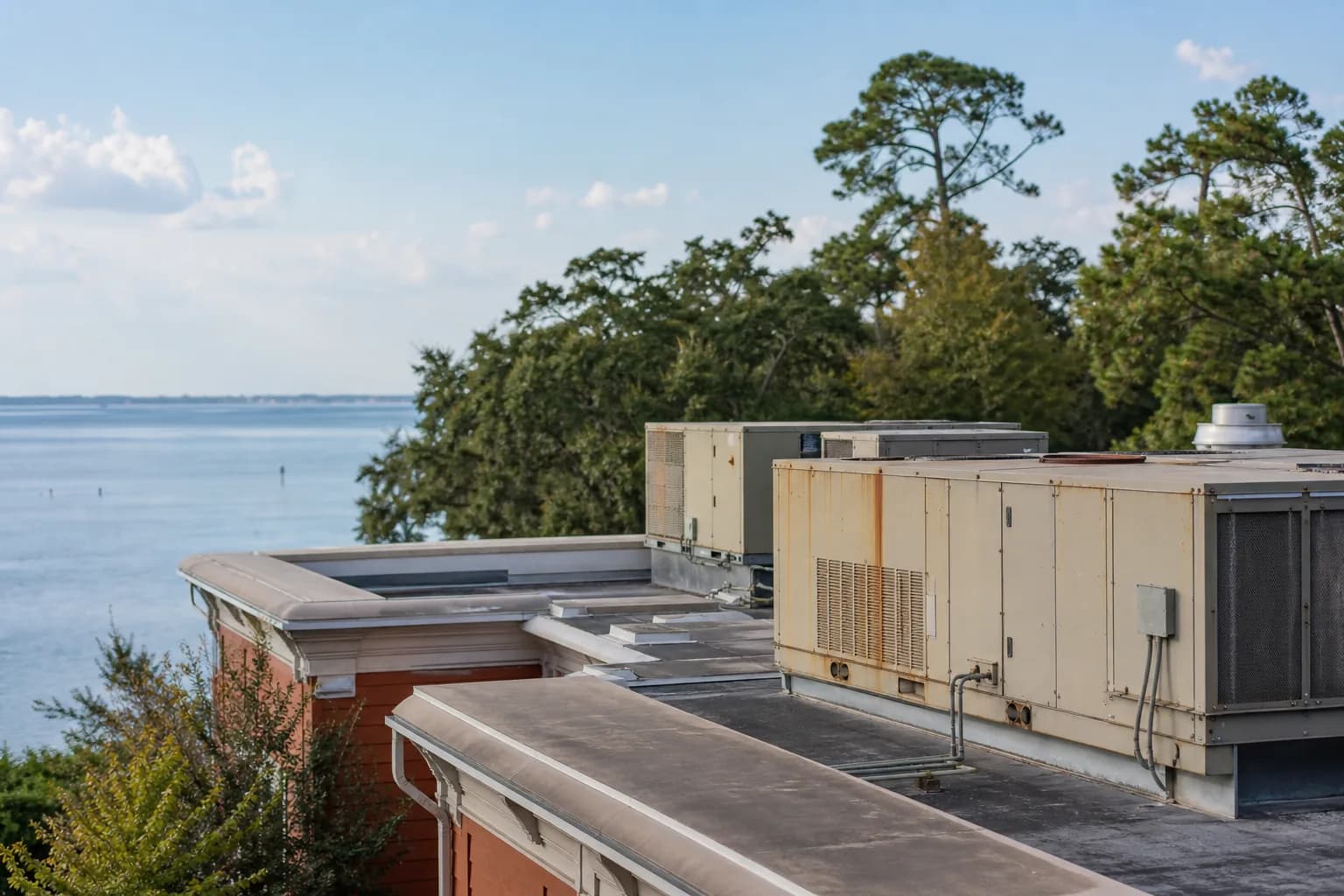
Commercial HVAC maintenance contracts in Baldwin County range from informal one-page agreements with a single line-item annual fee to multi-tier service contracts with priority response windows, fleet billing, and detailed scope-of-work documentation. The price varies by structure as much as it does by the work involved — and what you're really buying often isn't the maintenance itself but the predictable response when the system fails on a Friday night during dinner service or Saturday turnover. For a Daphne restaurant on the Hwy 181 corridor or a retail strip near the Historic Malbis interchange, that response window is the whole point of the contract.
Here's how commercial HVAC contracts are typically priced, what each pricing model actually buys you, and what's worth negotiating.
Per-unit vs. flat-rate contracts
The two main pricing structures:
Per-unit pricing
Each rooftop unit, condensing unit, or split system is priced individually. The contract specifies a per-unit annual rate that covers a defined number of visits (typically two — spring + fall) plus included parts and labor scope.
Per-unit pricing works best for:
- Multi-tenant buildings where different tenants are responsible for different equipment
- Property managers handling a portfolio (vacation rentals, multi-family) where per-property accounting is needed
- Operations growing their unit count over time — easy to add new units at the same per-unit rate
- Anyone who needs cost transparency at the unit level for tax filings or owner reports
Flat-rate pricing
One annual fee covers everything in the building, regardless of unit count. Pricing is set at contract negotiation based on total equipment count, complexity, and access logistics.
Flat-rate works best for:
- Single-business operations with stable equipment count (one restaurant, one retail location)
- Smaller installations where the per-unit math doesn't generate enough granularity to matter
- Operators who prefer one annual line item on the books
Neither model is inherently cheaper. The per-unit total often comes out close to the flat-rate equivalent on the same equipment set — what differs is the billing format. Pick the format that matches how you actually account for HVAC costs in your business.
What should a real maintenance contract cover?
A complete commercial maintenance contract should specify, in writing:
Visit frequency. Twice a year minimum (spring + fall) for cooling-then-heating systems. Heavier-duty operations (kitchens, server rooms, vacation rental high-turnover seasons) often add a third mid-summer visit.
Scope of work per visit. Specific list of what gets inspected, cleaned, tested, and documented. At minimum: refrigerant pressures, electrical components (capacitors, contactors), coil cleaning (indoor + outdoor), drain line clearing, filter replacement, blower assembly inspection, thermostat verification, refrigerant lineset inspection, and (for gas equipment) combustion analysis + heat exchanger inspection.
Filter handling. Who supplies and changes filters? On commercial equipment, filters are typically a significant part of the maintenance economics. Some contracts include filters in the base rate; some charge them separately per change. Both can be reasonable — but it should be specified in writing.
Documentation. Written service report after every visit, with date, technician, work performed, component readings, and recommendations. This documentation is what protects your manufacturer warranty (most modern commercial equipment requires documented professional maintenance to keep warranty active) and provides evidence at insurance claim time after a hurricane or other covered loss. (If you operate coastal rentals, our hurricane prep guide for Gulf Coast HVAC covers the pre-storm documentation that strengthens those claims.)
Priority response commitment. Contract customers get first-in-line routing during multi-call peak windows. The specific commitment varies — same-day, 24-hour, 4-hour response targets — and should be in writing. Without a priority clause, "contract customer" means nothing in the queue.
Repair labor rate / parts handling. Most contracts specify that repairs surfaced during maintenance visits are billed separately, often with a discounted contract-customer rate. Some include a defined number of repair hours; some include parts at cost; some include nothing beyond the maintenance scope itself.
After-hours / emergency rate. What happens when the system goes down at 11 PM on a Saturday in July? The contract should specify the after-hours rate and whether contract customers get an after-hours discount.
Coverage exclusions. Acts of nature, vandalism, customer-caused damage, equipment over a defined age — these are typically excluded. Specifics should be in writing.
What to negotiate
Five things worth pushing on before signing a commercial HVAC contract:
-
Priority response language. Make sure the contract specifies a response target, not just "priority routing." Same-day-during-business-hours is reasonable for most operations; same-day-including-evenings/weekends is the premium tier.
-
Filter handling. Inclusion of filters in the base rate isn't always cheaper than separate billing, but it makes budgeting predictable. If filters are separate, confirm the per-filter rate and the change frequency in writing.
-
Documentation format. Ask for the format of the written service report. If you need it in a specific format for property management software, owner reports, or accounting integration, raise it before signing.
-
Multi-property pricing breaks. If you operate 5+ rental units or multi-property restaurant locations, ask about portfolio pricing. Most contractors will discount the per-unit rate at scale.
-
Termination terms. Some contracts auto-renew annually. Make sure you know the termination notice window and whether mid-year cancellation triggers a penalty.
What it should NOT include
A few red flags in commercial HVAC contracts:
- Required equipment replacement clauses that lock you into using the same contractor for any new installations. You should be free to bid replacements independently.
- Excessive minimum terms. Three- and five-year minimums sometimes appear; one-year minimums are standard.
- "Recommended" repairs at every visit. A maintenance contract is not a repair-finding contract. If every visit surfaces a growing list of "recommended" repairs that didn't exist last visit, the contractor is upselling against the contract.
- Vague scope of work. "Inspect and tune-up as needed" isn't a scope. Specifics are.
Pricing factors that legitimately affect cost
What actually drives contract pricing up or down on equivalent equipment:
- Roof access difficulty. Equipment on a third-floor rooftop with limited access takes longer to service than ground-level units.
- Equipment age. Older equipment requires more careful inspection and tends to surface more during maintenance visits.
- Operating hours of the business. Restaurants and 24-hour operations require evening/weekend service windows that cost more to staff.
- Refrigerant type. R-22 systems (legacy) cost more to top off than R-410A or R-454B systems if any refrigerant work is needed.
- Coastal exposure. Gulf Shores / Orange Beach / Fort Morgan equipment needs more frequent coil cleaning due to salt-air corrosion — a Daphne or Spanish Fort rooftop unit set back from the water ages more slowly than a beachfront one, as we explain in how far from Mobile Bay corrosion matters.
Ready for a commercial maintenance quote?
Air Solutions Heating & Cooling provides commercial HVAC service contracts for restaurants, vacation rentals, property managers, and retail across Baldwin County — Daphne, Fairhope, Foley, Gulf Shores, Orange Beach, and beyond. We're family-run and based right here on the Eastern Shore, founded in Daphne up the bluffs from Mobile Bay, licensed AL#23194.
- Get a Commercial Quote — walkthrough plus written contract proposal
- Commercial HVAC services — full overview including response framework, multi-unit billing, and coastal vacation rental specifics
- HVAC service in Daphne — our home-base service area
- Call (251) 300-9817 — the office answers during business hours; after hours, our 24/7 emergency dispatch routes your call