
Hurricane-Proofing Your HVAC in South Alabama
A Baldwin County field tech's before, during, and after playbook for protecting your AC from named storms — and the restart mistake that kills compressors.
I've restarted a lot of air conditioners after a lot of storms down here, and the pattern almost never changes. The systems that come back clean belong to people who did three or four small things before the wind showed up and then waited before flipping the breaker. The ones that turn into a compressor replacement belong to good people who didn't know an air conditioner needs a plan too. Hurricane season runs June through November, Baldwin County sits in the crosshairs of the Gulf, and your HVAC is the last thing on the prep list until it's the only thing you're thinking about. Let's get ahead of it.
This is the wide-angle version — the whole arc, start to finish, for anywhere in South Alabama. Most of what I know about this came the hard way, and Hurricane Sally taught the whole coast its lessons in one night. I've written tighter guides for specific towns and problems and I'll point you to those as we go, because the right move for a beachfront condo isn't the right move for a bluff-top house. But the shape of it is the same everywhere, and the shape is what most folks are missing.
Before the storm
The best storm prep happens on a calm day, not when there's a cone on the news and a line at every gas pump on Highway 59. A pre-season maintenance visit between March and May does double duty: it's the tune-up that keeps your system efficient through a brutal Gulf Coast summer, and it's your hurricane check. While we're out, we tighten electrical connections, confirm the unit is anchored, and flag anything weak before a storm finds it for you. If you only do one thing on this whole list, make it that.
When a named storm actually enters the Gulf and the forecast starts including us, here's the order I'd work in:
- Shut it down completely — thermostat and breaker. Set the thermostat to off, then go to the panel and trip the HVAC breaker, and flip the outdoor disconnect on the wall by the condenser too. The thermostat stops the call for cooling; the breaker and disconnect physically isolate the equipment from the voltage spikes that ride in when the grid gets hit or comes back. This is your surge protection in the moment, and it costs nothing.
- Add a whole-home surge protector at the panel if you don't have one. It guards the whole house, your HVAC included, against the exact grid chaos a hurricane causes. Set against what a compressor costs to replace, a surge protector is a rounding error — the cheapest insurance in the building.
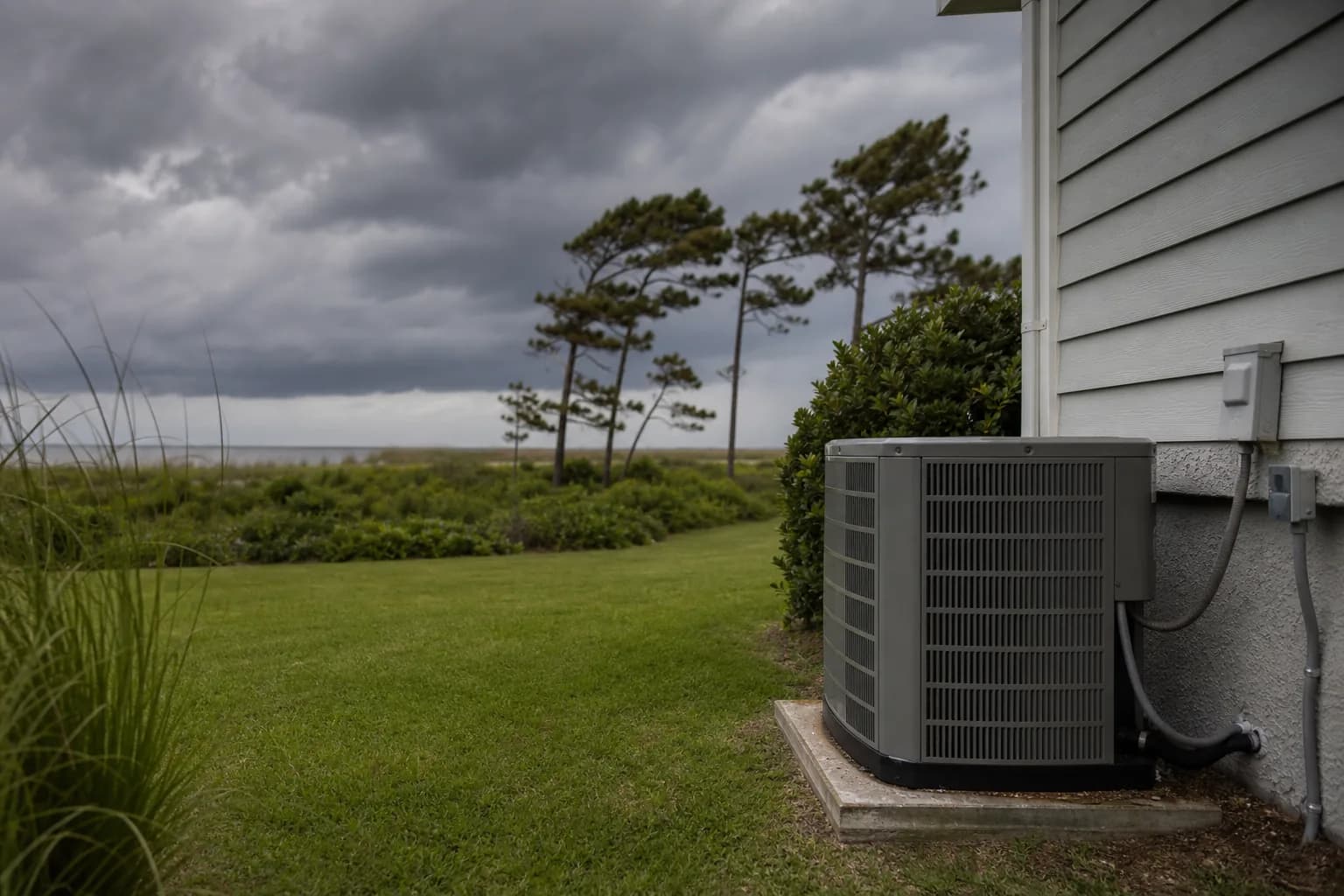
- Deflect debris — don't seal the unit. A sheet of plywood leaned and weighted to take a hit from flying debris is smart. Shrink-wrapping the condenser in a tarp is not. A sealed unit traps moisture against the coil and electrical, and that does its own slow damage. Block projectiles, leave it able to breathe.
- Strap or bracket the condenser for a serious storm. For a Category 3 or stronger landfall projection, hurricane straps anchored to the pad keep the unit from walking or tipping in the wind. Whether your specific home needs this depends a lot on your exposure, and it's a pre-season decision, not a day-of scramble.
- Clear ten to fifteen feet around it. Patio furniture, planters, the grill, the trash cans, kids' toys — anything the wind can pick up becomes a missile aimed at your fan grille and refrigerant lines. Move it or tie it down. Trim back any weak limbs hanging over the unit while you still can.
- Document and confirm coverage. Take dated photos of the condenser from every side, get the model and serial plate, and confirm with your insurer that named-storm HVAC damage is actually covered. Five minutes now is worth hours during a claim.
During the storm
Once it's blowing, your job is mostly to leave things alone. The system should already be off at the breaker — keep it that way. Don't be tempted to run it for a little relief between bands, and be careful running it off a portable generator, because a generator's dirty power and surges are hard on a compressor.
Resist opening the house up, too. Every door and window you crack lets humid air and wind-driven rain inside, and that moisture has to come back out of your walls, your air handler, and your ductwork later. A closed-up house dries out a lot faster afterward.
If you're on the water — a Gulf Shores beach house off Beach Boulevard, a slab home in Craft Farms or Kiva Dunes, anywhere a ground-level condenser sits low near the coast — surge is the real threat, not just wind. Elevation helps, but raising a unit is something you decide and do before the season, not while Mobile Bay or the Gulf is coming up the street. That's the kind of call your pre-season visit is for.
After the storm
Here's where most of the expensive mistakes happen, so this is the part to slow down on. When the wind quits and the power blinks back, the instinct is to walk straight to the thermostat and crank it. That instinct is exactly what turns a fine air conditioner into a dead one.
Before you energize anything, walk out and really look at the condenser. You're checking for debris jammed in the fan, standing water in or around the unit, a pad that's shifted or sunk, refrigerant lines that got bent or kinked, and any wiring that's frayed or pulled loose. If you see any of that, stop — that's a call, not a restart. If it genuinely looks clean, here's the sequence I'd walk a homeowner through:
Inspect before you touch a switch.
Clear the condenser of debris and confirm no standing water, no shifted pad, no kinked refrigerant lines, and no frayed wiring. Any of those means leave it off and call — don't try to power through it.Restore power at the breaker.
Once it's visibly clean and dry, flip the HVAC breaker and outdoor disconnect back on — but leave the thermostat OFF for now. You're powering the equipment, not calling for cooling yet.Wait a full 24 hours before cooling.
Modern compressors have a crankcase heater that warms the oil so refrigerant doesn't pool in it during an outage. Give it about 24 hours powered-but-off to do its job. Skipping this lets liquid refrigerant 'slug' the compressor on startup — mechanical damage that shortens the unit's life or ends it.Switch to cooling and watch it.
After the wait, set the thermostat to cool a few degrees below room temp and listen. A normal start is a smooth hum. Hard knocking, screeching, repeated clicking, or any burning smell means shut it off immediately and call. Stay with it the first hour to confirm it's actually pulling the temperature and humidity down.
A couple of things to handle in the days after, especially near the coast. Rinse salt spray off the condenser with a gentle hose stream — salt drives corrosion deep into the coil fins and quietly eats months off the unit's life if it sits. And if your roof took any damage or you had water intrusion anywhere, get the ductwork checked for mold; wet ducts breed it and drag moisture through the whole house long after the storm's a memory. When in doubt, a short post-storm inspection catches the latent stuff — surge damage, absorbed moisture, a stressed capacitor — before it becomes a 2 a.m. failure at the peak of summer.
The wait after a storm is the hardest part to sell people on, and it's the part that saves the compressor. Twenty-four hours of patience beats a new condenser every time.
Does insurance cover storm damage to your HVAC?
Often yes for named-storm wind damage — but the details are where people get caught, so handle them before the season, not mid-claim. Document before you touch anything. The moment it's safe, photograph the damage from several angles — those images, paired with the dated before photos you took during prep, are the backbone of a clean claim. An adjuster can't argue with a clear before-and-after.
Know your deductible, because coastal Alabama policies almost always carry a separate named-storm or hurricane deductible, and it's a percentage of your home's insured value — often somewhere in the 2 to 5 percent range — not a flat dollar figure. On a coastal home that can be a real number, which means minor HVAC damage sometimes lands below the deductible and isn't worth filing at all. Run that math before you start a claim.
If you're filing, get a written assessment from a licensed tech. A documented diagnosis of what the storm did carries far more weight with an adjuster than a homeowner's description. And handle the obvious stuff promptly — most policies expect you to prevent further damage, so leaving a clearly compromised system to keep deteriorating can cut into what they'll pay. I've written a fuller walk-through of the claims side if you're staring down a damaged unit and a deductible.
Bottom line
Hurricane prep for your HVAC comes down to a handful of cheap, calm-day moves and one hard-won piece of patience. Shut it all the way down before the storm, deflect debris without smothering the unit, leave it off and the house closed up while it blows, and then — the part everyone wants to skip — inspect it and give it a full day before you ask it to cool again. Do that, and most South Alabama systems ride out a storm just fine. The ones that don't are almost always the ones that got rushed.
If the system won't restart cleanly after the wait, an Eastern Shore no-cool troubleshooting pass walks the same checks we'd run on the phone. If you want a hand getting ready or getting back online:
- Schedule pre-season maintenance — the tune-up that doubles as your hurricane check.
- Call us at (251) 300-9817 — a real person, around the clock through storm season.
- Request emergency service — priority response when a storm leaves you without cooling.
Related resources
- Hurricane prep for your HVAC: a Gulf Coast homeowner's guide — the companion deep-dive on why coastal equipment fails and the property-by-property risk read.
- Hurricane insurance and HVAC damage claims — the full claims walk-through, from documentation to deductibles.
- Before-season checklist for Fairhope HVAC — the calm-calendar version, done before a storm is ever named.