
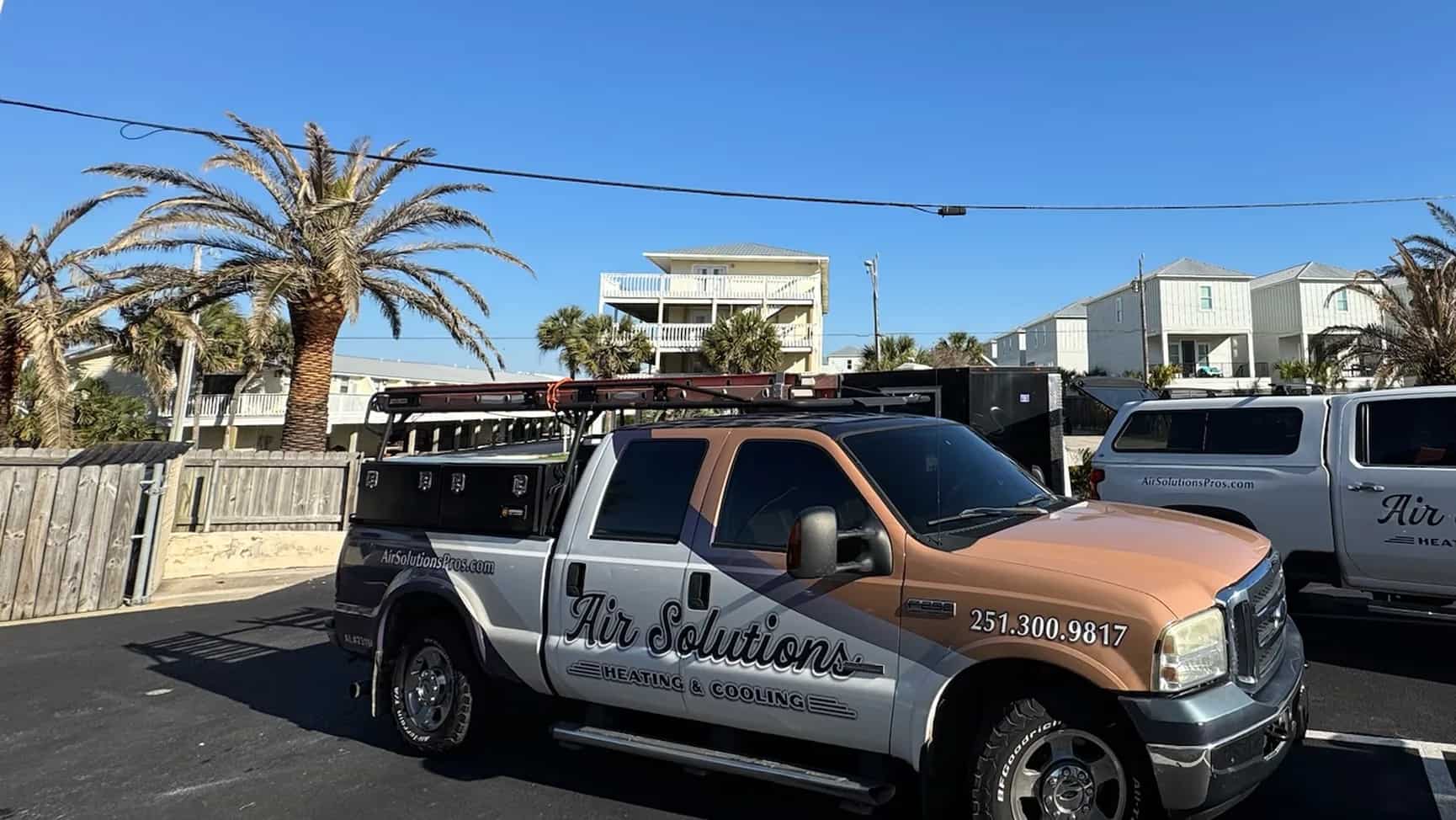
Emergency HVAC in Orange Beach.
Local emergency HVAC in Orange Beach, Alabama and surrounding Baldwin County. 24/7 emergency response across Baldwin County. Licensed AL#23194. 353+ five-star reviews. Call (251) 300-9817.
AC Not Cooling? Not Blowing Cold Air? Start Here.
Most Orange Beach calls start with one of these symptoms. Same-day weekday diagnostic, written estimate before any work — call (251) 300-9817.
- AC running but not cooling the house — usually a refrigerant leak, dirty condenser coil, or weak capacitor
- AC not blowing cold air — warm air from the vents means the compressor isn't engaging or refrigerant is low; we test both and explain what we find
- Weak airflow or nothing from the vents — blower motor, clogged filter, or a collapsed duct run
- Ice on the copper lines or evaporator coil — switch the system off before we arrive; running it frozen risks compressor damage
- AC short-cycling — starting and stopping every few minutes signals an electrical, thermostat, or refrigerant problem that worsens if ignored
- House cools but stays humid and clammy — in Baldwin County that often points to an oversized system, not a broken one
What emergency HVAC looks like in this climate.
Orange Beach sits on the Gulf at the mouth of Perdido Pass with approximately 8,800 full-time residents and a much larger transient population each summer, and that geography drives an emergency-call profile unlike anywhere else in Baldwin County. The Open-Meteo ERA5-Land grid cell that resolves to the city puts annual cooling degree days near 2,999.9 — slightly less than the inland cells because the Gulf moderates daytime highs, but with humidity that runs higher and more persistent than anywhere on the Eastern Shore. The July average daily high sits around 89.9°F, the January average low near 51.7°F, and elevation at the resolved coordinate is only 5 meters, which is one reason the salt-air load on outdoor equipment here is on a different timeline than the rest of the county. An emergency call in Orange Beach on a 95°F July afternoon is rarely the first sign of trouble — it is usually the moment a system that has been quietly losing performance under salt-corrosion stress finally hits the threshold where it stops cooling at all. Heating degree days come in around 946.5, the lightest in the entire service area, so when a rare hard-freeze stretch does hit the coast, the reversing valves, defrost boards, and auxiliary heat strips that have been idle for ten months get tested all at once.
Two pieces of local-environment honesty for the emergency picture. First, the FEMA point check at the city center returns Zone X — minimal flood hazard at that single coordinate — but that classification stops being useful the moment you move toward the actual coastline. Parcels along the Gulf-front strip, the Perdido Pass channel, Cotton Bayou, Terry Cove, and the canal network behind Bear Point sit in coastal AE and VE zones on parcel-level FEMA mapping with real surge exposure during a tropical system. We check the address before we promise anything on a storm-adjacent call. Second, Orange Beach is on the part of the Alabama coast that takes direct hits, not just inland pushes — Hurricane Sally crossed the eyewall directly over the Gulf Shores / Orange Beach line in September 2020, and Ivan came ashore with the eastern eyewall over Orange Beach in September 2004. Hurricane-restart emergency work here is not a hypothetical pattern; it is a documented one with a multi-week tail every time the Gulf produces a landfalling system.
Direct-hit storms, salt-air-driven heat events, and rare freezes that have driven Orange Beach emergency HVAC calls.
- Sep 2020 — Hurricane Sally — direct landfall at Gulf Shores / Orange Beach: Sally crossed the eyewall directly over the Gulf Shores / Orange Beach line as a Cat-2 with a slow forward speed that pushed surge into Perdido Pass and the canal network for hours. Ground-level outdoor condensers along the Bear Point and Terry Cove canal corridors took salt-water inundation that meant replacement rather than repair on most submerged units. The grid took days to fully restore in the hardest-hit pockets, and the emergency-restart wave on systems that powered through and then quit on the third or fourth reboot ran for weeks afterward — capacitors, contactors, control boards, and a meaningful number of compressors that had been audibly straining before the storm and finally lost the start sequence under post-storm voltage cycling.
- Sep 2004 — Hurricane Ivan — eastern eyewall over Orange Beach: Ivan came ashore as a Cat-3 just west of Gulf Shores with Orange Beach in the eastern eyewall and the worst of the wind field. The dominant repair pattern on equipment that survived structural damage was debris-driven condenser fin damage, bent fan blades, and copper line-set tears at salt-corroded penetrations. The post-Ivan replacement cycle is part of the reason the current Orange Beach median home build year sits around 2000 — a meaningful share of the housing stock was rebuilt in the years immediately after, and the HVAC equipment that went into those rebuilds is now itself approaching the end of its serviceable coastal life.
- Jan 2024 — Multi-night hard freeze on the coast: Three consecutive sub-freezing nights with daytime highs that struggled to clear 40°F — unusual for a Gulf-coast January and harder on coastal heat pumps than inland numbers would suggest, because Orange Beach heat pumps see very little hard-freeze duty and their reversing valves, defrost boards, and auxiliary heat strips spend most of the year idle. Emergency call volume spiked relative to a normal winter week, with reversing valves that would not seat cleanly, auxiliary strips reading open at the contactor, and defrost boards stuck mid-cycle on units that had skipped a fall tune-up.
- Aug 2023 — Extended heat-advisory stretch: Heat-index readings above 105°F for the better part of a week with overnight lows that never broke humidity below 70%. The Orange Beach call mix during the run leaned heavily on vacation-rental Saturday-turnover failures, capacitor failures on the second hot afternoon, and a small cluster of compressors on Gulf-front condos that had been straining audibly and finally quit. Salt-corrosion load on outdoor coils raised head pressure enough on several of those calls that the failure happened sooner than it would have on the same equipment a mile inland. HOA-managed buildings on the Boulevard had a parallel surge in shared-condensate-drain trips and float-switch shutoffs.
Every Orange Beach neighborhood, every zip.
Air Solutions covers emergency HVAC across all of Orange Beach, AL — ZIP 36561 — which in practice means Ono Island via the toll bridge, the Bear Point Estates and Bear Point Heights peninsula, the Cotton Bayou and Terry Cove canal networks, Palm Harbor, the Village of Tannin, Perdido Gates, Wolf Bay Terrace, Windward Lakes, and the Perdido Beach Boulevard high-rise corridor with the Wharf-area buildings. Orange Beach has approximately 8,800 full-time residents and a much larger transient short-term-rental population during the summer season, which is the single biggest factor that shapes the dispatch conversation here. A call about a primary-residence canal home on a weekday is a different routing decision than a call about a peak-season Saturday-turnover rental on the Boulevard, and we ask the questions on the phone that let us put the right truck on the right address.
From the Daphne shop, an Orange Beach emergency address sits at about 40 miles by road and roughly 63 minutes by OSRM, which we display as a 65-minute drive — the longest one-way run in our service area. We do not minimize that. The 24/7 number is (251) 300-9817; we keep the after-hours line open seven nights a week, and the practical promise is that we pick up live when we can and return the rest as fast as we can manage, with the dispatch ETA and the overtime-fee structure disclosed on the call before a truck is routed. We would rather quote you a realistic two-hour window we can keep than a forty-minute window we cannot. Routing-wise, we take the Foley Beach Express via Highway 59 in the standard case; on an Ono Island address we factor in the bridge approach and the toll-gate timing. Coastal-spec parts ride on the truck for the failure modes that dominate Orange Beach calls — capacitors, contactors, common condenser fan motor sizes, condensate-pump replacements, and fittings for a clean line-set repair at a salt-corroded penetration. None of that is theoretical — Orange Beach is a real part of our south-Baldwin emergency footprint, and the salt-air-corrosion failure mode that brings most calls here is one we plan for.
- Ono Island
- Bear Point Estates
- Bear Point Heights
- Cotton Bayou
- Terry Cove
- Palm Harbor
- Village of Tannin
- Perdido Gates
- Wolf Bay Terrace
- Windward Lakes
What we see on calls in Orange Beach.
What qualifies as an HVAC emergency in Orange Beach overlaps with the rest of the county on the safety basics — no cooling under a heat advisory or in a household with infants, elderly residents, or anyone medically dependent on temperature control; no heating during a freeze warning with pipes at risk; a refrigerant leak audible enough to hear or strong enough to smell; visible arcing at the disconnect, a breaker that will not reset, smoke or burning-plastic smell from the equipment. Those are the calls the 24/7 line is built for. The local twist in Orange Beach is the rental-economics angle: an AC failure inside an occupied short-term rental on a Saturday turnover is its own category of emergency for the owner even if no one in the unit is medically vulnerable, because a refund or relocation hit lands hard against the peak-season weekly rate. We treat those calls seriously and route them within the after-hours queue, with the caveat that we will not jump a life-safety dispatch for a comfort dispatch — we will tell you honestly on the call which tier we are placing your situation in, and what that means for the ETA.
The failure patterns we see most often on Orange Beach emergency calls cluster around three local realities. First, salt-air corrosion on outdoor coil fins, condenser-cabinet fasteners, contactor faces, disconnect lugs, and line-set penetrations runs ahead of the same equipment installed inland — a Gulf-front or canal condenser that looked fine in March can be the source of a high-pressure lockout by mid-July because coil airflow has degraded enough to push head pressure into the lockout range. Second, condo and high-rise emergencies on the Perdido Beach Boulevard corridor and the Wharf-area buildings involve a different chain of command than a single-family call: HOA-managed systems on shared risers, VRF and split-system mini-splits stacked on multi-story balconies, and condensate drains feeding shared building plumbing all need HOA coordination, and the dispatch conversation has to account for who is authorized to let a tech onto a unit at 2 a.m. Third, Ono Island access is a real factor — the island is reached via a toll bridge with traffic patterns that can add 30 minutes onto a summer-evening dispatch, and we factor that into the ETA rather than pretending the drive is the same as a Bear Point address. While a truck is en route, the safe-to-do moves are: cut power to a smoking or arcing unit at the disconnect, switch the thermostat off if the system has failed under load, close blinds on the Gulf-facing and west-facing windows, and skip the oven and dryer until the system is back up. If anyone is medically vulnerable and the indoor temperature is climbing past safe range, relocate to a cool space and tell us on the dispatch call so we can prioritize accordingly.
- Mid-life equipment is the common profile in this area. Capacitor and contactor failures dominate the service-call mix.
- Long cooling season means compressors run heavy May through October. Annual maintenance pays for itself in compressor lifespan.
- Mild winters mean heat pumps cover the season comfortably without backup runtime in normal years. Cold-snap weeks expose undersized units.
Emergency HVAC in Orange Beach — the questions that come up.
- Our short-term rental on the Perdido Beach Boulevard corridor lost AC mid-stay on a Saturday turnover — how fast can you actually get there from Daphne?
- Honest answer first: from our Daphne shop, the OSRM-verified drive to most Orange Beach addresses is about 40 miles and roughly 63 minutes via the Foley Beach Express, displayed as a 65-minute drive. That is the longest one-way run in our service area. On an after-hours dispatch, the realistic ETA on a peak-summer Saturday is the drive plus whatever the dispatch routing adds, and we will quote the actual window on the call rather than promise a tighter one we cannot keep. If a tech is already working a south-Baldwin job in Foley or Gulf Shores when the call lands, the run can be shorter. We treat rental-occupied failures seriously because the economics matter, but we will not jump a life-safety dispatch for a comfort dispatch — we will tell you honestly on the call which tier your situation falls in and what that means for the ETA.
- We have a unit on Ono Island that lost cooling overnight. Does the bridge access change how the emergency call works?
- Yes, and we factor it into the dispatch math up front. Ono Island is reached only via the toll bridge from Perdido Beach Boulevard, and during peak summer evenings the bridge approach can add 20 to 30 minutes onto the drive time relative to a Bear Point or Cotton Bayou address. The toll-bridge gate hours and traffic patterns also matter for a true after-hours call, and we will tell you on the dispatch call what the realistic Ono Island ETA is for the moment we are routing. The diagnostic profile on the island is its own pattern: estate-scale custom split systems, longer line-set runs with more potential leak points, salt-air exposure on outdoor units facing open water, and limited access windows on gated properties. We carry coastal-spec parts on the truck for the failure modes we see most often there, and we will ask up front about gate codes and property-manager contacts so we are not stuck at the gate at 3 a.m.
- Our Perdido Pass condo HOA manages the AC system on shared risers. How does an emergency call work when the homeowner is not the one with full access authority?
- Condo and high-rise emergencies on the Perdido Beach Boulevard and Wharf-area buildings run on a different chain of command than a single-family call. HOA-managed systems on shared risers often need management authorization before a tech can do anything beyond an immediate life-safety intervention — we will ask on the call who the building contact is and whether you have the authority to authorize the diagnostic. VRF and split-system mini-splits on multi-story balconies have access requirements the dispatcher needs to know about. Condensate drains feeding shared building plumbing can be a building-plumbing emergency rather than an HVAC one, and we will tell you honestly on the dispatch call which one your situation looks like.
- We rode out a tropical system in our Orange Beach house and now nothing on the AC will start. What is the safest first move?
- Three things, in order. First, if you smell anything burning, see any smoke or arcing, or hear a hum that does not resolve into a normal startup, kill power at the outdoor disconnect and at the breaker panel before anything else — running a damaged compressor under load compounds the damage and creates fire risk. Second, check the breaker panel itself: a tripped breaker is the only thing safe to reset at home, and the right move is to flip it fully off and then back on, once. If it trips again, leave it off and call. Third, do not pull the panel off the outdoor unit yourself to check the capacitor — capacitors hold a dangerous stored charge after power is disconnected, and post-storm capacitor work on a salt-water-exposed condenser is not a safe DIY task even with a YouTube video open. Call the 24/7 number at (251) 300-9817 and describe what you saw and heard. One specific question we will ask is whether the outdoor unit took standing water at any point — a unit whose electrical compartment was under salt water is a replacement conversation rather than a repair conversation, and being straight about that on the dispatch call lets us bring the right diagnostic toolkit.
- Why does coastal Orange Beach equipment seem to fail more often than the same model at our inland house? Can preventive work cut emergency calls?
- The dominant mechanism is salt-air corrosion on outdoor components: coil fins, condenser-cabinet fasteners, contactor faces, disconnect lugs, line-set penetrations, and condenser fan motors. A standard outdoor condenser within a mile of the Gulf or Perdido Pass loses meaningful efficiency on a faster timeline than the same unit five miles inland, and emergency calls cluster on systems where a marginal compressor finally lockouts because the corroded coil is no longer moving enough air to keep head pressure in range. Preventive work that meaningfully reduces emergency call rates: a spring coil rinse and tune-up before the heat load picks up, replacement of pitted contactors and weak capacitors before they fail under load, and on Gulf-front and canal addresses the next-replacement decision should weigh coastal-grade equipment with corrosion-resistant fasteners and coil coatings. Cool Club membership covers bi-annual tune-ups plus member discounts on repairs — 15% off all AC repairs and 5% off new systems per the published Air Solutions terms. The discount applies on emergency repair work the same as on scheduled work, and the tune-up cadence is the single biggest lever for cutting the number of 2 a.m. calls.
What Orange Beach customers can claim.
- Per the verified WP service-area page for Orange Beach, Baldwin EMC provides electric service to the community and CMC Gas (the Clarke-Mobile Counties Gas District) supplies natural gas. Baldwin EMC is the largest electric cooperative in Alabama; CMC Gas is a regional distribution district with its own customer-service contact, worth knowing on a storm-recovery call where the gas side may need separate attention.
- Baldwin EMC historically participates in regional efficiency programs for qualifying heat-pump and HVAC upgrades, but program dollar amounts and eligibility criteria shift year to year. Confirm the current Baldwin EMC program directly through baldwinemc.com before banking on a specific rebate figure in the replace-versus-repair conversation that often follows a major Orange Beach emergency.
- Emergency repair work itself does not generally qualify for utility rebates — those programs target qualifying full-system installs. If the after-hours diagnostic uncovers a salt-corroded system past its serviceable coastal life, we surface the available rebate paths so the decision is made with current numbers.
Emergency HVAC Coverage Map — Orange Beach, Alabama
Centered near Orange Beach for orientation. Air Solutions Heating & Cooling provides emergency HVAC throughout every Orange Beach neighborhood and zip code, plus the surrounding Baldwin County area. Same crew, same number — we travel the whole county.
353+ Five-Star Reviews. And Counting.
“We had an issue on a weekend at our office and Jacob with AirSolutions was quick to respond, kept me informed throughout the entire process and had it fixed same day! So thankful for reliable and efficient service. Never been disappointed with AirSolutions and recommend to anyone in need of repairs or preventative maintenance. They are the absolute BEST!”
“I can’t say enough good things about Air Solutions! Jesse was so kind and helpful, and came to my house within an hour of calling for a repair! Best ac repair service I’ve ever had!”
“Same day appointment during excessive heat. Very professional service from Jacob.”
When It Fails at 2 AM.
We answer the phone. Same-day diagnostic, same-day repair where parts allow. (251) 300-9817.
Schedule Emergency HVAC in Orange Beach.
24/7 emergency response across Baldwin County. Same-day appointments most weekdays in Orange Beach and surrounding Baldwin County. Tell us when works for you — we'll confirm by phone during weekday office hours (8 AM-4 PM).
Need someone right now? Call (251) 300-9817 — our 24/7 emergency line is answered live when we can and returned quickly when we can't.
Emergency HVAC in Orange Beach — FAQs
When should I call the emergency HVAC line?
Anytime your AC or heat is fully out and a return visit during normal hours is unworkable — a 95-degree afternoon, a sleeping infant, a vacation rental between renters. Call (251) 300-9817 and a technician routes to you.What's the after-hours emergency rate?
After-hours service includes a dispatch fee on top of standard repair pricing. We disclose the fee on the call before dispatching — no surprise charges. Cool Club members get 15% off the repair work.Do you respond on weekends and holidays?
Yes. The number is the same: (251) 300-9817. Answered live when we can, returned quickly when we can't.Do you service all of Orange Beach, AL?
Yes — Air Solutions Heating & Cooling covers every neighborhood and zip code in Orange Beach, Alabama — including Ono Island, Bear Point Estates, Bear Point Heights, plus the surrounding subdivisions and rural roads. We handle AC repair, AC installation, AC maintenance, emergency HVAC, and commercial HVAC. Standard service hours weekdays, 24/7 emergency response, and same-day appointments most of the year. Call (251) 300-9817 to schedule.What HVAC issues are most common in Orange Beach?
Homes around Perdido Pass most commonly call us for refrigerant leaks (often salt-air or coil corrosion related on the Gulf Coast), undersized air conditioning systems struggling with Baldwin County summer humidity, and capacitor failures during peak load between June and September. A Cool Club bi-annual maintenance plan catches most of these issues before they cause a breakdown.
Emergency HVAC Near Orange Beach.
Right at the Orange Beach city limit? We service the surrounding Baldwin County communities on the same routes — same crew, same response times.
Related HVAC Guides.
Long-form articles about emergency HVAC and Baldwin County HVAC, with practical advice from our team.
 Seasonal
Hurricane-Proofing Your HVAC in South Alabama
A Baldwin County field tech's before, during, and after playbook for protecting your AC from named storms — and the restart mistake that kills compressors.
June 8, 20268 min Coastal HVAC
Hurricane Prep for Your HVAC: A Gulf Coast Homeowner's Guide
Step-by-step hurricane prep for Baldwin County HVAC equipment — what to do before, during, and after a storm to protect your AC and avoid costly post-storm failures.
May 1, 202611 min Coastal HVAC
Hurricane Insurance & HVAC Damage Claims: What Baldwin County Homeowners Need to Know
How HVAC damage claims actually work after a Gulf Coast hurricane — what's covered, what isn't, and the documentation that makes claims succeed in Baldwin County.
November 1, 20259 min
Other services in Orange Beach & this service across Baldwin County.
- All HVAC services in Orange Beach, AL
- Emergency HVAC across Baldwin County
- AC Repair in Orange Beach
- AC Installation in Orange Beach
- AC Maintenance in Orange Beach
- Commercial HVAC in Orange Beach
- Heating Repair in Orange Beach
- Heat Pump Services in Orange Beach
- Indoor Air Quality in Orange Beach
- Ductless Mini-Splits in Orange Beach
- Heating Installation in Orange Beach
Emergency HVAC in Orange Beach — Schedule Today.
Same-day appointments most weekdays. Cool Club members get prioritized scheduling.