
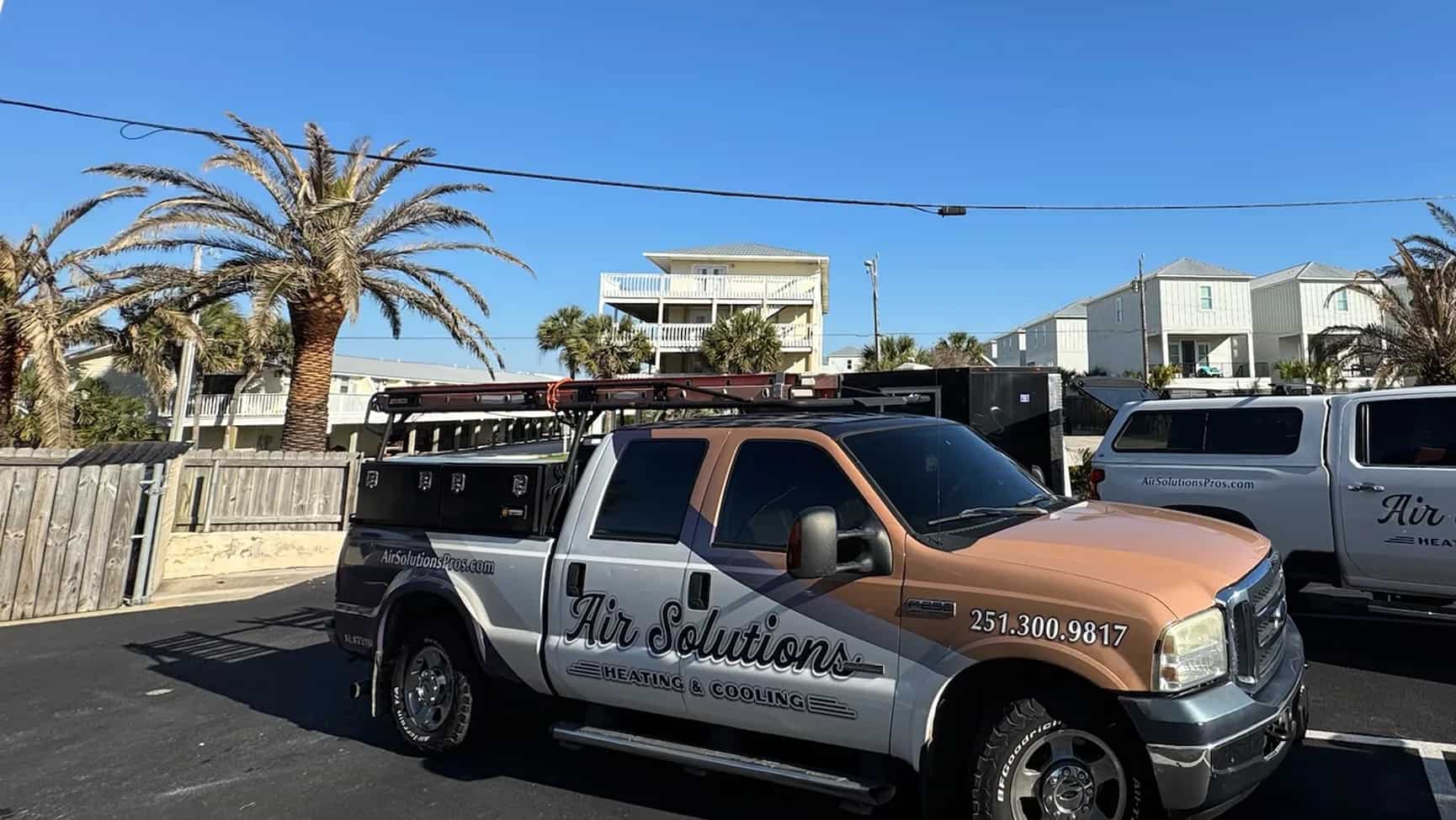
Emergency HVAC in Gulf Shores.
Local emergency HVAC in Gulf Shores, Alabama and surrounding Baldwin County. 24/7 emergency response across Baldwin County. Licensed AL#23194. 353+ five-star reviews. Call (251) 300-9817.
AC Not Cooling? Not Blowing Cold Air? Start Here.
Most Gulf Shores calls start with one of these symptoms. Same-day weekday diagnostic, written estimate before any work — call (251) 300-9817.
- AC running but not cooling the house — usually a refrigerant leak, dirty condenser coil, or weak capacitor
- AC not blowing cold air — warm air from the vents means the compressor isn't engaging or refrigerant is low; we test both and explain what we find
- Weak airflow or nothing from the vents — blower motor, clogged filter, or a collapsed duct run
- Ice on the copper lines or evaporator coil — switch the system off before we arrive; running it frozen risks compressor damage
- AC short-cycling — starting and stopping every few minutes signals an electrical, thermostat, or refrigerant problem that worsens if ignored
- House cools but stays humid and clammy — in Baldwin County that often points to an oversized system, not a broken one
What emergency HVAC looks like in this climate.
An emergency HVAC call in Gulf Shores sits inside a climate envelope no inland Baldwin cell shares. The per-coordinate ERA5 reanalysis at the city's sea-level coordinate logs roughly 3,069 cooling degree days against only 885 heating degree days — the highest CDD and the lowest HDD anywhere we serve. Average July highs settle near 88.7°F, January lows hover around 53°F, and the resolved grid cell sits at 3 meters above sea level right on the Gulf. Those numbers describe a long cooling season and a short, mild winter, but for an emergency dispatch the more operative climate fact is the calendar overlay sitting on top of them. The Atlantic hurricane season opens June 1 and runs through November 30, and Gulf Shores is on the section of the Alabama coast that takes direct hits, not just inland pushes. That seasonal overlap — peak cooling demand stacked against active named-storm risk for half the year — is the structural reason emergency-call urgency in Gulf Shores has a different texture than the same call type in Daphne, Fairhope, or Foley.
Two pieces of local-environment honesty for the emergency picture. First, the FEMA point check at the city-center coordinate returns null on the NFHL query, which typically resolves to Zone X at that single point. That classification stops being useful the moment you move toward the actual coastline: parcels along Beach Boulevard and the Gulf-front strip, the Peninsula along Fort Morgan Road, and the Lagoon Pass and Oyster Bay canal corridors sit inside coastal AE and VE zones at the parcel level with real surge exposure during a tropical system. We verify the address before promising anything on a storm-adjacent call. Second, the hard-freeze stretches that occasionally reach the coast — three or four nights in the upper 20s and 30s, once or twice a winter at most — hit a heat-pump population whose reversing valves, defrost boards, and auxiliary heat strips spend ten months of every year idle. When the rare freeze does arrive, those components get tested all at once. The 884.5 HDD figure looks light on paper; on the rare cold morning it carries more dispatch weight than the number suggests.
Direct-hit storms and coastal weather events that have shaped emergency HVAC dispatch across Gulf Shores.
- Sep 16, 2020 — Hurricane Sally — direct Cat-2 landfall at Gulf Shores: Sally crossed the eyewall directly over the city as a Category 2 with a slow forward speed that pushed surge into the Beach Boulevard corridor and the Lagoon Pass canal network for hours. Ground-level outdoor condensers along the beach strip and the canal blocks took salt-water inundation that put most submerged units into replacement territory rather than repair. The dispatch consequence ran on two timelines. The immediate one was the multi-day restart surge once power returned in the hardest-hit pockets — capacitors that absorbed surge events, contactor faces pitted by voltage cycling across the restoration window, control boards that quit on the third or fourth power-on cycle. The longer one ran into 2021's peak rental season: equipment that powered through the storm itself, looked fine for weeks afterward, and then failed mid-summer on the first sustained 95°F afternoon when the marginal damage finally surfaced. A meaningful share of the post-Sally emergency dispatches we still occasionally trace back to that storm involve damage that didn't manifest until the following peak cooling season.
- Sep 16, 2004 — Hurricane Ivan — major Cat-3 landfall just west of Gulf Shores: Ivan came ashore as a Category 3 just west of the city with the eastern eyewall over Gulf Shores and the worst of the wind field along Beach Boulevard and the Peninsula. The dominant emergency-HVAC pattern on equipment that survived the structural damage involved debris-driven condenser fin damage, bent fan blades, copper line-set tears at salt-corroded penetrations, and outdoor disconnect cabinets that took wind-driven rain straight into the electrical compartment. The 2005-2010 rebuild wave that followed Ivan reset much of the city's HVAC inventory; the 1997 median build year recorded in the 2022 ACS reflects a housing stock that has been through at least one major rebuild cycle since Ivan, and the equipment that went into those rebuilds is now itself approaching the end of its serviceable coastal life.
- Aug 2023 — Extended heat-advisory stretch with turnover-window pressure: Six straight days of heat-index readings above the upper triple digits with overnight humidity that never broke below 70%. The Gulf Shores call mix during the run combined the standard late-summer failure pattern (capacitor end-of-life clusters on the second hot afternoon, condensate-drain overflows tripping float switches at 2 and 3 a.m. on systems whose primary drains had not been treated in a year, compressor lockouts on older equipment that had been audibly straining and finally lost the start sequence) with the genuinely Gulf-Shores-specific Saturday-turnover compression: rental-property failures discovered on Saturday-morning cleaning visits with a Sunday-afternoon check-in deadline pressing against the dispatch math. Property managers ran parallel emergency calls across multiple addresses; cleaning crews became the de facto first-responders flagging no-cool symptoms during their turnover hours.
- Jan 2024 — Multi-night hard freeze along the coast: Three consecutive sub-freezing nights with daytime highs that struggled to clear 40°F. Hard freezes are atypical for Gulf Shores — the city's average January low sits around 53°F — and Gulf Shores heat pumps see very little hard-freeze duty during a normal winter, so their reversing valves, defrost boards, and auxiliary heat strips spend most of the year idle. Emergency call volume meaningfully exceeded a normal winter week, clustering around reversing valves that wouldn't seat cleanly on the changeover from cooling, defrost boards drifted out of timing spec, and auxiliary strips reading marginal at their nameplate rating. Vacation-rental inventory caught additional exposure because guest arrivals continued through the freeze stretch on properties whose owners had not stress-tested the heating side since the previous January.
Every Gulf Shores neighborhood, every zip.
Emergency HVAC coverage in Gulf Shores spans the single 36542 ZIP that defines the city limits plus a meaningful stretch of unincorporated beach, and the neighborhood mix on our after-hours call book reflects the full geographic range of the city. Craft Farms and Craft Farms North on the inland subdivisions where the salt-aerosol load is moderated by distance from open water; Kiva Dunes and The Peninsula along the Fort Morgan Road corridor where coastal-spec equipment dominates the install base; Cotton Creek Trace and Gulf Shores Golf Club Estates north of the canal in mid-vintage stock; Oyster Bay and the Lagoon Pass canal blocks on the back-bay side where parcel-level FEMA AE-zone exposure matters on every storm-adjacent call; the Beach Club Cottages and Sunset Bay at Bon Secour for the rental-heavy portfolio addresses where the property-manager call flow runs the after-hours conversation. WP describes Gulf Shores as roughly 16,000 permanent residents and thousands of vacation rental properties; the ACS 2022 count of 15,178 residents against 14,331 total housing units (only 6,981 occupied year-round) puts numbers behind that framing and explains why the emergency call mix here looks different from anywhere else we serve.
From the Daphne shop, a Gulf Shores emergency address sits at about 37 miles by road and roughly 60 minutes by OSRM on a normal weekday — well past 75 minutes once summer-Saturday Highway 59 traffic backs up south of Foley through the Tanger Outlets corridor. The after-hours queue at (251) 300-9817 runs every night of the rental calendar; we work the queue with live pickup when conditions allow and a quick return on the rest, with the dispatch ETA and the overtime-fee structure disclosed on the call before a truck is committed. We refuse to invent a tighter minute window than the actual truck-location math supports — the WP service-area page itself publishes a 1-to-2-hour typical-response range, and on a peak-summer Saturday with the destination-retail spine backed up that's the honest number we work against rather than promise tighter and walk back. Coastal-grade parts ride on the truck for the failure modes that dominate Gulf Shores calls: capacitors and contactors in common sizes, condenser fan motors in the sizes most often installed on the post-2010 second-cycle residential equipment, condensate-pump replacements for indoor units that have flooded a coil pan, fittings for clean line-set repairs at salt-corroded penetrations on Beach Boulevard and Peninsula addresses. Cool Club membership covers bi-annual tune-ups plus 15% off all AC repairs and 5% off new systems per the published Air Solutions terms; the repair-side discount applies on emergency work the same as it applies on scheduled work, and on an absentee-owner rental portfolio running multiple after-hours service tickets across a 12-month rental year that discount compounds across the operating math whether the owner watches each per-call invoice or not.
- Craft Farms
- Craft Farms North
- Kiva Dunes
- The Peninsula
- Cotton Creek Trace
- Gulf Shores Golf Club Estates
- Oyster Bay
- Lagoon Pass
- The Beach Club Cottages
- Sunset Bay at Bon Secour
What we see on calls in Gulf Shores.
What qualifies as an HVAC emergency on a Gulf Shores address overlaps with the rest of the county on the safety basics — no cooling under a heat advisory or in a household with infants, elderly residents, or anyone medically dependent on temperature control; no heating during a freeze warning with pipes at risk; a refrigerant leak audible enough to hear or strong enough to smell at the indoor coil; visible arcing, smoke, or a burning-plastic odor at the equipment; a breaker that trips and won't reset after one clean cycle. The local twist is what the rental-property economics layer adds on top. The 2022 ACS counts 14,331 total housing units in Gulf Shores against only 6,981 occupied year-round, which means roughly half the inventory is seasonal or vacation rental on any given day. On an occupied-rental address, an AC failure mid-stay is its own genuine emergency for the property owner even when no one in the unit is medically vulnerable — guest comfort, refund exposure, and review-platform fallout against the peak-season weekly rate all hit hard. The harder operational hinge is the Saturday-checkout-to-Sunday-check-in turnover window. A unit that quit running Saturday morning after the cleaning crew left has roughly 24 hours before the next guest party arrives at 4 PM Sunday, and that deadline is not movable.
The recurring failure patterns on Gulf Shores emergency calls cluster around two coastal-specific realities stacked against that rental-window urgency. First, salt-fog corrosion on outdoor electrical components — disconnect-switch contacts that read clean on a static meter but arc under inrush current at startup, contactor terminals pitted enough that the spring tension no longer makes a clean closure, capacitor terminal connections where the salt-aerosol influence has produced a high-resistance interface, condenser fan motor bearings that have absorbed enough salt-driven wear that they seize under sustained run-time on the first 95°F afternoon. None of those are unusual on a coastal install; all of them are recurring patterns on Beach Boulevard, the Peninsula, and the Lagoon Pass canal addresses where the half-mile envelope from open water keeps the outdoor cabinet in a permanent salt-aerosol bath. Second, the rental-cycle accelerated-wear pattern: equipment in a vacation rental logs roughly twice the cumulative runtime hours of an owner-occupied unit of the same age, which moves capacitors and contactors into their end-of-life window years ahead of the calendar date. While a truck is en route on any of these calls, the homeowner-safe steps stay short — cut power at the outdoor disconnect if anything is smoking or arcing, switch the thermostat off if a failed compressor is still trying to start, close blinds on the Gulf-facing and west-facing windows, leave ceiling fans running only in occupied rooms, and if a guest is in the unit and the indoor temperature is climbing past safe range, relocate them to a cool space and tell us on the dispatch call so we route accordingly.
- Mid-life equipment is the common profile in this area. Capacitor and contactor failures dominate the service-call mix.
- Long cooling season means compressors run heavy May through October. Annual maintenance pays for itself in compressor lifespan.
Emergency HVAC in Gulf Shores — the questions that come up.
- Our Gulf Shores vacation rental's AC failed Saturday morning right after the cleaning crew flagged it. The next guests check in at 4 PM Sunday. What's realistic?
- Honest answer first: from our Daphne shop, the OSRM-verified drive to a Gulf Shores address is about 37 miles and roughly 60 minutes one way under normal weekday traffic. On a peak-summer Saturday with Highway 59 backed up south of Foley, that drive frequently runs 75 minutes or more by the time the truck clears the destination-retail spine. A Saturday-morning call that reaches us first thing usually lands a truck at the property in the early-to-mid afternoon window if our same-day routing has availability that hasn't already been committed elsewhere. We won't promise a specific minute window on the booking call before we know what truck is rolling and where it's coming from — saying we'll be there in 90 minutes when the reality is three hours doesn't help anyone, least of all a property manager trying to communicate with an arriving guest party. What we will do is quote the honest window on the call, tell you immediately if the day's truck count means we cannot make the Sunday check-in cutoff (so you can adjust on the guest-communications side before they leave home), and dispatch as quickly as conditions allow. The WP service-area page describes Gulf Shores typical response as in the 1-to-2-hour range under normal conditions; peak-summer Saturdays sit at the longer end of that and we say so honestly.
- What actually counts as an HVAC emergency on a Gulf Shores address versus something we should book on the next available slot?
- The threshold is whether the situation is unsafe to leave overnight, and there are five clear yeses that route to the after-hours queue at (251) 300-9817. No cooling when the National Weather Service has a heat advisory active, or when the household or rental guest party includes someone medically dependent on temperature control. No heating during a freeze warning, particularly with exposed plumbing at risk. A refrigerant leak audible from the line set or strong enough to smell at the indoor coil. Visible arcing at the outdoor disconnect, or a breaker that trips and won't hold after one full reset cycle. Smoke or burning-plastic odor from any part of the equipment. For an occupied rental property, the equivalent threshold expands to include any AC or heating failure during an active guest stay — guest comfort, refund exposure, and review-platform fallout against the peak-season weekly rate are real economic emergencies for the owner even when no one in the unit is medically vulnerable. A system running but undershooting setpoint by three or four degrees between guest stays, or developing a new noise you'd like a tech to listen to, is a normal scheduled call — we'll be out quickly without after-hours overtime rates attached.
- Our outdoor unit on a Gulf Shores beachfront condo looks fine but the AC keeps tripping a breaker after a thunderstorm last night. Is it the storm or the salt air?
- Probably some of both, and on a beachfront or canal-adjacent Gulf Shores address the two failure mechanisms compound. Salt-fog corrosion on a coastal outdoor unit doesn't have to be visible on the obvious surface (the coil fins) before it becomes electrically meaningful underneath. Disconnect-switch contacts pitted enough to read clean on a static meter but arc under the compressor's inrush current at startup. Capacitor terminal connections where the salt-aerosol influence has produced a high-resistance interface that drops voltage to the start winding. Contactor terminals where the spring tension no longer makes a clean closure. A thunderstorm voltage cycle stresses every one of those marginal connections, and the breaker trip is often the system's symptom of an upstream electrical fault rather than a problem at the breaker itself. The breaker reset is the only thing safe to try at home — flip it fully off and then back on, exactly once; if it doesn't hold the second time, leave it off and call. Do not pull the panel off the outdoor unit yourself to check the capacitor; capacitors hold a dangerous stored charge after power is disconnected and post-storm capacitor work on a salt-exposed condenser is not a safe DIY task even with a tutorial video open.
- We're an absentee Gulf Shores rental owner and our property manager handles day-to-day. How does an after-hours emergency call work when we're not the one calling?
- The decision flow we see most often runs like this. The property manager (or the cleaning crew, on a Saturday turnover) calls the 24/7 line, we confirm the property address and what the symptom is, and we put a truck on the schedule. We send the written estimate to whichever email is on file (often both the property manager and the owner) before any work past the diagnostic begins, so an absentee owner can approve the spend without waiting for a phone callback chain across time zones that loses hours during a rental window. The post-work invoice gets itemized in a format useful for owner bookkeeping — measured pre-work readings, parts replaced with part numbers, post-work readings, and labor — which matters when the rental income reports on a Schedule E and the repair expense needs to land cleanly on the books. We'll ask up front about guest access, key codes, lockbox combinations, and whether the property manager or the owner is the right point of contact, so a tech isn't stuck at a locked rental at 11 p.m. waiting on a callback. None of that is unique to Gulf Shores, but the rental-portfolio share of our Gulf Shores emergency call mix is high enough that we've built the documentation flow around it as a default rather than as an extra step.
- How do after-hours and weekend overtime fees work on a Gulf Shores emergency call, especially during hurricane-prep season?
- After-hours, weekend, and holiday calls carry overtime rates — the Air Solutions site says that plainly, and we say it plainly on the dispatch call before a truck is routed. The fee structure, the diagnostic fee, and what the visit will cover get disclosed up front so there is no surprise when the tech arrives at the door. If the issue is one that can wait safely until normal business hours, we say so honestly and let you choose whether to proceed at overtime or schedule for the next business day. The 60-minute drive from the Daphne shop does not change the overtime policy itself; the time-of-day premium is the time-of-day premium regardless of geography. During the active part of the Atlantic hurricane season — particularly when a named storm is in the basin and tracking toward the central Gulf — we do field a pre-storm dispatch surge from owners and property managers wanting equipment checked before a system makes landfall. Pre-storm prep work scheduled during normal business hours is normal-rate, scheduled service; post-storm restart and damage-assessment work after a named-storm landing carries the overtime structure honestly. For Cool Club members, the published discount of 15% off all AC repairs and 5% off new systems applies on emergency repair work the same as it applies on scheduled repair work — the membership does not waive the overtime fee, but the repair-side discount does apply against the total invoice.
What Gulf Shores customers can claim.
- Most Gulf Shores residential electric meters run through Baldwin EMC, the member-owned cooperative chartered in 1937 whose footprint covers more than 90,000 south-Alabama accounts per the published WP service-area page. A subset of Gulf Shores addresses falls on Riviera Utilities depending on the specific subdivision; the masthead at the top of any recent power statement is the fastest way to confirm which provider handles your specific meter. On an emergency dispatch call itself the provider identity is rarely load-bearing — both utilities lose grid reliably and restore reliably during storm restoration — but it does become load-bearing the moment a diagnostic surfaces a system past its serviceable coastal life and the conversation pivots toward replacement.
- Natural gas in Gulf Shores comes through Riviera Utilities in the portions of the city where the distribution network reaches; a substantial share of the city, particularly along the immediate beach corridor, is all-electric. On a winter no-heat emergency the gas-availability fact is dispatch-relevant — the truck arrives with diagnostic tools for both a heat pump and (in the gas-served subdivisions) a gas furnace, because the dispatcher can't always confirm which configuration is installed from the phone call alone. In an all-electric address the failure is by definition on the heat-pump side or the auxiliary-strip electrical side.
- Emergency repair work itself — a Saturday-afternoon capacitor swap, a midnight contactor replacement, a defrost-board service on a rare January morning, a condensate-pump replacement on a flooded indoor coil — does not generally qualify for utility rebates from either Baldwin EMC or Riviera Utilities. The rebate menus on both sides target qualifying full-system replacement at high-efficiency tiers, not the parts-and-labor side of a repair ticket. That distinction holds regardless of which provider serves the meter.
- When an after-hours diagnostic surfaces a Gulf Shores system past its serviceable coastal run and the conversation turns toward a full replacement, note that the federal Section 25C Energy Efficient Home Improvement Credit expired December 31, 2025 — emergency replacements placed in service in 2026 do not qualify. For a replacement completed before that date, a CPA can advise on the 2025 return. Utility rebate amounts at both Baldwin EMC and Riviera adjust annually, so confirm the current program directly with the relevant utility on any replacement-side conversation.
Emergency HVAC Coverage Map — Gulf Shores, Alabama
Centered near Gulf Shores for orientation. Air Solutions Heating & Cooling provides emergency HVAC throughout every Gulf Shores neighborhood and zip code, plus the surrounding Baldwin County area. Same crew, same number — we travel the whole county.
353+ Five-Star Reviews. And Counting.
“We had an issue on a weekend at our office and Jacob with AirSolutions was quick to respond, kept me informed throughout the entire process and had it fixed same day! So thankful for reliable and efficient service. Never been disappointed with AirSolutions and recommend to anyone in need of repairs or preventative maintenance. They are the absolute BEST!”
“I can’t say enough good things about Air Solutions! Jesse was so kind and helpful, and came to my house within an hour of calling for a repair! Best ac repair service I’ve ever had!”
“Same day appointment during excessive heat. Very professional service from Jacob.”
When It Fails at 2 AM.
We answer the phone. Same-day diagnostic, same-day repair where parts allow. (251) 300-9817.
Schedule Emergency HVAC in Gulf Shores.
24/7 emergency response across Baldwin County. Same-day appointments most weekdays in Gulf Shores and surrounding Baldwin County. Tell us when works for you — we'll confirm by phone during weekday office hours (8 AM-4 PM).
Need someone right now? Call (251) 300-9817 — our 24/7 emergency line is answered live when we can and returned quickly when we can't.
Emergency HVAC in Gulf Shores — FAQs
When should I call the emergency HVAC line?
Anytime your AC or heat is fully out and a return visit during normal hours is unworkable — a 95-degree afternoon, a sleeping infant, a vacation rental between renters. Call (251) 300-9817 and a technician routes to you.What's the after-hours emergency rate?
After-hours service includes a dispatch fee on top of standard repair pricing. We disclose the fee on the call before dispatching — no surprise charges. Cool Club members get 15% off the repair work.Do you respond on weekends and holidays?
Yes. The number is the same: (251) 300-9817. Answered live when we can, returned quickly when we can't.Do you service all of Gulf Shores, AL?
Yes — Air Solutions Heating & Cooling covers every neighborhood and zip code in Gulf Shores, Alabama — including Craft Farms, Craft Farms North, Kiva Dunes, plus the surrounding subdivisions and rural roads. We handle AC repair, AC installation, AC maintenance, emergency HVAC, and commercial HVAC. Standard service hours weekdays, 24/7 emergency response, and same-day appointments most of the year. Call (251) 300-9817 to schedule.What HVAC issues are most common in Gulf Shores?
Homes around Beach Boulevard most commonly call us for refrigerant leaks (often salt-air or coil corrosion related on the Gulf Coast), undersized air conditioning systems struggling with Baldwin County summer humidity, and capacitor failures during peak load between June and September. A Cool Club bi-annual maintenance plan catches most of these issues before they cause a breakdown.
Emergency HVAC Near Gulf Shores.
Right at the Gulf Shores city limit? We service the surrounding Baldwin County communities on the same routes — same crew, same response times.
Related HVAC Guides.
Long-form articles about emergency HVAC and Baldwin County HVAC, with practical advice from our team.
 Coastal HVAC
Post-Storm AC Restart in Gulf Shores: Look Before You Flip the Switch
After a coastal storm in Gulf Shores, inspect your outdoor AC unit for debris, standing water, and flood damage before re-energizing. A safe step-by-step sequence.
August 3, 20266 min Seasonal
Hurricane-Proofing Your HVAC in South Alabama
A Baldwin County field tech's before, during, and after playbook for protecting your AC from named storms — and the restart mistake that kills compressors.
June 8, 20268 min Commercial
Commercial HVAC for Baldwin County Businesses
A plain-English overview of commercial HVAC in Baldwin County — how it differs from residential, what each business type needs, and what a service contract covers.
May 15, 20268 min
Other services in Gulf Shores & this service across Baldwin County.
- All HVAC services in Gulf Shores, AL
- Emergency HVAC across Baldwin County
- AC Repair in Gulf Shores
- AC Installation in Gulf Shores
- AC Maintenance in Gulf Shores
- Commercial HVAC in Gulf Shores
- Heating Repair in Gulf Shores
- Heat Pump Services in Gulf Shores
- Indoor Air Quality in Gulf Shores
- Ductless Mini-Splits in Gulf Shores
- Heating Installation in Gulf Shores
Emergency HVAC in Gulf Shores — Schedule Today.
Same-day appointments most weekdays. Cool Club members get prioritized scheduling.