
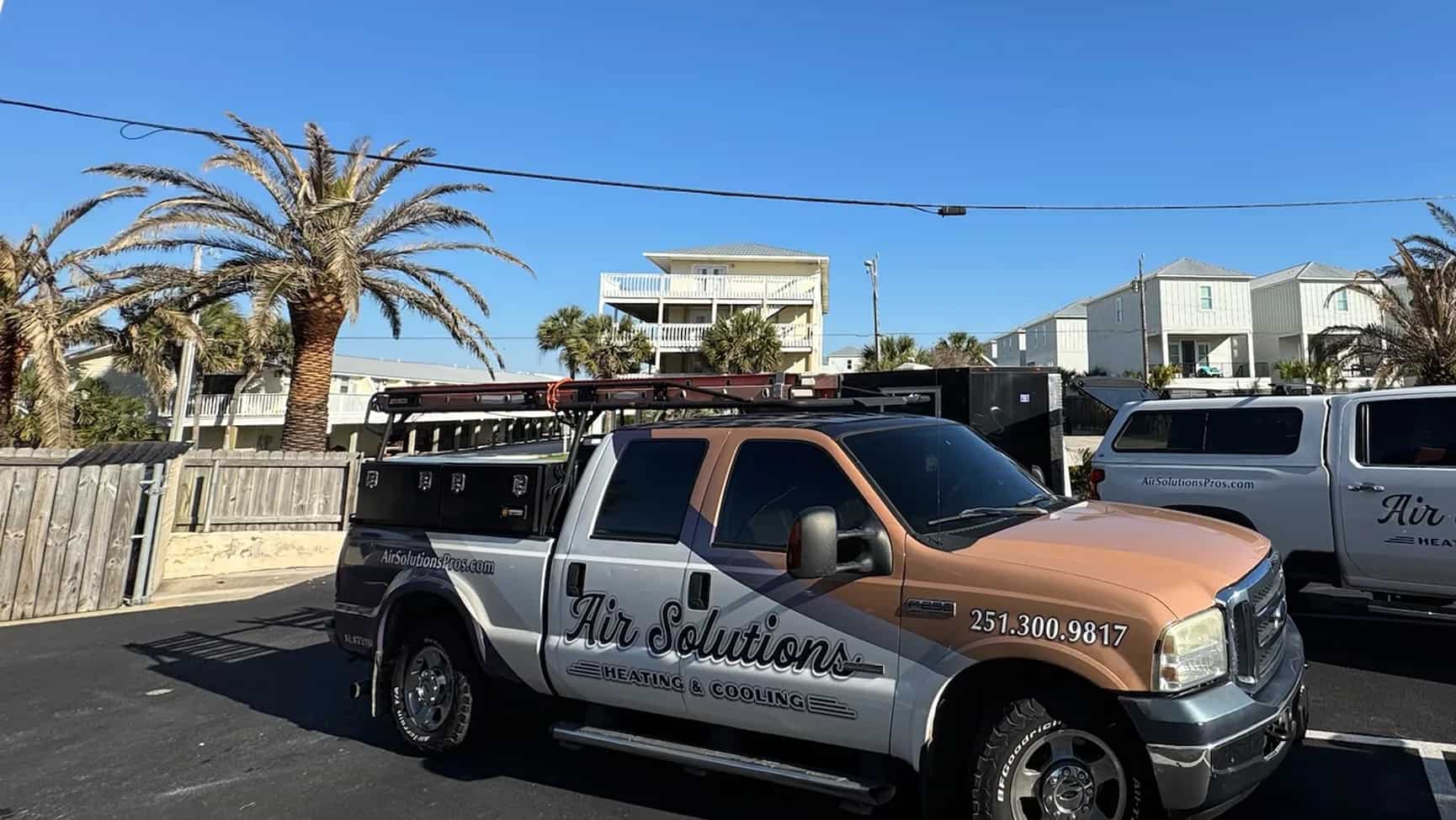
Heat Pump Services in Gulf Shores.
Local heat pump services in Gulf Shores, Alabama and surrounding Baldwin County. Repair, install, maintenance for Baldwin County's #1 system type. Licensed AL#23194. 353+ five-star reviews. Call (251) 300-9817.
Get a Free Estimate
Name and phone is all we need to call you back. Takes ~20 seconds.
353+ five-star reviews · Same-day · 24/7 · Licensed AL#23194
What heat pump services looks like in this climate.
A heat pump installed on a Gulf Shores address operates inside the most lopsided cooling-to-heating climate ratio anywhere on the Baldwin County map. The per-coordinate ERA5 reanalysis at the city's sea-level coordinate logs roughly 3,069 cooling degree days against only 885 heating degree days — a 3.47-to-1 split that is the warmest cooling load and the lightest heating load we serve. Translated into how the equipment actually behaves across a calendar year: somewhere on the order of forty-plus weeks of active cooling-mode operation, with the indoor blower carrying continuous duty through the long humid stretch from late April well into October, and only a handful of weeks scattered across December through early February where the reversing valve flips into heat-mode cycling at all. Average July highs settle near 88.7°F, January overnight lows hover around 53°F, and the resolved grid cell sits 3 meters above sea level on the Gulf. The functional spec implication for the equipment itself is that a Gulf Shores heat pump earns its keep almost entirely on the cooling side, with the heat-mode hardware along for the rare-occasion ride.
That reality reshapes the service conversation in ways the dry-bulb numbers alone don't capture. Overnight humidity rarely drops below the upper 70s through summer, which loads the indoor coil's latent-removal capacity well above what a forecast high suggests, and a system that's lost five or ten percent of its heat-transfer surface to outdoor-coil salt deposition keeps up with sensible cooling before it loses the latent fight — the comfort complaint arrives weeks before the thermostat reading starts to drift. On the heat-mode side, the reversing valve, the defrost board, and the auxiliary heat strip spend the vast majority of their service lives idle, and the few mornings each winter that push the heat-mode hardware into duty are stress-test conditions rather than routine operation. A service plan that ignores either of those climate quirks ends up reactive instead of preventive on the equipment.
What we see on calls in Gulf Shores.
The heat-pump service mix in Gulf Shores clusters around three coastal-specific wear patterns stacked on top of the city's rental-inventory load profile. The 2022 ACS counts 14,331 total housing units against only 6,981 occupied year-round — roughly half the inventory is seasonal or vacation rental on any given day — and equipment in a rental unit logs roughly twice the cumulative cooling-mode runtime hours of an owner-occupied system of the same age. That accelerated runtime moves the wear clock independent of the calendar date the system was placed in service. Capacitor chemistry degrades faster against the higher operating-temperature exposure, contactor terminals see more start-stop cycles across the May-through-October peak rental window, and condenser fan motor bearings accumulate more revolutions on properties where guest occupancy keeps the system in continuous demand rather than the start-stop pattern an owner-occupied home produces.
The first pattern is outdoor-coil salt deposition that eats cooling-mode heat-rejection capacity across forty-plus weeks of duty. On parcels inside the half-mile envelope from open water — Beach Boulevard, the Peninsula along Fort Morgan Road, the Lagoon Pass and Oyster Bay canal corridors, the Bon Secour back-bay frontage — outdoor units sit inside a permanent salt-aerosol exposure curve. Visible fin-pack corrosion is the obvious surface; the more operationally meaningful loss is the cumulative reduction in effective heat-transfer area as salt crystals bond to the aluminum and the coil's ability to reject compressor heat into outdoor air degrades season over season. Spring tune-up rinse work is the controllable variable on that timeline. The second pattern is the long-idle heat-mode-component trio that the matrix's most-lopsided climate ratio puts in its most extreme form here: reversing valves that did not actuate across nine or ten months of pure cooling duty and stick mid-position on the first call for heat, defrost boards drifted out of timing spec across the long idle that miscount the cycle when ice finally accumulates on a humid 38°F morning, and auxiliary heat strips with continuity faults that read fine on a static multimeter but open under real current draw the first winter morning a guest needs the heat. The third pattern is the rental-cycle accelerated-electrical-wear layer that compounds with both of the others — capacitors and contactors arriving early into end-of-life, condensate drains developing biological fouling that doesn't clear with the usual once-a-season treatment because the system never gets the natural off-cycle drying an owner-occupied unit produces between guest stays.
- Mid-life equipment is the common profile in this area. Capacitor and contactor failures dominate the service-call mix.
- Long cooling season means compressors run heavy May through October. Annual maintenance pays for itself in compressor lifespan.
Every Gulf Shores neighborhood, every zip.
Coverage of every Gulf Shores address falls inside the single 36542 ZIP, and the neighborhood map our heat-pump service routes touch reflects the full geographic spread of the city. Craft Farms and Craft Farms North on the inland north-side subdivisions where the salt-aerosol load is moderated by distance from open water and standard-spec outdoor units perform near their published lifespan curve; Kiva Dunes and The Peninsula along Fort Morgan Road where coastal-spec equipment dominates and the spring rinse work is the load-bearing maintenance step; Cotton Creek Trace and Gulf Shores Golf Club Estates north of the canal in mid-vintage stock cycling through second-generation replacement equipment; Oyster Bay and the Lagoon Pass canal blocks on the back-bay side where parcel-level FEMA AE-zone exposure changes outdoor-unit pad-height conversations; and The Beach Club Cottages plus Sunset Bay at Bon Secour for the rental-heavy portfolio addresses where the service-relationship conversation flows through a property management firm rather than directly with the resident owner.
From the Daphne shop the OSRM routing covers about 37 miles and roughly 60 minutes one way under normal weekday conditions to a Gulf Shores heat-pump service address. The arithmetic on a single isolated service call is straightforward: two hours of round-trip deadhead before the diagnostic work itself starts. That math is why we stack the day on Gulf Shores service routes whenever the schedule allows — bi-annual Cool Club tune-up clusters routed across four or five addresses spanning Craft Farms, the Peninsula, Kiva Dunes, and the canal blocks in a single dispatch day so the drive amortizes across the call volume. When a same-day emergency lands and the schedule does not permit a stack, the truck rolls solo on a dedicated run and the booking call gets an honest arrival window rather than a marketing-rounded one. For the service-window conversation on absentee-owner properties — booking the spring rinse around a turnover calendar, slotting the fall reversing-valve exercise into a vacancy stretch, coordinating a mid-cycle diagnostic when the owner is across the country — the 24/7 line is (251) 300-9817 and the dispatch coordinator walks through how the routing fits whichever property management or local-contact chain the property runs on. Cool Club membership covers two visits a year (spring cooling-mode service, fall heating-mode check) plus the published member benefits of 15% off all AC repairs and 5% off new systems; the spring-and-fall structure pairs neatly with what the climate ratio asks of a heat pump at this latitude.
- Craft Farms
- Craft Farms North
- Kiva Dunes
- The Peninsula
- Cotton Creek Trace
- Gulf Shores Golf Club Estates
- Oyster Bay
- Lagoon Pass
- The Beach Club Cottages
- Sunset Bay at Bon Secour
Heat Pump Services in Gulf Shores — the questions that come up.
- Our Gulf Shores beach-house heat pump is on a coastal-spec outdoor unit. Does that change how it should be serviced or just how it was installed?
- It changes both, though most of the service-side adjustment lives in the maintenance discipline. The install-time piece is the coil coatings, stainless or upgraded hardware, and sealed disconnect cabinet that resist the galvanic and salt-aerosol corrosion mechanisms a standard outdoor unit absorbs within the first two to three coastal summers. On the service side, the coastal-spec equipment still benefits meaningfully from an annual outdoor coil rinse to flush salt deposits before they bond to the fin pack, from periodic fastener and cabinet-seal inspection because the coastal hardware ages slowly but does still age, and from a more attentive check on the line-set penetration through the building envelope because coastal driven rain finds gaps inland weather rarely tests. The coastal-spec cabinet doesn't eliminate the reversing-valve or defrost-board long-idle wear that the local climate ratio produces — that's a separate failure mode the equipment-tier upgrade doesn't address. The right cadence is the same bi-annual rhythm as for any other Gulf Shores system, weighted slightly more toward the spring rinse-and-inspect visit.
- How often does the outdoor coil on our Gulf Shores heat pump really need to be rinsed, given how close we are to the water?
- Once a year as a routine baseline, with a second rinse warranted on parcels inside the half-mile envelope from open water — Beach Boulevard, the Peninsula, the Lagoon Pass and Oyster Bay canal corridors, the Bon Secour back-bay frontage. The mechanism is straightforward: salt-aerosol particles deposit continuously on the outdoor fin surface, and during cooling-mode operation the coil runs warm and stays mostly dry between rain events, which lets the salt crystals bond to the aluminum rather than rinsing off naturally. Over a year of accumulation that bonded layer reduces effective heat-transfer area and the compressor works harder to reject the same amount of heat into outdoor air, with the capacity drift usually unnoticed until a 95°F afternoon exposes it. The rinse itself is a quick, low-pressure flush with fresh water (not high-pressure spray, which bends fins) timed for the spring tune-up. Inland Gulf Shores neighborhoods like Craft Farms North or Cotton Creek Trace get by on the once-a-year cadence; half-mile-envelope parcels benefit from a second rinse mid-summer when the prior season's salt-spray exposure justifies it.
- Our Gulf Shores heat pump cooled fine all summer and now won't switch into heating on the first cold morning of the year. Is the system done?
- Almost never, and the symptom is so structurally consistent here that it's effectively a textbook Gulf Shores diagnostic. The most common root cause is a reversing valve that spent nine or ten months in the cooling position and stuck mid-actuation on the first heat-mode call. The slide can seize from refrigerant residue and seal stiction across the long off-season idle, and the first real call for heat in November or December is when the symptom surfaces. The diagnostic runs at the truck — solenoid coil resistance check, pressure readings on both sides of the valve, a controlled attempt to actuate the slide under live system pressure — and the fix is usually a solenoid replacement, sometimes a measured technique that frees the slide cleanly under pressure cycling, occasionally something deeper. The reason this is so reliably a Gulf Shores symptom is the climate ratio: 885 HDD against 3,069 CDD means the reversing valve genuinely sits idle through most of the calendar. While the tech is on site, pair the diagnostic with a check on defrost-board timing and auxiliary-strip continuity — those two components share the same long-idle exposure and often surface their own faults the same morning.
- We own a Gulf Shores vacation rental and our property management firm handles day-to-day. How does heat-pump service scheduling work when we're not local?
- The coordination chain we see work best runs through the property management firm as the primary contact with whoever holds physical property access. Spring and fall tune-up visits get pre-scheduled into the vacancy windows your management calendar already tracks — a Tuesday-through-Thursday block between turnovers is the cleanest slot for a non-emergency service visit and avoids any guest-comfort question. Multi-property owners running several Gulf Shores addresses get scheduled as a route cluster so the whole portfolio cycles through on the same dispatch day. The written service report goes to the email on file (usually both the property manager and the owner) with measured pre-work readings, steps performed, parts replaced with part numbers, and post-work readings — a format useful for owner bookkeeping when rental income reports on a Schedule E. For a mid-cycle issue between scheduled visits, the property management firm calls the 24/7 line at (251) 300-9817; the booking conversation confirms address, symptom, and access chain before a truck is routed.
- Does the Cool Club bi-annual schedule (spring and fall) actually match what a Gulf Shores heat pump needs given how mild the winters are?
- Yes, and the climate ratio is precisely why. The spring AC tune-up visit catches a system about to enter a forty-plus-week cooling marathon: capacitor microfarad readings to verify the start-and-run components hold through peak season, contactor inspection for terminal pitting from the prior summer's cycles, refrigerant-charge verification at design conditions, outdoor coil rinse to flush salt deposits from the off-season, and condensate-drain treatment. The fall heating-mode tune-up addresses the long-idle component trio that the Gulf Shores climate ratio puts in its most extreme form: reversing-valve actuation exercise to break any seal stiction before the first heat call lands, defrost-board timing verification to confirm the cycle hasn't drifted out of spec, and auxiliary heat-strip continuity testing under live current draw rather than a static meter check. Skipping the fall visit on the theory that winters here are mild is the pattern that turns a 38°F January morning into a no-heat emergency call. Cool Club runs without long-term contracts; the published benefit set is 15% off all AC repairs and 5% off new systems, which applies on heat-pump component repair work the same as it applies on cooling-only AC work.
What Gulf Shores customers can claim.
- Most Gulf Shores residential electric meters run through Baldwin EMC, the member-owned cooperative chartered in 1937 whose footprint covers more than 90,000 south-Alabama accounts per the published WP service-area page. A subset of addresses falls on Riviera Utilities depending on subdivision; the masthead at the top of any current power bill confirms which provider serves a particular meter.
- On routine heat-pump service work — spring rinse and tune-up, fall heating-mode check, capacitor swap, contactor replacement, condensate-drain clearing, reversing-valve repair — the provider identity is rarely load-bearing. Parts-and-labor on a service ticket doesn't qualify for utility rebates from either Baldwin EMC or Riviera; the rebate menus on both providers target qualifying full-system replacement at high-efficiency tiers rather than the maintenance and repair work that defines most of the call book.
- Natural gas in Gulf Shores comes through Riviera Utilities only in the portions of the city where the distribution network reaches; a substantial share, particularly along the immediate beach corridor and the Peninsula, is all-electric. For most Gulf Shores heat-pump service the gas-availability question doesn't surface, but on the smaller share of inland addresses where a dual-fuel configuration (heat pump outdoor unit paired with a gas furnace) is in service, confirming active gas service on the booking call helps the dispatcher prepare the truck before arrival.
- The federal Section 25C Energy Efficient Home Improvement Credit expired December 31, 2025 — it no longer applies to replacement installations placed in service in 2026. For a qualifying replacement completed before that date, the AHRI certificate and commissioning documentation in the project folder are what a tax preparer needs to evaluate the 2025 return. Baldwin EMC and Riviera Utilities residential programs remain the active incentive lanes for new qualifying installs.
- Cool Club membership is separate from any utility incentive. Published benefits are 15% off all AC repairs and 5% off new systems, with no long-term contract; on heat-pump service the repair-side discount applies to component repair tickets the same way it applies to cooling-only AC repair work.
Storms and freeze events that shape the heat-pump service population in Gulf Shores.
- Sep 16, 2020 — Hurricane Sally — direct Cat-2 landfall at Gulf Shores: Sally tracked the eyewall straight across the city with multi-day power restoration and salt-water surge inundation along the beach corridor and the back-canal blocks. The post-Sally insurance-claim replacement wave through 2020-2022 funded a substantial share of full-system swaps, which means the current Gulf Shores heat-pump population skews heavily toward equipment four to six years into its first coastal lifespan. That generational cohort is now in the band where reversing-valve solenoid coils begin showing intermittent actuation on the first cold morning, defrost-board firmware drifts out of timing spec if heat-mode behavior hasn't been verified during a documented fall tune-up, and the original-install capacitors enter their typical end-of-life window. The service conversation on a 2020-2022-vintage Gulf Shores heat pump today is less about acute failure and more about catching mid-cycle drift on equipment that hasn't yet had its components stress-tested by a real cold morning.
- Jan 2024 — Multi-night hard freeze along the coast: Three consecutive sub-freezing nights with daytime highs that struggled to clear 40°F. Hard freezes are atypical for Gulf Shores — the city's average January low sits around 53°F — and a heat pump in this climate spends the overwhelming share of its service life idle on the heat-mode side. The 2024 freeze stress-tested reversing valves, defrost boards, and auxiliary heat strips simultaneously across most of the city's equipment population, and the failure-pattern data from that week sets the diagnostic priorities we work against on every fall tune-up since. Long-idle component awareness moved from a theoretical consideration to a documented intake-checklist item on every Gulf Shores heat-pump fall service visit.
- Aug 2023 — Sustained late-summer heat run: Six straight days of heat-index readings above the upper triple digits with overnight humidity that never broke below 70%. The immediate call mix was pure cooling-mode work — capacitor end-of-life clusters surfacing on equipment under load, contactor pits showing on second-cycle systems from the 2010-2018 install wave, compressor lockouts on older equipment finally losing the start sequence — but the longer-tail relevance for heat-pump service shows up months later. Cooling-side electrical components that absorbed marginal damage during the August stress run often surface as failed parts the following spring when the system tries to start up at the front of the next cooling season. The bi-annual cadence is meant to catch those before the first warm week exposes them.
- Sep 16, 2004 — Hurricane Ivan — major Cat-3 landfall just west of Gulf Shores: Ivan came ashore as a Category 3 just west of the city with the eastern eyewall over Gulf Shores. The 2005-2010 rebuild wave that followed Ivan reset much of the city's HVAC inventory, and the equipment installed in that window is now well past 17 years of coastal exposure. Heat-pump systems still in service from that rebuild cohort are functionally at or past their realistic coastal-spec service life; service conversations on equipment of that vintage are almost always end-of-life triage rather than mid-life maintenance, with the replacement-cycle conversation queued up as a parallel track to whatever the immediate repair call is.
Heat Pump Services Coverage Map — Gulf Shores, Alabama
Centered near Gulf Shores for orientation. Air Solutions Heating & Cooling provides heat pump services throughout every Gulf Shores neighborhood and zip code, plus the surrounding Baldwin County area. Same crew, same number — we travel the whole county.
353+ Five-Star Reviews. And Counting.
“Jacob was friendly, professional and prompt.”
“Jacob was absolutely wonderful. Definitely would recommend him and this company!!”
“⭐⭐⭐⭐⭐ **Outstanding Service from Air Solutions and Jesse!** I can't say enough good things about my experience with **Air Solutions**, especially their technician **Jesse**. After dealing with my 10-year-old HVAC system, I wanted someone who would actually take the time to diagnose and properly service the system rather than simply recommend replacing it. Jesse exceeded my expectations. He was…”
Schedule Heat Pump Services in Gulf Shores.
Repair, install, maintenance for Baldwin County's #1 system type. Same-day appointments most weekdays in Gulf Shores and surrounding Baldwin County. Tell us when works for you — we'll confirm by phone during weekday office hours (8 AM-4 PM).
Need someone right now? Call (251) 300-9817 — our 24/7 emergency line is answered live when we can and returned quickly when we can't.
Heat Pump Services in Gulf Shores — FAQs
Why are heat pumps the most common HVAC system in Baldwin County?
Baldwin County's mild winter climate (Climate Zone 2A) is ideal for heat pump operation. Heat pumps deliver 2-3 units of heat for every unit of electricity consumed in our typical winter conditions, while also providing all the summer cooling. One outdoor unit, both seasons, lower utility bills than separate AC + gas furnace setups in our climate. Alabama Power and TVA EnergyRight rebate programs may apply to qualifying high-efficiency installs.How long do heat pumps last on the Gulf Coast?
Inland Baldwin County heat pumps (Daphne, Fairhope, Spanish Fort, Bay Minette) typically last 12-15 years with bi-annual maintenance. Coastal heat pumps (Gulf Shores, Orange Beach, Fort Morgan) typically last 8-12 years due to salt-air corrosion. Coastal-grade outdoor units with corrosion-resistant coatings extend coastal lifespan to 12-16 years. Cool Club bi-annual maintenance documented for warranty purposes maximizes equipment life.Is the federal 25C tax credit still available for heat pump installations?
No — the federal 25C Energy Efficient Home Improvement Credit expired December 31, 2025. Heat pump systems placed in service in 2026 or later are not eligible. If your system was installed on or before December 31, 2025, the credit may be available on your 2025 federal return — verify with a CPA. For new 2026 installs, ask about Alabama Power, TVA EnergyRight, and manufacturer rebate programs that remain in effect.Do you service all of Gulf Shores, AL?
Yes — Air Solutions Heating & Cooling covers every neighborhood and zip code in Gulf Shores, Alabama — including Craft Farms, Craft Farms North, Kiva Dunes, plus the surrounding subdivisions and rural roads. We handle AC repair, AC installation, AC maintenance, emergency HVAC, and commercial HVAC. Standard service hours weekdays, 24/7 emergency response, and same-day appointments most of the year. Call (251) 300-9817 to schedule.What HVAC issues are most common in Gulf Shores?
Homes around Beach Boulevard most commonly call us for refrigerant leaks (often salt-air or coil corrosion related on the Gulf Coast), undersized air conditioning systems struggling with Baldwin County summer humidity, and capacitor failures during peak load between June and September. A Cool Club bi-annual maintenance plan catches most of these issues before they cause a breakdown.
Heat Pump Services Near Gulf Shores.
Right at the Gulf Shores city limit? We service the surrounding Baldwin County communities on the same routes — same crew, same response times.
Related HVAC Guides.
Long-form articles about heat pump services and Baldwin County HVAC, with practical advice from our team.
 Coastal HVAC
The Coastal HVAC Longevity Guide: Salt Air, Corrosion, and Equipment Life in Baldwin County
How salt air shortens HVAC life along the Baldwin County coast versus inland — realistic equipment lifespans, what corrodes first, and the protective measures that work.
August 12, 20267 min Cost Guides
How Long Does AC Installation Take?
Most residential AC installations finish in one day in Baldwin County — here's what affects the timeline and what to expect.
April 28, 20265 min Tax Credits
The 25C Heat Pump Tax Credit Ended After 2025: What Alabama Homeowners Should Know
The federal 25C heat pump tax credit expired December 31, 2025. What that means for Baldwin County homeowners — and what's still available now.
April 24, 20266 min
Other services in Gulf Shores & this service across Baldwin County.
- All HVAC services in Gulf Shores, AL
- Heat Pump Services across Baldwin County
- AC Repair in Gulf Shores
- AC Installation in Gulf Shores
- AC Maintenance in Gulf Shores
- Commercial HVAC in Gulf Shores
- Emergency HVAC in Gulf Shores
- Heating Repair in Gulf Shores
- Indoor Air Quality in Gulf Shores
- Ductless Mini-Splits in Gulf Shores
- Heating Installation in Gulf Shores
Heat Pump Services in Gulf Shores — Schedule Today.
Same-day appointments most weekdays. Cool Club members get prioritized scheduling.