
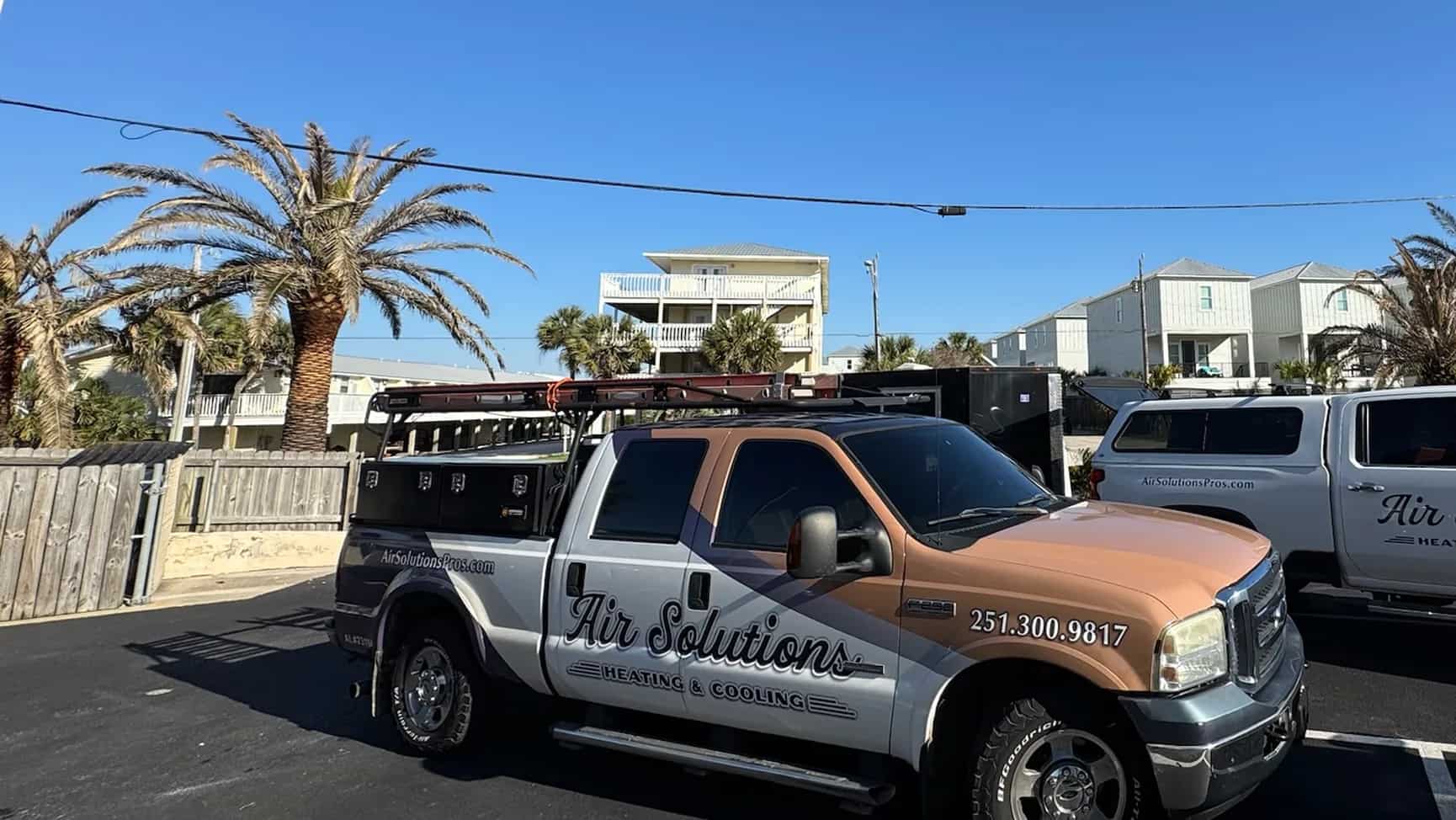
Heating Repair in Gulf Shores.
Local heating repair in Gulf Shores, Alabama and surrounding Baldwin County. Heat pumps, gas + electric furnaces, manufactured home heating. Licensed AL#23194. 357+ five-star reviews. Call (251) 300-9817.
Get a Free Estimate
Name and phone is all we need to call you back. Takes ~20 seconds.
357+ five-star reviews · Same-day · 24/7 · Licensed AL#23194
What heating repair looks like in this climate.
A heating-repair call in Gulf Shores sits inside the lightest heating load anywhere in the matrix. The per-coordinate ERA5 reanalysis at the city's sea-level coordinate logs roughly 885 heating degree days against 3,069 cooling degree days, which works out to a 3.47-to-1 cooling-to-heating ratio that is the most lopsided number anywhere we serve. January overnight lows hover around 53°F, average July highs land near 88.7°F, and the resolved grid cell sits 3 meters above sea level on the Gulf. Translated into operational reality, a Gulf Shores heat pump spends roughly ten months of every twelve idle on the heat-mode side of its hardware, then has to perform cleanly on the handful of cold fronts that push past the coast each winter. The reversing valve, the defrost board, and the auxiliary heat strip all sit dormant from roughly March through November and then get asked to actuate on a 38°F humid morning in January that arrives without much warning.
The rare hard-freeze stretches that reach the coast — three or four nights in the upper 20s and 30s once or twice a winter at most — hit a heat-pump population whose heat-side hardware spends most of the year idle, and the 885 HDD figure looks light on paper but carries more dispatch weight on the rare cold morning than the number suggests. One layer of local-environment honesty: the FEMA point check at the city-center coordinate returns null on the NFHL query, but parcels along Beach Boulevard, the Peninsula along Fort Morgan Road, and the Lagoon Pass and Oyster Bay canal corridors sit inside coastal AE and VE zones at the parcel level, and outdoor heat-pump units on those parcels carry salt-fog exposure year-round even though heat-mode duty is light.
Cold snaps and storm history that shape the heating-repair call book in Gulf Shores.
- Jan 2024 — Multi-night hard freeze along the coast: Three consecutive sub-freezing nights with daytime highs that struggled to clear 40°F. Hard freezes are atypical for Gulf Shores — the city's average January low sits around 53°F — and the reversing valves, defrost boards, and auxiliary heat strips on the typical system spend most of every year idle. The freeze stress-tested all three of those long-dormant components on the same morning across most of the city's equipment population. Heat-mode call volume meaningfully exceeded a normal winter month within the first 48 hours, and vacation-rental properties caught additional exposure because guest arrivals continued through the cold stretch on properties whose owners had not stress-tested the heating side since the previous January.
- Jan 2018 — Hard freeze, low near 20°F at the coast: A reference cold event for the current Gulf Shores equipment population. Many heat pumps that survived 2018 were subsequently replaced after Hurricane Sally in 2020, which means the current heat-mode equipment population skews heavily toward 2020-2022 install vintage. That generational reset is why the January 2024 failure pattern landed on relatively young equipment that nevertheless failed across the long-idle component trio.
- Sep 16, 2020 — Hurricane Sally — direct Cat-2 landfall at Gulf Shores: Sally is not a direct heat-mode event but it reset enough Gulf Shores HVAC inventory that the current heat-mode call book is shaped by it. Outdoor units replaced in the late-2020 insurance-claim window are now four to five years into service — the band where reversing-valve solenoid coils begin showing intermittent actuation on the first cold morning and defrost-board firmware drifts out of timing spec if heat-mode timing has not been verified during a documented fall tune-up.
- Aug 2023 — Extended heat-advisory stretch with delayed heat-side surfacing: Six straight days of heat-index readings above the upper triple digits. The immediate call mix was pure cooling-mode work, but heat-mode relevance shows up months later: cooling-side electrical components that absorbed marginal damage during the August stress run — capacitors that survived the heat but degraded faster, contactor terminals pitted by extended high-current cycling — often surface as failed parts the first morning the system tries to start in heat-mode after the long fall idle.
Every Gulf Shores neighborhood, every zip.
The long haul south from Daphne to a Gulf Shores heating-repair address covers about 37 miles by road and roughly 60 minutes by OSRM routing on a normal weekday. The heat-mode call book being a winter pattern, the drive is usually unobstructed through the cooler months, though the few shoulder weekends in November and early March that still draw beach traffic to the Tanger Outlets corridor can stretch the run. Coverage spans the single 36542 ZIP that defines the city limits plus a meaningful stretch of unincorporated beach. The neighborhood mix matches the full footprint — Craft Farms and Craft Farms North on inland subdivisions where the salt-aerosol load is moderated by distance from open water; Kiva Dunes and The Peninsula along Fort Morgan Road where coastal-spec equipment dominates; Cotton Creek Trace and Gulf Shores Golf Club Estates north of the canal in mid-vintage stock; Oyster Bay and the Lagoon Pass canal blocks on the back-bay side; the Beach Club Cottages and Sunset Bay at Bon Secour for rental-heavy portfolio addresses where the property-manager call flow runs the heat-mode conversation.
Heat-mode dispatch differs from cooling-mode dispatch on the Gulf Shores side of the drive in two ways. Heat-mode calls cluster on a narrow calendar — the dozen or so cold mornings each winter that push past the coast — so the day's routing can absorb several Gulf Shores addresses on the same dispatch day without the truck-time fragmentation that cooling-season weekend work produces. The off-season heat-mode call queue at (251) 300-9817 takes calls year-round, but actual dispatch volume is concentrated in roughly six weeks across January and early February with a smaller cluster around the November cold-front season. The winter calendar makes staffing that easier than the August cooling peak. We won't invent a tighter minute window than the actual truck-location math supports — the WP service-area page publishes a 1-to-2-hour typical-response range for Gulf Shores, and that's the honest number we work against. Coastal-grade parts for Gulf Shores winter work ride on the truck: reversing-valve assemblies, defrost board controls, auxiliary heat-strip elements, and the cooling-side capacitors and contactors that often surface as failed components the first morning the system tries to start in heat-mode. Cool Club membership covers bi-annual tune-ups (spring AC, fall heating) plus 15% off all AC repairs and 5% off new systems per the published Air Solutions terms; on Gulf Shores the fall heating tune-up is specifically where reversing-valve, defrost-board, and aux-strip drift gets caught before January's first cold morning turns it into a no-heat call.
- Craft Farms
- Craft Farms North
- Kiva Dunes
- The Peninsula
- Cotton Creek Trace
- Gulf Shores Golf Club Estates
- Oyster Bay
- Lagoon Pass
- The Beach Club Cottages
- Sunset Bay at Bon Secour
What we see on calls in Gulf Shores.
The heating-repair call book in Gulf Shores has a structurally different intake pattern than any inland Baldwin city. On an owner-occupied address in Daphne, Fairhope, or Foley, a no-heat symptom gets discovered the morning it happens — homeowner wakes up cold, calls the same day, dispatch is reactive within a sleep cycle. On the rental-heavy half of Gulf Shores's housing inventory, that same symptom often gets discovered days or weeks before any guest occupancy. The ACS 2022 counts 14,331 total housing units against only 6,981 occupied year-round, putting roughly half the inventory in the seasonal or vacation-rental pool. Property managers walking units during November-December vacancy stretches, cleaning crews running pre-winter turnover visits, and owners doing pre-holiday inventory checks are the most common first-responders flagging a no-heat issue. That timing layer changes the dispatch math: a failure flagged during a vacancy stretch can be diagnosed, parts-ordered, and repaired without guest-comfort emergency pressure on the calendar — the opposite of the Saturday-to-Sunday compression that defines cooling-side rental work.
The recurring failure patterns cluster around three coastal-specific realities stacked against the heat-mode dormancy. The long-idle component trio every heat-pump-dominant southern cell sees but Gulf Shores sees in its most extreme version: reversing valves that did not actuate cleanly on changeover from cooling and sit stuck mid-position on the first heat call, defrost boards drifted out of timing spec across a ten-month idle period that miscount the defrost cycle when ice finally accumulates, and auxiliary heat strips with continuity faults that read fine on a static multimeter check and open under real current draw. The coastal-outdoor-coil layer during rare heat-mode duty: in heating mode the outdoor coil runs cold and condenses moisture out of ambient air, so salt-aerosol on marine wind gets deposited directly onto a wet coil surface during the few hours per winter the system actually runs heat-mode. That direct salt-on-wet-fin contact accelerates coil corrosion in ways pure cooling-mode duty does not, and it shows up first on the half-mile envelope from open water. And the rental-cycle accelerated-wear pattern: vacation-rental equipment logs roughly twice the cumulative cooling-mode runtime hours of an owner-occupied unit of the same age, which moves capacitors and contactors into end-of-life ahead of the calendar date and often surfaces those failures the first morning the system tries to start in heat-mode after a long idle stretch.
- Mid-life equipment is the common profile in this area. Capacitor and contactor failures dominate the service-call mix.
- Long cooling season means compressors run heavy May through October. Annual maintenance pays for itself in compressor lifespan.
Heating Repair in Gulf Shores — the questions that come up.
- Our Gulf Shores rental was vacant in November and the property manager found no heat on a pre-winter walkthrough. Is this an emergency or can it wait?
- Almost always not an emergency in the dispatch sense, and that timing is actually a good outcome. A no-heat symptom discovered during a vacancy stretch — no guest, no medically vulnerable occupant, no freeze warning putting pipes at risk that night — sits in the normal scheduled-repair queue rather than the after-hours emergency queue. That gives the diagnostic room to breathe: we pull the data plate, run the failure-mode workup, source any longer-lead-time parts through normal channels rather than expedited overnight shipping, and complete the repair before the next guest stay or the next genuine cold front. A no-heat symptom flagged in November is what catches the failure before January's cold morning turns it into an emergency. We do still want to know if the symptom is paired with anything else — water on the floor near the indoor unit, breaker trips, burning smell at the equipment — because layered symptoms change the urgency even if heat alone does not.
- Last January's hard freeze took out our Gulf Shores heat pump. The repair tech said the reversing valve, the defrost board, and the aux strip were all bad. Is that normal?
- On a Gulf Shores address that pattern is genuinely normal for the January 2024 freeze specifically. Gulf Shores logs roughly 885 heating degree days against 3,069 cooling degree days — the most lopsided cooling-to-heating ratio in the matrix — which means the reversing valve, defrost board, and auxiliary heat strip on a typical heat pump spend roughly ten months of every twelve idle. During a normal mild winter those components might get exercised a dozen hours across the whole season. The January 2024 freeze put three consecutive sub-freezing nights against components idle for ten months, and the entire long-dormant chain got tested simultaneously. The all-three-failure pattern was widespread across the city. The honest test on whether the repair was appropriately scoped: does the invoice itemize measured pre-work readings (refrigerant pressures, voltage and amp draws, defrost timing data) for each component, photos of failed parts, and a written diagnostic tying each replacement to the measured fault? If that documentation is present, the scope was warranted.
- Our Gulf Shores beachfront condo's outdoor heat pump is showing visible coil corrosion on the fins facing the water. Does heating mode make that worse?
- It can, and the mechanism is worth understanding. In cooling mode the outdoor coil runs warm — refrigerant rejects heat to outdoor air — so moisture that contacts the coil evaporates off the fin surface relatively quickly. In heating mode the physics reverse: the outdoor coil runs cold (absorbing heat from outdoor air) and actively condenses ambient moisture onto the fin surface. Salt-aerosol particles on the marine wind deposit directly onto a wet coil during those heat-mode hours, which accelerates fin corrosion in a way pure cooling-mode duty doesn't. The asymmetry you're describing is consistent with that mechanism plus prevailing-wind directionality on the beach corridor and the Peninsula. Heat-mode duty hours here are limited enough that the corrosion clock is mostly set by cooling-mode salt exposure and ambient deposition during dormant periods, but the marginal acceleration during rare heat-mode runs is real. The diagnostic on a coil this corroded usually shifts toward measuring residual heat-transfer capacity, checking the line set for salt-corroded penetrations, and assessing whether cabinet fasteners and electrical components have aged faster than the equipment's published coastal service life.
- I have a gas furnace, not a heat pump, in my older Gulf Shores home. Do you handle gas furnace repairs, and is gas service even common here?
- Yes on the repair work, with a caveat on the gas-availability part. Riviera Utilities is the natural-gas distribution provider in the portions of Gulf Shores where the gas network reaches, but a substantial share of the city — particularly along the immediate beach corridor and the Peninsula along Fort Morgan Road — is all-electric. Gas furnace stock concentrates in the older interior subdivisions where gas was historically extended. Typical gas-furnace repair work runs through the standard component list: ignition-control modules that fail closed, flame sensors that build up oxidation and lose their flame signal mid-cycle, draft-inducer motors and pressure switches that wear out after years of cycling, and gas-valve diagnostics on intermittent-ignition symptoms. We carry common universal control modules and the major sensor parts on the truck so most diagnostic-to-repair conversions complete in a single visit. Safety verification — combustion analyzer readings, draft confirmation, gas-leak check on accessible joints — closes out every gas-furnace call, not as an upsell. The masthead on a current Riviera Utilities bill confirms gas service quickly if you're unsure.
- If our Gulf Shores heat pump fails in heating mode and the equipment is still relatively new, what should the tech document for warranty purposes?
- The biggest preventable cause of denied warranty claims on heat-mode failures is missing failure-mode documentation, and heat-mode-specific components — reversing valve, defrost board, aux strip — are where the manufacturer reviewer scrutinizes the paperwork most closely. On any heat-mode repair on equipment under about twelve years old we document the model and serial off the data plate, record measured failure-mode data (refrigerant pressures, voltage and current readings, defrost-cycle timing, fault codes from service mode), photograph the failed part before removal, and produce a written diagnostic report. Surface the original install paperwork on the call if you have it — registration date and homeowner-of-record information determine whether the warranty is active, and a Gulf Shores property that has changed ownership since install may have warranty-transfer language worth checking. We don't handle the manufacturer's filing itself — that runs through the original installing dealer or the manufacturer's homeowner portal — but our diagnostic documentation supports whatever filing path the warranty terms specify.
What Gulf Shores customers can claim.
- Most Gulf Shores residential electric meters run through Baldwin EMC, the member-owned cooperative chartered in 1937 whose footprint covers more than 90,000 south-Alabama accounts per the published WP service-area page. A subset of addresses falls on Riviera Utilities depending on subdivision; the masthead on any current power bill confirms which provider serves your meter. On a heating-repair call the provider identity rarely changes the work — heat-pump and auxiliary-strip components look the same regardless of which utility delivers the power. It becomes load-bearing the moment a diagnostic surfaces a system past its serviceable coastal life and the conversation pivots toward replacement.
- Natural gas is served by Riviera Utilities in the portions of the city where the distribution network reaches; a substantial share, particularly along the immediate beach corridor and the Peninsula along Fort Morgan Road, is all-electric. On a winter no-heat call the gas-availability fact is dispatch-relevant — the truck arrives prepared to diagnose either a heat pump with auxiliary-strip backup or, on a gas-served parcel, a gas furnace, because the dispatcher can't always confirm which configuration is installed from the booking call alone.
- Standard heating-repair line items — reversing-valve replacement, defrost-board service, auxiliary-strip diagnostics and element swaps, ignition-module work on gas furnaces, capacitor or contactor repair that surfaces during a heat-mode call — do not qualify for utility rebates from either Baldwin EMC or Riviera. The rebate menus on both sides target qualifying full-system replacement at high-efficiency tiers, not parts-and-labor on a repair ticket.
- If a heat-mode diagnostic uncovers a system at end-of-life and the conversation turns toward replacement, note that the federal Section 25C Energy Efficient Home Improvement Credit expired December 31, 2025 — replacements placed in service in 2026 no longer qualify. For a pre-cutoff replacement, a CPA can advise on the 2025 return. Utility rebate amounts adjust annually; confirm current programs directly with the relevant utility. Cool Club membership sits separately: 15% off all AC repairs and 5% off new systems, with the repair-side discount applying on heating-mode work the same as cooling-mode work.
Heating Repair Coverage Map — Gulf Shores, Alabama
Centered near Gulf Shores for orientation. Air Solutions Heating & Cooling provides heating repair throughout every Gulf Shores neighborhood and zip code, plus the surrounding Baldwin County area. Same crew, same number — we travel the whole county.
357+ Five-Star Reviews. And Counting.
“The BEST A/C guys in Baldwin County! Always do a fantastic job at a fair price and their techs are always very polite and knowledgeable.”
“Justin was very professional and knowledgeable. He diagnosed the issue very quickly and had my AC back up and running in no time.”
“Reaves was amazing and super professional! He did a phenomenal fast job and prevented my unit from flooding again! 10/10 definitely recommend this company, I called today and they were able to send him out 30 min later! Ask for Reaves!”
Schedule Heating Repair in Gulf Shores.
Heat pumps, gas + electric furnaces, manufactured home heating. Same-day appointments most weekdays in Gulf Shores and surrounding Baldwin County. Tell us when works for you — we'll confirm by phone during weekday office hours (8 AM-4 PM).
Need someone right now? Call (251) 300-9817 — our 24/7 emergency line is answered live when we can and returned quickly when we can't.
Heating Repair in Gulf Shores — FAQs
Do you repair heat pumps, gas furnaces, AND electric furnaces in Baldwin County?
Yes — Air Solutions Heating & Cooling repairs every common heating system type in Baldwin County: heat pumps in heating mode (the most common system in Gulf Shores, Orange Beach, Fort Morgan, Bon Secour, and surrounding cities), gas furnaces, electric furnaces, and manufactured home heating systems. Same-day service most weekdays; 24/7 emergency line at (251) 300-9817 for cold-snap nights.Why does my heat pump blow cool air in winter?
Three common causes in Baldwin County heat pumps: (1) the system is in defrost mode (briefly normal — check again in 10-15 minutes), (2) the auxiliary heat strips aren't engaging when outdoor temps drop below balance point, or (3) the reversing valve isn't switching from cooling to heating mode. We diagnose all three on the same visit and most heat pump heating issues are repaired same-day.How much does heating repair cost in Baldwin County?
It depends on what failed. Small electrical parts — a capacitor, contactor, igniter, or flame sensor — sit at the low end; defrost boards, reversing valves, gas valves, and control boards cost more; a failed compressor or a cracked heat exchanger is where repair-versus-replace becomes a real question. We diagnose first, give a written estimate before any work starts, and never start without your approval.Do you service all of Gulf Shores, AL?
Yes — Air Solutions Heating & Cooling covers every neighborhood and zip code in Gulf Shores, Alabama — including Craft Farms, Craft Farms North, Kiva Dunes, plus the surrounding subdivisions and rural roads. We handle AC repair, AC installation, AC maintenance, emergency HVAC, and commercial HVAC. Standard service hours weekdays, 24/7 emergency response, and same-day appointments most of the year. Call (251) 300-9817 to schedule.What HVAC issues are most common in Gulf Shores?
Homes around Beach Boulevard most commonly call us for refrigerant leaks (often salt-air or coil corrosion related on the Gulf Coast), undersized air conditioning systems struggling with Baldwin County summer humidity, and capacitor failures during peak load between June and September. A Cool Club bi-annual maintenance plan catches most of these issues before they cause a breakdown.
Heating Repair Near Gulf Shores.
Right at the Gulf Shores city limit? We service the surrounding Baldwin County communities on the same routes — same crew, same response times.
Related HVAC Guides.
Long-form articles about heating repair and Baldwin County HVAC, with practical advice from our team.
 Emergency
Heat Out on a Cold Night in Gulf Shores? What to Do First
Heat pump quit on a cold Gulf Shores night — or is it just defrosting? How to tell normal defrost from a real failure, first checks, the emergency-heat setting, and when to call.
July 16, 20266 min Maintenance
Weak AC Airflow in Gulf Shores: Filter, Duct, or Blower? Diagnose Yourself
Step-by-step diagnostic for weak AC airflow in Gulf Shores, AL — three causes, how to test for each yourself, and when to call a professional.
September 4, 20264 min Indoor Air Quality
Why Your Gulf Shores House Is Humid Even When the AC Runs All Day
Cool but sticky? Here's why your Gulf Shores, AL home stays humid in summer even with the AC running constantly — and the real fixes that work.
August 31, 20265 min
Other services in Gulf Shores & this service across Baldwin County.
- All HVAC services in Gulf Shores, AL
- Heating Repair across Baldwin County
- AC Repair in Gulf Shores
- AC Installation in Gulf Shores
- AC Maintenance in Gulf Shores
- Commercial HVAC in Gulf Shores
- Emergency HVAC in Gulf Shores
- Heat Pump Services in Gulf Shores
- Indoor Air Quality in Gulf Shores
- Ductless Mini-Splits in Gulf Shores
- Heating Installation in Gulf Shores
Heating Repair in Gulf Shores — Schedule Today.
Same-day appointments most weekdays. Cool Club members get prioritized scheduling.