
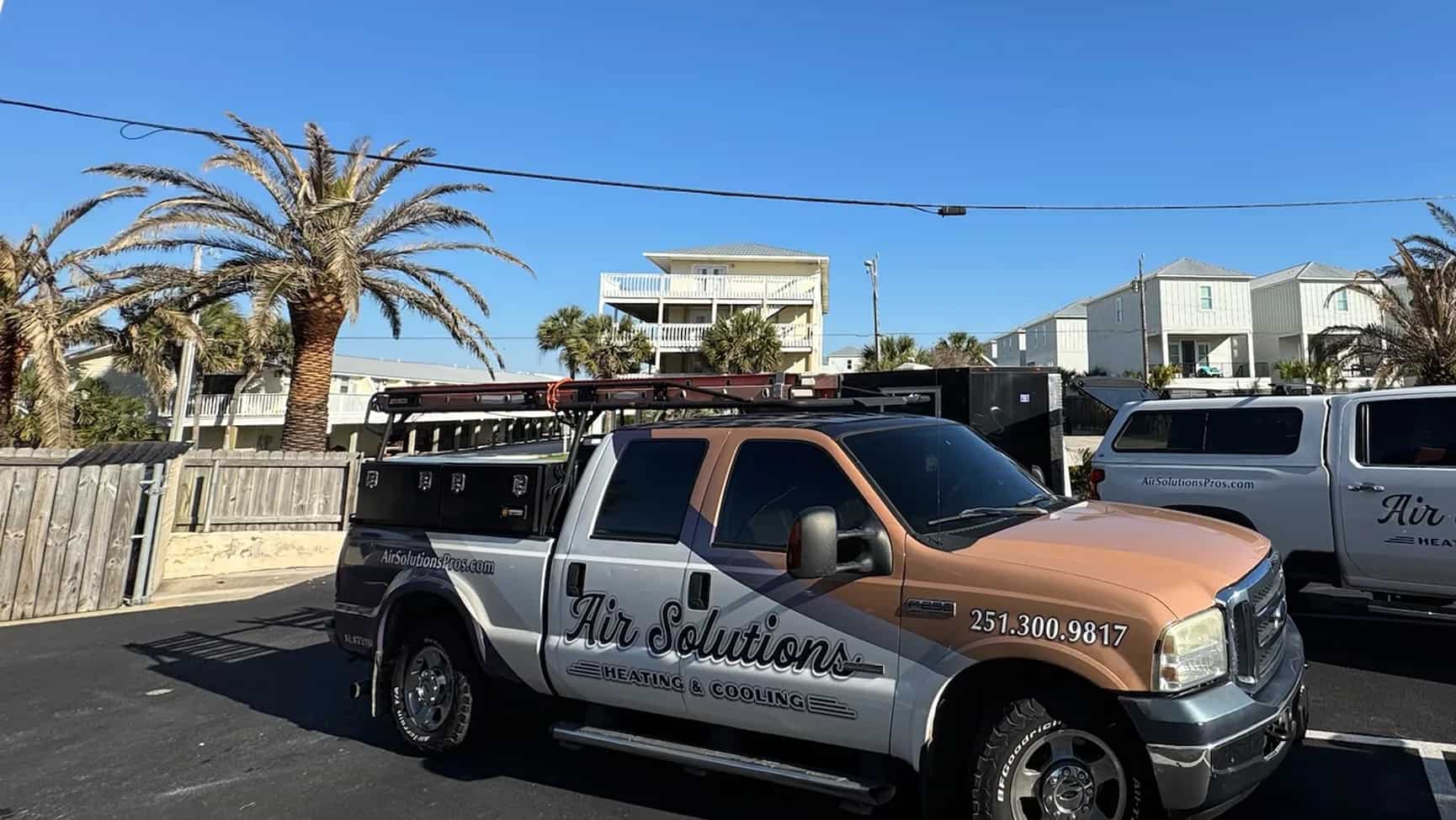
Heating Repair in Fort Morgan.
Local heating repair in Fort Morgan, Alabama and surrounding Baldwin County. Heat pumps, gas + electric furnaces, manufactured home heating. Licensed AL#23194. 353+ five-star reviews. Call (251) 300-9817.
Get a Free Estimate
Name and phone is all we need to call you back. Takes ~20 seconds.
353+ five-star reviews · Same-day · 24/7 · Licensed AL#23194
What heating repair looks like in this climate.
A heating-repair call on a Fort Morgan address gets diagnosed against the lightest winter envelope anywhere we work. The per-coordinate ERA5 reanalysis at the peninsula coordinates returns roughly 642 heating degree days for 2023 — the lowest figure published anywhere in the Baldwin matrix, lower than Gulf Shores at 884.5, lower than Orange Beach at 946.5, lower than Foley at 1,065, lower than every inland point on our service map. Stacked against an annual cooling load of about 3,008 degree days, the cooling-to-heating ratio works out to 4.69-to-1, which is the most lopsided number anywhere we serve. Translating those figures into operating hours: a peninsula heat pump typically runs the heating side of its hardware for a couple dozen hours across an average January and February combined, and the reversing valve, defrost board, and auxiliary heat strip sit dormant from about mid-March through early December. Sitting at three meters of elevation with Mobile Bay on the north flank and the open Gulf on the south flank, the peninsula's thermal envelope is moderated by saltwater on both sides in ways no inland Baldwin parcel can match — January overnight lows hover around 56.4°F, and the average year produces only a small handful of mornings cold enough to genuinely test the heating-side equipment.
What that asymmetry means for the diagnostic conversation on a no-heat call is that the failure-mode probability distribution looks structurally different from any inland heating-repair page. A Bay Minette or Stockton heat pump that fails in heating mode has typically been running heat-mode duty for weeks already at the point the symptom surfaces, so the failure tends to be a fatigue or end-of-life event on components actively in service. A Fort Morgan heat pump that fails in heating mode is, in the great majority of cases, failing on its FIRST heat-mode actuation of the season after a long dormant stretch — and the dormancy itself is the most common root cause rather than fatigue under sustained load. The diagnostic starts there, with the long-idle-component-trio probability stack at the top and the more conventional fatigue patterns lower in the order. One layer of local-environment honesty: the FEMA NFHL point check at the peninsula center returned a Zone X designation with the 0.2 percent annual chance flood hazard subtype — the shaded-X or 500-year zone — and addresses along Mobile Point, the Gulf-facing south side of Fort Morgan Road, the Mobile Bay Ferry landing area, and the bay shore commonly fall into coastal AE or VE zones at the parcel level, with the outdoor heat-pump equipment on those parcels carrying continuous salt-aerosol exposure even though heat-mode duty hours are scarce.
Cold-mornings and storm history that have produced the heating-repair call clusters on the Fort Morgan peninsula.
- Jan 2024 — Multi-night sub-freezing stretch across the central Gulf Coast: Three consecutive sub-freezing nights with daytime highs that struggled to clear 40°F — atypical for Mobile Point, where the average January low sits around 56°F, and harder on peninsula heating systems than the bare climate numbers would suggest. The event arrived after most peninsula heat pumps had been completely idle on the heating side for ten months, and the long-idle-trio failure pattern — reversing valves that wouldn't actuate cleanly on changeover, defrost boards drifted out of timing spec, auxiliary heat strips with continuity faults that surfaced only under real current draw — surfaced across the install base simultaneously. The peninsula's heating-repair call volume across the week of the freeze meaningfully exceeded the typical entire-winter total. A meaningful share of the calls came from owners present at the property for the holiday-week stays that overlapped the cold stretch, with the no-heat symptom surfacing on systems that had run cleanly the prior winter. The freeze became the reference event for owners thinking about the difference between dormancy-driven failures and fatigue-driven failures on heating-side hardware.
- Jan 2018 — Hard freeze with overnight lows near 20°F at the coast: The prior reference cold event in the current Fort Morgan equipment population's living memory. The systems that survived 2018 in service have largely been replaced since — through Hurricane Sally insurance-claim cycles in 2020 and through normal coastal-coil end-of-life replacement waves through the early 2020s — which means the heat pumps actually exposed to the 2018 freeze are mostly off the peninsula now. The relevance for the current heating-repair call book is generational: many of the 2020-2022 replacement systems installed after Sally are now four-to-six years into service and approaching the age where reversing-valve solenoids begin showing intermittent actuation on the first cold morning of a season and defrost-board firmware drifts out of factory timing spec if heating-mode operation has not been verified through a documented fall tune-up.
- Sep 16, 2020 — Hurricane Sally (Cat-2 landfall at Gulf Shores; eyewall across the Fort Morgan peninsula): Sally is not a heat-mode event directly but reset enough peninsula HVAC inventory that the current heat-mode equipment population is shaped by it more than by anything else. Outdoor units replaced in the late-2020 insurance-claim window are now four-to-six years into service, sitting in the heart of the band where heating-side components begin showing the first dormancy-driven faults under cold-morning load. The post-Sally generation of installs is also the cohort where install-day heating-mode commissioning matters most for repair-call prevention: a fall Cool Club tune-up that verifies reversing-valve actuation, defrost-board timing, and auxiliary-strip continuity catches the long-idle drift before the first cold morning of the next season surfaces it as a no-heat call.
- Sep 16, 2004 — Hurricane Ivan (major Cat-3 landfall just west of the peninsula): Ivan is the reference event for the older peninsula property owners and the rebuild wave that followed reshaped a substantial share of the Fort Morgan housing stock. Heat-pump installations on those post-Ivan rebuilds are typically now in their second or third generation, with the original 2005-era systems aging out around 2015-2020 and the second-generation systems either currently in service or themselves coming up on the next replacement window. The heating-repair call book sees both populations: older systems in the late-life heating-side fatigue band where reversing valves, defrost boards, and aux strips are all aging in parallel, and newer post-Sally systems in the early-life dormancy-driven failure band described above.
Every Fort Morgan neighborhood, every zip.
Dispatching a heating-repair truck to a Fort Morgan address pushes the parts-truck loadout decision back to the Daphne shop before the crew leaves the bay, and the reason is the drive distance. The OSRM-verified routing runs roughly 57 miles and right at 90 minutes one way under normal weekday traffic — south on US-98 to Foley, south again on Highway 59 to the Highway 180 turn-off, then the full length of Fort Morgan Road out the peninsula. Highway 180 is the only road in or out of the peninsula. That is the longest dispatch in our entire Baldwin County service area, and a missed reversing-valve assembly, a missed defrost-board control, or a missed auxiliary heat-strip element on a January cold-morning call doesn't get resolved with a quick same-afternoon return trip the way it might on a Daphne or Fairhope call. The truck stages with the full long-idle-trio parts inventory — reversing valves and solenoids in the common peninsula sizes, defrost-board controls for the manufacturers we see most often on the peninsula install base, auxiliary heat-strip elements and sequencers — alongside the cooling-side capacitor and contactor stock that often surfaces as failed components the first morning a system tries to start in heat-mode after the long fall idle. Coverage spans the single 36542 ZIP that Fort Morgan shares with Gulf Shores: Mobile Point at the tip, the Fort Morgan Peninsula proper, Gulf Shores Plantation, The Colony at Fort Morgan, the residential blocks around the Mobile Bay Ferry landing area, and every address along the full Highway 180 corridor.
Phone access into dispatch runs through (251) 300-9817 around the clock, and on a peninsula heating-repair situation we ask for the symptom description in enough detail at the booking call that the parts loadout can be tailored before the truck rolls. Useful detail at booking includes: what the thermostat is set to (heat vs auto), what the system is actually doing (blower running but no warm air? blower not running at all? outdoor unit silent? outdoor unit running but indoor air handler silent?), how long it has been since the system last ran in heat mode (last winter? earlier this season?), and whether the symptom appeared on the first actuation attempt of the season or after the system had been running heat-mode duty for some hours. That information shapes the probability stack we work against and meaningfully tightens the first-visit fix rate against a 90-minute one-way drive. We do not promise a specific minute window for the arrival on a peninsula heating-repair call — the road distance, the cold-morning dispatch picture, and what else is on the route that day all factor in — and the dispatcher quotes an honest arrival window on the call rather than promising a tighter slot than the geography supports. Cool Club membership on the peninsula carries the same published terms as anywhere we cover — 15% off all AC repairs and 5% off new systems, with the repair-side discount running against the final invoice on a heating-repair ticket exactly the way it would on a cooling-repair ticket — and on the heating-mode side specifically the fall tune-up visit each Cool Club year is the one realistic opportunity to verify long-idle components are working before the next genuine cold morning surfaces a fault on a system the owner is sitting in person to discover.
- Mobile Point
- the Fort Morgan Peninsula
- Fort Morgan Road (Highway 180)
- Gulf Shores Plantation
- The Colony at Fort Morgan
- the Mobile Bay Ferry landing area
Heating Repair in Fort Morgan — the questions that come up.
- We came down to our Fort Morgan house in November for a quiet weekend and the heat won't kick on. Is this a real emergency?
- Usually not in the after-hours dispatch sense, and that timing actually works in your favor on a peninsula repair. A no-heat symptom discovered by the owner during a personal off-season visit — no paying guest in the unit, no overnight freeze warning putting pipes at imminent risk, and you present in the property able to layer up for the night — sits comfortably in the normal scheduled-repair queue rather than the after-hours emergency queue. The diagnostic can move at a deliberate pace once a truck arrives, parts that aren't on the initial loadout can be sourced through normal supply channels rather than expedited overnight shipping, and the repair can be done correctly the first time. The owner-first-discoverer pattern is genuinely common on Fort Morgan because the property managers running peninsula rental portfolios don't typically exercise the heat-mode side during vacancy turnovers — the owner's first heat-on attempt of the year is the actual functional test the system gets. Useful detail to give at booking: what the thermostat is set to, whether the indoor blower runs at all, whether the outdoor unit is running or silent, and roughly how long it has been since the system last ran in heat mode. That information shapes what gets loaded on the truck before it leaves the Daphne shop.
- Our Fort Morgan heat pump ran fine last winter. Why would the long-idle components fail this year if they were working before?
- Because the dormancy clock on a peninsula heat pump is harder on heating-side components than the running-hours clock that homeowners intuitively expect to govern wear. A typical Fort Morgan heat pump runs heat-mode for a couple dozen hours total across an average January and February, and the reversing valve, defrost board, and auxiliary heat strip then sit completely idle from about mid-March through early December — roughly ten months of zero exercise on the heating-side hardware every year. Across that long dormant window several things happen independent of any prior winter's clean operation: the reversing-valve solenoid coil sits inside a continuous salt-aerosol environment on the peninsula and can develop a salt-influenced bind that surfaces on its first heat-mode actuation specifically rather than on any cooling-mode call in between; the defrost-board firmware timing can drift out of factory calibration across the idle period in ways that don't show up until ice actually accumulates on the outdoor coil; the auxiliary heat-strip elements can develop continuity faults that pass a static multimeter check at the panel and only open under real current draw. None of those failure mechanisms care that last winter's heat-mode duty went cleanly. The previous winter's clean operation predicts very little about this winter's cold-morning result on heating-side hardware that has been completely idle in between.
- Why does salt corrosion on our peninsula outdoor unit matter for heating repair specifically? Doesn't the equipment mostly run in cooling mode anyway?
- Two heat-mode-specific corrosion mechanisms surface on a peninsula outdoor unit that pure cooling-mode duty does not produce, and they shape the heating-repair call book even though heat-mode duty hours are scarce. First, the reversing-valve solenoid sits on the outdoor unit through eleven months of continuous salt-aerosol exposure each year, and the solenoid coil and the valve's mechanical actuation hardware can develop a salt-influenced bind that surfaces specifically on the first heat-mode actuation of the season. The system runs, the indoor blower moves air, the outdoor unit cycles — but the refrigerant cycle never reverses, and the air at the registers stays room-temperature. Second, the physics of the outdoor coil actually reverse between cooling and heat modes. In cooling mode the outdoor coil runs warm and any moisture that contacts the fin surface evaporates off relatively quickly. In heat mode the outdoor coil runs cold (absorbing heat from outdoor air) and actively condenses ambient moisture onto the fin surface. Salt-aerosol particles on the marine wind deposit directly onto a wet coil during the few hours per winter the system runs heat-mode, which accelerates fin corrosion in a way pure cooling-mode duty does not. The asymmetric peninsula geography — saltwater on both flanks, sea-breeze cycles pushing salt-laden air across structures from opposite directions twice a day — means the corrosion clock is set continuously for the cooling-mode hardware and gets a measurable bump up during the rare heat-mode runs.
- Your truck is 90 minutes from Fort Morgan. What if the part our heat pump needs isn't on it when the technician arrives?
- Honest answer: the parts-truck loadout decision gets made at the Daphne shop before the crew leaves on a Fort Morgan dispatch, and the loadout for a heating-repair call is built specifically against the long-idle-component probability stack that dominates peninsula heat-mode failures. The truck stages reversing valves and solenoids in the common peninsula sizes, defrost-board controls for the manufacturers we see most often on the peninsula install base, auxiliary heat-strip elements and sequencers, plus the cooling-side capacitor and contactor inventory that frequently surfaces as failed components on a system trying to start in heat-mode after the long fall idle. The detail you give at booking — what the thermostat is set to, what the system is actually doing, how long it has been since heat-mode last ran, whether the symptom appeared on first actuation or after some hours of duty — meaningfully tightens what we load. When the failed component is something less common (a specific manufacturer's proprietary control board for an older inverter system, an unusual sequencer configuration, a reversing valve in a size we don't stock for this peninsula's install base), we diagnose the fault on the visit, write up the part-sourcing path with a realistic timeline, and schedule the return work on the next peninsula route day rather than running the truck back from Daphne on a single-part errand. For owners present in person on an off-season visit, that scheduling cadence usually fits the trip plan; for vacation-rental properties with guest stays scheduled, the timeline conversation happens upfront so any guest-communications adjustments happen on the property-manager side before the next stay arrives.
- Our Fort Morgan heat pump barely runs in heating mode anyway. Does it make sense to repair the heating side, or should we just live with the cooling-mode performance?
- On a Fort Morgan address that economic question is genuinely worth pausing on, because the peninsula's climate envelope (642 heating degree days against 3,008 cooling degree days, the most lopsided cooling-to-heating ratio in our service area) means heating-mode duty is genuinely a small fraction of the equipment's annual workload. That said, the answer is usually still to repair the heating side, and the reason is that the failure modes we're talking about are not just heating-mode failures. A stuck reversing valve is a failure of the refrigerant-cycle hardware that also matters for the system's ability to manage humidity during the long shoulder season when dehumidification matters more than sensible cooling, and a system with reversing-valve issues often produces uneven cooling performance during the peak summer too. Defrost-board faults can cause unnecessary cooling-mode short-cycling that wastes energy across the long cooling season. Auxiliary heat-strip continuity issues at minimum mean you have no backup on the rare hard-freeze morning a guest or family member might be present. The repair-vs-replace pivot point is the cooling-side age of the outdoor equipment rather than the heating-side performance specifically. A peninsula heat pump approaching 8 to 10 years on a coated-coil outdoor unit (or 5 to 7 years on a standard galvanized outdoor unit, which is what the peninsula's salt-aerosol envelope produces) is genuinely reasonable to replace as a full system regardless of which side of the equipment surfaced the immediate failure; a 4-year-old coated-coil system on the peninsula is worth repairing on the heating side even if heat-mode duty hours are scarce.
What Fort Morgan customers can claim.
- Every residential address on the Fort Morgan peninsula is served by Baldwin EMC for electric, and there is no natural-gas distribution network on Fort Morgan Road past the early portion of the peninsula per the verified service-area documentation. The all-electric reality shapes what a heating-repair call looks like in scope: there is no gas-furnace dispatch on a peninsula no-heat call by definition, so the failure is always on the heat-pump side or the auxiliary-strip electrical side, and the truck arrives with diagnostic tools and parts sized for that scope rather than carrying gas-furnace ignition modules, flame sensors, and draft-inducer parts that simply have no application on this peninsula.
- Standard heating-repair line items — reversing-valve replacement, defrost-board service, auxiliary-strip element and sequencer swaps, capacitor and contactor work that surfaces during a heat-mode call on cooling-side components, refrigerant leak repair at salt-corroded line-set joints — do not generally qualify for Baldwin EMC residential rebates. The cooperative's incentive pathways target qualifying full-system replacement at high-efficiency tiers, not the parts-and-labor side of a repair ticket.
- When a cold-morning diagnostic surfaces a system past its serviceable peninsula run and the conversation turns toward a full replacement, the primary incentive path is through Baldwin EMC residential energy-efficiency programs targeting qualifying high-efficiency heat-pump installations — coated-coil variable-speed inverter equipment of the kind appropriate for peninsula salt exposure typically clears the program floors, but specific qualifying-equipment lists and dollar amounts move on the cooperative's own annual cycle and the responsible move is to verify the active offer directly with BEMC at the time of the replacement quote. Note: the federal Section 25C Energy Efficient Home Improvement Credit expired December 31, 2025 — replacements placed in service in 2026 do not qualify; for a prior-cutoff replacement, a CPA can advise on the 2025 return.
- Our role on any replacement that follows a heating-repair diagnostic is to provide the invoice, the equipment model and serial numbers, and the install record the property file needs; a CPA handles any tax-treatment questions. Cool Club membership applies on heating-repair line items on the peninsula exactly as it applies elsewhere we cover, with the published 15% off all AC repairs and 5% off new systems running against the final invoice the same way on a January no-heat ticket as on a scheduled spring tune-up; on the heating-mode side specifically the value of the fall tune-up visit each Cool Club year is the realistic opportunity to verify long-idle components are working before the next genuine cold morning surfaces a fault.
What Fort Morgan homeowners say after a Heating Repair call.
Hand-picked GBP reviews for this cell pending. Wave C selects 1-3 reviews from the existing pool, ensuring no review appears on more than two cells per the master-plan uniqueness rule.
Heating Repair Coverage Map — Fort Morgan, Alabama
Centered near Fort Morgan for orientation. Air Solutions Heating & Cooling provides heating repair throughout every Fort Morgan neighborhood and zip code, plus the surrounding Baldwin County area. Same crew, same number — we travel the whole county.
353+ Five-Star Reviews. And Counting.
“Jacob was friendly, professional and prompt.”
“Jacob was absolutely wonderful. Definitely would recommend him and this company!!”
“⭐⭐⭐⭐⭐ **Outstanding Service from Air Solutions and Jesse!** I can't say enough good things about my experience with **Air Solutions**, especially their technician **Jesse**. After dealing with my 10-year-old HVAC system, I wanted someone who would actually take the time to diagnose and properly service the system rather than simply recommend replacing it. Jesse exceeded my expectations. He was…”
Schedule Heating Repair in Fort Morgan.
Heat pumps, gas + electric furnaces, manufactured home heating. Same-day appointments most weekdays in Fort Morgan and surrounding Baldwin County. Tell us when works for you — we'll confirm by phone during weekday office hours (8 AM-4 PM).
Need someone right now? Call (251) 300-9817 — our 24/7 emergency line is answered live when we can and returned quickly when we can't.
Heating Repair in Fort Morgan — FAQs
Do you repair heat pumps, gas furnaces, AND electric furnaces in Baldwin County?
Yes — Air Solutions Heating & Cooling repairs every common heating system type in Baldwin County: heat pumps in heating mode (the most common system in Fort Morgan, Gulf Shores, Orange Beach, Foley, and surrounding cities), gas furnaces, electric furnaces, and manufactured home heating systems. Same-day service most weekdays; 24/7 emergency line at (251) 300-9817 for cold-snap nights.Why does my heat pump blow cool air in winter?
Three common causes in Baldwin County heat pumps: (1) the system is in defrost mode (briefly normal — check again in 10-15 minutes), (2) the auxiliary heat strips aren't engaging when outdoor temps drop below balance point, or (3) the reversing valve isn't switching from cooling to heating mode. We diagnose all three on the same visit and most heat pump heating issues are repaired same-day.How much does heating repair cost in Baldwin County?
Most heat pump heating repairs fall between $150 and $600 (capacitor, contactor, defrost board, reversing valve solenoid). Gas furnace repairs typically run $200 to $700 (igniter, flame sensor, gas valve, control board). Major component failures (compressor, heat exchanger crack) run higher. We diagnose first, give a written estimate before any work starts, and never start without your approval.Do you service all of Fort Morgan, AL?
Yes — Air Solutions Heating & Cooling covers every neighborhood and zip code in Fort Morgan, Alabama — including Mobile Point, the Fort Morgan Peninsula, Fort Morgan Road (Highway 180), plus the surrounding subdivisions and rural roads. We handle AC repair, AC installation, AC maintenance, emergency HVAC, and commercial HVAC. Standard service hours weekdays, 24/7 emergency response, and same-day appointments most of the year. Call (251) 300-9817 to schedule.What HVAC issues are most common in Fort Morgan?
Homes around the historic Fort most commonly call us for refrigerant leaks (often salt-air or coil corrosion related on the Gulf Coast), undersized air conditioning systems struggling with Baldwin County summer humidity, and capacitor failures during peak load between June and September. A Cool Club bi-annual maintenance plan catches most of these issues before they cause a breakdown.
Heating Repair Near Fort Morgan.
Right at the Fort Morgan city limit? We service the surrounding Baldwin County communities on the same routes — same crew, same response times.
Related HVAC Guides.
Long-form articles about heating repair and Baldwin County HVAC, with practical advice from our team.
 Commercial
Vacation Rental AC Failures Between Guests in Fort Morgan: The Turnover Playbook
How Fort Morgan, AL vacation rental owners can prevent and respond to AC failures during the critical guest-turnover window — protocols, contracts, monitoring.
September 14, 20265 min Coastal HVAC
Hurricane Prep for Your HVAC: A Gulf Coast Homeowner's Guide
Step-by-step hurricane prep for Baldwin County HVAC equipment — what to do before, during, and after a storm to protect your AC and avoid costly post-storm failures.
May 1, 202611 min Maintenance
AC Unit Lifespan on the Gulf Coast
How long AC units actually last on the Gulf Coast, what salt air does to them, and how Baldwin County homeowners extend service life.
April 22, 20267 min
Other services in Fort Morgan & this service across Baldwin County.
- All HVAC services in Fort Morgan, AL
- Heating Repair across Baldwin County
- AC Repair in Fort Morgan
- AC Installation in Fort Morgan
- AC Maintenance in Fort Morgan
- Commercial HVAC in Fort Morgan
- Emergency HVAC in Fort Morgan
- Heat Pump Services in Fort Morgan
- Indoor Air Quality in Fort Morgan
- Ductless Mini-Splits in Fort Morgan
- Heating Installation in Fort Morgan
Heating Repair in Fort Morgan — Schedule Today.
Same-day appointments most weekdays. Cool Club members get prioritized scheduling.