
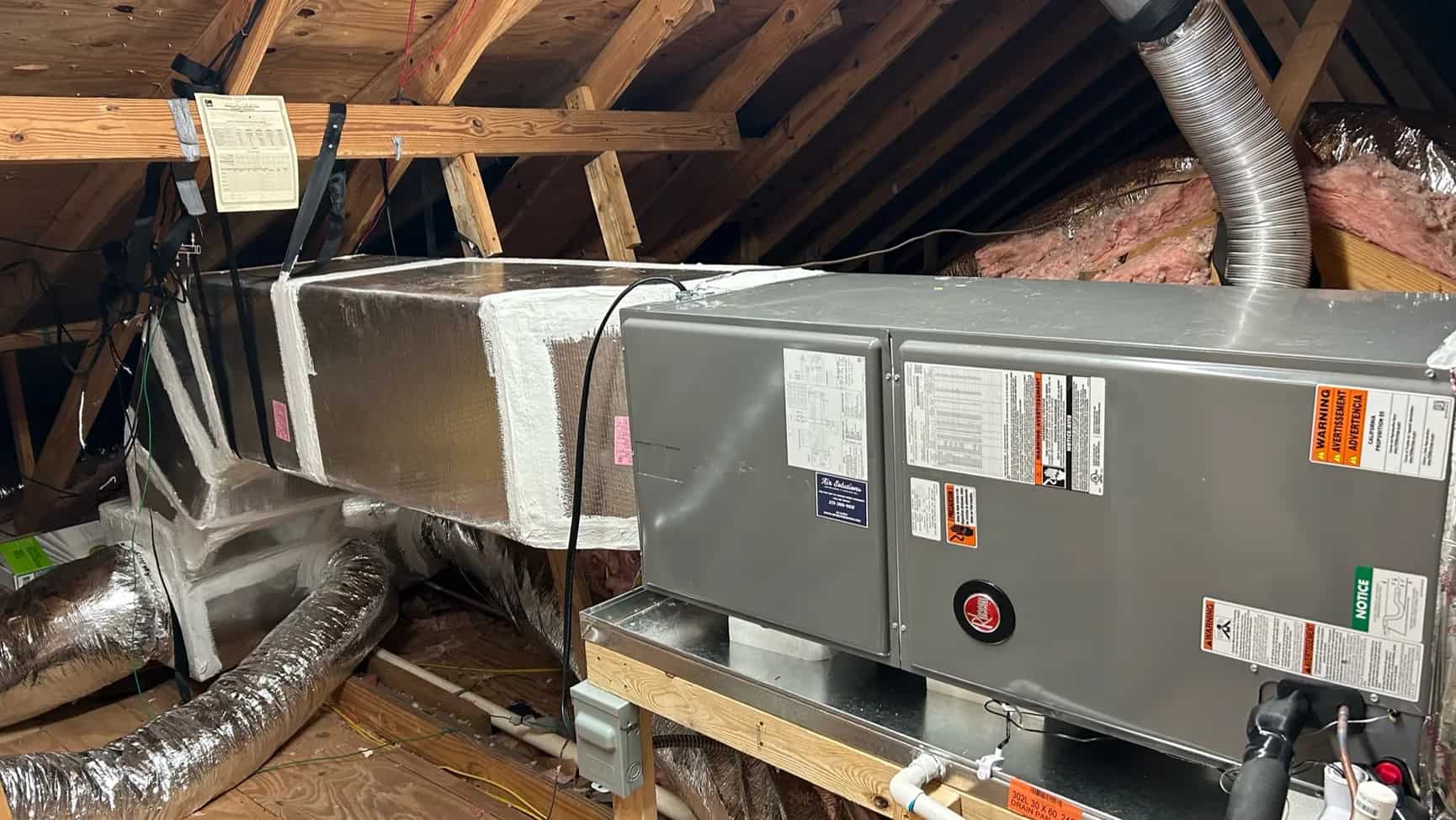
Heating Repair in Bon Secour.
Local heating repair in Bon Secour, Alabama and surrounding Baldwin County. Heat pumps, gas + electric furnaces, manufactured home heating. Licensed AL#23194. 353+ five-star reviews. Call (251) 300-9817.
Get a Free Estimate
Name and phone is all we need to call you back. Takes ~20 seconds.
353+ five-star reviews · Same-day · 24/7 · Licensed AL#23194
What heating repair looks like in this climate.
Bon Secour carries one of the smallest heating loads of any mainland community we cover — about a thousand heating degree days in a typical year, against a cooling load better than three times that. It helps to translate that out of degree-day units. In practical terms it means the heating side of your system does meaningful work for something on the order of two to three weeks spread across a winter, and spends the remaining eleven-plus months doing nothing at all. Average January lows sit near 50.9°F. Most winter nights here, a house coasts.
That is pleasant to live with and it creates a specific problem for the equipment. Heating faults in this village are almost never progressive. In a market where the furnace runs from November through March, a failing component announces itself — efficiency drops, noises change, cycles get strange, and the homeowner notices something is off weeks before it quits. Here there is no such runway. The system sits idle, something fails silently during the idle period with nobody using it, and the fault is discovered in the instant it matters, on the coldest night, with no warning history behind it.
It also means the winter equipment in this community is, on average, in unknown condition at any given moment. Not bad condition — unknown. The only way to convert unknown into known is to run it deliberately, which is why the fall check matters more in a mild climate than in a harsh one, exactly opposite to most people's intuition.
The cold events that define heating repair in a village averaging a thousand heating degree days.
- Jan 2025 — Gulf Coast snow and hard freeze: The reanalysis record at this coordinate shows roughly 9.7 cm of snowfall on 21 January 2025 and a low of 13.3°F on the 22nd — about 38 degrees below the average January low for this location, and the most severe cold in the modern record here. Events like that do not create heating faults so much as reveal every one that had accumulated silently through the preceding year, all at once and across the whole county. They also expose the second-order problems a mild climate lets people ignore: uninsulated pipe runs, unconditioned crawlspaces, and vacant properties with no freeze protection at all.
- Jan 2024 — Hard-freeze week: Several consecutive sub-freezing nights the prior winter served as the first of a back-to-back pair of tests. Coming twelve months before the 2025 event, it is a useful reference point for anyone deciding whether to take winter seriously here: two genuine freezes in consecutive years in a place where the average January night stays above 50°F. Equipment that struggled in either one has now had two warnings.
- Sep 2020 — Hurricane Sally: The heating-side relevance of a hurricane is indirect but real. Salt water pushed up the river and bay into outdoor equipment attacks the electrical compartment, the contactor, and the low-voltage wiring — components the heating mode depends on exactly as much as the cooling mode does. A heat pump that has cooled acceptably every summer since 2020 can still fail to switch into heating because of corrosion damage that only shows itself when the reversing valve solenoid is finally asked to energize.
Every Bon Secour neighborhood, every zip.
Here is the thing nobody in this trade wants to put on a heating-repair page, and it is the most useful thing we can tell you. On the two or three nights a year when Baldwin County actually gets cold, every heating system in the county is asked to work at once, every latent fault surfaces simultaneously, and every HVAC company in the region is over capacity at the same moment. We will not promise you same-day service on those nights, because nobody can honestly promise it and the companies that do are simply going to break the promise later. We will tell you where you actually stand when you call so you can plan around it.
What that means practically is that the fall check is not an upsell on a heating page, it is the whole strategy. Getting the reversing valve cycled, the auxiliary strips load-tested, and the defrost function verified in October — when the weather is mild, we are not slammed, and a needed part can be ordered without urgency — is the difference between a scheduled appointment and being one of four hundred people calling on the same January morning. In a climate this mild the temptation to skip it is strong precisely because the heat almost never matters, and that is the trap.
Coverage is the full 36511 and we come from the Daphne shop on US-98, a run of a bit under fifty minutes down through Foley. Outside of freeze events, heating diagnostics here are easy to schedule and we route them with other south-of-the-bay work. Our line is (251) 300-9817 and we hold Alabama license AL#23194.
- Downtown Bon Secour
- the Bon Secour River waterfront
- Hidden Lakes at Bon Secour
- Whispering Oaks
- the Plash Island Road area
- the County Road 10 corridor
- the Oyster Bay shoreline
What we see on calls in Bon Secour.
The faults we find on Bon Secour heating calls cluster tightly, and every one of them is the kind that hides. On heat pump systems, which are the majority here, the reversing valve leads the list — the component that swaps the system between cooling and heating, sitting in one position for the better part of a year and then declining to move. Auxiliary heat strips are second: electric resistance elements that may energize only a handful of times annually, and a burned-out element or a failed sequencer produces exactly zero symptoms until the temperature drops far enough to call for it. Defrost boards are third, and they are the sneakiest, because a defrost cycle only runs in cold humid conditions and a dead board is completely invisible outside them.
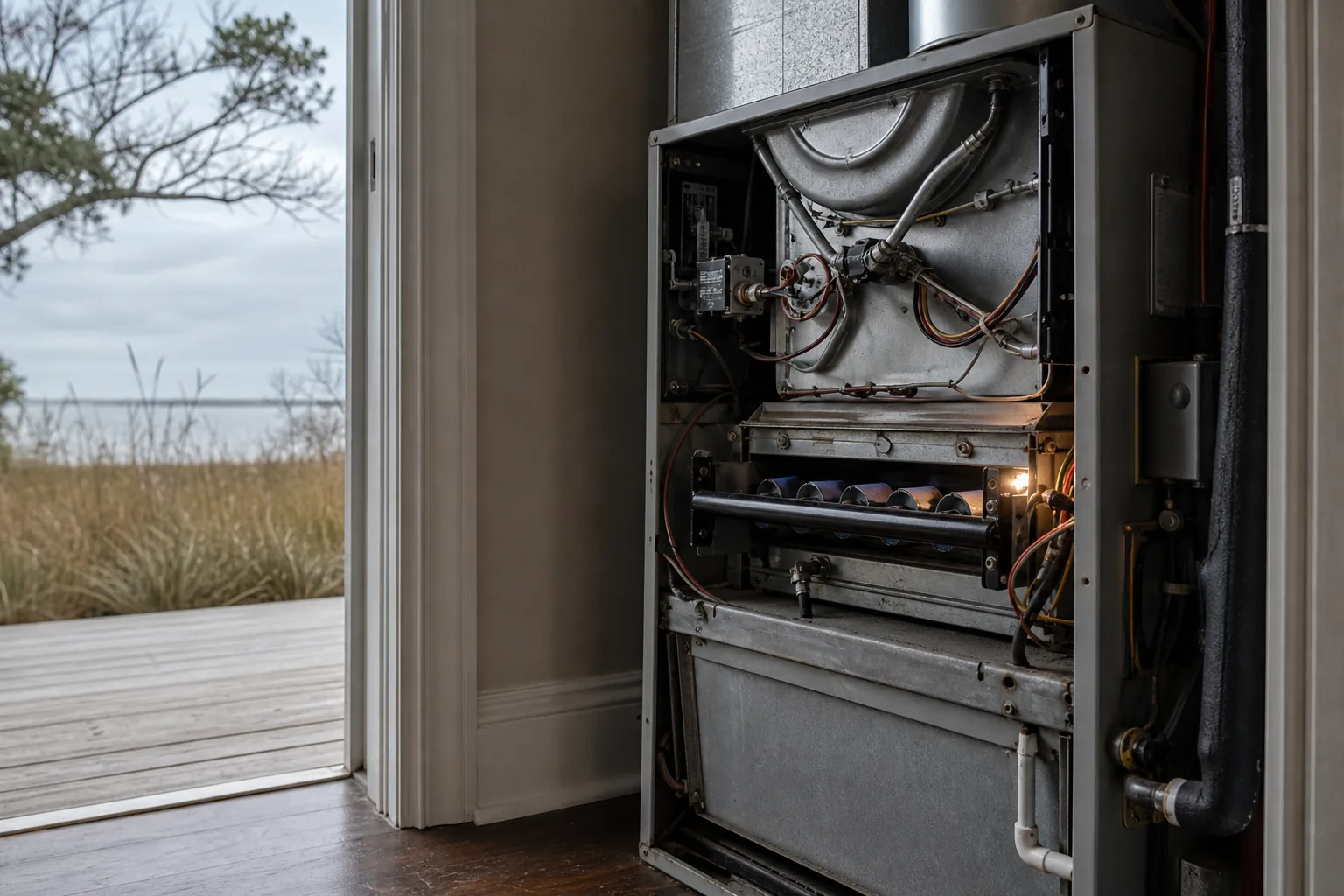
On the gas side, where a furnace is installed, the pattern rhymes. Igniters and flame sensors that were marginal when the system shut down in March are fully failed by the following December, because nothing exercised them. Rodents and wasps take up residence in flue passages and burner compartments during a long warm idle. Condensate traps on high-efficiency units dry out and crack. And a pressure switch or an inducer motor that has not turned in ten months does not always turn on the eleventh.
There is one more that is specific to this village rather than to mild climates generally. At six meters of elevation surrounded by brackish tidal water, the corrosion that everyone associates with the outdoor cooling coil is also working on the outdoor unit's electrical compartment, the contactor, and the low-voltage wiring — all of which the heating mode depends on just as much as the cooling mode does. A heat pump that cools acceptably can still fail to heat because of a corrosion-related electrical fault that only manifests when the reversing valve solenoid is asked to energize.
- Mid-life equipment is the common profile in this area. Capacitor and contactor failures dominate the service-call mix.
- Long cooling season means compressors run heavy May through October. Annual maintenance pays for itself in compressor lifespan.
- Mild winters mean heat pumps cover the season comfortably without backup runtime in normal years. Cold-snap weeks expose undersized units.
Heating Repair in Bon Secour — the questions that come up.
- My heat worked fine last winter and won't come on now. What happened?
- Most likely nothing happened this winter — it failed sometime during the year and you are only finding out now. That is the defining pattern of heating repair in a climate with about a thousand heating degree days: the system sat unused for ten or eleven months, and whatever failed did so quietly with nobody asking it to work. A reversing valve that will not shift, an auxiliary heat strip that burned out, a failed defrost board, a corroded contactor, an igniter that gave up — all of these produce no symptom whatsoever during the long idle stretch. So the honest answer to 'what happened' is usually 'this broke months ago and tonight is the first time anything asked it to run.' Before you call, check the obvious: confirm the thermostat is actually set to heat rather than auto, check the breaker for both the air handler and the outdoor unit, and change the filter if it is loaded. Those three resolve a real share of calls.
- How cold does it actually get in Bon Secour?
- Most winters, not very — the average January low sits around 50.9°F, and a typical cold night here is one where you want a jacket rather than one where anything is at risk. But the average hides the tail, and the tail is what breaks equipment. The archived reanalysis for this exact coordinate shows that on 21 January 2025 this area received roughly 9.7 centimeters of snow, and the following night bottomed out at 13.3°F. That is roughly 38 degrees below the January average low, and it is the hardest freeze in the modern record for this stretch of coast. Two things follow. First, a heating system here does need to actually work, because when it is called on it may be called on hard. Second, plumbing and equipment that has never been tested by a real freeze in this village has now been tested once, and anything that failed then is worth having looked at before the next one rather than after.
- Is it worth repairing the heat if I barely use it?
- Usually yes, and the reasoning is a bit different from a cooling repair. On the cooling side you can weigh repair cost against remaining life and runtime fairly cleanly. On the heating side in this climate, the equipment is barely accumulating wear at all, so a repair frequently buys you many more years of service than the same repair would somewhere the system runs all winter — you are fixing a component that will then sit largely unused. The exception is when the heating fault is really a symptom of the whole system being at end of life, or when the repair is a large one on a system already old enough that the cooling side is the real concern. Since the cooling side is where this equipment actually lives, we tend to make the repair-or-replace call on cooling considerations and treat the heating fault as one input rather than the deciding factor. We will explain which situation you are in rather than defaulting to the bigger ticket.
- Can I just use space heaters instead of fixing it?
- For a night or two while you wait for a repair, that is a reasonable bridge, and given how few genuinely cold nights this village gets it is tempting to make it permanent. We would push back on the permanent version, for safety reasons more than comfort ones. Portable electric heaters are a leading cause of residential fires, and the risk concentrates in exactly the way people use them during a cold snap: run continuously, placed near furniture or bedding, plugged into extension cords or power strips they should never be on. If you do use them, plug directly into a wall outlet, keep a clear perimeter, and never leave one running in an unoccupied room or overnight in a bedroom. Never use a gas range or an outdoor grill for heat under any circumstances — that produces carbon monoxide indoors and it kills people every winter. And if your house sits empty part of the year, understand that space heaters are not a freeze-protection strategy for the plumbing at all, because they only heat the room they are in.
- Why can't anyone get out to me during a cold snap?
- Because in a climate with a heating load this small, every heating fault in the county reveals itself in the same forty-eight hours. Equipment that has been idle for eleven months all gets switched on at once when the first real Arctic air arrives, every latent failure surfaces simultaneously, and demand for heating service goes up by an order of magnitude overnight against a fixed number of technicians in the region. It is not that companies are ignoring you; there is genuinely a queue and it is genuinely long. This is the single strongest argument for the fall check, and it is why we push it on a mild-climate page where it seems least necessary. A system verified working in October is a system that is not in that queue in January.
What Bon Secour customers can claim.
- Two electric providers meet in this area and Bon Secour sits on the boundary, so which one serves you depends on your specific parcel rather than on the ZIP. Your statement settles it.
- Heating repair is not a rebate-eligible event under either provider's programs, and no honest contractor will tell you otherwise. Efficiency incentives attach to equipment replacement at qualifying tiers, not to fixing what you have.
- The winter billing point that IS worth knowing: when a heat pump's compressor or reversing valve fails, many systems fall back to auxiliary electric resistance heat, which is dramatically more expensive to run than the heat pump it replaced. A house can limp along on aux heat feeling adequately warm while the electric bill climbs sharply, and the owner attributes it to the cold weather rather than to a fault. If your winter usage spikes far beyond what a brief cold snap should explain, that is worth a diagnostic — the repair frequently costs less than a season of running on strips.
Heating Repair Coverage Map — Bon Secour, Alabama
Centered near Bon Secour for orientation. Air Solutions Heating & Cooling provides heating repair throughout every Bon Secour neighborhood and zip code, plus the surrounding Baldwin County area. Same crew, same number — we travel the whole county.
353+ Five-Star Reviews. And Counting.
“Jacob was friendly, professional and prompt.”
“Jacob was absolutely wonderful. Definitely would recommend him and this company!!”
“⭐⭐⭐⭐⭐ **Outstanding Service from Air Solutions and Jesse!** I can't say enough good things about my experience with **Air Solutions**, especially their technician **Jesse**. After dealing with my 10-year-old HVAC system, I wanted someone who would actually take the time to diagnose and properly service the system rather than simply recommend replacing it. Jesse exceeded my expectations. He was…”
Schedule Heating Repair in Bon Secour.
Heat pumps, gas + electric furnaces, manufactured home heating. Same-day appointments most weekdays in Bon Secour and surrounding Baldwin County. Tell us when works for you — we'll confirm by phone during weekday office hours (8 AM-4 PM).
Need someone right now? Call (251) 300-9817 — our 24/7 emergency line is answered live when we can and returned quickly when we can't.
Heating Repair in Bon Secour — FAQs
Do you repair heat pumps, gas furnaces, AND electric furnaces in Baldwin County?
Yes — Air Solutions Heating & Cooling repairs every common heating system type in Baldwin County: heat pumps in heating mode (the most common system in Bon Secour, Foley, Gulf Shores, Magnolia Springs, and surrounding cities), gas furnaces, electric furnaces, and manufactured home heating systems. Same-day service most weekdays; 24/7 emergency line at (251) 300-9817 for cold-snap nights.Why does my heat pump blow cool air in winter?
Three common causes in Baldwin County heat pumps: (1) the system is in defrost mode (briefly normal — check again in 10-15 minutes), (2) the auxiliary heat strips aren't engaging when outdoor temps drop below balance point, or (3) the reversing valve isn't switching from cooling to heating mode. We diagnose all three on the same visit and most heat pump heating issues are repaired same-day.How much does heating repair cost in Baldwin County?
Most heat pump heating repairs fall between $150 and $600 (capacitor, contactor, defrost board, reversing valve solenoid). Gas furnace repairs typically run $200 to $700 (igniter, flame sensor, gas valve, control board). Major component failures (compressor, heat exchanger crack) run higher. We diagnose first, give a written estimate before any work starts, and never start without your approval.Do you service all of Bon Secour, AL?
Yes — Air Solutions Heating & Cooling covers every neighborhood and zip code in Bon Secour, Alabama — including Downtown Bon Secour, the Bon Secour River waterfront, Hidden Lakes at Bon Secour, plus the surrounding subdivisions and rural roads. We handle AC repair, AC installation, AC maintenance, emergency HVAC, and commercial HVAC. Standard service hours weekdays, 24/7 emergency response, and same-day appointments most of the year. Call (251) 300-9817 to schedule.What HVAC issues are most common in Bon Secour?
Homes around the Bon Secour River most commonly call us for refrigerant leaks (often salt-air or coil corrosion related on the Gulf Coast), undersized air conditioning systems struggling with Baldwin County summer humidity, and capacitor failures during peak load between June and September. A Cool Club bi-annual maintenance plan catches most of these issues before they cause a breakdown.
Heating Repair Near Bon Secour.
Right at the Bon Secour city limit? We service the surrounding Baldwin County communities on the same routes — same crew, same response times.
Related HVAC Guides.
Long-form articles about heating repair and Baldwin County HVAC, with practical advice from our team.
Other services in Bon Secour & this service across Baldwin County.
- All HVAC services in Bon Secour, AL
- Heating Repair across Baldwin County
- AC Repair in Bon Secour
- AC Installation in Bon Secour
- AC Maintenance in Bon Secour
- Commercial HVAC in Bon Secour
- Emergency HVAC in Bon Secour
- Heat Pump Services in Bon Secour
- Indoor Air Quality in Bon Secour
- Ductless Mini-Splits in Bon Secour
- Heating Installation in Bon Secour
Heating Repair in Bon Secour — Schedule Today.
Same-day appointments most weekdays. Cool Club members get prioritized scheduling.