
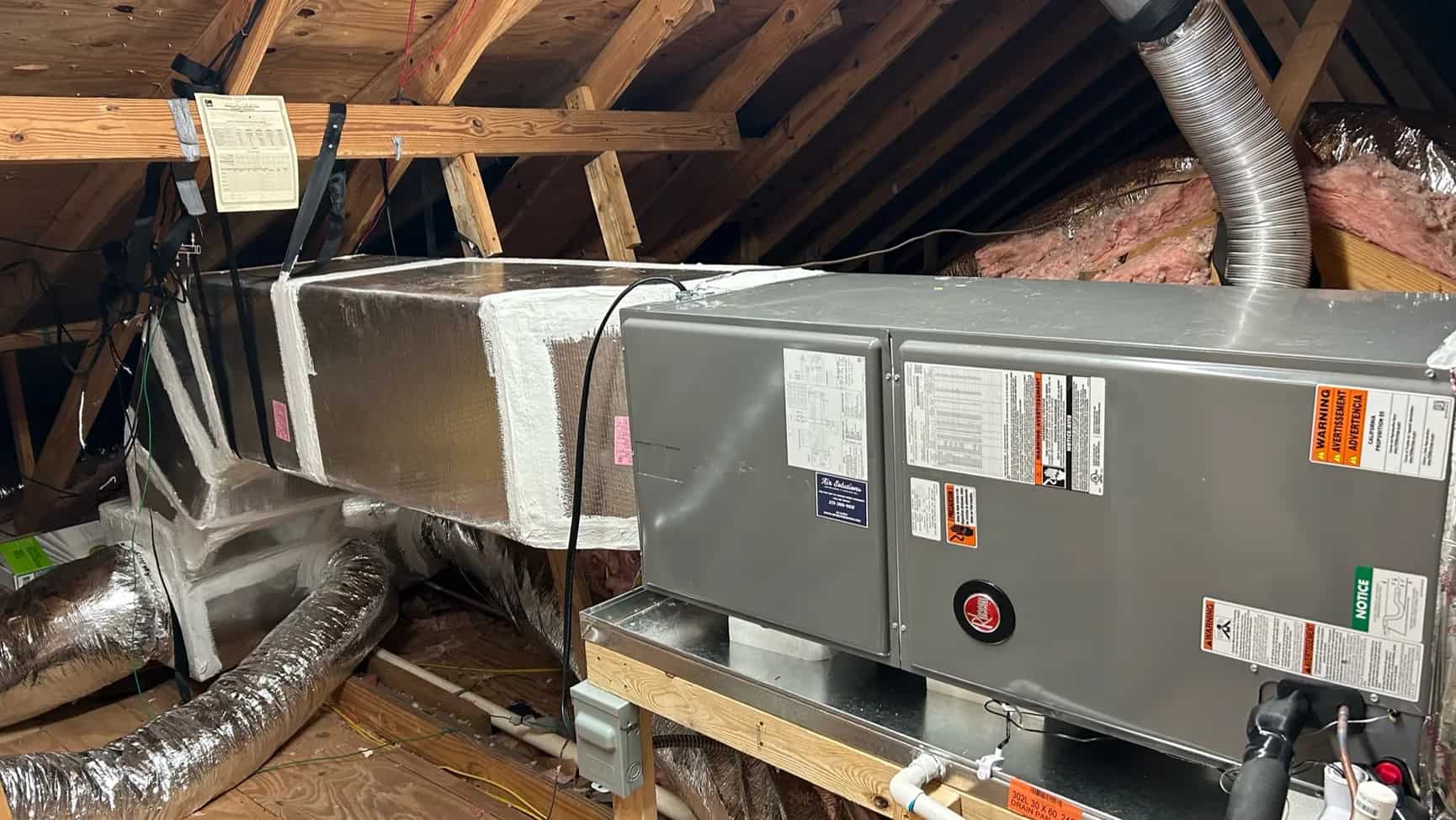
Heating Installation in Bon Secour.
Local heating installation in Bon Secour, Alabama and surrounding Baldwin County. Heat pumps, gas + electric furnaces, manufactured home heating — sized for Baldwin County winters. Licensed AL#23194. 353+ five-star reviews. Call (251) 300-9817.
Get a Free Estimate
Name and phone is all we need to call you back. Takes ~20 seconds.
353+ five-star reviews · Same-day · 24/7 · Licensed AL#23194
What heating installation looks like in this climate.
Specifying heating equipment for Bon Secour means resolving a genuine tension, and most contractors resolve it by ignoring one side. Side one: this is among the mildest heating markets on this site. The annual heating load is under a third of the cooling load, and the average January low sits near 50.9°F. On that evidence you would buy the least heating capability the equipment lines offer and put every remaining dollar into cooling performance, which is where the hours actually are.
Side two: the archived record for this exact coordinate shows about 9.7 centimeters of snow on 21 January 2025 and a low of 13.3°F the following night. That is roughly 38 degrees below the average January low — an outlier by any measure, and it happened. A system specified purely against the average leaves a house cold, with no reserve, on precisely the nights that make the news. In a village where roughly a quarter of the homes have no full-time occupant, it also leaves a lot of unattended buildings exposed to a freeze nobody is there to notice.
Both sides are right, which is why the answer is not a compromise between them but a different structure altogether. You size the heat pump against the cooling load, because that is what governs eleven months of operation and because an oversized compressor dehumidifies badly, which is the real everyday penalty here. Then you cover the rare extreme with properly sized auxiliary heat, which is cheap to install, costs nothing when it is not running, and exists precisely for the handful of hours a decade when the compressor alone cannot carry the house. Buying a larger compressor to chase a design temperature that occurs almost never means paying a comfort and efficiency penalty every single day of the cooling season in exchange for a few hours of winter margin.
Every Bon Secour neighborhood, every zip.
A heating installation here runs as a scheduled project and almost always as part of a full system changeout, since the heating and cooling sides share the same equipment. The assessment covers the load calculation, the ductwork and static pressure, the electrical panel capacity, and the changeover strategy. Best time to do this work in Bon Secour is spring or fall — not because the equipment cares, but because you do not want to be arranging a heating installation in the middle of the week everyone else in the county has discovered their heating problem.
For the seasonal owners who make up a large share of this community, there is an install-time decision worth making deliberately rather than by default: what the system should do while you are not here in winter. A thermostat that can hold a low freeze-protection setpoint and report its status remotely costs very little as part of an installation and is awkward to retrofit later. Given that the January 2025 event dropped this village to 13.3°F, an unattended house with no heating strategy is a genuine plumbing risk, not a theoretical one. We will set that up as part of the commissioning if you tell us the property sits empty.
We work out of the Daphne shop on US-98, a little under fifty minutes from the 36511 by way of Foley and County Road 10. Most changeouts complete in a day and we commission before leaving — heating mode verified under actual operation, each auxiliary stage confirmed to energize and draw correctly, changeover behavior checked rather than assumed. Equipment carries the manufacturer's warranty alongside our workmanship warranty. Alabama license AL#23194, fully insured, no distance surcharge on a Bon Secour address, and HVAC financing is available if you want to spread the cost.
- Downtown Bon Secour
- the Bon Secour River waterfront
- Hidden Lakes at Bon Secour
- Whispering Oaks
- the Plash Island Road area
- the County Road 10 corridor
- the Oyster Bay shoreline
What we see on calls in Bon Secour.
The first decision is whether you are installing heat at all as a separate thing. In this climate, for most Bon Secour households, the answer is no — you are installing a heat pump, which is one piece of equipment doing both jobs, and the heating capability comes along with the cooling equipment you were buying anyway. Adding a separate gas furnace means buying, installing, venting, and maintaining a second appliance to serve the smaller third of an already-modest annual load. The arithmetic rarely supports it here. Where it does: if you already have gas service and an existing furnace with genuine life left in it, replacing only the cooling half and keeping the furnace is frequently the better spend than scrapping working equipment for tidiness. And confirm what fuel is actually available at your specific address before the conversation goes further — natural gas service is not uniform across this area and it should not be assumed.
The second decision is auxiliary heat sizing, and it is where the Bon Secour specification genuinely differs from a standard one. Auxiliary strips are electric resistance elements that supplement the heat pump when the compressor cannot carry the load alone. In a mild market the temptation is to minimize them or skip staging entirely, since they will hardly ever run. We would specify them deliberately rather than minimally: enough capacity to hold the house through a 13-degree night, staged so that the first stage handles ordinary cold mornings without dumping full resistance load onto the panel, and with the changeover logic set up so the system is not defaulting to strips when the compressor could be doing the work more cheaply. That last point is worth real money — a badly configured changeover runs expensive backup heat on nights the heat pump could have handled, and the homeowner sees it only as a high winter bill.
The third is electrical service. Auxiliary heat strips draw substantially, and in a housing stock with a median build year of 1999 the existing panel may or may not have the headroom. That gets checked at the assessment rather than discovered on install day, because a service upgrade is a meaningful cost and it belongs in the quote you are comparing rather than as a surprise afterward.
- Mid-life equipment is the common profile in this area. Capacitor and contactor failures dominate the service-call mix.
- Long cooling season means compressors run heavy May through October. Annual maintenance pays for itself in compressor lifespan.
- Mild winters mean heat pumps cover the season comfortably without backup runtime in normal years. Cold-snap weeks expose undersized units.
Heating Installation in Bon Secour — the questions that come up.
- How much heating capacity do I actually need in a place this mild?
- Enough to hold the house on a 13-degree night, which sounds excessive for a village averaging a 50.9°F January low until you know that 22 January 2025 recorded exactly that here. The structure that gets you there without overpaying is to size the heat pump compressor against the cooling load — that is what runs eleven months of the year and it is what governs whether your house is comfortable and dry all summer — and then to specify auxiliary electric heat with enough capacity and sensible staging to cover the extremes. Auxiliary heat is inexpensive to install and costs nothing on the many nights it does not run. Oversizing the compressor instead, to chase a winter design temperature that occurs for a handful of hours a decade, means accepting worse dehumidification and more short-cycling every single day of a very long cooling season. That trade is a bad one, and it is the one a contractor sizing off a rule of thumb will make for you by accident.
- Should I install a gas furnace or a heat pump?
- In this climate a heat pump is the right answer for most households, and the ratio is why. Your heating load is under a third of your cooling load, so a furnace means installing and maintaining a second appliance dedicated to the smaller share of the work, in a place where that work amounts to a couple of weeks a year. A heat pump handles both from one system, and at these temperatures it handles the heating side comfortably — this is not a climate where heat pump capacity falls off in any meaningful way for most of the season. Two genuine exceptions. If you already have gas service and a furnace with real remaining life, replace the cooling half and keep it. And if you strongly prefer the feel of furnace heat — the delivery air is considerably warmer than a heat pump's, which some people notice and dislike — that is a legitimate comfort preference and worth paying for if it matters to you. Confirm gas availability at your address before planning around it either way.
- What's the right thermostat setup for a house that sits empty in winter?
- The goal is freeze protection at the lowest running cost, plus visibility. Set a low heating setpoint — enough to keep the structure and its plumbing safely above freezing rather than enough to be comfortable, which for most houses means somewhere in the fifties. Then make sure you can see it from wherever you actually live: a connected thermostat that reports temperature and will alert you if the indoor temperature falls below a threshold you set. That alert is the entire point, because it converts a burst-pipe disaster into a phone call to someone local. Worth pairing with an awareness that a thermostat only protects the space it conditions — pipe runs in an unconditioned crawlspace or an exterior wall can freeze while the living space reads fine, which is what caught a lot of properties in January 2025. If the house will be empty through winter, shutting off and draining the water supply is more robust than any thermostat strategy, and for a property you will not visit for months it is the approach we would actually recommend.
- Will installing heat make my summer cooling worse?
- It can, and this is the failure mode worth watching for. If a contractor sizes the system to satisfy a winter design temperature rather than the cooling load, you end up with a compressor larger than your summer requires. An oversized compressor cools the house quickly, satisfies the thermostat, and shuts off before it has run long enough to remove much moisture — which in a place six meters above sea level surrounded by tidal water leaves you cool and damp for most of the year. You would be trading everyday summer comfort for a few hours of winter margin you could have bought far more cheaply with auxiliary heat strips. Ask any bidder explicitly which load they sized the compressor against. In Bon Secour the correct answer is the cooling load, and a contractor who sized against heating in the most cooling-dominant market on the Alabama coast has not thought about your house.
- How long does a heating installation take, and when should I schedule it?
- A straightforward residential changeout is typically a single day, including commissioning. Add time if the ductwork needs meaningful work or if the electrical panel needs upgrading to carry auxiliary heat — both are things the assessment should identify so they are in the quote rather than in a surprise conversation on install morning. On timing, do it in spring or fall. Scheduling is easier, we are not competing with a countywide freeze backlog, and it gives you a full mild season to run the system and surface anything that needs adjusting before the equipment actually has to perform. The worst time to arrange a heating installation in this county is the week everybody discovers simultaneously that their heat does not work, which given how rarely it runs here is exactly when most people start thinking about it.
What Bon Secour's cold record should change about a heating specification.
- Jan 2025 — Gulf Coast snow and hard freeze: Roughly 9.7 cm of snow on 21 January 2025 at this coordinate and a 13.3°F low the following night. For anyone specifying equipment now, this is the number that should set auxiliary heat capacity — not the average January low, and not a design temperature borrowed from a table that assumes a milder tail than this location actually has. It is also the event that makes remote temperature monitoring a default rather than an upgrade on any property that sits unattended in winter.
- Jan 2024 — Hard-freeze week: Multiple consecutive sub-freezing nights the winter before. Taken with the 2025 event it establishes that hard freezes here are not a once-in-a-generation curiosity to be designed away — two in consecutive years. A specification that treats winter as negligible because the annual degree-day total is small is reading the average and ignoring the distribution.
- Sep 2020 — Hurricane Sally: The installation-relevant lesson from Sally is about siting rather than sizing. Surge moving up the river and the bay reached outdoor equipment that no wind map would have flagged. When we specify pad height on a new Bon Secour installation we are accounting for that, and it is part of why our default here is higher than we would use inland — on a new install, elevation is nearly free to get right and expensive to correct later.
What Bon Secour customers can claim.
- The 36511 sits across the boundary between two electric providers, with Riviera Utilities territory extending down from the Foley side and Baldwin EMC up from Gulf Shores. Since a heating installation is usually a full system changeout, it is the job most likely to attract an incentive — which makes confirming your provider worth doing before you finalize a specification, not after.
- A wrinkle specific to a climate this mild: some efficiency programs weight their qualifying criteria toward heating-season performance metrics, because most of the country needs heat more than Bon Secour does. That can mean the equipment scoring best against a rebate's criteria is not the equipment best matched to a load that is three-quarters cooling. Our advice is to specify for the actual load first and then determine what it qualifies for, rather than letting a rebate table drive a decision your house will live with for fifteen years.
- Auxiliary electric heat capacity generally does not attract incentives on its own and is not usually the driver of program eligibility either way. Federal energy-efficiency tax credits may apply to qualifying heat pump installations — take that to your tax preparer rather than to us. The date that matters for eligibility is when the system went into service, not when it was purchased.
Heating Installation Coverage Map — Bon Secour, Alabama
Centered near Bon Secour for orientation. Air Solutions Heating & Cooling provides heating installation throughout every Bon Secour neighborhood and zip code, plus the surrounding Baldwin County area. Same crew, same number — we travel the whole county.
353+ Five-Star Reviews. And Counting.
“Jacob was friendly, professional and prompt.”
“Jacob was absolutely wonderful. Definitely would recommend him and this company!!”
“⭐⭐⭐⭐⭐ **Outstanding Service from Air Solutions and Jesse!** I can't say enough good things about my experience with **Air Solutions**, especially their technician **Jesse**. After dealing with my 10-year-old HVAC system, I wanted someone who would actually take the time to diagnose and properly service the system rather than simply recommend replacing it. Jesse exceeded my expectations. He was…”
Schedule Heating Installation in Bon Secour.
Heat pumps, gas + electric furnaces, manufactured home heating — sized for Baldwin County winters. Same-day appointments most weekdays in Bon Secour and surrounding Baldwin County. Tell us when works for you — we'll confirm by phone during weekday office hours (8 AM-4 PM).
Need someone right now? Call (251) 300-9817 — our 24/7 emergency line is answered live when we can and returned quickly when we can't.
Heating Installation in Bon Secour — FAQs
How much does a new heating system cost installed in Baldwin County?
Heat pump replacements (which double as your AC) typically run $7,500 to $14,000 installed depending on capacity, efficiency tier, and any ductwork modifications. Standalone gas furnace replacements run $4,500 to $9,000 (less if you're keeping the existing AC). Manufactured home heating systems start around $3,500. Air Solutions provides a written load calculation, AHRI match documentation, and itemized pricing — no salesperson math, no surprise add-ons. Cool Club members receive 5% off new system installations.Heat pump vs. gas furnace — which makes sense in Baldwin County?
For most homes, heat pumps win. Baldwin County is Climate Zone 2A: a properly-sized heat pump runs efficiently in our winter conditions, delivers 2-3 units of heat per unit of electricity consumed, and pulls double duty as the air conditioner all summer. Gas still pencils when natural gas is already at the meter and the home has a heavier-than-typical heating load — common for older inland houses with poor insulation. If you don't already have gas service, the cost of running a new line plus a gas furnace plus a separate AC almost always exceeds the cost of a single high-efficiency heat pump installation.What size heating system do I need for my home?
Right-sized — not bigger. Baldwin County's mild winters mean an oversized heating system short-cycles, wastes electricity, and wears out faster. Air Solutions runs a Manual J load calculation that accounts for square footage, insulation quality, window orientation, ceiling height, ductwork condition, and the actual design heating temperature for your zip code. The result is usually smaller than the system being replaced — and cheaper to operate. Oversizing is the most common mistake we see on heating installs in Baldwin County, and it shows up as humidity complaints in summer, not warmth in winter.Do you service all of Bon Secour, AL?
Yes — Air Solutions Heating & Cooling covers every neighborhood and zip code in Bon Secour, Alabama — including Downtown Bon Secour, the Bon Secour River waterfront, Hidden Lakes at Bon Secour, plus the surrounding subdivisions and rural roads. We handle AC repair, AC installation, AC maintenance, emergency HVAC, and commercial HVAC. Standard service hours weekdays, 24/7 emergency response, and same-day appointments most of the year. Call (251) 300-9817 to schedule.What HVAC issues are most common in Bon Secour?
Homes around the Bon Secour River most commonly call us for refrigerant leaks (often salt-air or coil corrosion related on the Gulf Coast), undersized air conditioning systems struggling with Baldwin County summer humidity, and capacitor failures during peak load between June and September. A Cool Club bi-annual maintenance plan catches most of these issues before they cause a breakdown.
Heating Installation Near Bon Secour.
Right at the Bon Secour city limit? We service the surrounding Baldwin County communities on the same routes — same crew, same response times.
Other services in Bon Secour & this service across Baldwin County.
- All HVAC services in Bon Secour, AL
- Heating Installation across Baldwin County
- AC Repair in Bon Secour
- AC Installation in Bon Secour
- AC Maintenance in Bon Secour
- Commercial HVAC in Bon Secour
- Emergency HVAC in Bon Secour
- Heating Repair in Bon Secour
- Heat Pump Services in Bon Secour
- Indoor Air Quality in Bon Secour
- Ductless Mini-Splits in Bon Secour
Heating Installation in Bon Secour — Schedule Today.
Same-day appointments most weekdays. Cool Club members get prioritized scheduling.