
Indoor Air Quality in Bon Secour.
Local indoor air quality in Bon Secour, Alabama and surrounding Baldwin County. Dehumidifiers, air scrubbers, UV purification, ventilation. Licensed AL#23194. 353+ five-star reviews. Call (251) 300-9817.
Get a Free Estimate
Name and phone is all we need to call you back. Takes ~20 seconds.
353+ five-star reviews · Same-day · 24/7 · Licensed AL#23194
What indoor air quality looks like in this climate.
Air conditioning does two jobs, and in Bon Secour the second one is the one that matters for air quality. Cooling drops the dry-bulb temperature, which is what a thermostat reads. Dehumidification pulls water out of the air, which is what actually determines whether a house feels right and whether anything grows in it. Most of the year here, the moisture side is the harder job. The village sits at about 6 meters above sea level — lower than any community we cover except the Gulf-front beaches themselves — with the Bon Secour River on one flank, Bon Secour Bay on another, and Oyster Bay to the south. That is a lot of standing brackish water within a mile of most addresses, and it keeps the outdoor dew point high enough that any air leaking into a house is bringing water with it.
The 2023 per-coordinate reanalysis puts Bon Secour at roughly 3,059 cooling degree days against about 1,001 heating degree days. That is the most cooling-dominant ratio of any mainland community we cover, and for indoor air quality it means the moisture load runs nearly year-round rather than for a concentrated summer. Average July highs near 90.1°F with an average January low around 50.9°F describe a place that essentially never gets a hard, dry winter — the kind of extended sub-freezing stretch that in a northern climate resets the moisture load in a building envelope every year. Here, nothing resets. Whatever moisture management a house has, or does not have, it carries through all twelve months.
Every Bon Secour neighborhood, every zip.
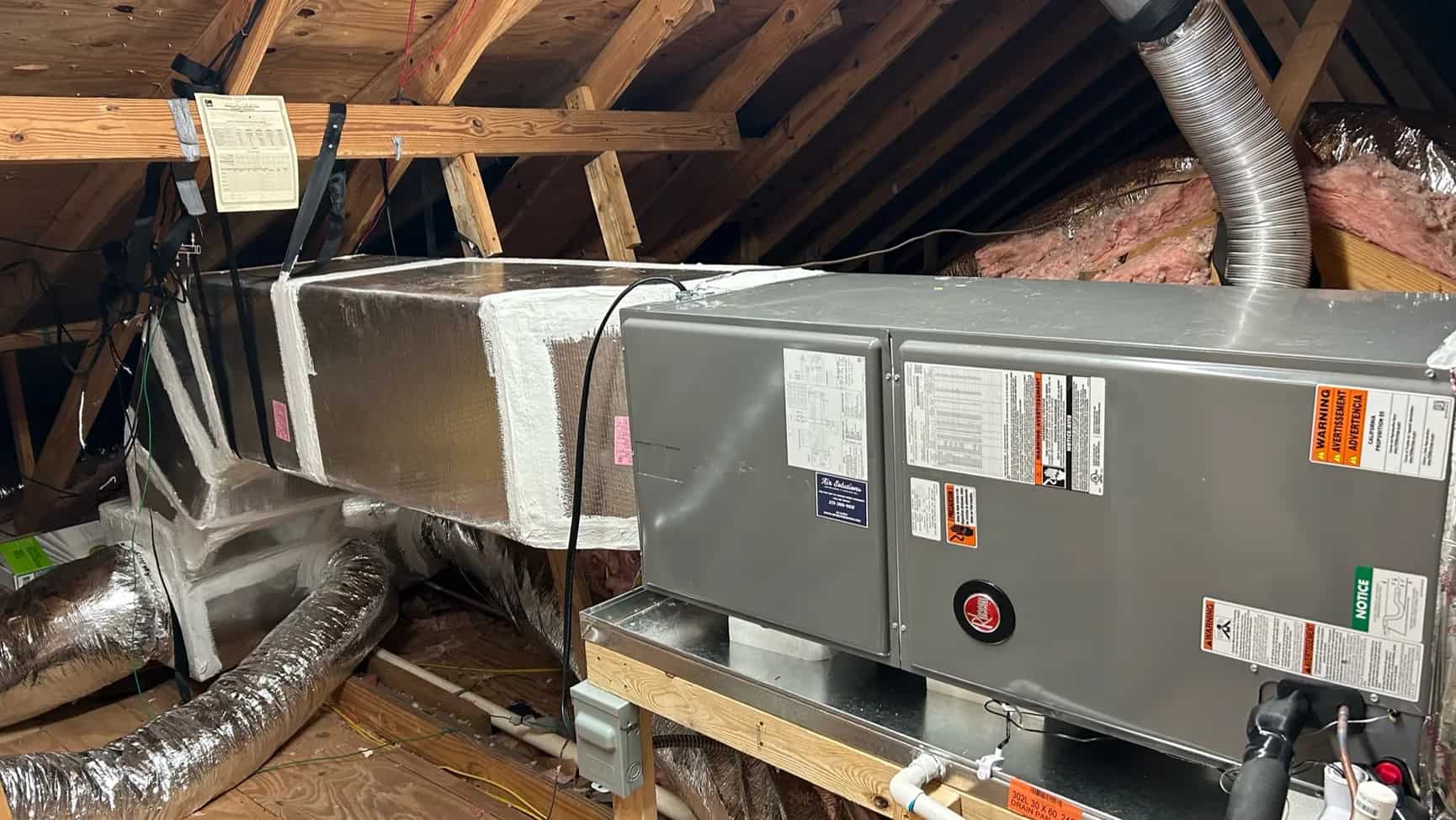
An indoor-air-quality job in Bon Secour starts with a visit, not a quote, because there is no way to size a dehumidifier or diagnose a moisture path from a phone call. What we want to see is the actual relative humidity in the space, where the envelope is leaking, whether the ductwork runs through an unconditioned crawl or attic and whether it is sealed, what the condensate path looks like, and whether the existing air conditioner is oversized — which is the single most common reason a house in this climate cools fine and still feels damp. An oversized system satisfies the thermostat quickly and shuts off before it has run long enough to pull meaningful water out of the air, and no amount of filtration fixes that.
Where a property sits changes what the assessment finds. Out toward Plash Island and along the open water of the Oyster Bay shoreline, the driver is exposure — wind-driven moisture and an envelope that has to work harder. Up in the newer subdivisions like Hidden Lakes, the more common story is a tight-ish house with ductwork run through a humid crawl and an air conditioner sized generously enough that it never runs long enough to dry the place out. The older village-core houses near the river are a third case again, where the envelope leaks enough that no amount of equipment wins until the leaks are dealt with. We cover the whole 36511 either way; the point is that the answer is not the same across it. Because IAQ assessments are scheduled rather than urgent, we book against the owner's availability, and for the seasonal-property owners who make up much of this market that usually means coordinating with a trip down rather than a service window. Tell us your arrival day and we will work to it.
One thing worth saying plainly: we don't offer duct cleaning as a standalone service. Plenty of companies will sell it as a recurring line item, and in most houses it is not the thing that will change your air. Sealing leaky ductwork so it stops pulling humid crawlspace air into the supply, right-sizing equipment so it actually dehumidifies, and adding real dehumidification capacity where the load calls for it are the interventions that move the number. Our 24/7 line is (251) 300-9817 and we are licensed in Alabama as AL#23194.
- Downtown Bon Secour
- the Bon Secour River waterfront
- Hidden Lakes at Bon Secour
- Whispering Oaks
- the Plash Island Road area
- the County Road 10 corridor
- the Oyster Bay shoreline
What we see on calls in Bon Secour.
Here is the combination that makes Bon Secour different. The 2022 ACS counts 1,208 housing units against 908 that are occupied — roughly 300 homes, close to a quarter of the stock, vacant at any given time. Plenty of Baldwin County beach markets run higher vacancy than that, but they are professionally managed rental inventory with somebody checking systems between bookings. Fish camps, river cabins, family places used a few weekends a season, second homes owned from somewhere inland. And among the units that are occupied, 87.8 percent are owner-occupied, which tells you this is not a professionally managed rental market with somebody checking systems between bookings. It is largely private owners with keys, and long gaps between visits.
Now put a closed-up house into a 3,059-cooling-degree-day climate at 6 meters of elevation surrounded by tidal marsh, and turn the air conditioner off to save money. Inside of a few weeks the indoor relative humidity climbs past 70 percent and stays there. Above roughly 60 percent sustained, the moisture content of the air is enough for mold to establish on any organic surface — drywall paper, upholstery, closet contents, the underside of a mattress, the back of a picture frame. Nothing dramatic happens on day one. The owner arrives in October, opens the door, and the house smells wrong. That musty odor is not a ventilation problem to be aired out; it is the smell of something already growing, and by the time it is detectable the colonization is established.
The other pattern we find in seasonally-closed Bon Secour houses is the dry P-trap. Every drain in an unoccupied home — sinks, showers, floor drains, the HVAC condensate trap — slowly evaporates its water seal over a few weeks. Once that seal is gone, the drain line is an open pipe from the sewer or septic into the house, and in a low-elevation area with a high water table that is both a smell problem and an air-quality problem. It is also trivially preventable, and almost nobody knows to do it. Pour a cup of water and a splash of mineral oil down each drain before you close the house up; the oil floats and slows the evaporation enough to hold the seal through a season.
- Mid-life equipment is the common profile in this area. Capacitor and contactor failures dominate the service-call mix.
- Long cooling season means compressors run heavy May through October. Annual maintenance pays for itself in compressor lifespan.
- Mild winters mean heat pumps cover the season comfortably without backup runtime in normal years. Cold-snap weeks expose undersized units.
Indoor Air Quality in Bon Secour — the questions that come up.
- What should I set the thermostat to when I close up my Bon Secour place for a few months?
- Do not switch it off. That is the single most expensive decision available, because remediating a mold problem costs many multiples of a season of setback cooling. What you want is a setback that holds humidity rather than temperature — most modern thermostats will let you set a humidity ceiling, and holding indoor relative humidity below about 55 to 60 percent is the actual goal. Practically, that usually means setting the temperature somewhere in the high seventies to around 80°F and letting the system cycle as needed to hold the humidity target. The house will not be comfortable to walk into, but it will be dry, and the runtime cost of holding 80°F is a fraction of holding 72°F. If your thermostat cannot control to humidity, a standalone whole-home dehumidifier on its own humidistat will do it more efficiently than running the AC colder to chase the same result.
- Is a whole-home dehumidifier actually worth it here, or is my AC enough?
- In a fully occupied, well-sized, continuously-run house, the air conditioner usually handles it. In a Bon Secour house that sits empty for stretches, a dedicated dehumidifier is often the better tool, and the reason is a mismatch between the two jobs. Your AC only dehumidifies while it is running, and it only runs when the space is warm enough to call for cooling. In the shoulder months — those spring and fall weeks when the air outside is pleasant but the bay is still throwing moisture at you — the thermostat is satisfied, the compressor barely cycles, and the humidity climbs with nothing fighting it. That shoulder-season gap is precisely when closed-up houses get into trouble. A whole-home dehumidifier runs on humidity rather than temperature, so it covers exactly the window the air conditioner does not. We install them ducted into the existing system, and they are the intervention we recommend most often in this specific community.
- The house smells musty when I open it up. Can you get rid of that?
- We can address what is causing it, and we should be straight with you about the boundary. That smell is microbial growth somewhere — usually in the ductwork, on an evaporator coil, in a drain pan, or in the building materials and contents themselves. What we do is find and fix the moisture path that let it happen: seal the ducts, correct the condensate drainage, right-size or supplement the equipment so the space actually stays dry, and add UV purification at the coil where the growth is happening on the equipment itself. What we are not is a mold remediation contractor. If there is visible growth on drywall, in insulation, or in the structure, that is a licensed remediation job and it needs to happen before or alongside the HVAC work, not instead of it. We will tell you honestly which situation you are in when we look at it, including when the answer is that you need somebody other than us first.
- My ductwork runs through a crawlspace. Does that matter more here than somewhere else?
- Considerably more, yes. At around 6 meters of elevation with a high water table and tidal water nearby, a Bon Secour crawlspace is a humid space — often close to saturated in summer. Every leak in a supply duct running through it is pulling that air into your conditioned envelope, and every leak in a return is doing the same in reverse. In a dry inland climate leaky ducts are mostly an efficiency problem. Here they are an air-quality problem, because the air being pulled in is loaded with moisture and whatever else is in the crawl. Duct sealing is usually the highest-return single intervention we can make on a house like this, and it frequently does more for the humidity number than adding equipment would. It is also worth looking at whether the crawlspace itself should be encapsulated — that is not HVAC work, but it is the right conversation to have at the same time.
- What IAQ equipment do you actually install?
- Whole-home dehumidifiers, air scrubbers, UV purification, ductwork sealing, and advanced filtration systems. Which of those makes sense depends entirely on what the assessment finds, and for most Bon Secour properties the honest answer is that dehumidification and duct sealing carry the load while filtration is secondary. Filtration addresses particulates — dust, pollen, dander — and it is worth having, but a good filter does nothing about water in the air, and water in the air is this community's actual problem. We would rather sell you the dehumidifier you need than the filter upgrade you do not. Note also that higher-MERV filtration adds static pressure to the system, so it is not a free upgrade; on an older blower it can reduce airflow enough to make comfort and coil performance worse. We check static pressure before recommending a filter change, not after.
Why storm history matters for indoor air quality in a low-elevation river community.
- Sep 2020 — Hurricane Sally: Sally's lasting air-quality legacy in low-lying river communities is not the wind damage, it is what got wet and how long it stayed wet. Water intrusion into wall cavities, insulation, and subfloor at 6 meters of elevation dries slowly in a climate with this dew point, and material that was wet for more than a couple of days frequently was never fully dried before it was closed back up. Buildings that took water in 2020 can still carry moisture-related issues inside the envelope years later, particularly where a repair went back over material that had not dried out.
- Sep 2004 — Hurricane Ivan: Ivan drove the rebuild wave that produced much of the current Bon Secour housing stock — ACS puts the median build year at 1999, and a substantial share of what stands today was repaired or reconstructed in the years after. That matters for air quality because construction practice in that period often prioritized speed, and crawlspace vapor barriers, duct sealing, and envelope detailing were frequently the corners cut. A lot of what we find as a duct-leakage or crawlspace-moisture problem today traces back to how fast the work had to happen then.
- Jan 2024 — Hard-freeze week: The freeze itself is an air-quality event in a community with this vacancy rate, because a burst supply line in an unoccupied house can run for days before anyone knows. Water into an empty, unheated structure in this climate is close to a worst case — it will not dry on its own, and it typically goes undiscovered until the next visit. For seasonally-closed Bon Secour properties, a freeze-season plan matters as much as a hurricane-season one, and a connected sensor is the cheapest part of it.
What Bon Secour customers can claim.
- Which electric utility serves a Bon Secour address depends on the parcel. Riviera Utilities dominates immediately north toward Foley and Baldwin EMC dominates immediately south toward Gulf Shores, and the 36511 sits across the seam. We do not assume one or the other on your behalf; the provider named on your statement is the one whose programs apply.
- Worth setting expectations on rebates specifically for indoor-air-quality work: utility efficiency programs are generally built around high-SEER cooling and heat pump equipment, because those are what move measurable kilowatt-hours. Standalone dehumidifiers, filtration upgrades, UV purification, and duct sealing usually fall outside those menus even though duct sealing in particular has a real efficiency benefit. Occasionally a duct-sealing or weatherization program exists separately — ask your provider directly rather than assuming either way.
- If IAQ work is bundled into a full system replacement at a qualifying efficiency tier, the equipment portion may qualify under whichever program serves your meter. Confirm the current terms with the utility before budgeting a figure, and take any federal-credit question to your tax preparer for the year the equipment is placed in service.
Indoor Air Quality Coverage Map — Bon Secour, Alabama
Centered near Bon Secour for orientation. Air Solutions Heating & Cooling provides indoor air quality throughout every Bon Secour neighborhood and zip code, plus the surrounding Baldwin County area. Same crew, same number — we travel the whole county.
353+ Five-Star Reviews. And Counting.
“Jacob arrived as scheduled and completed the service quickly and efficiently despite the severely adverse conditions working in the attic in extreme heat and humidity.”
Schedule Indoor Air Quality in Bon Secour.
Dehumidifiers, air scrubbers, UV purification, ventilation. Same-day appointments most weekdays in Bon Secour and surrounding Baldwin County. Tell us when works for you — we'll confirm by phone during weekday office hours (8 AM-4 PM).
Need someone right now? Call (251) 300-9817 — our 24/7 emergency line is answered live when we can and returned quickly when we can't.
Indoor Air Quality in Bon Secour — FAQs
Why is indoor air quality such a big deal on the Gulf Coast?
Baldwin County's outdoor humidity averages 75% annually and peaks above 90% on summer mornings. Indoor humidity tracks outdoor humidity, and at 60%+ indoor RH, problems start: dust mite populations explode, mold can germinate on indoor surfaces, wood furniture warps, and that distinctive 'musty house' smell appears. Getting indoor RH into the 40-55% range solves most indoor air quality complaints — and that's primarily an HVAC engineering problem, not just a 'buy an air purifier' problem.Do I need a whole-house dehumidifier in Baldwin County?
Probably not if your AC is properly sized and maintained — a right-sized AC removes plenty of moisture during normal cooling cycles. You DO benefit from a whole-house dehumidifier if: (1) your home is tight new construction where AC doesn't run long enough to dehumidify, (2) you have a vacation rental that sits at higher setpoints during vacancy, (3) you have chronic mold complaints despite good cooling, or (4) you have indoor pools/spas/large fish tanks adding moisture continuously. We provide a written estimate before any work begins.Are UV-C lights worth installing on my HVAC system?
Coil-mounted UV-C lights are genuinely useful in Baldwin County's humidity — they keep evaporator coils and drain pans biologically sterile, preventing the musty smell that humid climates produce. Worth considering for homes with chronic supply-vent odor or vacation rentals. We provide a written estimate before installation. The marketing claims about UV killing airborne pathogens are overstated; airflow is too fast for meaningful kill rates. For air sterilization, better filtration is more cost-effective.Do you service all of Bon Secour, AL?
Yes — Air Solutions Heating & Cooling covers every neighborhood and zip code in Bon Secour, Alabama — including Downtown Bon Secour, the Bon Secour River waterfront, Hidden Lakes at Bon Secour, plus the surrounding subdivisions and rural roads. We handle AC repair, AC installation, AC maintenance, emergency HVAC, and commercial HVAC. Standard service hours weekdays, 24/7 emergency response, and same-day appointments most of the year. Call (251) 300-9817 to schedule.What HVAC issues are most common in Bon Secour?
Homes around the Bon Secour River most commonly call us for refrigerant leaks (often salt-air or coil corrosion related on the Gulf Coast), undersized air conditioning systems struggling with Baldwin County summer humidity, and capacitor failures during peak load between June and September. A Cool Club bi-annual maintenance plan catches most of these issues before they cause a breakdown.
Indoor Air Quality Near Bon Secour.
Right at the Bon Secour city limit? We service the surrounding Baldwin County communities on the same routes — same crew, same response times.
Related HVAC Guides.
Long-form articles about indoor air quality and Baldwin County HVAC, with practical advice from our team.
 Indoor Air Quality
Why Your Gulf Shores House Is Humid Even When the AC Runs All Day
Cool but sticky? Here's why your Gulf Shores, AL home stays humid in summer even with the AC running constantly — and the real fixes that work.
August 31, 20265 min Indoor Air Quality
Mold Prevention Starts With Your HVAC in Baldwin County
Most household mold in Baldwin County starts inside the air conditioner. Where it grows, the warning signs, the fan-On trap, and the prevention plan that keeps it out.
June 8, 20267 min Indoor Air Quality
Why Your HVAC Smells Musty Across Baldwin County
A musty AC smell is your system losing the humidity fight. How to read the pattern, why it differs across Baldwin County, and when it's time to call a pro.
June 8, 20267 min
Other services in Bon Secour & this service across Baldwin County.
- All HVAC services in Bon Secour, AL
- Indoor Air Quality across Baldwin County
- AC Repair in Bon Secour
- AC Installation in Bon Secour
- AC Maintenance in Bon Secour
- Commercial HVAC in Bon Secour
- Emergency HVAC in Bon Secour
- Heating Repair in Bon Secour
- Heat Pump Services in Bon Secour
- Ductless Mini-Splits in Bon Secour
- Heating Installation in Bon Secour
Indoor Air Quality in Bon Secour — Schedule Today.
Same-day appointments most weekdays. Cool Club members get prioritized scheduling.