
Mold Prevention Starts With Your HVAC in Baldwin County
Most household mold in Baldwin County starts inside the air conditioner. Where it grows, the warning signs, the fan-On trap, and the prevention plan that keeps it out.

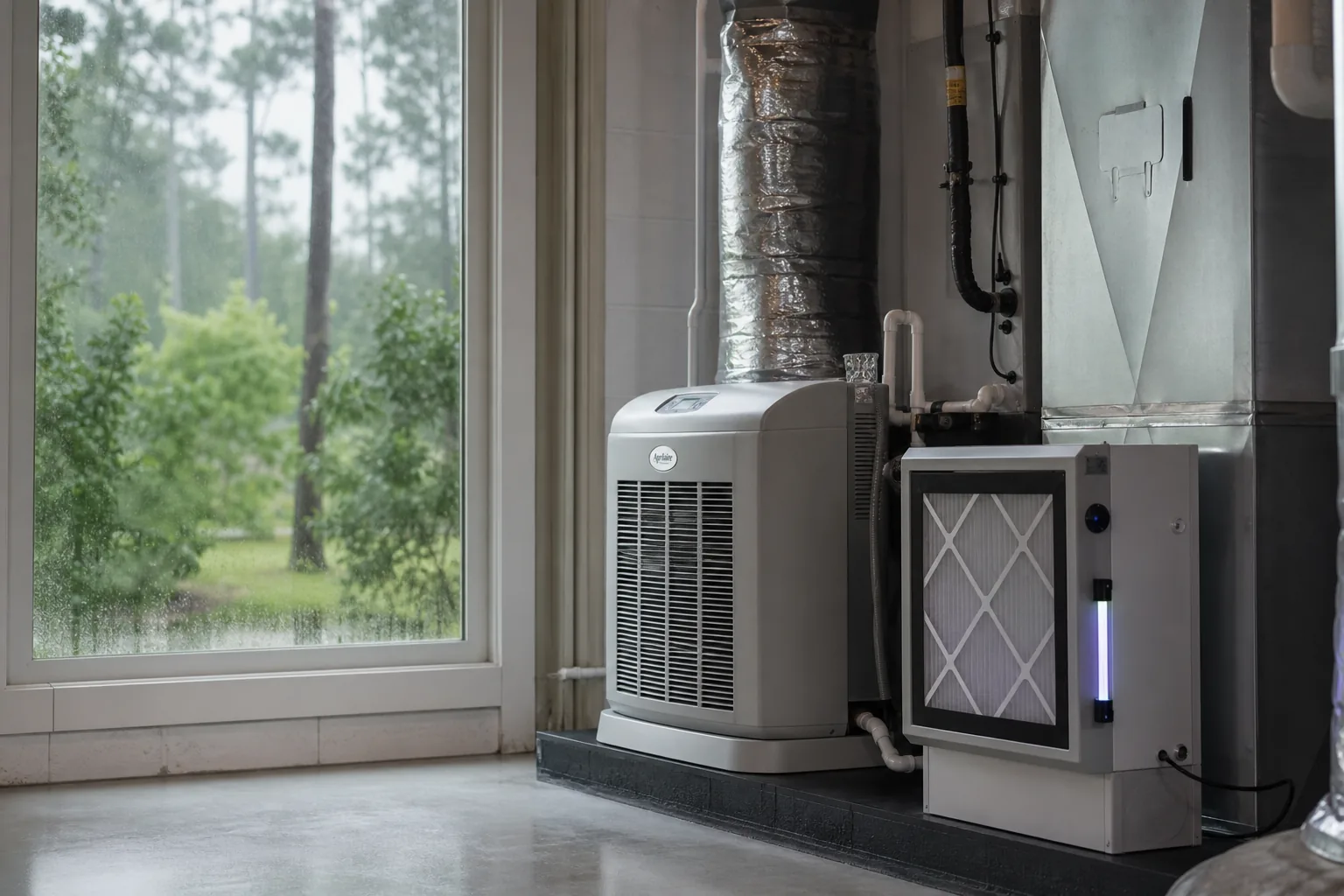
When folks call me about mold, they start with the bathroom grout or the closet wall. Fair enough — that's where you can see it. But after enough years crawling around Daphne and Baldwin County attics, I'll tell you where the trouble usually starts, and it's not the grout. It's the air conditioner. The machine you run all day to stay comfortable is also the dampest, darkest, best-fed spot in your house, and when it's neglected it turns into a mold factory that seeds the rest of your rooms through the ductwork. Before you buy bleach for the bathroom, let me show you what's happening inside the system.
Mold only needs three things — and you can only control one
Mold is not complicated. It needs three ingredients to grow: moisture, warmth, and something organic to eat. That's it. Down here on the Gulf Coast, two of those three are a lost cause. Warmth? We've got eight months of it. Organic food? Every speck of dust, pollen, skin, and pet dander that rides through your return is a buffet — and mold isn't picky. The fiberglass and adhesives inside your equipment will do in a pinch too.
That leaves moisture. Moisture is the only one of the three you actually get a vote on, which is the whole reason this article exists. Take the water away and the other two don't matter — the colony starves. Leave the water sitting and you've handed it everything it needs.
Here's the number worth taping to the fridge. The EPA says indoor relative humidity should stay below 60 percent, and ideally land between 30 and 50 percent. Now look at what's happening outside: a Baldwin County summer routinely runs 80 to 90 percent outdoor humidity, day after day, and the air rolling off Mobile Bay keeps it that way well into the fall. That gap — pulling the air from swamp-level down into the safe zone — is a job your air conditioner does every single time it runs. When it does that job, it's protecting you from mold. When it can't, it stops being the cure and becomes the cause.
Where does mold actually live inside your system?
People are always surprised when I open up a return or pop the access panel and show them. Mold in an HVAC system clusters in three predictable spots, and knowing them tells you exactly where the moisture is pooling.
The evaporator coil
This is the cold heart of the indoor unit, and it's wet by design — warm house air hits the cold fins, water condenses out, and that's how your AC dehumidifies. A clean coil sheds that water fast. A coil furred with dust holds it, and damp dust on cold metal in the dark is the single most reliable place to grow mold in your entire house.The condensate drain pan and line
All that water the coil pulls out has to go somewhere. It drips into a pan and runs out a drain line. When that line clogs — and in our humidity they clog constantly with algae and slime — the pan fills and just sits there. Standing water inside a warm, dark cabinet is a mold incubator with a lid on it. This is the one I find most often.The ductwork, especially in the attic
Cold supply air moving through ducts that sit in a 130-to-140-degree attic sweats on the outside and sometimes the inside. Any duct with a loose seal, missing insulation, or a low sag that traps condensation will grow mold on its inner lining, and then your blower distributes those spores to every room on the run.
Notice the pattern: every one of those spots is a place where water is supposed to move and instead is standing still. Mold doesn't grow in the water that's flowing out your drain line on schedule. It grows in the water that got stuck — which is also why a leaking AC almost always traces back to that drain line, and why duct mold gets its own deeper Gulf Coast guide.
The signs you've already got it
You usually smell mold before you ever see it, because most of it is hidden inside equipment you never open. Here's what tips me off on a service call, roughly in the order homeowners notice them.
The tells, in plain terms:
- A musty, sour, or "dirty sock" smell that's strongest in the first minute or two after the system kicks on. That blast of stale air is coming straight off the coil.
- Symptoms that track your AC, not the weather. Stuffy nose, itchy eyes, a scratchy throat, or a nagging cough that's worse indoors with the AC running and eases when you leave the house.
- Visible specks at the supply registers — black, gray, or greenish flecking on the vent louvers or the ceiling around them. If it's reached the register, it's well established inside.
- A drain line that's backed up or a pan with standing water, which you might only discover when the safety float shuts your system off on a 95-degree afternoon.
If two or three of those line up, you don't have a bathroom problem. You have an HVAC problem.
The fan-On trap that quietly undoes everything
This one costs people more than they realize, and it's a thermostat setting most folks have never thought about. Your fan has two modes: Auto and On.
On Auto, the blower only runs when the system is actively cooling. The moment cooling stops, the fan stops, and the water clinging to that cold coil gets a chance to drip down and drain away like it's supposed to.
On On, the blower runs nonstop, even between cooling cycles. Sounds harmless — more air movement, right? But here's the catch: when the compressor cuts off, the coil is still soaking wet, and now you've got a fan blowing warm house air across it 24/7. That doesn't drain the water. It re-evaporates it and pushes that moisture right back into your house, raising your humidity instead of lowering it. You've turned your dehumidifier into a little fountain.
This ties straight into a bigger truth about how your equipment behaves. A right-sized AC that runs in long, steady cycles wrings a lot of water out of the air. An oversized one that short-cycles — blasts cold for five minutes, slams off, repeats — barely runs long enough to dehumidify at all, so it leaves your house cool but clammy and damp. If you want the full picture on how sizing and runtime drive your humidity, we get into it here:
When the HVAC is working FOR you vs. against you
Same machine, two completely different outcomes. The difference is entirely down to whether the moisture path is clean and the system is set up right. Here's how to tell which side of the line yours is on.
| Component | Working FOR you | Working AGAINST you |
|---|---|---|
| Evaporator coil | Clean fins shed condensation fast, no biofilm | Dust-caked fins hold water, mold takes root on the buildup |
| Condensate drain | Line flows clear, pan stays dry between cycles | Clogged line, pan holds standing water, incubates spores |
| Fan setting | Auto — coil drains between cooling cycles | On — warm air re-evaporates coil water back into the house |
| Cycle length | Long, steady runs that pull real moisture out | Short-cycling leaves the air cool but clammy and damp |
| Attic ductwork | Sealed and insulated, no condensation inside | Loose seals and bare ducts sweat and grow duct mold |
The prevention plan that actually keeps it out
None of this is exotic. Keeping mold out of your HVAC comes down to keeping the moisture moving and the system clean. Here's the plan I'd give my own family.
Twice-a-year professional maintenance, spring and fall. This is the backbone, and it's not about a glance and a handshake. A real visit means the coil gets cleaned so it sheds water instead of holding it, and the condensate drain gets flushed clear so the pan never stands full. Those two tasks alone shut down the two most common mold sites in your system. Our Cool Club members get two tune-ups a year built in, plus 15 percent off any repairs and priority scheduling when the heat breaks something — it exists precisely so this stuff happens on a schedule instead of after the smell shows up.
Seal and insulate your attic ductwork. If your ducts run through that 130-to-140-degree attic — and in most Baldwin County homes they do, from the older streets around Olde Towne Daphne to newer builds in Jubilee Farms — getting them properly sealed and insulated stops the condensation that breeds duct mold. It's also one of the bigger comfort and efficiency upgrades most homes here are missing.
Consider a whole-home dehumidifier if your system can't keep up. Some homes — tight new construction, big open floor plans, places with humidity that won't quit even when the AC runs right — need help the air conditioner alone can't give. A dehumidifier installed inline with your HVAC holds the whole house in that safe sub-60-percent zone regardless of what the AC is doing. If your house stays muggy with the AC running, it's worth understanding why a house stays humid even when the system works and whether a whole-home dehumidifier is the right call on the Eastern Shore.
Ask about UV germicidal lights for the coil. A UV light mounted to shine on the evaporator coil sterilizes the surface continuously, killing mold and bacteria before they can establish on the one spot that's always wet. It's not a substitute for cleaning, but on a system that keeps growing biofilm, it's a real layer of insurance.
One more thing while we're here: your filter is part of this too. The right filter keeps the dust load off your coil — which is half the mold's food supply — without choking your airflow, and how often you change it on the Gulf Coast matters more here than the box suggests. We sort out what actually works in our humidity here:
Bottom line
Mold in a Baldwin County home is usually a moisture problem, and the moisture problem usually lives inside your air conditioner. You can't beat our heat or our dust, but you absolutely control the water — and your HVAC system is the machine that controls it for you, as long as the coil is clean, the drain runs clear, the fan's on Auto, and your attic ducts aren't sweating. Stay on top of those and the air conditioner stays your best defense. Let them slide and it becomes the source. Twice-a-year maintenance is what keeps it on the right side of that line, and it's a whole lot cheaper than the alternative.
If you're smelling something musty or you just want eyes on the system before the worst of summer hits, here's how to get us out:
- Schedule an HVAC and indoor-air-quality assessment and we'll find the source, not just the symptom.
- Call us at (251) 300-9817 — we're locally owned, Alabama-licensed, and answer 24/7.
- Explore our indoor air quality services for coil cleaning, drain service, UV lights, dehumidifiers, and whole-home solutions.
Related resources
- Controlling Indoor Humidity on the Gulf Coast: Dehumidification and Ventilation
- Do You Need a Whole-Home Dehumidifier in Baldwin County?
- MERV Ratings, HEPA Filters, and What Actually Works in Gulf Humidity