
Indoor Air Quality in Fairhope.
Local indoor air quality in Fairhope, Alabama and surrounding Baldwin County. Dehumidifiers, air scrubbers, UV purification, ventilation. Licensed AL#23194. 353+ five-star reviews. Call (251) 300-9817.
Get a Free Estimate
Name and phone is all we need to call you back. Takes ~20 seconds.
353+ five-star reviews · Same-day · 24/7 · Licensed AL#23194
What indoor air quality looks like in this climate.
Fairhope sits at roughly 39 meters of elevation on the Eastern Shore with Mobile Bay running the western edge of town, and the per-coordinate ERA5 reanalysis for 2023 puts the local climate load at about 3,032 cooling degree days against 1,045 heating degree days. An average July high near 90°F and an average January low around 51°F describe a cooling season that runs eight to nine months and a winter that never really shuts off the latent-load conversation. For an indoor-air-quality assessment that asymmetry is the entire story: a Fairhope system has to manage moisture for almost three quarters of the calendar year, and the dew point on a typical August afternoon sits in the mid-70s with overnight lows that rarely drop the dew point below the low 60s even into October.
Two seasonal layers add to the baseline humidity load in a way Fairhope feels more than its neighbors. The mature live oak canopy across the Fruit-and-Nut District, the older Magnolia Avenue blocks, and the pier-adjacent streets produces a heavy oak-pollen wave from mid-March into late April, followed by pine-pollen weeks in early summer and an autumn cycle of leaf and acorn debris that finds its way into outdoor coils and return-side intakes through November. Layered on top of that, the Scenic 98 frontage along the bay puts a brackish-air signature on the western edge of town — not the open-Gulf salt spray that hits Orange Beach or Fort Morgan, but a measurable saline aerosol that moves up the bluff on the afternoon sea breeze and back across town on the overnight return flow. The combined humidity, pollen, and salt-air load is what makes indoor air quality an ongoing engineering problem here rather than a one-time install.
Every Fairhope neighborhood, every zip.
Indoor-air-quality work at a Fairhope address is the kind of project where the short drive from the Daphne shop genuinely changes the visit economics. The OSRM-verified route up Highway 98 or Scenic 98 is about 6.2 miles and runs roughly 12 minutes in normal traffic — Fairhope sits inside the three closest service-area cities alongside Daphne and Montrose. For an IAQ engagement that typically unfolds across two visits (a diagnostic assessment, then an install if the homeowner moves forward), the proximity means we can book the assessment within the week and return for the install work without the road time dominating the schedule. Coverage spans both Fairhope ZIPs, 36532 and 36559, reaching the Fruit-and-Nut District and the older blocks downtown, the pier-area cottages, Quail Creek and Rock Creek, Audubon Place, Stone Creek, Old Battles Village, Lakewood Club Estates, Battle's Trace at the Colony, The Waters at Fairhope, and the Scenic 98 frontage running south toward Battles Wharf and Point Clear.
What an IAQ-focused homeowner in Fairhope usually wants from the assessment visit is not a sales pitch on whichever accessory carries the biggest margin — it is documentation. Indoor relative humidity measured at multiple stations, return-side static pressure read across the existing filter, coil and condensate-line inspection photographs, chase moisture observations on the older homes, and a written recommendation document that lays out what would actually move the needle on this specific house. We bring that to the consultation by default because the long-tenure owners who anchor the Fairhope market read the documentation, ask the follow-up questions, and want the technical justification spelled out before any work gets scheduled. For 24/7 emergency situations the line at (251) 300-9817 handles after-hours calls, but the honest reality on IAQ specifically is that chronic indoor humidity and chase moisture do not benefit from a 2 AM site visit; we return the IAQ-flagged voicemails the same business morning and book the assessment for a scheduled window that lets us do the work properly. Cool Club membership covers the two annual professional tune-ups plus 15% off all AC repairs and 5% off new systems, and IAQ accessory installs commonly stack onto the spring or fall maintenance visit window.
- Point Clear
- Battles Wharf
- Quail Creek
- Rock Creek
- Audubon Place
- The Fruit and Nut District
- Stone Creek
- Old Battles Village
- Battle's Trace at the Colony
- The Waters at Fairhope
- Lakewood Club Estates
What we see on calls in Fairhope.
The recurring IAQ failure mode in the historic Fairhope housing stock — the Fruit-and-Nut District cottages, the older blocks off Section Street, the 1920s and 1930s heart-pine homes along Magnolia Avenue — is the retrofit ductwork chase. These houses were built half a century before central air conditioning, and the chases that carry supply and return runs were cut through plaster walls and unconditioned crawl spaces during a post-war retrofit window where vapor barriers and chase sealing simply were not part of the standard. The chase cavities now act as moisture traps inside the building envelope. Humid Eastern Shore air infiltrates the chase from the crawl space, condenses against the cooler supply-duct surfaces during summer operation, and re-emerges as the chronic musty-vent smell at the supply registers. Ductwork sealing on these properties is a real intervention with measurable IAQ benefit; one-time duct cleaning is not, and we say so plainly because the duct-cleaning industry has a poor track record on durable improvement once the chase moisture pathway is left in place.
The other three Fairhope-specific patterns sit alongside the historic-chase issue. The live-oak canopy across the older neighborhoods loads return-side air filters two to three times faster than baseline weeks during the spring pollen surge and during the autumn leaf-and-acorn fall, and the same canopy contributes to outdoor coil debris on the condenser side that drives indoor cooling capacity down precisely when the system needs to be pulling moisture out of the air most aggressively. The Scenic 98 bayfront corridor — the pier blocks, Audubon Place, Battles Wharf, and the bayside lots running south toward Point Clear — sees salt-air ingress through outdoor-air intakes, leaky window frames, and any positive-pressure ventilation pathway, which loads MERV filtration on a faster cadence and accelerates aluminum-fin corrosion on the outdoor coil over a ten-year horizon. And the tight new construction in Battle's Trace at the Colony, The Waters at Fairhope, Old Battles Village, and the post-2010 builds along Greeno Road produces the opposite problem: building envelopes designed for thermal efficiency that incidentally trap indoor pollutants because mechanical ventilation was not engineered into the original install. Our IAQ service catalog covers whole-home dehumidifiers, air scrubbers, UV purification, ductwork sealing, and advanced filtration systems, and we do not offer duct cleaning as a standalone service.
- Mid-life equipment is the common profile in this area. Capacitor and contactor failures dominate the service-call mix.
- Long cooling season means compressors run heavy May through October. Annual maintenance pays for itself in compressor lifespan.
- Mild winters mean heat pumps cover the season comfortably without backup runtime in normal years. Cold-snap weeks expose undersized units.
Indoor Air Quality in Fairhope — the questions that come up.
- Our Fruit-and-Nut District house sits under a heavy live-oak canopy and the spring pollen wave is brutal. What MERV filter strategy actually works here?
- The working range on an Eastern Shore residential system runs from MERV 8 at the low end to MERV 13 at the upper end, but the right answer for a Fruit-and-Nut canopy property usually has more to do with the filter cabinet geometry than with the MERV number itself. A 1-inch filter slot running MERV 13 produces a static-pressure drop that an older Fairhope air handler can't push through cleanly — the airflow falls, the dehumidification capacity drops with it, and the system risks overheating the blower motor on a continuous-runtime summer day. The durable fix on a heavy-canopy property is a 4-inch media cabinet retrofit, which lets you run MERV 11 or MERV 13 with a much lower pressure drop and stretches the replacement cadence from monthly to roughly quarterly. We measure the actual return-side static pressure during the assessment and recommend a filter type, MERV rating, and replacement cadence that puts your specific system inside spec rather than guessing at a generic answer.
- I have a 1925 cottage near Section Street with retrofit ductwork running through the crawl space. The supply registers smell musty in summer. What can be done short of replacing all the ductwork?
- The musty-supply-register smell on a Fruit-and-Nut historic cottage is almost always tied to the retrofit duct chase rather than to a coil or condensate problem at the air handler. The chase cavity traps humid crawl-space air, that humid air condenses against the cooler supply-duct surface during cooling-mode operation, and the moisture eventually reaches the airstream and produces the smell at the register. Ductwork sealing — pressure-testing the duct system, identifying the leak points, and sealing the chase-side leaks with mastic or aerosolized sealant where the geometry allows — is a legitimate intermediate intervention that can produce a meaningful improvement without the tear-out of a full replacement. Where the inner duct liner has already deteriorated past the point where sealing can recover, full replacement becomes the durable answer. We assess which is appropriate on a per-house basis rather than defaulting to the more expensive recommendation. To be explicit on what we don't do: we don't offer duct cleaning as a standalone service, because one-time cleaning has a poor track record once the underlying chase-moisture pathway is left in place.
- What size whole-home dehumidifier makes sense for a 2,800-square-foot Fairhope home?
- Sizing comes off a latent-load calculation rather than a square-footage rule of thumb, because the building envelope tells the story more than the floor area does. For a 2,800-square-foot Fairhope home the inputs that actually matter are the year built and envelope tightness (a 1925 Fruit-and-Nut cottage and a 2018 Battle's Trace build present completely different latent profiles), the existing AC dehumidification performance measured at the coil under load, the indoor relative humidity baseline taken at multiple stations before any new equipment goes in, and the moisture-intrusion sources we identify during the assessment such as crawl-space vapor barrier condition and duct chase tightness. A typical Fairhope home in the mid-vintage band tends to need a unit somewhere in the 70-to-110-pints-per-day range to hold indoor RH at the 50-to-55 percent target. Tight Battle's Trace and Waters of Fairhope builds can sometimes run slightly lower; bayfront cottages with leaky envelopes run higher. Whole-home dehumidifier installations vary based on system size and installation complexity, and the project quote reflects the actual measured load rather than a tonnage chart.
- How often does a UV-C purification lamp need to be replaced, and does it really help on an older Fairhope home with retrofit ductwork?
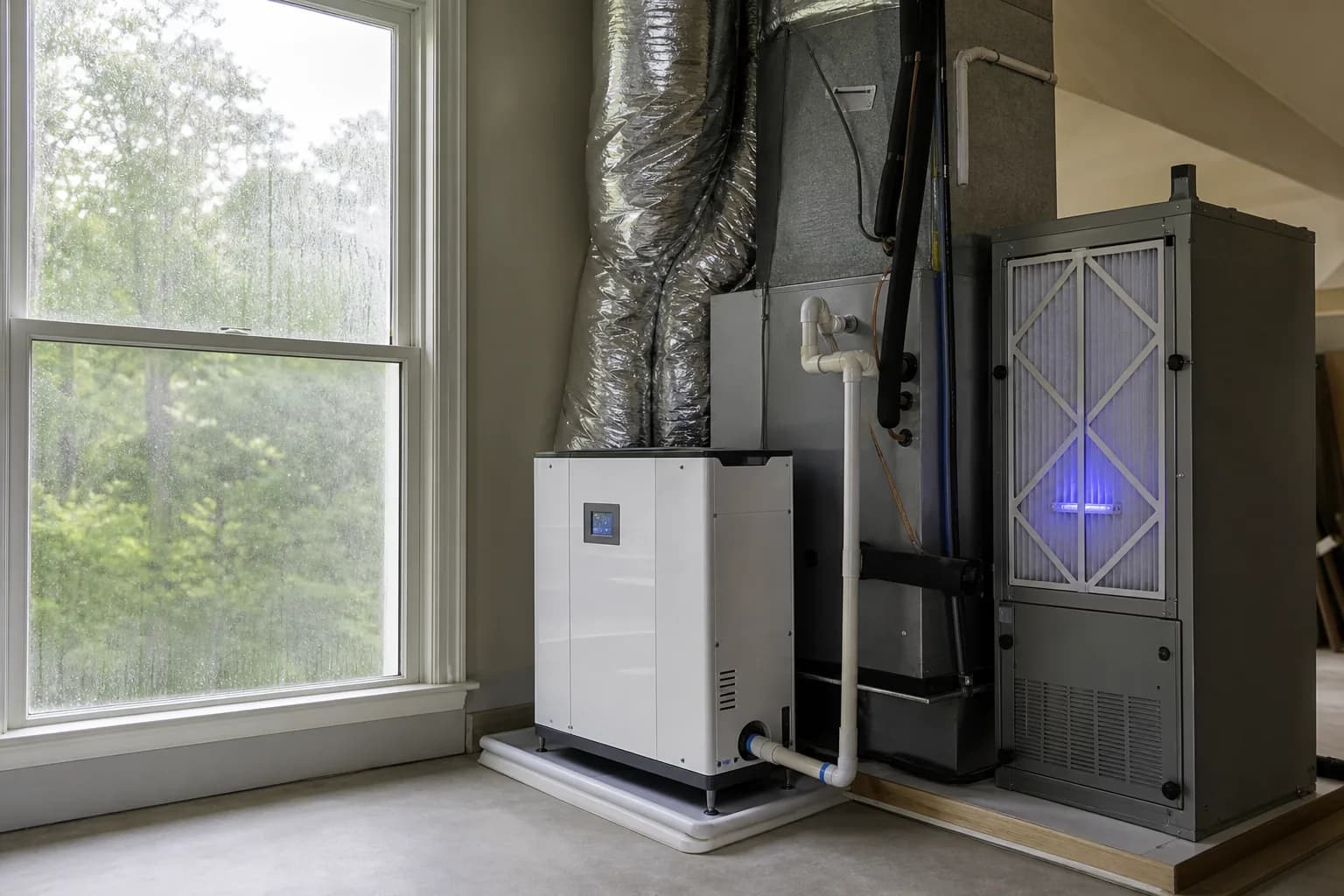
- UV-C lamps used for coil sterilization carry a rated effective-output life somewhere between 9,000 and 12,000 hours, which works out to roughly one calendar year of continuous duty regardless of whether the visible blue glow continues past that mark. The lamp keeps glowing well after its germicidal output has dropped below the useful threshold, which is why a calendar-based annual swap at the spring tune-up makes more sense than a wait-until-it-stops-glowing approach. As for whether UV-C actually helps on an older Fairhope home: yes, but the use case is more constrained than the marketing implies. UV-C is a coil-sterilization technology — installed downstream of the evaporator coil it suppresses biofilm regrowth on the coil surface and condensate pan, which is where most of the in-system biological growth that fuels the musty-vent smell originates. It does not capture pollen particles, sterilize air passing through the ducts at duct-passage time scales, or fix a duct chase that's leaking unconditioned humid air into the supply stream. UV-C is a legitimate part of a layered IAQ stack on a Fairhope retrofit; it isn't a substitute for ductwork sealing or filtration cabinet upgrades when those are the underlying issue.
- Our new house in Battle's Trace at the Colony is supposedly built tight to code. Do we need mechanical ventilation, and what does that look like?
- Tight-envelope construction in the Battle's Trace, Waters of Fairhope, and post-2010 Greeno Road subdivisions is generally good for the energy bill and indirectly challenging for indoor air quality. A sealed envelope retains less of the natural air-change rate that an older leaky cottage gets passively, which means cooking moisture, shower humidity, off-gassing from cabinetry and flooring, pet dander, and any biological growth in the wet-cavity spaces all accumulate at higher concentrations than they would in an older home. The engineering answer is mechanical ventilation built around the building envelope spec rather than retrofitted as an afterthought. The two practical approaches we see work on Fairhope new builds are a dedicated outdoor air system that supplies measured fresh air to the return side during compressor runtime, and a balanced energy-recovery ventilator that exchanges indoor stale air for outdoor fresh air while pre-conditioning the incoming stream against indoor temperature and humidity. The right choice for your specific house depends on the existing duct geometry, the blower-door test result if one was performed at commissioning, and the indoor RH baseline we take during the IAQ assessment. We size and recommend the approach during the assessment visit; we don't assume the same answer applies across every Battle's Trace address.
Weather events that have shaped the Fairhope indoor-air-quality call mix.
- Sep 2020 — Hurricane Sally — multi-month wall-cavity humidity release: Sally tracked into the western Baldwin shoreline with a slow-moving wind and rain field that pushed sustained moisture into Fairhope structures across both ZIPs. The IAQ aftermath outlasted the equipment aftermath by a wide margin: wall cavities and attic insulation that took on water during the storm continued to release humidity into living spaces for many months, and the older Fruit-and-Nut cottages with their retrofit chases held the moisture longer than the newer tight-envelope Battle's Trace and Waters of Fairhope builds did. Properties that came back online without an explicit drying-and-dehumidification protocol produced the chronic mold-smell complaints that stretched well into 2021. A documented post-storm IAQ assessment — wall-cavity moisture measurement at multiple stations plus an indoor RH baseline reading — is what separates a clean recovery from a multi-year problem.
- Jan 2024 — Multi-night sub-freezing stretch and dehumidifier power-cycling: Fairhope sat through a rare three-night sub-32°F stretch in mid-January 2024, with daytime recovery capped in the upper 30s — unusual for the Eastern Shore, which typically holds January overnight lows near the 50°F bay-moderation baseline the ERA5 record describes. The IAQ failure mode was not the freeze itself; it was the grid behavior. Multiple short-duration power restoration cycles across town produced an uptick in whole-house dehumidifier control-board faults and humidistat-controller failures on units that lost power mid-cycle, and on the homes where the dehumidifier was down for the recovery week, indoor RH climbed back into the biological-growth band even while heating cycles were running. The lesson for Fairhope homeowners since has been to put the dehumidifier and IAQ accessory load on the same surge-protected circuit category as the rest of the HVAC equipment.
- Aug 2023 — Heat-advisory week — indoor RH climb during continuous AC: Heat-index values above 105°F for the better part of a week stacked the Fairhope IAQ call mix toward addresses where the AC was running essentially continuously and indoor relative humidity was still climbing above 60%. The pattern showed up across all four Fairhope housing-stock layers — Fruit-and-Nut cottages, mid-vintage builds, post-2010 tight subdivisions, and bayfront homes along Scenic 98 — but the symptom presented differently in each. On the older cottages the chase moisture release made the upstairs bedrooms feel worse than the downstairs living spaces; on the tight new builds the entire envelope held humidity uniformly above the comfort threshold because the AC alone could not wring the latent load out fast enough. The mechanical answer in both cases is supplemental whole-house dehumidification, but the sizing math differs by building envelope.
- Annual (mid-March through early-May, again in late summer) — Live-oak and pine pollen weeks under the Eastern Shore canopy: The mature live oak canopy across the Fruit-and-Nut District, the older Magnolia Avenue blocks, and the pier-adjacent streets produces a heavy oak-pollen wave every spring with the worst weeks falling between mid-March and early May. A pine-pollen cycle layers on in late spring and early summer. Indoor IAQ complaints during those weeks cluster around insufficient filtration MERV rating, return-grille undersizing that limits how aggressively a higher-MERV filter can run without choking static pressure on the air handler, and return-side air leaks pulling unfiltered attic and chase air directly into the supply stream. The intervention is rarely just a more expensive filter — it is usually a 4-inch media cabinet upgrade, return-grille rework where the existing geometry is restrictive, and return-side air sealing on the older homes. The fall leaf-and-acorn cycle adds an outdoor-coil debris dimension that affects indoor capacity by reducing the system's ability to manage latent load.
What Fairhope customers can claim.
- Most Fairhope parcels inside the city limits run on Fairhope Public Utilities for electricity, natural gas, water, and sewer service, which puts all four utility relationships under a single municipal provider. A portion of outer-edge meters and recently-annexed parcels sit on Baldwin EMC for electric or on Riviera Utilities depending on the specific territory line; the fastest confirmation for an IAQ project is the provider name printed on a current power bill.
- Standalone IAQ accessories — whole-home dehumidifiers, UV-C lamp kits, media filtration cabinets, and dedicated outdoor air systems — are typically not on the utility-rebate menu the way a complete heat-pump replacement might be. Utility rebate frameworks are built around system-level kilowatt-hour efficiency thresholds rather than indoor-air-quality outcomes, so a dehumidifier or UV-C install on its own does not usually qualify for a direct rebate from FPU, Baldwin EMC, or Riviera Utilities. The practical exception is when the IAQ work bundles into a qualifying heat-pump replacement at the same install, in which case the system-level rebate covers the combined project.
- FPU program eligibility and dollar amounts shift year over year, and any specific rebate posture for the current quarter should be verified directly with FPU before counting an incentive into a project budget. The municipal utility is responsive to direct inquiries and the answer you get from FPU customer service on a current-quarter rebate is more reliable than a stale figure pulled from a contractor brochure.
- The federal Section 25C Energy Efficient Home Improvement Credit expired December 31, 2025. Pure IAQ accessory work — dehumidifiers, UV-C kits, media filtration — never qualified on its own regardless of when it was installed. For IAQ work bundled into a qualifying heat-pump replacement placed in service before the year-end 2025 deadline, the AHRI match certificate and commissioning documentation in the project folder are what a tax preparer needs to evaluate the 2025 return. New qualifying replacements in 2026 do not qualify for 25C; the FPU and Baldwin EMC residential programs remain the active incentive pathways.
Indoor Air Quality Coverage Map — Fairhope, Alabama
Centered near Fairhope for orientation. Air Solutions Heating & Cooling provides indoor air quality throughout every Fairhope neighborhood and zip code, plus the surrounding Baldwin County area. Same crew, same number — we travel the whole county.
353+ Five-Star Reviews. And Counting.
“Jacob arrived as scheduled and completed the service quickly and efficiently despite the severely adverse conditions working in the attic in extreme heat and humidity.”
Schedule Indoor Air Quality in Fairhope.
Dehumidifiers, air scrubbers, UV purification, ventilation. Same-day appointments most weekdays in Fairhope and surrounding Baldwin County. Tell us when works for you — we'll confirm by phone during weekday office hours (8 AM-4 PM).
Need someone right now? Call (251) 300-9817 — our 24/7 emergency line is answered live when we can and returned quickly when we can't.
Indoor Air Quality in Fairhope — FAQs
Why is indoor air quality such a big deal on the Gulf Coast?
Baldwin County's outdoor humidity averages 75% annually and peaks above 90% on summer mornings. Indoor humidity tracks outdoor humidity, and at 60%+ indoor RH, problems start: dust mite populations explode, mold can germinate on indoor surfaces, wood furniture warps, and that distinctive 'musty house' smell appears. Getting indoor RH into the 40-55% range solves most indoor air quality complaints — and that's primarily an HVAC engineering problem, not just a 'buy an air purifier' problem.Do I need a whole-house dehumidifier in Baldwin County?
Probably not if your AC is properly sized and maintained — a right-sized AC removes plenty of moisture during normal cooling cycles. You DO benefit from a whole-house dehumidifier if: (1) your home is tight new construction where AC doesn't run long enough to dehumidify, (2) you have a vacation rental that sits at higher setpoints during vacancy, (3) you have chronic mold complaints despite good cooling, or (4) you have indoor pools/spas/large fish tanks adding moisture continuously. We provide a written estimate before any work begins.Are UV-C lights worth installing on my HVAC system?
Coil-mounted UV-C lights are genuinely useful in Baldwin County's humidity — they keep evaporator coils and drain pans biologically sterile, preventing the musty smell that humid climates produce. Worth considering for homes with chronic supply-vent odor or vacation rentals. We provide a written estimate before installation. The marketing claims about UV killing airborne pathogens are overstated; airflow is too fast for meaningful kill rates. For air sterilization, better filtration is more cost-effective.Do you service all of Fairhope, AL?
Yes — Air Solutions Heating & Cooling covers every neighborhood and zip code in Fairhope, Alabama — including Point Clear, Battles Wharf, Quail Creek, plus the surrounding subdivisions and rural roads. We handle AC repair, AC installation, AC maintenance, emergency HVAC, and commercial HVAC. Standard service hours weekdays, 24/7 emergency response, and same-day appointments most of the year. Call (251) 300-9817 to schedule.What HVAC issues are most common in Fairhope?
Homes around the Pier most commonly call us for refrigerant leaks (often salt-air or coil corrosion related on the Gulf Coast), undersized air conditioning systems struggling with Baldwin County summer humidity, and capacitor failures during peak load between June and September. A Cool Club bi-annual maintenance plan catches most of these issues before they cause a breakdown.
Indoor Air Quality Near Fairhope.
Right at the Fairhope city limit? We service the surrounding Baldwin County communities on the same routes — same crew, same response times.
Related HVAC Guides.
Long-form articles about indoor air quality and Baldwin County HVAC, with practical advice from our team.
 Indoor Air Quality
Whole-House Dehumidifiers for Fairhope Summer Humidity: When Worth It
When whole-house dehumidifier installation makes sense in Fairhope, AL — costs, benefits, and the specific household profiles where the math works.
September 23, 20264 min Indoor Air Quality
Mold Prevention Starts With Your HVAC in Baldwin County
Most household mold in Baldwin County starts inside the air conditioner. Where it grows, the warning signs, the fan-On trap, and the prevention plan that keeps it out.
June 8, 20267 min Indoor Air Quality
Why Your HVAC Smells Musty Across Baldwin County
A musty AC smell is your system losing the humidity fight. How to read the pattern, why it differs across Baldwin County, and when it's time to call a pro.
June 8, 20267 min
Other services in Fairhope & this service across Baldwin County.
- All HVAC services in Fairhope, AL
- Indoor Air Quality across Baldwin County
- AC Repair in Fairhope
- AC Installation in Fairhope
- AC Maintenance in Fairhope
- Commercial HVAC in Fairhope
- Emergency HVAC in Fairhope
- Heating Repair in Fairhope
- Heat Pump Services in Fairhope
- Ductless Mini-Splits in Fairhope
- Heating Installation in Fairhope
Indoor Air Quality in Fairhope — Schedule Today.
Same-day appointments most weekdays. Cool Club members get prioritized scheduling.