
Why Your Gulf Shores House Is Humid Even When the AC Runs All Day
Cool but sticky? Here's why your Gulf Shores, AL home stays humid in summer even with the AC running constantly — and the real fixes that work.

Your Gulf Shores AC is running. The thermostat reads 73°F. But the house feels muggy — like the air is heavier than the temperature should suggest. Wood floors feel slightly tacky. Towels never quite dry. The bathroom mirror fogs after a quick shower. This is one of the most common summer complaints we get from homeowners in the Gulf Shores–Orange Beach–Fort Morgan corridor.
The diagnosis is almost always the same: your AC is cooling, but it's not dehumidifying enough. Here's why that happens specifically in Gulf Shores and what genuinely fixes it.
The split-personality of an AC system
A central AC does two jobs simultaneously: it removes heat (cooling) and it removes moisture (dehumidification). Both happen when warm humid indoor air passes over the cold evaporator coil. Heat transfers into the refrigerant; moisture condenses on the coil and drains away.
Those two jobs are correlated but not the same. An AC can satisfy the temperature setpoint without removing much moisture. That's exactly what happens in Gulf Shores summers — your system cools the air to 73°F and shuts off, but the air still carries 65% relative humidity because the system didn't run long enough to do the dehumidification work.
Three factors determine how much moisture your AC pulls out:
- Cycle length. Longer runs = more moisture removed.
- Coil temperature. Colder coils condense more moisture per pass.
- Airflow rate. Faster airflow leaves less time for moisture transfer.
In Gulf Shores, with summer dew points routinely hitting 72°F, the moisture load is enormous. Even a properly-sized AC has to work hard to keep up.
Why coastal Gulf Shores has it worse than inland
From the beachfront condos off Beach Boulevard to golf-course communities like Craft Farms and Kiva Dunes, the whole city sits in some of the most moisture-laden air on the Gulf Coast. Three local factors compound the problem:
1. Salt-air corrosion on indoor coils. Even with coastal-grade equipment, salt particles deposit on the indoor evaporator coil over years. The coil surface develops microscopic pitting that traps moisture and reduces effective heat transfer. Older coils dehumidify less effectively than new ones — your 8-year-old system near the water is doing 80-85% of its original moisture-removal capacity.
2. Vacation-rental cycles. If your Gulf Shores property is rented — common near Gulf State Park and out toward The Peninsula — the AC gets turned UP between guests to save energy and slammed back DOWN by guests on arrival. Short, aggressive cooling cycles cool the air without dehumidifying it. The wet coil never has time to drain fully before the next cycle, so the rental sits at 70% humidity even when the temperature looks fine on the thermostat.
3. Tighter modern construction. Newer Gulf Shores homes built since 2015, including much of Craft Farms North, are dramatically better air-sealed than older construction. That's great for energy bills but bad for natural humidity exchange — there's less leakage to dilute indoor moisture from outdoor air. Indoor humidity stays trapped.
The four interventions that actually work
Ranked roughly by impact-per-dollar:
1. Lower fan speed (free, immediate)
Most thermostats let you adjust fan-on time per cycle. Check your thermostat manual or smart-thermostat app:
- Set fan to AUTO (not ON) — this lets the wet coil drain between cycles
- Enable dehumidify-priority mode if your thermostat has it
- Lower fan speed in cooling mode if adjustable — slower airflow = more moisture removal per pass
Cost: free. Effect: 5-10% humidity drop for many Gulf Shores homes.
2. Verify AC sizing (mid-cost diagnostic)
An OVERSIZED AC is the single most common cause of humidity problems in coastal homes. Symptoms:
- House cools to setpoint quickly but feels clammy
- AC cycles on/off frequently (every 5-10 minutes)
- Indoor humidity sits at 60%+ during cooling season
- High utility bills relative to home size
If your system was sized by "rule of thumb" (1 ton per 500 sq ft) instead of a Manual J load calculation, it's probably oversized for our humid climate. Manual J accounts for actual heat load including humidity reality. A properly-sized system runs longer cycles, dehumidifies effectively, and keeps Gulf Shores homes comfortable.
If you discover oversizing, options:
- Add a variable-speed compressor (allows the existing equipment to run at part-load)
- Switch to a properly-sized smaller system at next replacement
- Add standalone dehumidification (the option below)
3. Add a whole-house dehumidifier (the real solution)
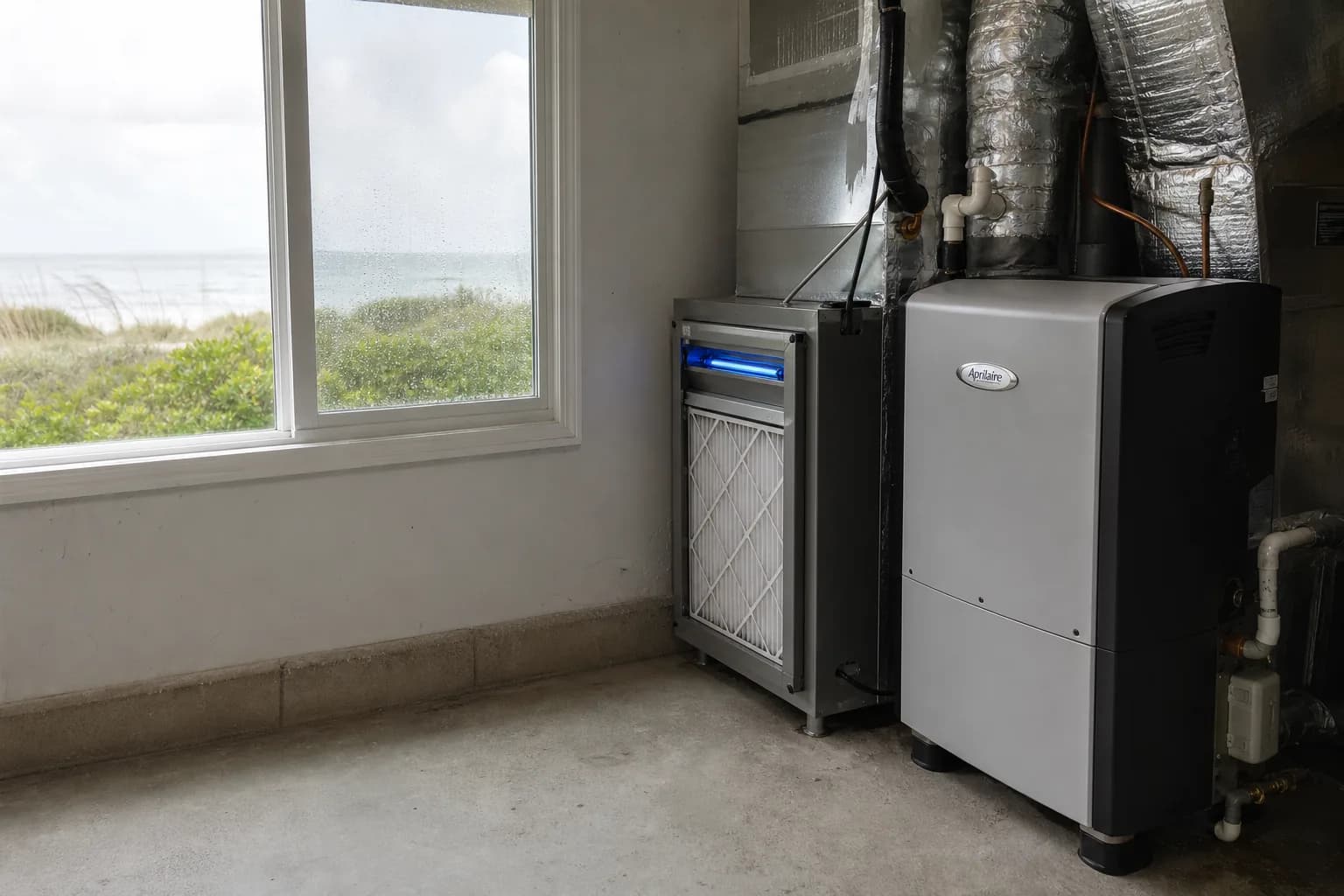
For Gulf Shores homes with chronic humidity issues, this is the highest-impact intervention available. A standalone dehumidifier integrates into your ductwork and maintains a humidity setpoint (typically 50%) regardless of what your AC is doing. The AC handles temperature; the dehumidifier handles moisture. Two specialized tools beat one general-purpose tool.
Specs to expect for a typical Gulf Shores home:
- Capacity: 70-95 pints per day for whole-house systems
- Configuration: ducted (integrated into your system) or standalone
- Lifespan: 10-15 years
- Operating draw: modest, with most of the cost showing up only during humid summer months
We'll give you a written estimate before any work starts, so you can weigh the investment against your situation. The math works for any household with chronic humidity complaints, particularly vacation rentals where guest comfort drives reviews.
4. Address coil cleanliness (annual)
A clean evaporator coil dehumidifies dramatically better than a fouled one. Salt-air aerosols, biological film, and dust accumulation all reduce effective coil surface area. If your coil hasn't been professionally cleaned in 2+ years, the dehumidification capacity loss is real and measurable.
Air Solutions includes coil cleaning in our standard maintenance visits.
What does NOT fix Gulf Shores humidity
A few things you'll see suggested that don't move the needle:
- Standalone dehumidifiers in single rooms. They lower humidity in that room only. The kitchen still feels muggy.
- Setting the AC colder. Lower setpoint runs the AC more but increases energy bills 20-30% with marginal humidity improvement.
- Closing vents to "force" longer runs. Creates static pressure issues that damage the blower over time. Net negative.
- Ceiling fans. Move air, feel cooler, but don't actually remove humidity.
How to test if you have a humidity problem
Buy an inexpensive hygrometer at any hardware store. Place it in your main living area for 24-48 hours. Read the values:
- Below 50%: Excellent. No intervention needed.
- 50-55%: Acceptable. Routine maintenance is enough.
- 55-60%: Borderline. Address the easy fixes (thermostat, coil cleaning).
- 60-65%: Real problem. Consider dehumidifier.
- 65%+: Active mold-growth conditions. Professional intervention required.
For Gulf Shores rental properties, a wifi-enabled humidity sensor with phone alerts is a worthwhile investment. You'll catch problems before guest complaints.
Ready to fix Gulf Shores humidity?
Air Solutions Heating & Cooling handles indoor air quality work across Gulf Shores, Orange Beach, and Fort Morgan — IAQ assessments, dehumidifier installation, coil cleaning, system upgrades. Locally owned, family-run, founded in Daphne, licensed AL#23194.
- Schedule an IAQ Assessment — pick a time
- Call (251) 300-9817 — same-day available
- Indoor Air Quality services — full overview
Related resources
- IAQ in Gulf Shores — city-specific service page
- All HVAC services in Gulf Shores — every service locally
- Service in nearby Orange Beach — the same coastal humidity profile
- The Field Guide — searchable HVAC library
More on coastal humidity and indoor air:
- Why is my house still humid with the AC running? — the same problem, diagnosed step by step
- Do you need a whole-home dehumidifier on the Eastern Shore? — the highest-impact fix, evaluated
- Beating Gulf Coast humidity: an Eastern Shore home comfort guide — the full coastal-humidity playbook
- Mold in your AC ducts: a Gulf Coast indoor air guide — what happens if humidity stays above 65%