
Heat Out on a Cold Night in Gulf Shores? What to Do First
Heat pump quit on a cold Gulf Shores night — or is it just defrosting? How to tell normal defrost from a real failure, first checks, the emergency-heat setting, and when to call.

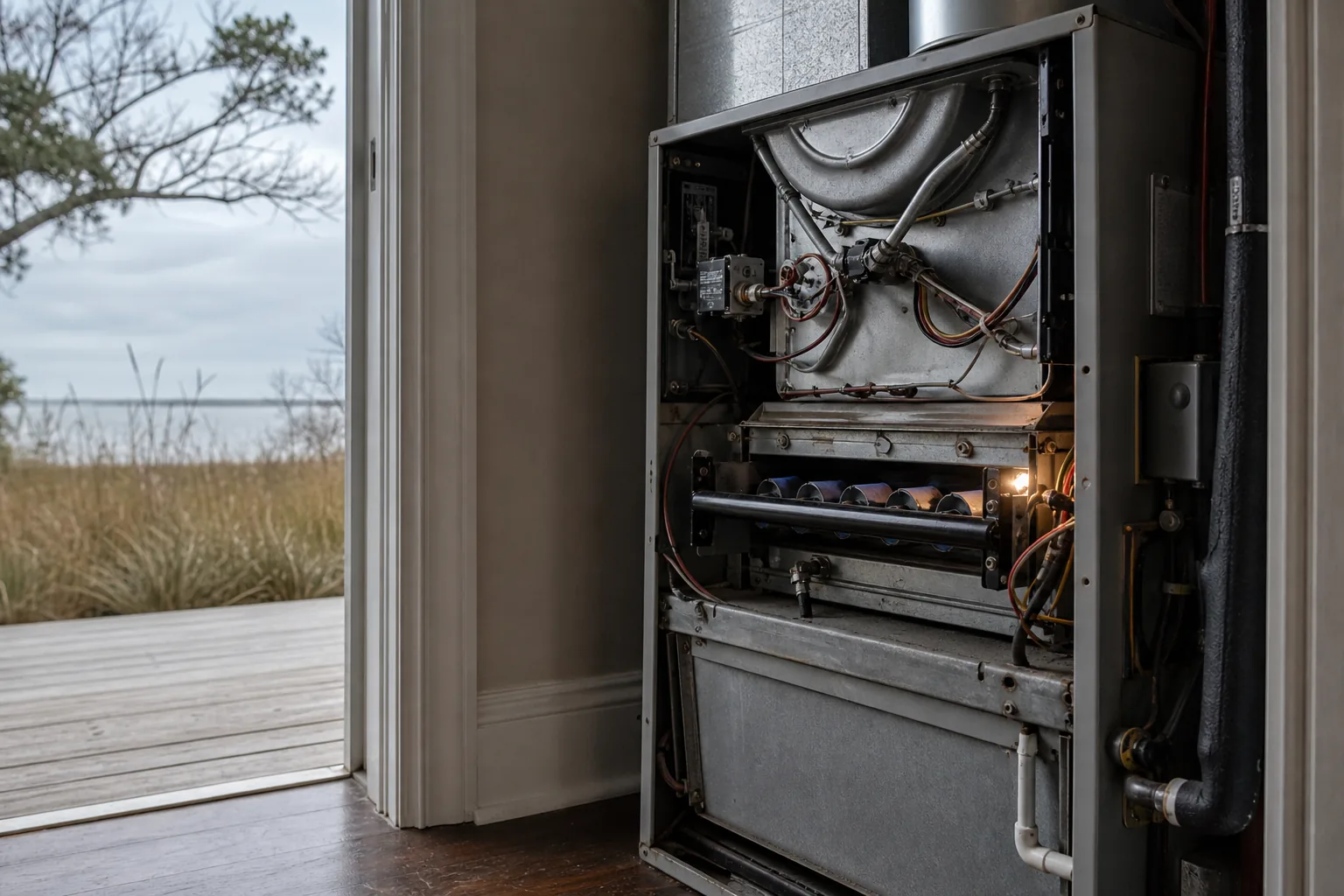
A cold snap rolls into Gulf Shores a handful of nights a year, and that's usually when somebody steps outside, sees their heat pump wreathed in steam and blowing what feels like cool air for a minute, and assumes it's dying. Before you panic — or worse, before you start flipping switches — it's worth knowing that what you're watching might be the system working exactly as designed. Then again, it might not be. Telling those two apart is the first and most useful thing you can do tonight.
So let's start there, then move through the checks and the call.
Normal defrost, or a real failure?
A heat pump pulls warmth from outdoor air even when it's cold. On a chilly, damp Gulf Coast night, the same Mobile Bay humidity that defines summer here works against you in reverse: frost builds up on the outdoor coil, so the system periodically runs a defrost cycle to melt it off — and that cycle looks alarming if you don't know what it is. Homes from West Beach to Craft Farms run almost pure cooling most of the year, so the heating side gets little exercise, which is part of why a routine defrost catches so many people off guard.
A real failure, by contrast, looks like: no warm air at all for an extended stretch (not just a few minutes), the outdoor unit completely dead and silent when it should be running, a coil that stays fully encased in thick ice cycle after cycle, repeated breaker trips, or any burning smell. Those are reasons to dig further.
Run these first checks
If it's clearly not just defrost, rule out the simple causes before assuming the worst.
Recheck the thermostat
Set it to HEAT, several degrees above the current room temperature, fan on AUTO. A dim or blank display points to a dead battery — change it. Confirm nobody left it on COOL or a hold.Reset the breaker once
Find the heat-pump and air-handler breakers and reset a tripped one a single time. If it trips again right away, leave it — that's a fault the system is protecting you from, not something to force.Check the filter
A clogged filter chokes airflow and can keep the indoor unit from delivering heat. If light barely passes through, replace it before you try again.Give the outdoor unit a quick look
Some steam and a paused fan are normal defrost. A unit buried in solid ice through multiple cycles, or one that's dead silent when it should run, is not. Don't pour water on it or chip at ice — just note what you see for the tech.
The emergency-heat setting — what it does
Most heat-pump thermostats have an Emergency Heat (often "Em Heat" or "Aux") mode, and a cold night is when people reach for it. Here's the honest version of what it does: it bypasses the heat pump entirely and runs only the backup electric heat strips (or, in some homes, a furnace). That keeps you warm if the heat-pump portion has genuinely failed — so it's a reasonable stopgap to get heat into the house overnight while you wait for a tech.
Two things to keep in mind. First, emergency heat is less efficient than normal heat-pump operation, so it's a hold-you-over setting, not a permanent one. Second — and this is the useful tell — if switching to Emergency Heat does warm the house, that's a strong sign the trouble is in the heat-pump side of the system specifically, which is helpful information to hand the tech. If even emergency heat gives you nothing, the problem may be electrical or in the air handler.
Staying safe and warm while you wait
Whatever the cause, keep everyone comfortable the right way. Pile on layers, gather into one room, and shut doors to the rest of the house to concentrate the warmth. Pull the blinds to slow heat loss through glass. If you use a portable space heater, set it on a hard, level surface well clear of anything that burns, plug it directly into the wall, and never leave it running unattended or overnight. And one hard line: don't ever heat the house with the oven, a gas range, a grill, or a generator indoors — they release carbon monoxide, which you can't see or smell, and that's never a trade worth making.
When to call tonight
A healthy household can usually ride out a cold coastal night and call in the morning, especially if emergency heat is holding the house. Lean toward calling tonight if the home is getting genuinely cold and someone inside is very young, elderly, or managing a health condition. And call right away — before anything else — if you smell gas (step outside first) or smell burning from the system. When you're not sure, describe what you're seeing over the phone and we'll help you judge it.
Ready for heat pump help in Gulf Shores?
Air Solutions Heating & Cooling is a family-run company based in Daphne, licensed AL#23194 and BBB A-rated. We serve Gulf Shores and the coast, keep a 24/7 emergency line, and give no-heat calls same-day priority whenever we can — with timing confirmed by phone.
- Schedule heating repair — request same-day help when available
- Call (251) 300-9817 — 24/7 emergency line for the coast
- Heating repair services — what we handle on a no-heat call
Related resources
- Heating repair in Gulf Shores — city-specific service page
- All HVAC services in Gulf Shores — every service we cover locally
- Heat out on a cold night in Foley: a calm game plan — the inland companion piece, with furnace-focused first checks
- No heat at 2 a.m. in Fort Morgan: step by step — what to do until we arrive on the far end of the coast
- Are heat pumps worth it on the Eastern Shore? — why the coast's mild winters make a heat pump the natural fit
- An Eastern Shore AC troubleshooting guide — the warm-season companion when it's the cooling side acting up
- Cool Club membership — two seasonal tune-ups a year and priority scheduling
- The Field Guide — more seasonal HVAC help for Baldwin County