
AC Capacitor Failure in Gulf Shores: Why Summer Heat Kills Them
How heat, salt air, and long rental runtimes shorten AC capacitor life in Gulf Shores, AL — how to tell a capacitor from other failures, and why a DIY swap is dangerous.

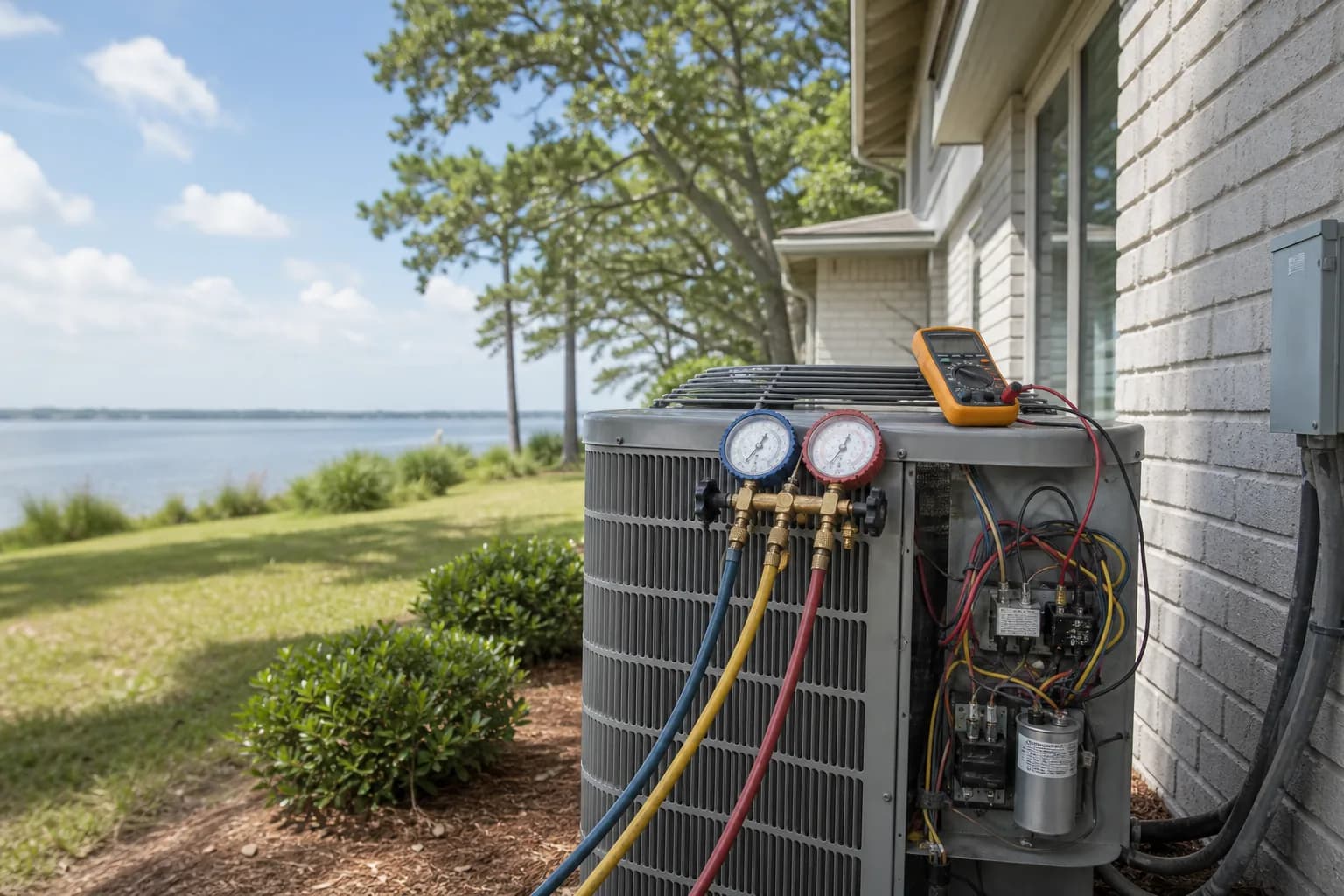
A condo manager near West Beach once told me she could set her watch by it: the first stretch of upper-90s every summer, and a handful of units across her buildings would go quiet on the same week. The air handlers ran, the thermostats read cool, and the rooms kept warming. Every one of them came down to the same little cylinder bolted inside the outdoor unit — a capacitor that had finally given up.
Down here at the coast, that part has a shorter life than it would almost anywhere inland, and there's a specific reason for it. If you understand what's working against your capacitor in Gulf Shores, you'll spot the failure quickly, tell it apart from the costlier problems people fear, and — most important — know why this is the one repair you should never attempt yourself.
A small part with a big job
Picture the capacitor as a spring-loaded battery whose whole purpose is to launch a stalled motor. Your outdoor unit has two motors that need that launch: the compressor and the fan on top. The capacitor stores a charge, releases it the instant a motor tries to start, and then keeps feeding a smaller steady boost while it runs. Most coastal systems use one dual capacitor serving both.
Drain its strength and the motors can't get over the hump. They sit there energized and straining, buzzing instead of spinning, pulling current they can't turn into motion — and heating up while they do it. That's why a failed capacitor doesn't just stop your AC; left running, it can damage the very motors it was supposed to help.
The coastal trifecta that wears them out
Capacitors are rated for heat, and heat is precisely what ages them. Three things conspire against them in Gulf Shores in a way they don't inland.
Relentless runtime. A beach rental or a full-time coastal home runs long, back-to-back cooling cycles all season. Turnover days mean doors propped open, sun-baked interiors cooling back down, and thermostats set aggressively for arriving guests. Every cycle dries the capacitor's internals a little more until it can no longer hold its rated charge.
Salt air on everything electrical. The same marine air that corrodes condenser fins and fasteners works on terminals and connections too. Salt and humidity accelerate the corrosion and electrical leakage that push a marginal capacitor over the edge. It's the reason coastal units, top to bottom, simply don't get the lifespan their inland twins do.
Heat soak at the cabinet. Units crammed into the narrow side yards and roof platforms common to condos and rentals bake in reflected heat off stucco, decking, and pavement. From the rental rows off West Beach to the golf-course homes in Craft Farms and Kiva Dunes, the air temperature is one thing; the temperature inside that metal cabinet on a still August afternoon is another, and the capacitor lives right in the middle of it. The closer the home sits to the open Gulf and Mobile Bay, the more salt rides in on that same heat.
Telling a capacitor apart from the scary stuff
The reason it's worth knowing the capacitor's signature is that its symptoms overlap with failures people dread — and the capacitor is usually the cheapest, easiest of the bunch. Here's how the common no-cool causes sort out at the outdoor unit.
- Loud hum, fan not turning, unit clearly powered → almost always the capacitor. The motors have power but no launch.
- Fan spins up after a gentle push with a stick (system off at the thermostat) → a weak capacitor, confirmed.
- Dead silent, no hum at all → not the capacitor. Look at the breaker, the outdoor disconnect, or a safety switch that's opened.
- Repeated breaker trips on startup → not a simple capacitor. That's an electrical fault or a struggling compressor and needs a tech, not a reset.
- Cold air for a while, then warm, then cold again → more likely a refrigerant or airflow issue than a capacitor.
That quick triage won't replace a meter reading, but it tells you whether you're likely looking at the inexpensive repair or something that warrants a faster call.
Why the DIY swap is genuinely dangerous
I know the part is cheap online and the video makes it look like a five-minute job. Here's what those videos skip: a capacitor stores electrical energy and keeps holding it after the power is off and even after the part has failed. Killing the breaker does not drain it. That stored charge is enough to deliver a serious shock to anyone who bridges the terminals — and people do get hurt every summer learning that the hard way.
A tech discharges the capacitor safely with the proper tool before touching anything, then confirms the replacement matches your motors' microfarad and voltage ratings exactly — a mismatch can cook a compressor. Just as important, we check why it failed, because at the coast a dead capacitor is sometimes the first symptom of corrosion or a tiring motor that will chew through a new part in weeks. This is the repair to hand to someone with the meter and the training. The risk isn't worth the few minutes saved.
What to expect when we roll up
We confirm power is actually reaching the unit before blaming the capacitor, discharge and meter the part to prove the diagnosis, check that the compressor and fan motor aren't pulling abnormal current, then fit a correctly rated replacement and watch the system start cleanly while we check cooling at the vents. On coastal units we'll also flag any salt corrosion that's setting up the next failure, so you can decide what to do about it.
A capacitor replacement is one of the least expensive repairs in HVAC and usually a same-day fix when we can reach you. We put the price in writing before any work begins, and you're welcome to see the meter reading yourself.
Ready to beat the heat in Gulf Shores?
Air Solutions is a family-run company founded in Daphne in 2023, licensed in Alabama as AL#23194 and BBB A-rated, and we work the full coastal corridor. If your unit is humming with a still fan, let's get it running.
- Schedule AC repair — same-day when we can; we'll confirm by phone.
- Call (251) 300-9817 — 24/7 emergency dispatch for the island.
- AC repair services — full overview of what we do.
Related reading
- AC went out tonight in Gulf Shores? What to do until help arrives — if the hum-and-dead-fan is already a full no-cool night, this is your hour-by-hour plan for the island.
- The same capacitor failure inland in Daphne — useful contrast for how much harder the coast is on the part.
- Common coastal summer failures in Perdido — more on the corrosion and heat patterns that take out coastal-corridor systems.
- How far from Mobile Bay does salt-air corrosion matter? — the corrosion behind so many coastal capacitor and electrical failures.
- An Eastern Shore AC troubleshooting guide — what to check yourself before the hum-and-dead-fan becomes a no-cool call.
- A spring AC tune-up — and why it matters more on the coast — how a calm-season visit catches a drifting capacitor before July.
Related resources
- AC repair in Gulf Shores — our coastal service page.
- All HVAC services in Gulf Shores — every service we offer locally.
- Cool Club membership — seasonal tune-ups that catch tired coastal parts early.