
AC Capacitor Failure in Daphne: The Most Common Summer No-Cool Repair
Why a failed capacitor is the No. 1 summer no-cool call in Daphne, AL — the humming-and-no-fan symptom, why Gulf-Coast heat kills them, and the part you must never touch.

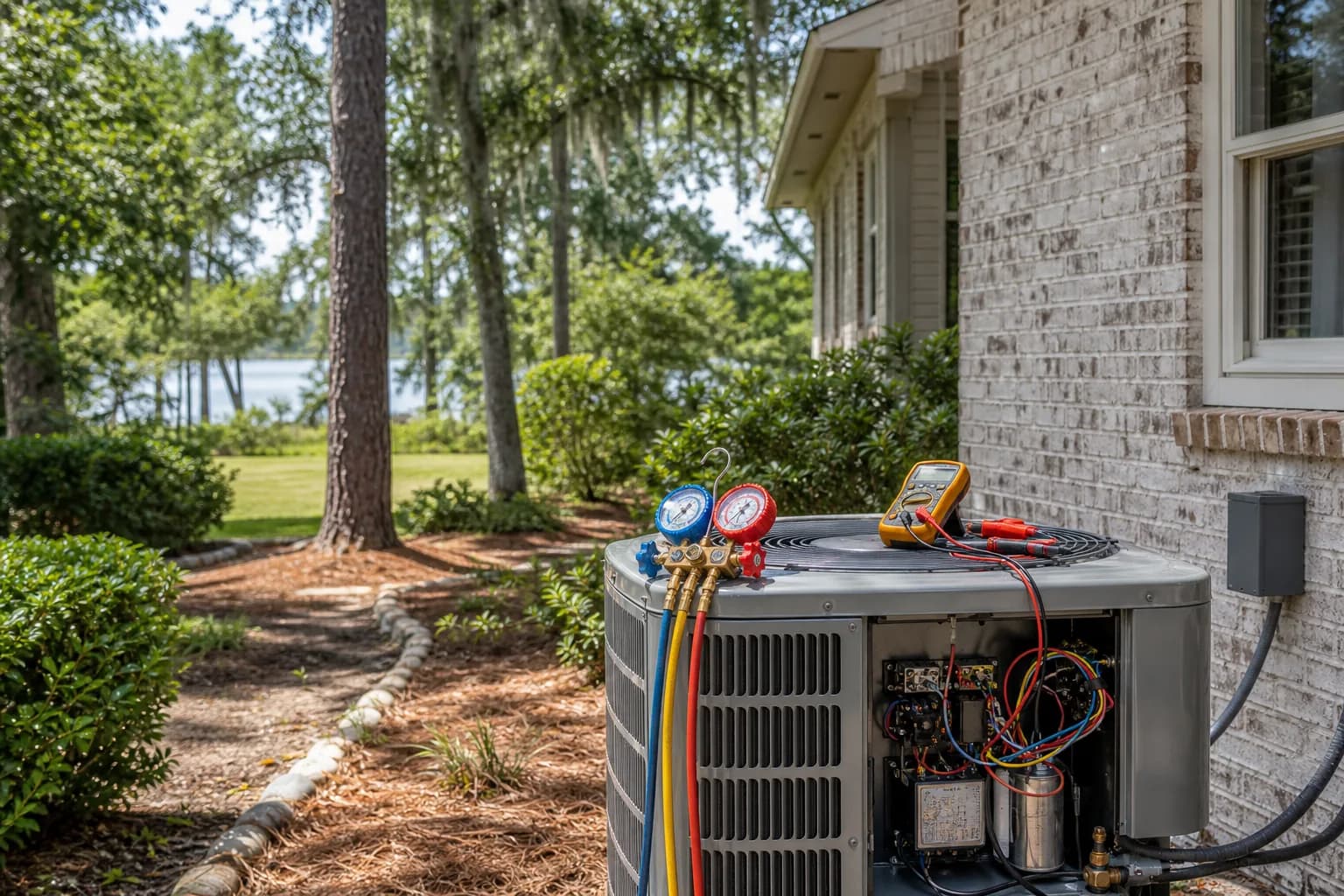
If we lined up every "the AC just quit" call we take across Daphne in July and sorted them by cause, one small cylinder would sit at the top of the pile by a wide margin. It isn't the compressor, it isn't the refrigerant, and it usually isn't anything dramatic. It's a capacitor the size of a soda can, baked past its limit by a summer of Eastern Shore heat.
The frustrating part for homeowners is how a failure this small can look this total. The thermostat says cool, the indoor blower hums along, and yet the house keeps climbing. A dead capacitor is one of several reasons an AC stops working on the Eastern Shore, and it's a common one behind a system that runs but blows warm air. Knowing the signature of a dying capacitor won't let you fix it safely — I'll be blunt about why in a minute — but it tells you what you're dealing with and keeps you from poking at the one part out there that can genuinely hurt you.
What the capacitor actually does out there
Your outdoor condenser has two motors that need a hard electrical shove to get moving: the compressor and the fan on top. A capacitor is the part that stores that shove and releases it the instant a motor needs to start, then keeps feeding it a steady boost while it runs. Most Daphne systems use a single "dual run" capacitor that handles both motors at once.
When that capacitor weakens, the motors no longer get the jolt they need. They'll sit there energized, straining to turn, drawing current they can't convert into motion. That's the buzzing you hear. And a motor that buzzes instead of spins gets hot fast, which is exactly how a cheap part failure turns into an expensive one if it's left alone.
The symptoms that point straight at it
A failing capacitor has a recognizable fingerprint. Walk outside to the condenser and look and listen for these — and if you're not sure the sound is a capacitor, our guide to what those AC noises mean sorts a hum from a hiss from a click.
- A loud hum with a still fan. The single most telling sign. The unit is clearly powered and droning, but the blade on top isn't turning.
- A fan that starts if you nudge it. If you slide a long stick through the top grille and give the blade a push and it then spins up on its own, that's a classic weak-capacitor tell. (Do this with the system off at the thermostat — never reach a hand in.)
- Clicking that repeats without a start. The contactor pulling in while the capacitor fails to deliver enough surge to actually launch a motor.
- A swollen or leaking top. Healthy capacitors are flat across the top. A domed, bulging, or oily one is done.
- A faint electrical or hot-metal smell near the unit after it's been straining.
Why Daphne summers are so hard on this one part
Capacitors are heat-rated components, and heat is what wears them out. A part spec'd to live a decade in a milder climate has a harder road here on the Eastern Shore. Three local factors stack against it.
First, the raw runtime. From June into September a Daphne system runs long, heavy cycles day after day, and every one of those cycles cooks the capacitor a little more. The internal electrolyte slowly dries and the part loses capacitance until it can no longer do its job.
Second, the radiant load on the condenser itself. A lot of homes here tuck the outdoor unit against a south- or west-facing wall where afternoon sun and reflected heat off brick and concrete push the cabinet temperature well above the air temperature. The capacitor lives inside that hot box.
Third, the humidity rolling off Mobile Bay makes every degree feel worse and pushes homeowners to set thermostats lower, which means longer runtimes still. We see it everywhere from the bluffs down to Lake Forest and out along Hwy 181 — none of it is a defect in your system, just the math of asking a heat-sensitive part to work the hardest exactly when it's hottest across Baldwin County. It's also why the season's first wave of these calls lands the same week the first real heat does.
The safety line you do not cross
This is the part I won't soften. A capacitor stores electrical energy, and it holds that charge even after the power to the unit is shut off and even after the part has failed. That stored charge is enough to deliver a serious, potentially dangerous shock. It does not care that the breaker is off.
Capacitors are sold cheaply online and the swap looks simple in a video, which is exactly why people get hurt trying it. A technician discharges the capacitor safely with the right tool before ever touching a terminal, confirms the replacement matches your motors' microfarad and voltage ratings, and checks why it failed — because a capacitor that died early can be a symptom of a struggling motor that will eat the new part too. Please leave this one to a tech. The savings on a DIY attempt are not worth the risk.
What a tech actually does on the call
When we run a no-cool that points to the capacitor, the visit is methodical, not guesswork.
Confirm power is reaching the unit
We verify voltage at the disconnect and contactor first, so we're certain we're chasing a capacitor and not a breaker, a tripped float switch, or a control issue upstream.Safely discharge and test the capacitor
The part is discharged with the proper tool, then read on a meter against its rated microfarads. A capacitor that's drifted well below spec is the culprit — no guessing required.Check what the capacitor was protecting
We confirm the compressor and fan motor aren't drawing abnormal current. A motor that's failing can kill a fresh capacitor in weeks, and we'd rather catch that now than on a repeat call.Install a correctly rated replacement and verify the start
We fit a capacitor matched to your equipment, restart the system, and watch the fan and compressor come up cleanly while we check the cooling at the vents.
A capacitor replacement is one of the least expensive repairs we do, and it's almost always a same-day fix when we can get to you. We quote it in writing before any work starts, and if you'd rather see the part on a meter before deciding, just ask the tech to show you the reading. Better still, a coastal spring tune-up reads a weakening capacitor on the meter before July finds it for you.
Ready to fix a no-cool in Daphne?
Air Solutions is a family-run shop founded right here in Daphne in 2023, licensed in Alabama as AL#23194 and BBB A-rated. If your outdoor unit is humming with a still fan, we'll get it sorted.
- Schedule AC repair — same-day when we can; we'll confirm by phone.
- Call (251) 300-9817 — 24/7 emergency dispatch when the heat won't wait.
- AC repair services — what we cover and how the visit works.
Related reading
- Why a hard-starting compressor in Daphne is worth taking seriously — a tired capacitor is the most common cause, so this is the natural next read if your unit clunks or dims the lights at startup.
- The same failure on the coast in Gulf Shores — how salt air shortens capacitor life even further once you get out to the beach.
- AC capacitor failure in Foley — the same no-cool story for south Baldwin homeowners.
Related resources
- AC repair in Daphne — our local service page for the Eastern Shore.
- All HVAC services in Daphne — everything we offer in town.
- Cool Club membership — two seasonal tune-ups a year that catch tired parts before July does.
- The Field Guide — more plain-English HVAC help for Baldwin County.