
HVAC Surge Protection in Daphne: Why Coastal Lightning Makes It Essential
Daphne sits in one of the most lightning-prone stretches of the Gulf Coast. Here's what power surges do to your AC's electronics and why surge protection is cheap insurance.

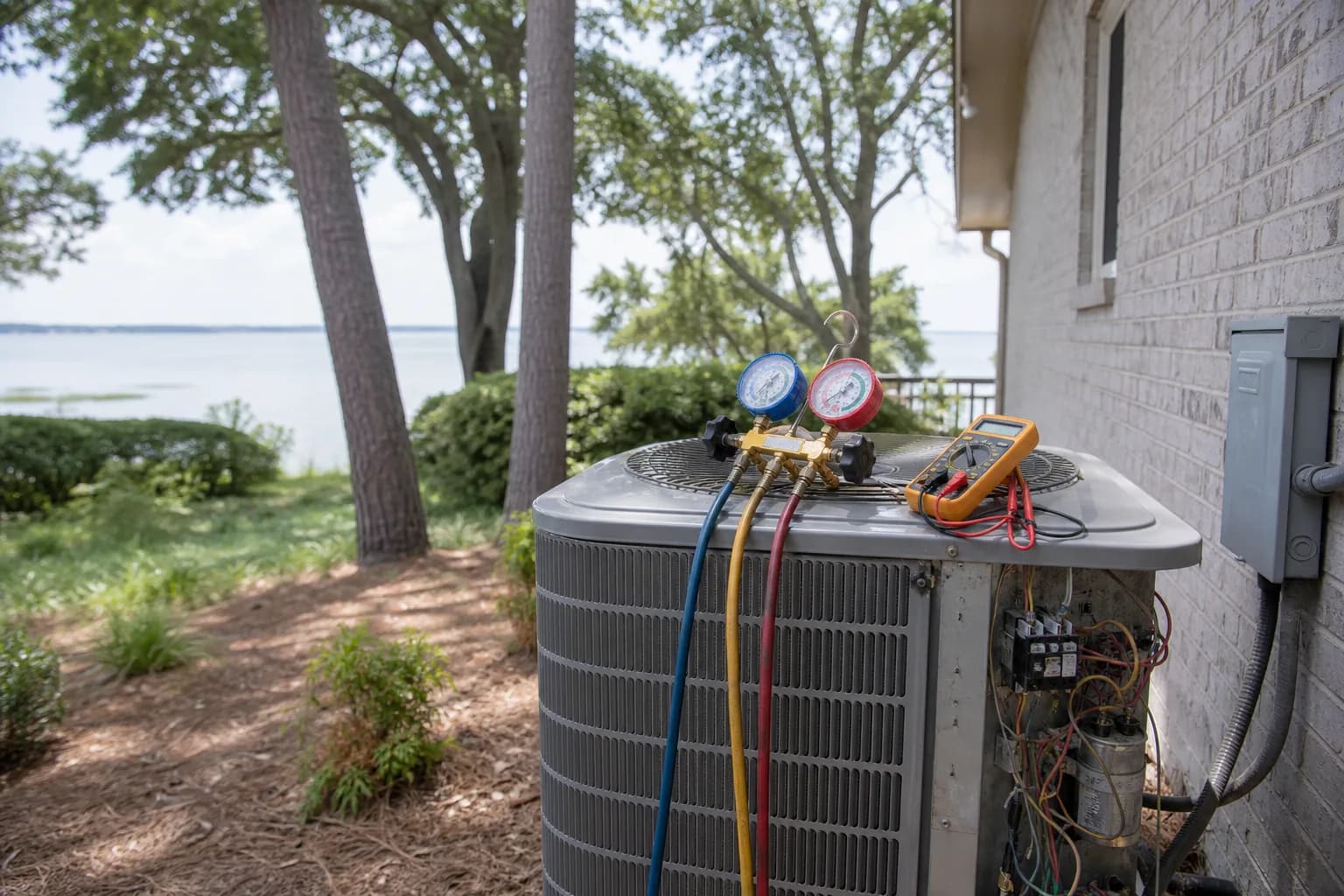
If you've spent a single summer in Daphne, you already know the drill: the afternoon sky goes from blue to bruised in twenty minutes, the wind kicks up off the bay, and the next thing you hear is a crack of thunder close enough to rattle the windows. The Gulf Coast gets some of the most frequent lightning in the entire country, and our corner of the Eastern Shore catches more than its share of those storms rolling in off Mobile Bay.
Most homeowners think about lightning in terms of a direct hit — the dramatic kind that splits a tree or fries a TV. But the far more common threat to your air conditioner is quieter and sneakier: the voltage surges that ripple through the power grid every time lightning strikes a line, a transformer trips, or the utility switches a circuit back on after a storm. Your AC's brain doesn't have to take a direct hit to die. It just has to be plugged in.
What a surge actually does to a modern AC
The air conditioners going into Daphne homes today are not the simple electromechanical units your grandparents had. A modern system is full of sensitive electronics, and those are exactly the parts a voltage spike goes after first.
- Control boards. The circuit board that runs your indoor air handler or outdoor unit is the most surge-vulnerable component in the whole system. A spike can scorch a trace, blow a relay, or quietly corrupt the board so it behaves erratically — short cycling, refusing to start, or throwing fault codes that send a tech chasing ghosts.
- The compressor. This is the expensive heart of the outdoor unit. A surge doesn't usually vaporize a compressor outright, but it can degrade the motor windings or weaken the start components, shaving years off its life. Repeated small surges add up.
- Capacitors. These store the jolt of energy your motors need to start. They already live a hard life in Alabama heat, and a surge can push a marginal capacitor over the edge, leaving you with a humming unit that won't kick on.
- Communicating controls and smart thermostats. Newer variable-speed systems and Wi-Fi thermostats run on low-voltage logic that's especially intolerant of dirty power.
Why Daphne is a worse-than-average risk
Lightning is a coastal fact of life here, but a few local realities stack the deck against unprotected equipment in Baldwin County's Eastern Shore.
Storms here are frequent and intense through the long cooling season — roughly May into October — which is exactly when your AC is running the hardest and is most exposed. The bay and the Gulf feed afternoon thunderstorms that fire up nearly every day in midsummer. More storm days means more grid events, and more grid events means more chances for a surge to find your equipment.
On top of that, a lot of Daphne's residential power runs overhead, and overhead lines are more exposed to both direct strikes and the induced surges that come from nearby ones. Whether you're up on the bluffs off Hwy 181 in Lake Forest or in an older home near Olde Towne Daphne, the more your home's incoming power has been jostled over the years, the more likely a marginal component is already living on borrowed time.
The two layers of protection that actually work
There's no single magic device. Good surge protection is layered, and a thoughtful setup uses two complementary pieces.
A whole-home surge protector at the panel
This installs at your main electrical panel and is your first line of defense. It clamps down on large surges coming in from the grid before they ever reach your AC, your appliances, or your electronics. It protects the whole house, not just the HVAC, which is why it's the foundation of any serious setup.A dedicated HVAC surge protector at the equipment
This mounts right at the outdoor condenser or the air handler disconnect and catches the smaller, faster spikes that slip past the panel device or get generated inside the home. Because it sits closest to the most expensive electronics you own, it's the targeted insurance policy for the equipment that costs the most to replace.Don't forget the low-voltage side
Communicating systems and smart thermostats can be hit through the thermostat wiring too. When we install surge protection on a high-end variable-speed system, we look at the control circuit as well, not just the line voltage.
Used together, the panel device handles the big hits and the equipment-level device mops up what's left. Skipping either layer leaves a gap.
Cheap insurance for expensive electronics
Think about the math the way an honest contractor frames it. A surge protection setup is a one-time, modest investment relative to what it guards. A fried control board means a service call, a part, and a hot house while you wait on it. A surge-damaged compressor can mean replacing the most costly component in the system — or the whole condenser. Set those potential outcomes next to the cost of protection and the decision tends to make itself.
We won't quote you a figure in a blog post, because the right setup depends on your panel and your equipment — but we will tell you the price in writing before we touch anything, and a surge protector is one of the least expensive HVAC upgrades you can make. It's the kind of thing that does nothing visible for years and then, one stormy August evening, quietly earns its keep.
What surge protection won't do
Honesty matters, so here's the limit. No surge device guarantees survival of a massive direct lightning strike to your home or the line at your meter — that's a different and far rarer event. Surge protection is built to handle the constant drumbeat of smaller spikes and the grid-recovery surges that do the real cumulative damage over a unit's lifetime. That's the threat that actually shortens equipment life in Daphne, and it's exactly the threat these devices are designed for. Pairing surge protection with a good homeowner's insurance policy covers both ends of the spectrum.
Ready to protect your AC in Daphne?
Air Solutions Heating & Cooling installs whole-home and dedicated HVAC surge protection for Daphne and the Eastern Shore. Family-run, founded in Daphne in 2023, licensed AL#23194 and BBB A-rated.
- Schedule a visit — we'll evaluate your panel and equipment and quote surge protection in writing
- Call (251) 300-9817 — questions about storm-season protection answered
- AC Repair services — full overview
Related resources
- AC Repair in Daphne — city-specific service page
- All HVAC services in Daphne — every service locally
- What a power outage and sudden restoration does to your AC — the grid-recovery surge explained in depth
- The same surge add for Orange Beach systems — why compressors are worth shielding
- A safe post-storm restart sequence for Foley — bringing the AC back after the grid returns
- How to protect your AC before a hurricane — lessons from Sally — the bigger storm-prep picture surge protection fits into
- Why is my summer power bill so high? — surge-degraded equipment is one quiet driver of a creeping bill
- Cool Club — seasonal tune-ups and member benefits
- The Field Guide — more Baldwin County HVAC reading