
Why Your AC Runs All Day But Won't Cool on Extreme-Heat Afternoons in Daphne
Your Daphne AC runs nonstop yet the house creeps up by 4 p.m. on the hottest days — here's what's normal, what's a real fault, and how to tell heat-load from a fixable problem.

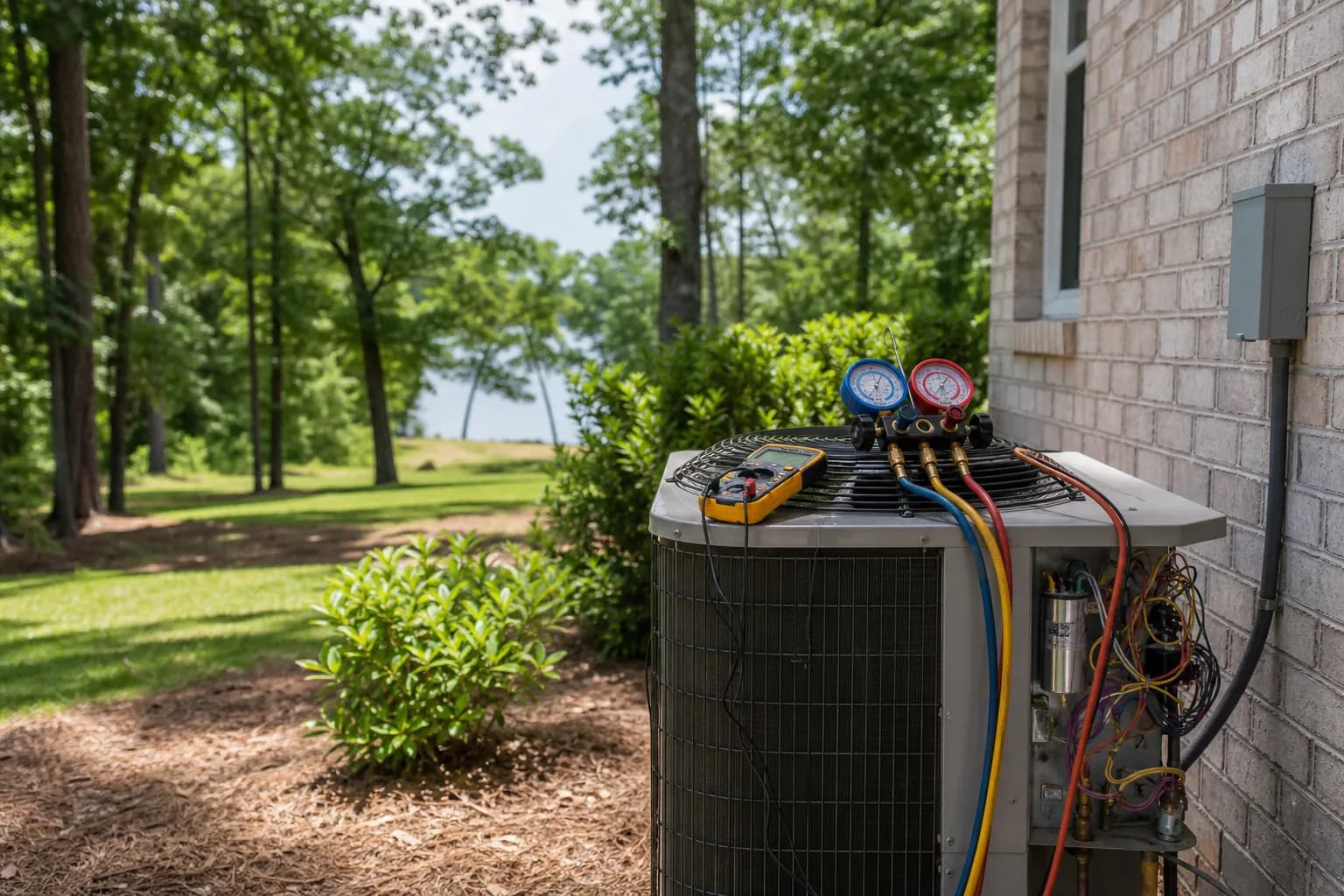
It's a familiar Daphne call in mid-July: the thermostat is set to 73°, the AC has been running since breakfast and hasn't shut off once, and by four in the afternoon the house reads 77° and still climbing. We hear it from Lake Forest and Olde Towne Daphne, from the Highway 181 subdivisions, and from the bayfront streets where the heat coming off Mobile Bay adds its own humidity load. The mornings are fine. The evenings are fine. But there's a window from roughly 2 to 6 p.m. when the system seems to throw up its hands.
Most homeowners assume that means a breakdown. Sometimes it does. But on the Eastern Shore, a lot of these afternoons are a system that's keeping up everywhere except the peak — and the trick is telling the difference before you spend money chasing the wrong thing.
First, the part nobody wants to hear
An air conditioner is sized to hold your setpoint against a particular outdoor design temperature, not against the worst the sky can do. When it's 98° with a heavy dewpoint, your unit is fighting two things at once: the outdoor coil is trying to shed heat into air that's already scorching, so its capacity drops — and the house is soaking up sun through windows, walls, and the roof faster than it does at any other hour.
So the equation tips. Less cooling available, more heat coming in. A perfectly healthy AC can lose a few degrees of ground during those hours and then quietly win it all back by dinnertime once the sun drops.
The causes we actually find, in order
When a Daphne system genuinely can't keep up, it's usually one of these — roughly from most to least common.
A dirty condenser coil
The outdoor unit sheds your home's heat through its coil. Cottonwood fluff, grass clippings, and Eastern-Shore pollen mat the fins so heat can't escape. Capacity quietly falls — and it falls hardest on the hottest days, which is exactly when you notice. This is one of the most common 'won't keep up' findings, and one of the simplest to fix.Low refrigerant charge
If the system is undercharged — usually from a slow leak — it limps through mild spring days and then can't deliver full cooling when the load peaks. Charge can only be checked with gauges, and a leak should be found and repaired, not just topped off and forgotten.A weak or failing capacitor
A tired capacitor can let the compressor or fan motor run sluggishly or cut out under the strain of a hot afternoon, then behave fine once things cool. Intermittent peak-heat trouble is a classic capacitor signature.Restricted airflow
A loaded filter, a dirty blower wheel, or closed-off returns choke the air moving across the indoor coil. Less airflow means less heat removed per minute — and on a brutal day, that gap is the difference between keeping up and falling behind.Duct loss and sun-load gain
Leaky or under-insulated ducts running through a 130°+ attic give away cooling before it ever reaches your rooms, while big west-facing windows pour heat in at exactly the wrong hour. The system is fine; the house is feeding it more work than it can win.
The reason a tech measures rather than guesses is that several of these only show up under load. A system can pass a quick look on a mild morning and still fold at 4 p.m. — so the honest diagnosis happens with the equipment running hard, gauges on, and airflow and electrical readings taken in the heat.
How do you tell heat-load from a real problem yourself?
Before you call, a few minutes of observation tells us a lot:
- Watch the trend, not the moment. Note the indoor temperature at 9 a.m., 2 p.m., and 6 p.m. for a day. Holding within a couple degrees and recovering at night points to normal heat-load. A number that climbs all day and never recovers points to a fault.
- Feel the air at a register. Cold, strong air that simply can't out-pace the heat suggests load. Weak or barely-cool air suggests airflow or refrigerant trouble.
- Check the easy stuff. Pull the filter — if light barely passes through it, replace it and give the system a fresh start. Walk the outdoor unit and clear leaves, clippings, and anything stacked against it; it needs clear breathing room on all sides.
- Compare to last summer. This is the most useful question of all. If the system comfortably held setpoint last July and can't this July, the weather didn't change — the equipment declined, and that's usually fixable.
What "fixing it" usually looks like
Most of these afternoons resolve without replacing the system. Clearing and cleaning the condenser coil restores capacity that was being thrown away. Finding and sealing a refrigerant leak, then charging to spec, brings back the cooling a slow leak had been quietly bleeding off. A failing capacitor is one of the least expensive repairs we do and is almost always handled the same visit. Restoring airflow — a fresh filter, a cleaned blower, opened returns — costs little and helps immediately.
Duct and sun-load issues are the bigger conversation. Sealing leaky attic ducts, adding insulation, or shading west windows reduces the heat the system has to fight in the first place. We'll lay out what's worth doing and what isn't, and quote any work in writing before it starts — no surprises.
If the restricted-airflow angle is where your symptoms point, our step-by-step on diagnosing weak airflow yourself — filter, duct, or blower walks the same path a tech follows. If you spotted ice on the lines, why a coil freezes on a 95-degree afternoon explains the cause and the fix. And for a broader checklist when an AC runs but the house won't cool, here's what to check.
When it's worth treating as urgent
Call us promptly, rather than riding it out, if:
- The indoor temperature is climbing all day with the system running and never recovers at night.
- The air at the registers has gone weak or barely cool.
- You see ice on the refrigerant lines or the indoor coil — shut the system off and let it thaw first.
- A vulnerable household member is in the house and it won't hold a safe temperature.
We run 24/7 dispatch and same-day priority when we can, and we'll confirm timing by phone. The goal isn't a freezing house in a record heat wave — it's a healthy system holding its own and recovering the moment the sun lets up.
Ready to fix an AC that won't keep up in Daphne?
Air Solutions is a family-run shop founded right here in Daphne in 2023, licensed in Alabama as AL#23194 and BBB A-rated. If your system runs all day and still loses the afternoon, we'll find out why.
- Schedule AC repair — diagnosed under load; same-day when we can.
- Call (251) 300-9817 — 24/7 dispatch when the heat won't wait.
- AC repair services — what we cover and how the visit works.
Related resources
- Surviving Baldwin County's Worst Heat: How Your AC Handles 95°+ and Humidity — the county-wide guide to peak-heat performance.
- AC repair in Daphne — our local service page for the Eastern Shore.
- All HVAC services in Daphne — everything we offer in town.
- Cool Club membership — two seasonal tune-ups a year that catch a tired capacitor or dirty coil before July does.