
Why Your Upstairs Rooms Never Cool Down in Foley: Attic and Duct Heat Gain
Why upstairs rooms in Foley homes stay hot all summer — attic heat gain, leaky upstairs ducts, the stack effect, single-zone limits — and the fixes that actually move the needle.

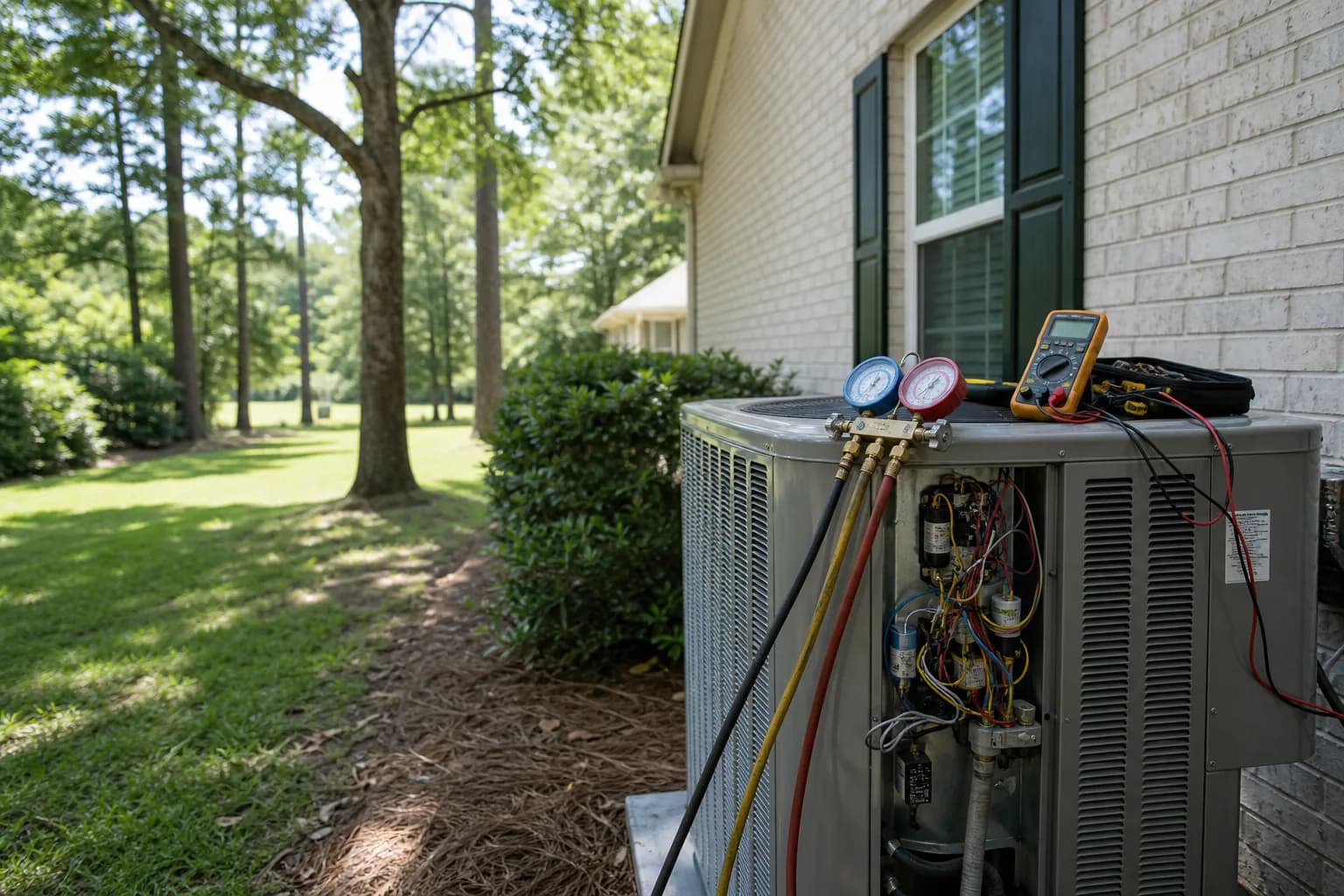
Downstairs is comfortable. The thermostat in the hallway says the house is at 73°. But climb the stairs in a two-story Foley home on an August afternoon and the bedrooms feel like a different building — easily five to ten degrees warmer, stuffy, and stubborn no matter how long the AC runs. Families end up sleeping downstairs, running box fans, and slamming the thermostat lower in a doomed attempt to force the upstairs to behave.
This is one of the most common comfort complaints we hear from Foley and the surrounding subdivisions — from two-story homes in Glenlakes and Liveoak Village to the newer builds off Hwy 59 — and it almost always traces back to the same handful of physics problems, not to a broken air conditioner. The good news is that there are real fixes, ranging from inexpensive to involved.
Why heat collects upstairs in the first place
Three forces gang up on a second floor in our climate, and they all peak on the hottest days.
- Attic heat gain. A Gulf-Coast attic can hit 130°+ on a sunny afternoon. That superheated air sits directly above your upstairs ceilings, radiating down. The upstairs is essentially being baked from above while the AC tries to cool it from inside.
- The stack effect. Warm air rises. As the day heats up, hot air naturally migrates to the top of the house and pools there, while cooler air settles downstairs. Your second floor is collecting everyone's heat.
- Ductwork that runs through that 130° attic. In most Foley homes, the supply ducts feeding the upstairs run through the attic — the hottest place in the house. Cooling leaks out and heat leaks in across every foot of that run, so the air arriving at the upstairs registers is warmer and weaker than what left the system.
Stack all three and the upstairs is fighting a battle the downstairs never has to.
Why can't a single-zone system win it?
Most two-story Foley homes have one thermostat — usually downstairs — controlling one system that serves the whole house. That setup has a built-in blind spot: the system shuts off when the downstairs sensor is satisfied, regardless of what's happening upstairs.
So before spending a dollar, it helps to understand that the upstairs problem is usually a distribution problem — getting enough cool air to the right place and keeping heat out — not a sign the equipment is failing.
Sorting out which cause is yours
A little observation points us toward the right fix:
- Feel the upstairs registers with the system running. Weak or barely-cool air there (while downstairs registers are strong) points to duct loss or undersized upstairs runs.
- Check whether it's every upstairs room or just one. A single hot room — often over a garage or on the west side — narrows it to that room's duct, insulation, or sun exposure. The whole floor being hot points to stack effect and attic gain.
- Notice the timing. Tolerable in the morning and brutal by late afternoon is the attic-and-sun signature, building as the attic and west walls soak up the day.
- Look at the return air. Many two-story homes have all their returns downstairs, which makes it hard to pull the hot air out of the upstairs. A lack of upstairs return is a frequent, overlooked culprit.
The fixes, from least to most involved
There's a real ladder here, and the right rung depends on your home and how far you want to go.
Seal and insulate the upstairs ducts
Often the highest-impact, lowest-drama fix. Sealing leaky joints with mastic and making sure attic ducts are properly insulated stops cooling from bleeding into the attic and heat from bleeding in. Air that leaves the system actually arrives at the registers.Improve attic insulation and ventilation
More attic insulation slows the heat radiating down into upstairs ceilings, and adequate attic ventilation keeps that space from turning into an oven. This reduces the load on the whole second floor, not just one room.Balance the airflow
Adjusting dampers to push more conditioned air upstairs and adding or enlarging an upstairs return so hot air can escape can rebalance a system that's favoring the first floor. Sometimes the capacity is there; it's just going to the wrong place.Add a second zone
Zoning splits the home into separately controlled areas with their own thermostats and motorized dampers, so the system can keep cooling upstairs after the downstairs is satisfied. It's a bigger project, but it directly fixes the single-sensor blind spot.Add a ductless mini-split for the worst room
For a bonus room over the garage or a stubborn west-facing bedroom that no amount of balancing will satisfy, a small ductless mini-split delivers dedicated cooling right where it's needed — no attic ductwork involved, and independent control.
We'll always start with the least invasive option that actually solves your pattern, and tell you honestly where the line of diminishing returns sits. There's no point adding a zone if sealing the ducts would have done it.
The weak-air-at-the-far-registers pattern shows up downstairs too; if you want to trace it yourself first, our filter-duct-or-blower airflow walkthrough follows the same logic. If the whole house — not just the upstairs — is losing ground on the hottest afternoons, why an AC runs all day but won't cool separates heat-load from a real fault, and a broader "runs but won't cool" checklist covers the rest.
What not to do
A few common moves either don't help or quietly make things worse:
- Cranking the downstairs thermostat way down. This mostly freezes the first floor and runs up energy use without meaningfully reaching the upstairs, because the system still can't run long enough to overcome the gap once downstairs is satisfied.
- Closing downstairs vents to "force" air upstairs. Shutting registers raises pressure in the duct system, which can reduce total airflow and even strain the equipment, rarely delivering the upstairs boost people expect.
- Assuming the AC is broken and replacing it. A bigger or newer single-zone system serving the same leaky upstairs ducts and uninsulated attic will still leave the bedrooms hot. Fix the distribution before you touch the box.
When it's worth calling rather than living with it
Reach out if the upstairs is consistently several degrees warmer than downstairs through the summer, if rooms over the garage or on the west side are essentially unusable in the afternoon, or if you're losing sleep and cooling the whole house harder just to make one floor tolerable. Those are distribution problems with known fixes — not something you have to accept as "just how two-story homes are." We'll find which of the causes is driving yours and quote any work in writing before it starts.
Ready to fix a hot upstairs in Foley?
Air Solutions is a family-run shop founded in Daphne in 2023, licensed in Alabama as AL#23194 and BBB A-rated. We work all over the Foley area, from the subdivisions off Hwy 59 outward, and we'll get to the bottom of why your second floor won't cool. Free estimates and free second opinions; any work is quoted in writing first.
- Schedule AC service — an assessment of your upstairs ducts, returns, and airflow.
- Call (251) 300-9817 — questions answered, 24/7 dispatch when you need it.
- AC repair services — what we cover and how the visit works.
Related resources
- Surviving Baldwin County's Worst Heat: How Your AC Handles 95°+ and Humidity — the county-wide peak-heat guide.
- AC repair in Foley — our local service page.
- All HVAC services in Foley — everything we offer locally.
- The Field Guide — more plain-English HVAC help for Baldwin County homes.