
AC Capacitor Failure in Foley: The Most Common Summer HVAC Repair
Why capacitors are the #1 summer AC failure in Foley, AL — symptoms, costs, and why DIY isn't worth attempting on this specific repair.

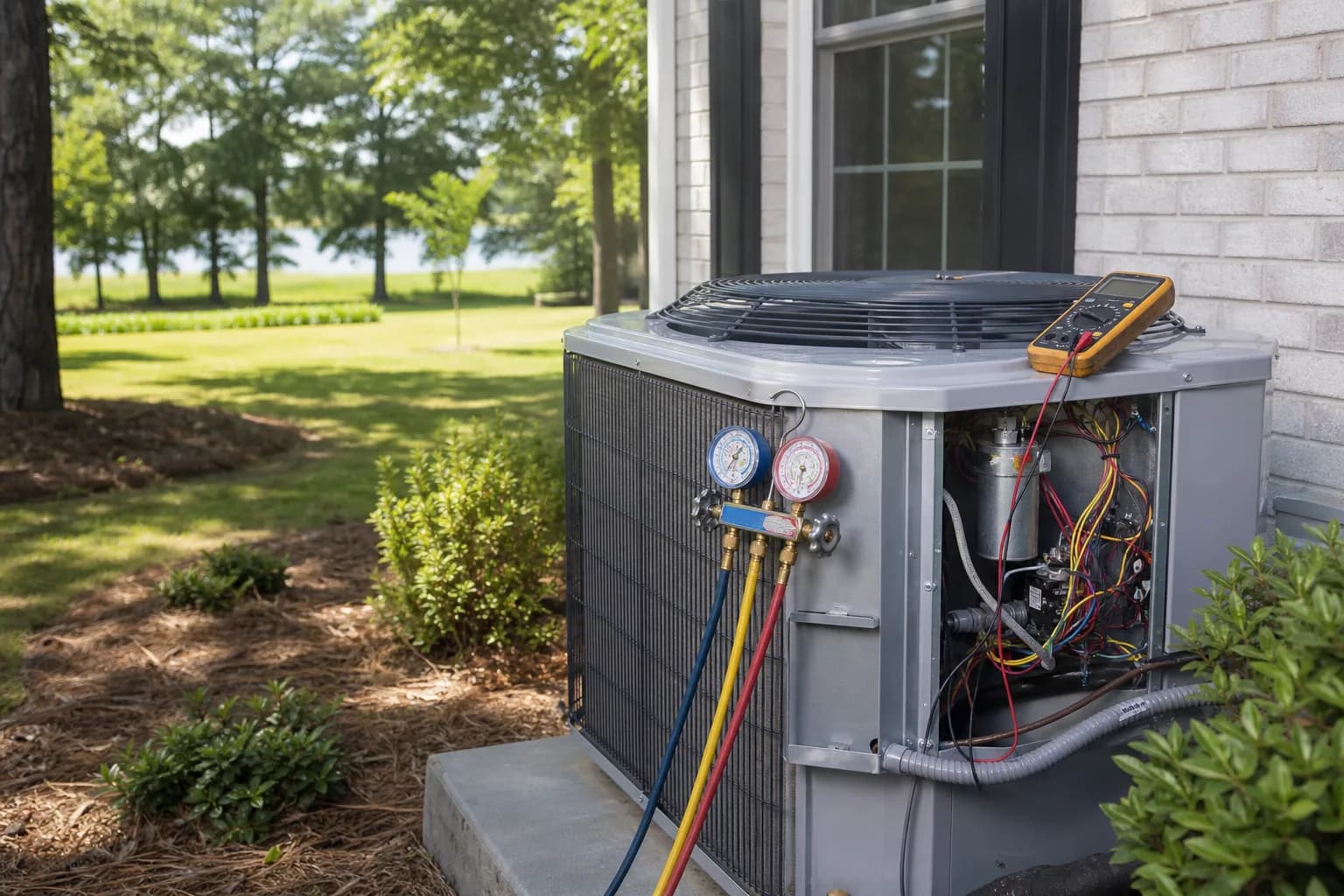
Of every AC repair we do across Foley during summer — from the Hwy 59 corridor near the Tanger Outlets to the subdivisions out by OWA — capacitor replacement is the most frequent by a wide margin. If your Foley AC suddenly stops cooling and you hear a hum from the outdoor unit but the fan isn't spinning, the capacitor is the most likely cause. Here's everything you need to know about this specific repair, and why this corner of Baldwin County is so hard on the part.
What the capacitor does
The capacitor is a small cylindrical electrical component (typically 2-4 inches tall, 2 inches in diameter) that lives inside your outdoor condenser unit. Its job is to provide the surge of electrical energy that:
- Starts the compressor each time the AC cycles on
- Powers the condenser fan motor
- Smooths electrical flow during operation
Think of it as the AC's electrical battery. When it works, you don't notice it. When it fails, the AC simply stops running.
Why do capacitors fail more in Foley than inland?
Three local factors:
1. Heat exposure. Capacitors are heat-sensitive. Foley summers run condenser internal temperatures at 130°F+ for hours daily. Heat stress shortens capacitor life.
2. Humidity infiltration. Salt-air and humidity can corrode capacitor terminals over years. Foley sits 8 miles inland from the Gulf — close enough to get coastal humidity exposure. (How far that salt reach actually extends is worth understanding: how far from Mobile Bay corrosion matters maps it out.)
3. Voltage events. Florida-style afternoon thunderstorms create voltage surges that damage capacitors progressively. Each surge weakens the cap a bit; eventually one event finishes it. The same storms that nibble at the capacitor can do bigger damage in a hurricane — how to protect your AC before a storm covers the rest.
A capacitor rated for 10 years in a dry inland climate often fails at 5-7 years in Foley.
Symptoms
The classic capacitor failure presentation:
1. AC won't start. You hear humming from the outdoor unit. The fan on top of the condenser isn't spinning. The compressor isn't engaging.
2. Hard starts. When the system cycles on, you hear a loud bang, click, or grinding sound, then the system runs.
3. Short-cycling. The system turns on, runs for 30-90 seconds, then shuts off. Repeats every few minutes without ever satisfying the thermostat.
4. AC won't restart after recent shutoffs. Power outage, breaker reset, or thermostat change leaves the system unable to come back on.
5. Higher utility bills with no obvious cause. A weak capacitor causes the compressor to draw more amps to start.
6. Burning smell from outdoor unit. Active capacitor failure can smell like burning plastic or fish.
If you see ANY of these, the capacitor is likely the cause.
Why DIY isn't recommended
Capacitors store electrical charge even after the unit is powered off. The stored charge can deliver a serious shock when you contact the terminals — burns, blown breakers, in severe cases cardiac issues.
A licensed tech discharges the capacitor with a resistor before touching it. They also test the new capacitor's microfarad rating against the old to ensure correct sizing. Wrong capacitor size = compressor damage over time.
For Foley homeowners with electrical experience: the small amount you'd save on a service call isn't worth the shock risk and the chance of installing the wrong part. This isn't a DIY repair.
What replacement involves
A typical capacitor replacement in Foley:
- Power off at disconnect AND breaker. Verified with a meter.
- Capacitor discharged with a resistor.
- Old capacitor removed. Wiring documented.
- New capacitor installed. Same microfarad and voltage rating.
- System tested. Verify clean startup, fan rotation, compressor engagement.
- Pressure check. Verify refrigerant pressures normal.
- Total time: 30-45 minutes for most installs.
We carry capacitors for the most common AC brands on every truck, so 90% of Foley capacitor repairs are completed same-visit.
What drives the cost in Foley
A capacitor replacement is one of the more affordable AC repairs, but a few things move the number:
- Capacitor type. A single run capacitor is the simplest case. A dual capacitor (which serves both the compressor and the fan on many systems) is a bit more.
- Part availability. We carry the common ratings on the truck. Older or specialty-brand units sometimes need a harder-to-source part.
- Same-visit diagnosis. When we diagnose and replace in one trip, you're not paying for a second visit.
You'll get the exact part and price quoted before we install anything, and we're glad to give a free second opinion if another company already diagnosed your system. Cool Club members also take 15% off all AC repairs.
For comparison: continuing to run a system with a failing capacitor leads to compressor damage, and a compressor is one of the most expensive repairs on the system. Catching the capacitor early is the cheap path by a wide margin.
When the symptom isn't actually a capacitor
Other things that can present like capacitor failure:
- Failed contactor — clicking but no startup; a modest repair
- Tripped breaker — free fix if you can reset it; a larger concern if it signals a real electrical fault
- Failed thermostat (less common)
- Compressor failure (the bad-news scenario, and the costliest)
- Stuck condenser fan motor — a mid-range repair
This is why diagnostics matter. A real tech tests with meters, doesn't just guess. If it's the sound that's tipping you off, what those AC noises mean — hissing, buzzing, clicking helps you describe it before we arrive.
Prevention
You can't fully prevent capacitor failure but you can extend life:
- Annual professional tune-up. Includes capacitor microfarad testing. Catches degrading capacitors BEFORE they fail.
- Surge protection at the disconnect. An affordable add-on that reduces damage from grid voltage events.
- Adequate clearance around outdoor unit. Better airflow = lower internal temperatures = longer capacitor life.
- Annual coil cleaning. Clean coils reduce compressor strain, which reduces capacitor cycling stress.
For Cool Club members, capacitor degradation is caught at tune-ups before failure. Replacement on schedule = no emergency call, no premium pricing.
Foley-specific considerations
Whether you're in an established neighborhood like Glenlakes or Liveoak Village or a newer build closer to the Gulf Coast, if your Foley AC has had previous capacitor failures, look for the underlying cause:
- System over 12 years old: Capacitor failures cluster as systems age. Consider replacement timing — when it's worth fixing versus replacing in coastal Alabama walks through that call.
- No surge protection: Add it. The single highest-ROI HVAC accessory in our climate.
- Hot install location: Outdoor unit in full sun with poor airflow = chronically high internal temps. Consider shade structure or relocation.
- Generic builder-grade equipment: Some brands have known capacitor issues. Replacement to better equipment makes long-term sense.
Ready for AC repair in Foley?
Air Solutions Heating & Cooling stocks capacitors for major AC brands on every truck — 90% of Foley capacitor calls completed same-visit. Family-run, founded in Daphne, licensed AL#23194.
- Schedule AC Repair — same-day available
- Call (251) 300-9817 — emergency service 24/7
- AC Repair services — full overview
Related resources
- AC Repair in Foley — city-specific service page
- All HVAC services in Foley — every service locally
- Cool Club Membership — preventive maintenance + member benefits