
Why Your Outdoor AC Unit Is Buzzing But Not Cooling in Magnolia Springs
Outdoor AC unit humming or buzzing without cooling in Magnolia Springs, AL — what causes it, what to do immediately, and what each fix costs.
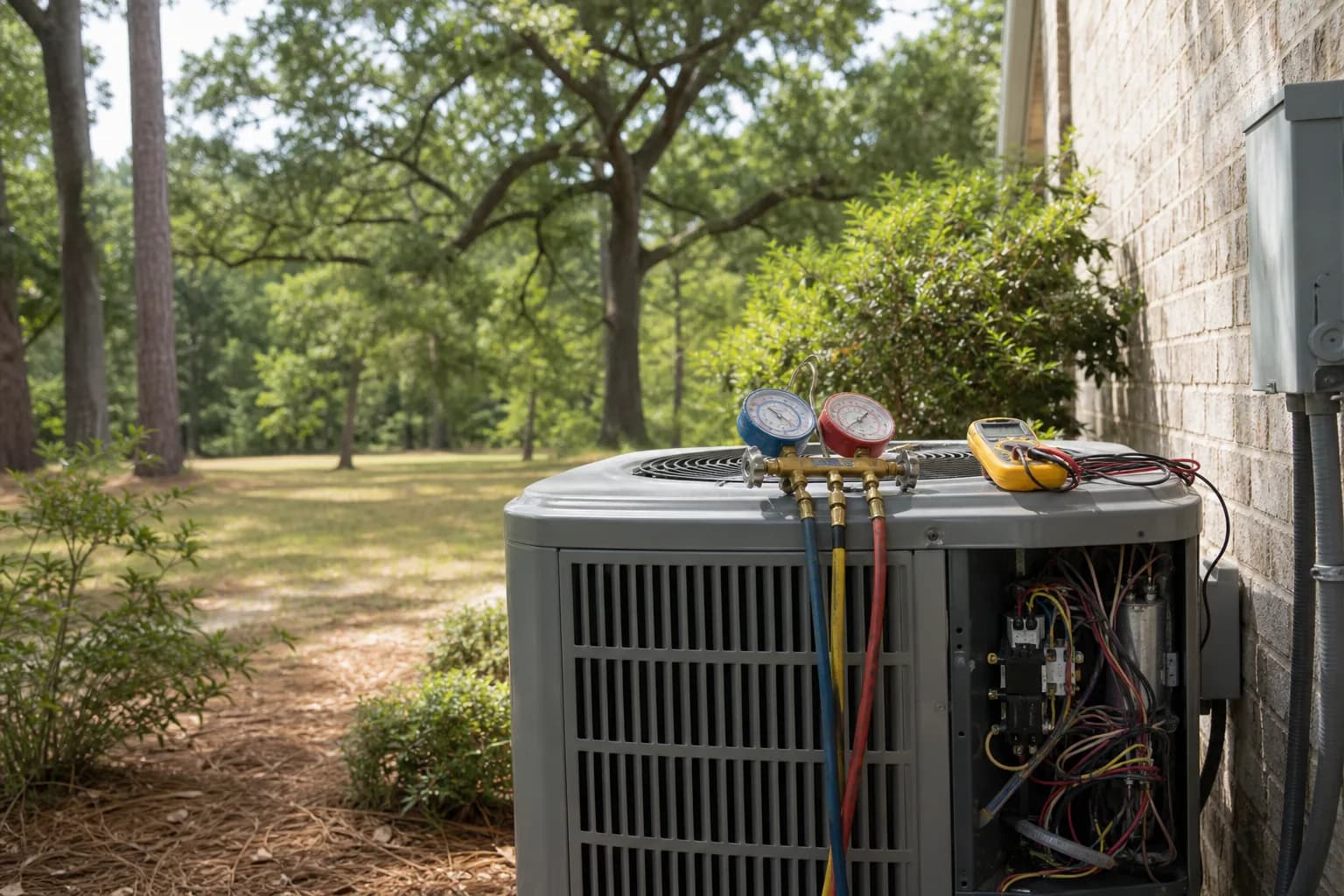
The outdoor AC unit at your Magnolia Springs home is making a humming or buzzing sound but the fan isn't spinning and the air inside isn't cooling. This is one of the most common AC failure presentations in summer, and 80% of the time it's the same diagnosis. Here's how to identify it and what to do immediately.
The most likely cause: failed run capacitor
Walk to the outdoor unit. With the AC trying to run (thermostat calling for cool):
- Look at the fan on top. Should be spinning steadily. If it's still while you hear humming — capacitor failure.
- Listen carefully. Steady electrical hum (not mechanical) coming from the unit casing.
- Check the time. How long has it been making the sound?
If the fan is still while humming continues, this is almost certainly a failed run capacitor. The compressor is trying to start but can't get enough electrical surge.
What to do immediately
Step 1: Turn the AC off at the thermostat. Don't let it keep trying to start. Each failed attempt damages the compressor.
Step 2: Note the symptom clearly for the call. "Outdoor unit hums but fan won't spin" tells our techs to bring a capacitor.
Step 3: Call (251) 300-9817. Magnolia Springs calls get same-day priority routing during business hours, and our 24/7 emergency dispatch covers you after hours. Capacitor replacement is usually completed in 30-45 minutes.
Step 4: Don't try to "spin the fan" with a stick. This trick is in some online videos. It can sometimes start a marginal capacitor temporarily, but you're putting yourself near energized electrical components and a moving fan blade. Skip it.
Why capacitors fail in Magnolia Springs
Three local factors compound capacitor wear:
1. Heat exposure. Capacitors are heat-sensitive. Magnolia Springs summers run condenser internal temperatures at 130°F+ for hours daily. Heat stress shortens capacitor life dramatically.
2. Humidity infiltration. Salt-air and humidity can corrode capacitor terminals and degrade internal dielectrics. Magnolia Springs sits along the Magnolia River — high humidity year-round.
3. Voltage events. Storm-related grid surges damage capacitors progressively. Each surge weakens the cap a bit; eventually one event finishes it. After-hurricane periods see spikes in capacitor failures.
A capacitor rated for 10 years in dry inland climate often fails at 5-7 years in Magnolia Springs.
What replacement involves
Standard capacitor replacement:
- Power-off at disconnect AND breaker (verified with meter)
- Capacitor discharged with resistor
- Old capacitor removed; wiring documented
- New capacitor installed (same microfarad and voltage rating)
- System tested — verify clean startup, fan rotation, compressor engagement
- Refrigerant pressures checked to confirm system operating normally
Total time: 30-45 minutes. You'll get a written estimate before we replace anything, so you approve the price up front. Cool Club members get 15% off all AC repairs.
What if it's NOT the capacitor
Other things that can present similarly:
Failed contactor. A relatively minor fix. Indicated by repeated clicking + no startup (rather than steady humming).
Failed start capacitor (separate from run cap). Some systems have both. Diagnostic identifies which is failed; the repair is comparable to a run capacitor replacement.
Compressor failure. The most expensive outcome — often a system-replacement conversation. Indicated by complete absence of humming combined with high amp draw on diagnostic.
Tripped overload protector. The compressor tripped its internal safety. May reset on its own after cooling; if it keeps tripping, real problem.
A real diagnostic identifies which one applies, and you get a written estimate before any repair.
Why you shouldn't try DIY
Three reasons capacitor work isn't worth attempting yourself:
1. Stored electrical charge. Capacitors store substantial voltage even after power is off. Touching the wrong terminal with a screwdriver can deliver a shock that knocks you off your feet — sometimes worse.
2. Wrong-sized replacement damages compressor. Capacitors are rated by microfarads (uF) and voltage. The correct part for YOUR system isn't always obvious from the cosmetic shape. Wrong cap = compressor damage over time.
3. Underlying issues missed. A failing capacitor is sometimes a symptom of compressor strain, refrigerant problems, or other issues. A pro diagnoses the root cause; DIY just replaces the part.
For a quoted, up-front fee, you get safe correct work plus diagnosis of any related issues.
Prevention
You can't fully prevent capacitor failure but you can extend life:
1. Annual professional tune-up. Includes capacitor microfarad testing. Catches degrading capacitors BEFORE they fail entirely (replacement on schedule vs emergency).
2. Surge protection at the disconnect. An affordable add-on. Reduces damage from voltage events. Highest single-ROI HVAC accessory in Magnolia Springs climate.
3. Adequate clearance around outdoor unit. Better airflow = lower internal temperatures = longer capacitor life. 24" minimum clear space all sides.
4. Annual coil cleaning. Clean coils reduce compressor strain, which reduces capacitor cycling stress.
For Cool Club members, capacitor degradation is caught at the two seasonal tune-ups before failure. Replacement on schedule means a planned visit instead of an emergency call.
Could surge protection have prevented this?
Often, yes — and it's worth understanding before the next storm season. Many capacitor failures on the Gulf Coast trace back to voltage events: each grid surge weakens the part a little until one finishes it, and post-storm periods reliably bring a spike in failures. Surge protection at the disconnect is an inexpensive add-on that absorbs those hits and is the highest single-ROI accessory for homes along the Magnolia River corridor. If a storm is on the way, pair it with the rest of our pre-hurricane AC checklist drawn from Sally. And if the buzzing turns out to be a dying compressor rather than a capacitor, our repair-versus-replace guide for coastal Alabama helps you weigh the next step.
Magnolia Springs-specific notes
Three factors specific to Magnolia River corridor properties:
1. Older home stock often has builder-grade equipment. Some brands have known capacitor reliability issues. Replacement to better equipment makes long-term sense.
2. Riverfront humidity is elevated. River-adjacent properties see 5-10% higher relative humidity than nearby inland. Capacitor stress is correspondingly higher.
3. Tree cover affects airflow. Many Magnolia Springs properties sit under the town's signature live oaks, and that established landscape crowds outdoor units and drops leaf litter onto the coil. Annual perimeter trimming matters. Restricted airflow is also a leading cause of a different summer failure — why an AC freezes up in the summer heat covers how a crowded or dirty coil ends in a block of ice.
Ready for AC repair in Magnolia Springs?
Air Solutions Heating & Cooling stocks capacitors for major AC brands on every truck — 90% of Magnolia Springs capacitor calls completed same-visit. Family-run, founded in Daphne, licensed AL#23194.
- Schedule AC Repair — same-day available
- Call (251) 300-9817 — emergency line 24/7
- AC Repair services — full overview
Related resources
- AC Repair in Magnolia Springs — city-specific service page
- All HVAC services in Magnolia Springs — every service locally
- What do those AC noises mean? Hissing, buzzing, clicking — decode the sound before you call
- AC not working? An Eastern Shore troubleshooting guide — the full no-cool checklist
- Cool Club Membership — preventive maintenance + benefits