
AC Short-Cycling in Magnolia Springs: Causes, Costs, and the Right Fix
AC short-cycling in Magnolia Springs, AL — what's causing it, what drives the repair cost, and why ignoring it shortens your compressor life.

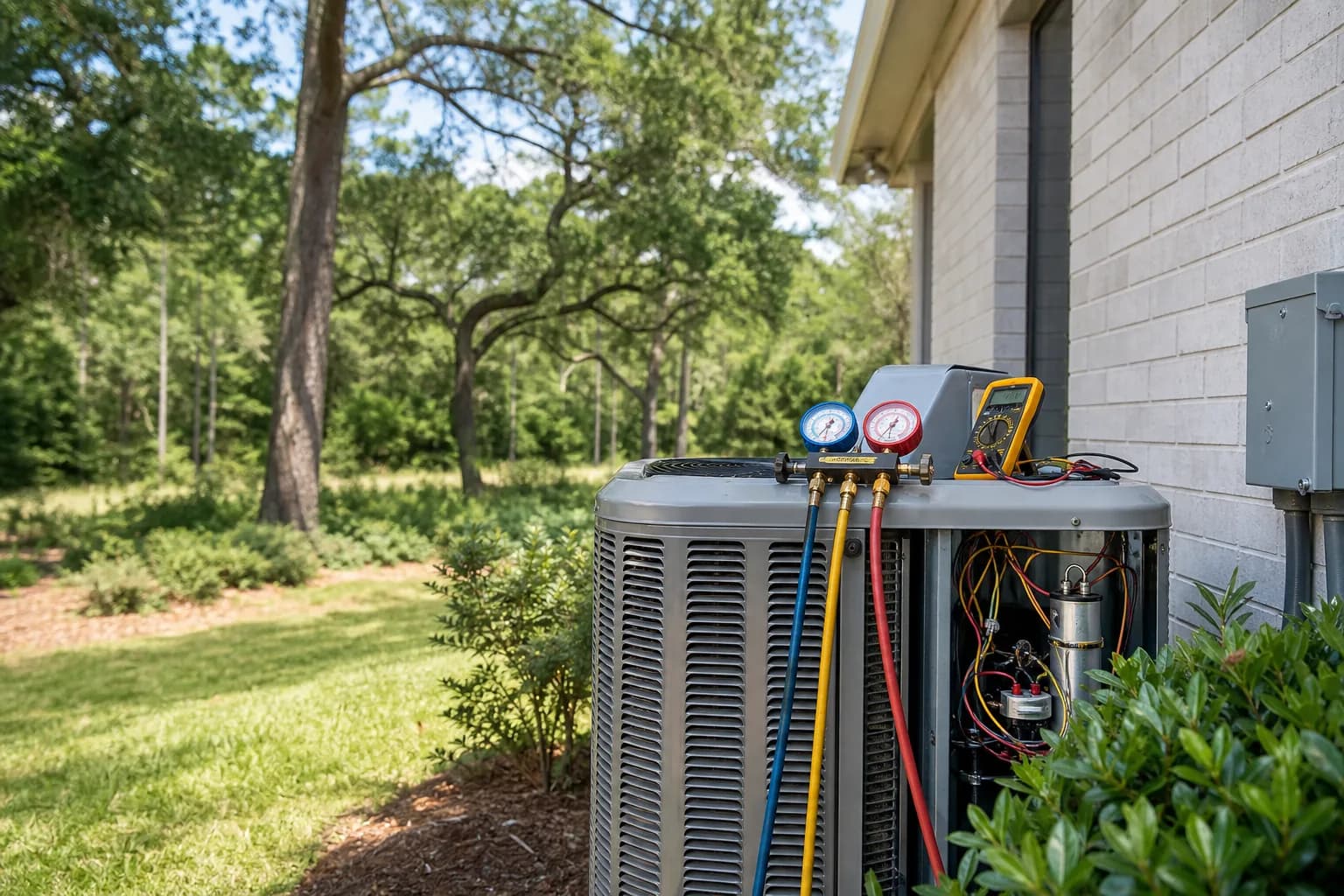
Your Magnolia Springs AC turns on, runs for two or three minutes, then shuts off. A few minutes later it kicks back on for another short burst. Repeat all day. The house never quite reaches the setpoint, and your utility bill is climbing despite the AC seeming to "run all the time."
That's short-cycling. It's hard on the equipment, miserable for comfort, and expensive on the bill. Here's what causes it and what's involved in fixing each cause.
What "short-cycling" really means
A normal AC cycle in Magnolia Springs during summer should run 10-20 minutes per cycle, removing both heat and humidity, then shut off for 10-30 minutes before the next cycle. Total: roughly 30-50% of total clock time during peak demand.
Short-cycling means cycles of less than 10 minutes — sometimes as short as 90 seconds. The compressor starts, draws huge inrush current, runs briefly, shuts off, then starts again moments later. The component that suffers most is the compressor itself, which is the single most expensive part in your system.
Industry numbers: a heavily short-cycling AC has roughly half the operational life of a normally-cycling unit. The compressor that should last around 12 years lasts 6-7 instead — and the compressor is the single most expensive part to replace.
The seven causes (in order of how often we find them in Magnolia Springs)
1. Oversized AC system
The single most common cause in Magnolia Springs homes. If your AC was sized by the rule-of-thumb method (1 ton per 500 sq ft) instead of a Manual J load calculation, it's almost certainly too big for your actual load.
How it short-cycles: the oversized system cools the temperature down quickly, satisfies the thermostat, and shuts off — without running long enough to do dehumidification or even reach steady-state operation. Then a few minutes later the room warms a couple degrees and the cycle repeats.
What's involved: This is the hard one. The real fix is right-sized equipment at the next replacement, sized by a Manual J load calculation rather than a rule of thumb. In some cases a variable-speed retrofit that can run at part-load is an option without a full changeout. The scope swings widely depending on which path fits your home, so we put it in writing after evaluating the system — your estimate is always free.
2. Low refrigerant from a leak
Low refrigerant causes the compressor to overheat and trip its safety. The system shuts down, cools off, restarts, runs briefly, overheats again, repeat.
What's involved: A leak search to pinpoint the source, the repair itself (which varies a lot by where the leak is), and a refrigerant recharge to spec. Location drives the cost more than anything, so we quote it once we've found the leak.
3. Iced evaporator coil
A frozen indoor coil from restricted airflow (clogged filter, dirty coil, blower issue) blocks airflow. The system trips its high-temperature safety. Once the ice melts, it runs for a few minutes and freezes again.
What's involved: Sometimes it's just a fresh filter you can swap yourself. If the coil is dirty, it needs a professional cleaning, and the underlying airflow problem gets diagnosed at the same visit. We confirm the scope before any work and give you the price up front.
4. Failed thermostat
A miscalibrated or failing thermostat reads incorrect temperature, causes the system to cycle on and off chasing a phantom setpoint.
What's involved: A replacement thermostat, installed and calibrated. The price depends mostly on which model you choose — basic programmable up to a full smart thermostat — and we'll walk you through the options.
5. Failed run capacitor
A weak capacitor causes hard starts. The compressor tries to start, can't get enough surge, trips its overload, waits a few minutes, tries again.
What's involved: A same-visit capacitor replacement. This is the most common spring service call we get, and we keep them stocked on every truck — so it's usually a quick, inexpensive fix quoted before we swap the part.
6. Electrical issue (loose wiring, failed contactor)
Loose or corroded electrical connections can cause intermittent power to the compressor. System cycles on and off as the connection makes and breaks.
What's involved: Tracking down the loose or corroded connection and repairing or replacing the affected part — often the contactor or a section of wiring. Common in older Magnolia Springs homes. The exact scope depends on what we find, and we price it before proceeding.
7. Bad placement / direct sun on outdoor unit
If your outdoor condenser sits in direct afternoon sun against a hot wall or in a poorly-ventilated location, the unit can't shed heat fast enough. It overheats and trips, then restarts.
What's involved: Adding a shade structure or relocating the condenser to a spot where it can shed heat. Scope ranges from a simple shade solution to a full relocation, so the cost varies — we'll assess your setup and quote the right approach for free.
How to diagnose at home
Before calling for service, gather data:
- Time the cycles. Get out a stopwatch. Time how long the AC runs per cycle, and how long it stays off. Record numbers.
- Check the filter. Replace if loaded. Wait 2 hours, then re-test cycle times.
- Look at the indoor coil. Visible ice? You have an airflow or refrigerant problem.
- Walk outside during operation. Listen for the outdoor unit cycling on and off. If only the indoor blower is running, the outdoor compressor is the problem.
- Check for warmth on the outdoor unit casing. Compressor that's tripped on overload is hot to the touch.
This information speeds up the diagnostic on a service call.
Why Magnolia Springs sees this more than dry climates
This is live-oak and river country — the Magnolia River corridor, Weeks Bay, and the historic district all sit in air that stays heavy with moisture most of the cooling season. That setting drives three local factors:
1. Humidity loads. Dehumidification work takes time, and short cycles can't do it. The persistent Gulf Coast humidity around Downtown Magnolia Springs makes oversized systems look adequate — they cool fast — while leaving the real comfort problem, humidity, unaddressed.
2. Older systems near waterfront. Coil corrosion from Magnolia River and Fish River moisture exposure causes early capacity loss. Aging compressors strain to make their rated output, which makes them run hot and cycle.
3. Builder-grade equipment in newer construction. Many Magnolia Springs homes built since 2015 came with builder-grade systems sized to a spec sheet, not to actual home performance under live-oak shade and river humidity. Short-cycling shows up at year 5-7 as the oversized capacity becomes obvious.
Why ignoring it costs more
The math on letting short-cycling continue:
- Compressor life cut roughly in half — instead of 10-12 years you get 5-7
- Higher utility bills — short cycles draw the inrush current repeatedly without sustained efficient operation; expect 15-25% premium
- Comfort loss — humidity stays high; rooms inconsistent
- Risk of catastrophic failure during peak demand — short-cycling systems often die spectacularly in mid-July
A professional diagnosis is a modest, up-front service charge. A compressor replacement once the part finally fails is one of the most expensive repairs on the system — which is exactly why catching short-cycling early pays off.
Ready to address short-cycling in Magnolia Springs?
Air Solutions Heating & Cooling provides AC diagnostics, repair, and replacement quotes across Magnolia Springs and the near-coast Baldwin County corridor. Family-run, founded in Daphne, licensed AL#23194.
- Schedule a Diagnostic — pick a time
- Call (251) 300-9817 — same-day available
- AC Repair services — full overview
Related resources
- AC Repair in Magnolia Springs — city-specific service page
- All HVAC services in Magnolia Springs — every service locally
- Service in nearby Foley — the closest hub to the south
- Repair vs Replace Calculator — run the math yourself
Related reading on sizing, humidity, and aging systems:
- What size AC do you need for a coastal home? — why oversizing causes short-cycling
- Why is my house still humid with the AC running? — the comfort problem short cycles leave behind
- Why does my AC freeze up in the summer heat? — one of the seven short-cycle causes, explained
- AC repair vs replace: when it's worth fixing in coastal Alabama — when a short-cycling system is near end of life