
Surviving Baldwin County's Worst Heat: How Your AC Handles 95°+ and Humidity
How residential AC actually copes with 95°+ heat and Gulf-Coast humidity across Baldwin County — design temperature, sizing, maintenance, and what's realistic to expect on the hottest afternoons.

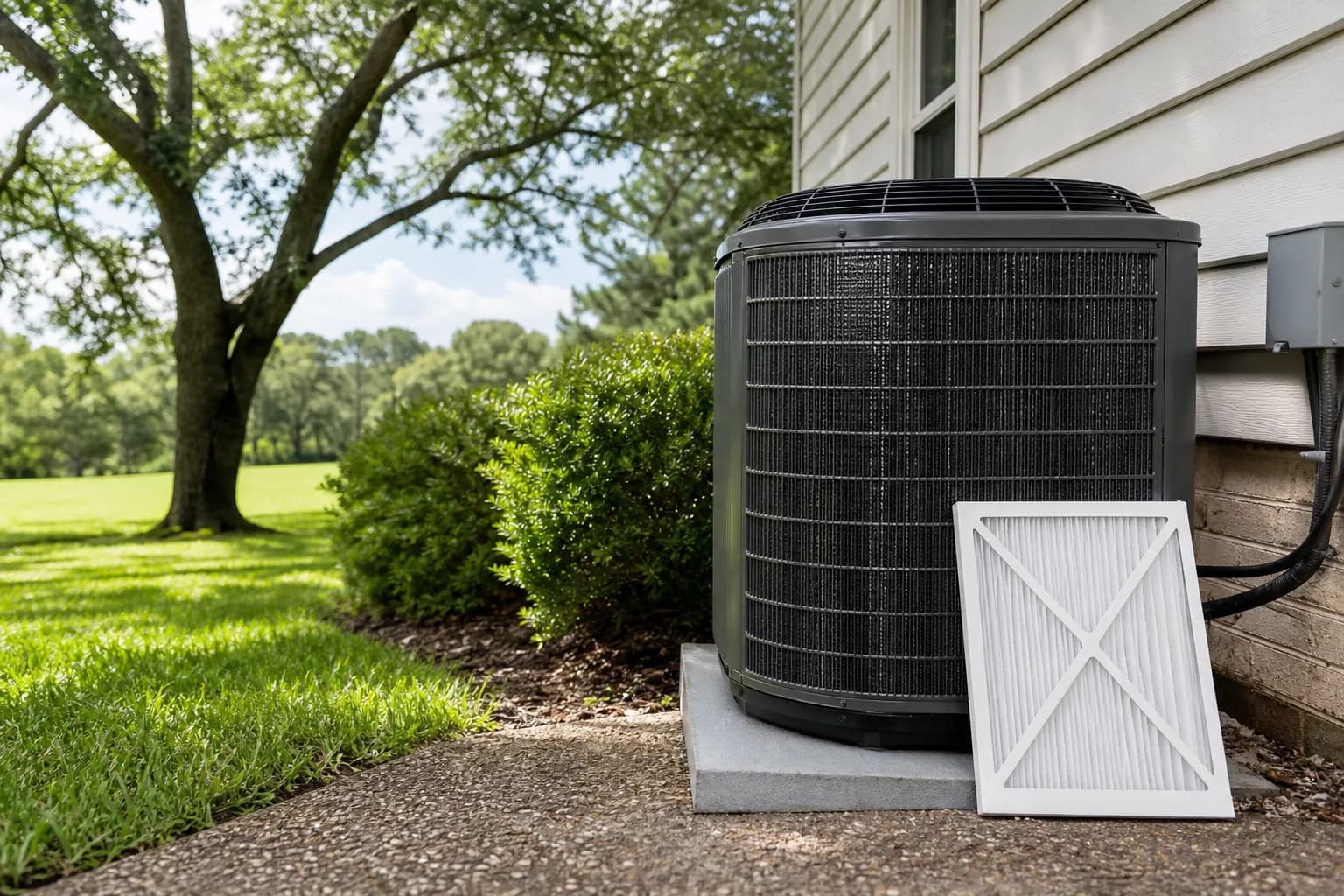
There's a stretch every Baldwin County summer — usually late June into August — when the dewpoint sits in the 70s and the thermometer climbs past 95° by mid-afternoon. The Eastern Shore commuter towns, the coastal strip down at Gulf Shores, and the open acreage up around Bay Minette all feel it differently, but every air conditioner in the county is wrestling the same two enemies at once: raw heat and heavy moisture. This is the week homeowners call us convinced something has broken, when often the equipment is doing exactly what it was built to do — just at the edge of what it was sized for.
This is the hub for our peak-heat series. Here we'll cover what your AC is really fighting on those afternoons, why a number called "design temperature" quietly decides whether your house ever reaches setpoint, why humidity is the part of the job nobody talks about, and what's reasonable to expect before something is genuinely wrong. The city-specific guides linked at the bottom go deeper on the problems particular neighborhoods see.
What your AC is actually doing in a heat wave
An air conditioner doesn't "make cold." It moves heat — pulling warmth and moisture out of your indoor air and dumping both outside through the condenser. On a mild day that's an easy trade. On a 96° afternoon with a soupy dewpoint, the outdoor unit is trying to reject heat into air that's already hot, while the indoor coil is trying to wring water out of air that's already saturated.
Two things happen as the day peaks:
- Capacity drops as it gets hotter. A system rated to remove a certain amount of heat at moderate conditions delivers measurably less when the outdoor air is 95°+. The hotter the air the condenser has to dump into, the less efficiently it works. So your AC has the least capacity exactly when your house has the most heat to shed.
- The latent load climbs. "Latent" load is the moisture. On a dry hot day, most of your system's effort goes to lowering temperature. On a humid Gulf-Coast day, a big share goes just to removing water — and that's effort not going toward dropping the thermostat number.
So a system can be running flawlessly and still gain ground slowly in the afternoon. That's physics, not a fault.
Design temperature: the number that decides everything
Here's the concept most homeowners have never heard of, and it explains more comfort complaints than anything else we measure.
When a system is sized correctly, an installer picks a design temperature — the outdoor condition the equipment is engineered to hold your setpoint against. For our part of Alabama, a sensible cooling design temperature sits in the low-to-mid 90s. The deal built into that number is this: at design conditions, a right-sized system runs nearly continuously and just maintains your indoor target. It is not built to hold 72° while it's 99° outside and the unit is cycling off between runs.
This is also why oversizing backfires. A unit sized for a once-a-decade extreme will short-cycle the other 95% of the summer — blasting the temperature down fast, shutting off before it has pulled enough moisture from the air, and leaving the house cool but clammy. Bigger is not better on the Gulf Coast. Right-sized is better.
Humidity is half the comfort battle
Two homes can read 75° on the thermostat and feel completely different. The one at 50% relative humidity feels crisp; the one at 65% feels heavy and warm. That's because your body sheds heat partly by evaporating sweat, and muggy air slows that down. It's the same reason 88° in Arizona and 88° on Mobile Bay are not the same experience.
A healthy AC quietly dehumidifies every time it runs. But it can fall behind when:
- The system is oversized and short-cycles, never running long enough to drain real moisture.
- Airflow is wrong — too high across the coil and it won't condense water; too low and it can ice up.
- Ductwork leaks pull humid attic or crawlspace air into the system.
- The fan is left in the "on" position instead of "auto," re-evaporating coil moisture back into the house between cooling cycles.
If your house is cool but sticky in July, the fix usually isn't a bigger AC. It's airflow, runtime behavior, duct sealing, or — in tighter or larger homes — dedicated dehumidification.
How geography changes the fight across the county
Baldwin County isn't one climate, and the failure patterns track the map:
- Eastern Shore (Daphne, Fairhope, Spanish Fort, Montrose). A mix of older bay-adjacent homes and newer subdivisions. The common theme is afternoon sun load and homes that were re-equipped without anyone checking whether the old ductwork could carry the new airflow. Two-story homes here see hot upstairs rooms.
- Coastal strip (Gulf Shores, Orange Beach, Fort Morgan). Salt air loads coils and filters faster, and the rental stock runs hard with doors opening all day. Humidity control is the headline issue.
- North and inland county (Bay Minette, Stockton, Stapleton, Rosinton). Bigger lots, longer duct runs, and homes where the outdoor unit may sit in full unshaded sun all afternoon — which directly raises the temperature it has to dump heat into.
Same heat wave, different bottlenecks. The diagnostic always starts with the same questions, but where it ends depends on the house.
What good maintenance actually buys you in summer
You can't change the weather, but you can keep the system at full capability so it isn't giving away performance it doesn't have to:
- A clean condenser coil. A dirty outdoor coil is like running with a blanket over the unit — it can't reject heat, and capacity falls right when you need it.
- A fresh filter. A loaded filter chokes airflow, which hurts both cooling and dehumidification. On the coast, filters load faster than the box suggests.
- Correct refrigerant charge. Low charge silently steals capacity and is invisible without gauges. A system slightly low limps along in spring and then can't catch up in July.
- Clear drainage. Humid air means lots of condensate; a clogging drain line can shut the system down on the worst possible day.
- Verified airflow. Static pressure and blower speed determine whether the coil can do its moisture job at all.
What's normal, and when to actually worry
Use this as a gut check before you assume a breakdown:
- Normal: the system runs nearly nonstop on a 95°+ afternoon and holds within a couple degrees of setpoint, then catches up once the sun drops.
- Normal: the house is a touch warmer at 5 p.m. than at 9 a.m. on the hottest day of the year.
- Worth a call: the indoor temperature keeps drifting up through the afternoon with the system running continuously.
- Worth a call: a system that comfortably held setpoint last summer suddenly can't this summer — that's usually a fixable decline (charge, coil, capacitor, airflow), not the weather.
- Worth a call: it's cool but persistently sticky and humid indoors.
- Stop and shut it off: ice on the refrigerant lines or indoor coil, or water pooling around the indoor unit.
The honest truth is that some of these afternoons are simply hard on equipment, and a right-sized, well-maintained system doing its best is the goal — not a house that feels like a meat locker at 4 p.m. in August.
Ready to get your AC ready for peak heat in Baldwin County?
Air Solutions is a family-run shop founded in Daphne in 2023, licensed in Alabama as AL#23194 and BBB A-rated. We cover the whole county — Eastern Shore, coast, and inland — and we'll tell you honestly whether your system is healthy, borderline, or genuinely undersized for our summers. Free estimates and free second opinions, and we quote any work in writing before it starts.
- Schedule maintenance — a pre-peak check of coil, charge, airflow, and drainage.
- Call (251) 300-9817 — questions answered, 24/7 dispatch when the heat won't wait.
- AC maintenance services — what a visit covers and why it matters in our climate.
Related resources
The city-specific guides in this series go deeper on the patterns particular neighborhoods see. If your system runs all day yet the house still creeps up by late afternoon, the Daphne breakdown of an AC that won't cool at peak heat walks the causes in order. Two-story owners losing the second floor should read why upstairs rooms in Foley never cool down. And when the complaint is dampness rather than heat, whether a whole-home dehumidifier is worth it in Baldwin County covers the moisture side.
- AC repair services — when "can't keep up" turns into a real fault.
- AC installation services — load calculations and right-sizing for Gulf-Coast summers.
- AC service in Daphne — Eastern Shore homes and afternoon sun load.
- AC service in Gulf Shores — coastal humidity and salt-air coil loading.