
Weak AC Airflow in Daphne: Filter, Duct, or Blower? Diagnose It Yourself
Vents barely pushing air in your Daphne, AL home? Follow the air from filter to registers to blower to ductwork — a homeowner's path to pinpoint weak airflow before you call.

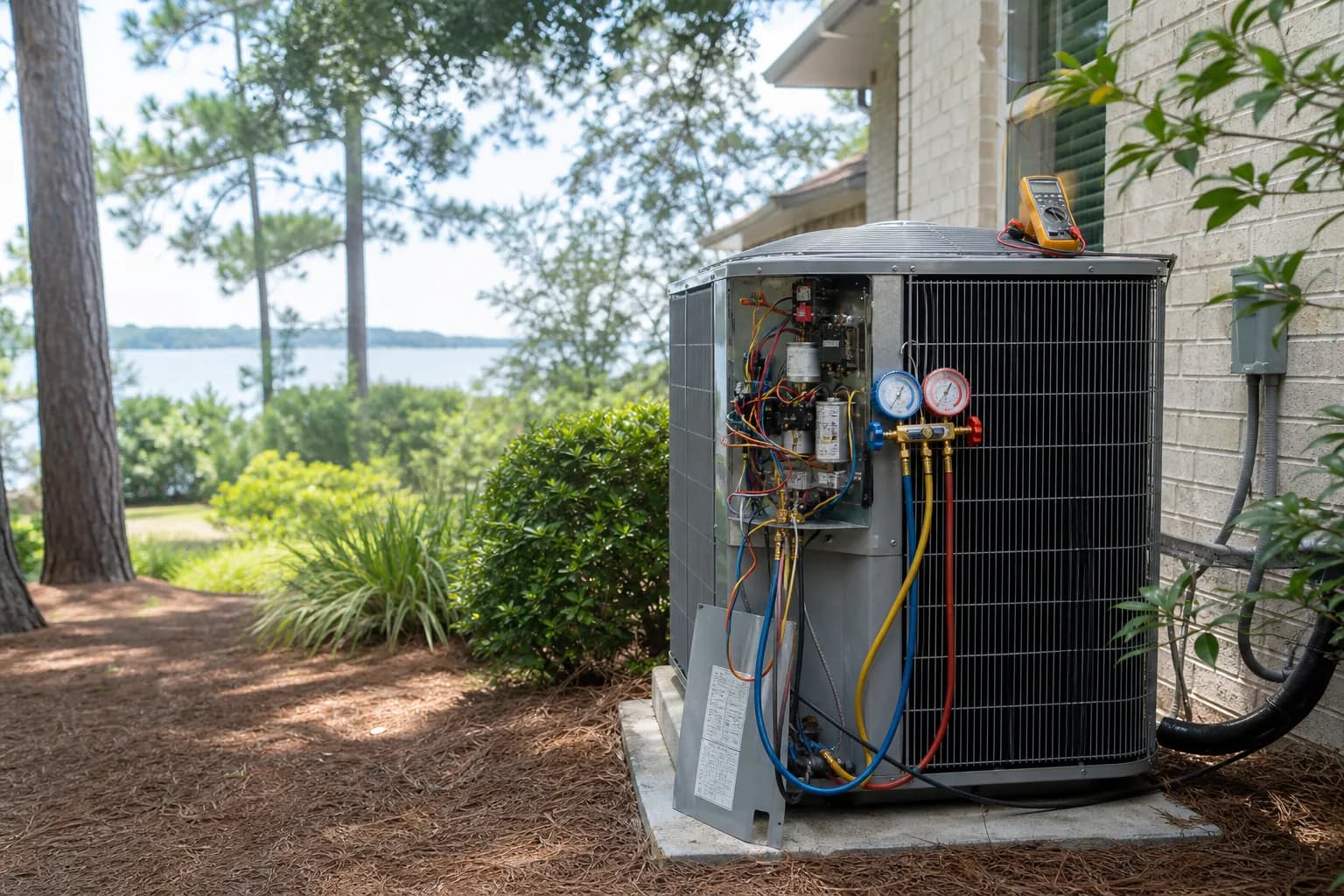
A lot of older Daphne homes sit under big live oaks on the Eastern Shore, and they have a quirk worth naming: the back bedroom never quite keeps up in summer. You hold your hand to the vent and the air is cool enough, there's just not much of it — a lazy push where there ought to be a steady stream. The thermostat reads fine in the hallway, but the far rooms stay stuffy and the Mobile Bay humidity creeps in. We see it from the established streets of Olde Towne Daphne to the newer builds out in Jubilee Farms and Lake Forest.
Weak airflow is its own distinct complaint, separate from "no cool" or "warm air," and the encouraging news is that you can trace it a long way yourself. The trick is to follow the air in the same order it travels through your system — from where it enters, to where it leaves, to what moves it, to what carries it. Work that path and you'll usually land on the cause, or at least hand your tech a precise starting point instead of a shrug.
Why is airflow the symptom worth chasing?
Before the diagnosis, here's why it's worth your half hour. Weak airflow isn't just a comfort gripe in the far rooms — it forces the whole system to work against itself. Starved of air, the coil runs colder than designed and can tip into a freeze; the system runs longer cycles trying to satisfy a thermostat it can't reach; humidity climbs because the air isn't turning over fast enough to wring out moisture; and all that extra runtime is wear you're paying for. Solve the airflow and a surprising number of "my AC is weak and my power bill is high" problems solve themselves.
Follow the air, one stage at a time
Run these in order. Each stage either clears itself or points you to the next, and none of it requires tools or any risk.
Start where the air enters — the filter
Pull the filter and look through it toward a light. Caked, gray, or hard to see through means it's choking the system, and a loaded filter is the most common airflow killer there is. Daphne's oak pollen and dust load them fast. Swap it, run the system, and recheck the vents before doing anything else.Walk the rooms — is it everywhere or just some?
With the AC running, hold your hand at every supply register in the house. Weak air at one or two rooms but strong elsewhere points to a duct problem feeding those rooms. Weak air at every register points upstream, to the blower or a system-wide restriction. This single observation splits the diagnosis in half.Check the returns and registers
Make sure the return grille isn't blocked by a couch, a bookshelf, or drapes — the system has to pull air in before it can push it out. Confirm supply registers are open; closing vents to 'send air elsewhere' usually backfires by raising pressure and choking flow overall.Listen at the air handler — the blower
Open the indoor unit's closet while the AC runs. You should hear a strong, steady fan. A weak, slow, or barely-there sound suggests a tiring blower motor or weak blower capacitor; a squeal or grind points to bearings. Note what you hear — that detail tells a tech a lot before they arrive.
If a fresh filter and clear returns bring the air back, you're done — set yourself a reminder to change the filter on a schedule. If not, what you found in the walk-through tells you where to look next.
When the ductwork is the real story
Older Eastern Shore homes are where ducts earn their reputation. Many Daphne houses have had additions, conversions, and re-runs over the decades, and the duct system rarely got upgraded to match. If your walk-through pointed at specific rooms, the duct feeding those rooms is the prime suspect, and the usual findings are:
- Crushed or kinked flex duct in the attic — stepped on during other work, pinched at a turn, or sagging where a strap let go.
- A disconnected duct that's come loose at a joint and is dumping cool air into the attic instead of the room.
- Undersized or leaky runs to additions that were tied into a system never sized for them.
- Crimped takeoffs where a branch leaves the main trunk at too sharp an angle.
You can sometimes spot an obvious crushed or detached run from the attic access, but tracing and correcting ductwork is a job for a tech with the instruments to measure where the pressure is being lost.
When it's the blower
If the air was weak at every register and the filter was clean, the suspect moves to the blower — the indoor fan that moves all your air. A blower motor losing strength, a weak blower capacitor, or a wheel caked with grime all cut the volume of air the system can push. A blower issue is a professional diagnosis and repair, but it's a routine one; the part is far less expensive than the compressor it helps protect. If you heard squealing or grinding at the air handler, mention it — that's bearings, and it's worth not putting off.
Knowing when you've done enough
You've done the smart, honest triage and it's time for a tech when:
- A clean filter and open returns didn't restore the airflow.
- Specific rooms stay weak after the filter change — ductwork.
- Every register is weak with a clean filter — likely the blower.
- You hear the blower struggling, squealing, or grinding.
- The system has run weak for a couple of weeks and indoor humidity is climbing.
None of that is a failure on your part — you've narrowed it down to where a tech can go straight to the cause. We measure the airflow and the static pressure on your system, find where it's being lost, and quote whatever the fix is in writing before any work begins.
Ready to get the air moving in Daphne?
Air Solutions is a family-run shop founded in Daphne in 2023, licensed in Alabama as AL#23194 and BBB A-rated, and we know the older homes on the Eastern Shore. If your vents are weak, let's find out where the air is going.
- Schedule AC repair — same-day when we can; we'll confirm by phone.
- Call (251) 300-9817 — 24/7 emergency dispatch.
- AC repair services — full overview.
Related resources
Starved airflow rarely travels alone. When a coil runs colder than designed, it can tip into a freeze — here's why an AC coil ices over on a 95-degree afternoon and how to handle it. If the air is strong but the house still loses ground at the worst hour, the Daphne guide to an AC that runs all day and won't cool covers the other causes. And when the weak rooms are all upstairs, hot upstairs rooms in two-story homes is the related duct-and-distribution story.
- AC repair in Daphne — our local service page.
- All HVAC services in Daphne — everything we offer in town.
- Cool Club membership — tune-ups that keep filters, blowers, and coils in shape.
- The Field Guide — more plain-English HVAC help for Baldwin County.