
What a Power Outage and Sudden Restoration Does to Your AC in Fairhope
When the power snaps back on in Fairhope after a storm outage, the inrush can damage your AC compressor. Here's why you should switch the thermostat off and wait.

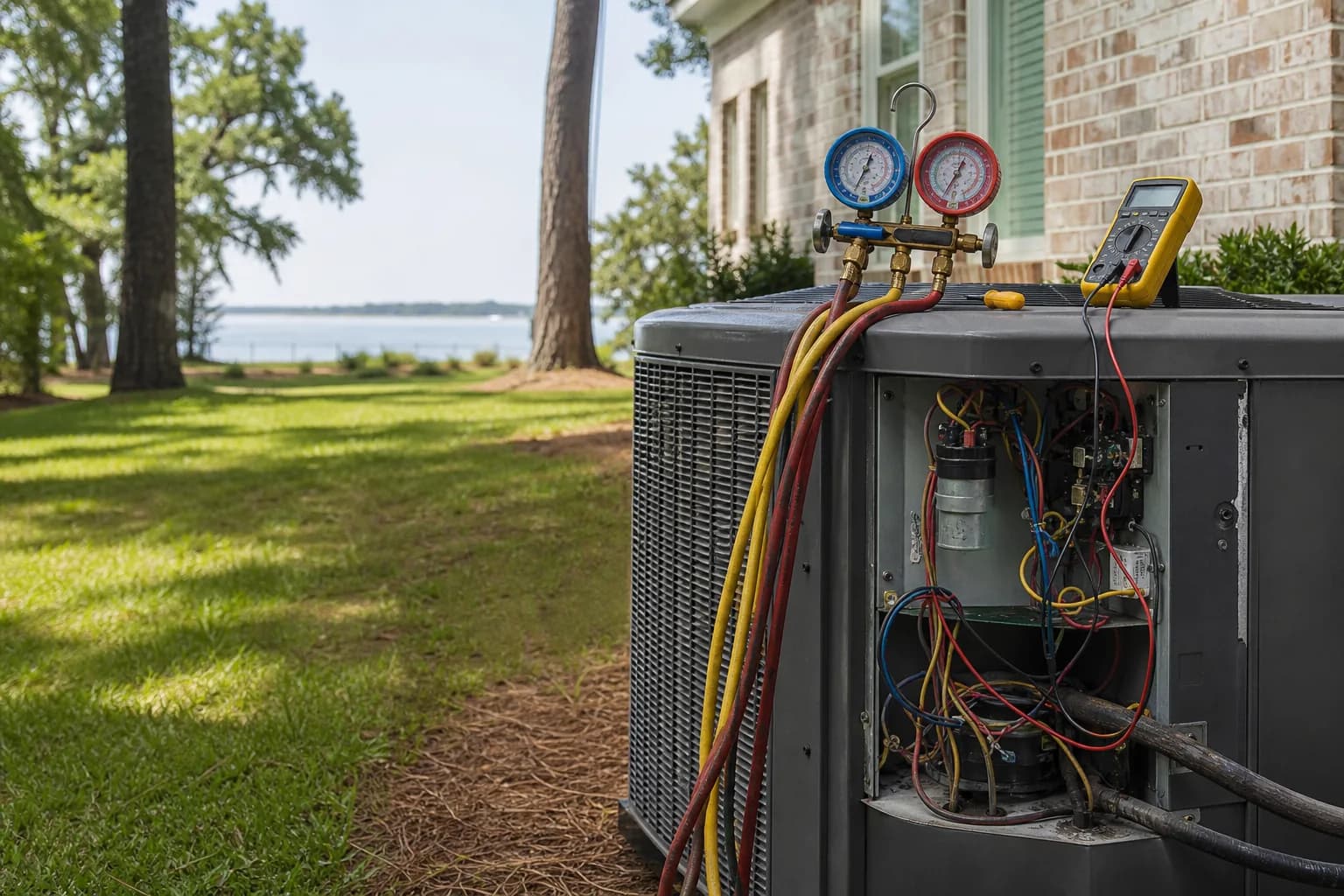
The lights flicker, then everything goes dark. A summer storm has knocked out power along the bluff in Fairhope, and the whole neighborhood goes quiet — no hum from the refrigerator, no whoosh from the vents. You light a candle, you wait it out, and an hour later the power comes roaring back. The lights snap on, the appliances chirp, and your AC kicks straight into gear. Crisis over, right?
Not quite. That moment when the power returns is one of the hardest things your air conditioner will go through all year, and most homeowners don't realize they can prevent the damage with a single move at the thermostat. Let me walk you through what's happening in those few seconds — and the simple habit that protects the most expensive part of your system.
The danger isn't the outage — it's the comeback
An outage itself is harmless to your AC. The system is just off, the same as if you'd switched it off yourself. The trouble starts the instant the utility restores power, and it comes in two flavors.
First is the restoration surge. When the grid recloses a circuit, voltage doesn't always come back clean. There's often a spike — a brief overvoltage as the system stabilizes — and on storm days that can be paired with the same lightning-induced surges that travel the lines. That spike is hard on control boards and capacitors.
Second, and more damaging, is the inrush on the compressor. Your compressor is essentially a large motor pumping refrigerant under pressure. When it shut off during the outage, the refrigerant in the system was still under high pressure on one side. A compressor is designed to start against balanced pressure — that's why a healthy system waits a few minutes between cycles, to let pressures equalize. When power slams back on and the compressor is commanded to start immediately against unequalized pressure, it draws a massive inrush of current and strains to overcome that load. Do that once and it might shrug it off. Do it repeatedly, storm after storm, and you're grinding years off the compressor's life.
The one move that protects your compressor
Here's the habit worth building in Fairhope, where bay storms make outages a regular summer event.
When the power goes out, switch the thermostat to OFF
Don't just let the system sit armed waiting for power. Walk to the thermostat and set it to OFF. This guarantees the compressor will not try to start the instant the grid comes back. Do this early in the outage, while you're thinking of it.When power returns, wait before you restart
Give it a few minutes after the lights come back on. Let the voltage settle and let the refrigerant pressures in the system equalize. There's no precise stopwatch rule worth obsessing over — a short, calm wait is the whole point.Turn the system back on deliberately
Set the thermostat back to COOL and your normal temperature. Now the compressor starts under conditions it's designed for, instead of being jolted awake against high pressure during a messy restoration.Listen and feel for the first cycle
When it kicks on, check that the outdoor fan is spinning, the air at the vents turns cold within a few minutes, and there are no new hums, buzzes, or clicks. A clean first cycle is a good sign.
That's it. It costs you nothing and it sidesteps the single most avoidable cause of storm-season compressor strain we see on the Eastern Shore. For the full checklist on bringing a system back up safely after the lights return, see our safe power-back-on sequence.
What are the signs your AC took a hit when the power came back?
Sometimes the damage is already done before you read this, or the system was vulnerable and the surge finished the job. Watch for these in the hours and days after an outage:
- It hums but won't start. A buzzing outdoor unit with a still fan is a classic failed-capacitor signature, and surges are a common trigger. Switch it off at the thermostat if you see this — letting it buzz cooks the motor. (More on this exact failure in our piece on why the capacitor is the most common summer no-cool repair.)
- The breaker trips when it tries to start. Repeated trips after an outage point to a compressor straining on inrush or a short. Don't keep resetting it; that just sends another surge through a struggling component.
- It short cycles. Starting and stopping every minute or two often means a confused or damaged control board, or a compressor that can't get over its starting load.
- No cold air despite the fan running. Strong airflow that simply isn't cold points outdoors — the compressor or refrigerant side took the brunt of it.
- New error codes on a smart or communicating thermostat. Dirty power can scramble the logic on these systems.
If you see any of these, the smart move is to shut the system off and call rather than force it to keep running. A compressor that's been wounded by a surge will sometimes limp along for days before it fails outright, and running it hard in the meantime only hastens the end.
A note for the bayfront and older bluff homes
Fairhope's mix of historic bluff homes and newer construction means a wide range of electrical situations. The older houses in the Fruit and Nut District near downtown sometimes have aging panels and overhead service that's more exposed to storm surges, while waterfront properties along Scenic 98 and out toward Point Clear catch weather coming straight off Mobile Bay. Whatever the vintage, the thermostat-off habit applies — and if your home loses power often, it's worth asking us about layered surge protection so the equipment has a hardware backstop, not just a careful homeowner. Protecting the controls and the compressor with surge devices is the companion step to the habit described above, and we explain how that hardware protects the compressor in its own guide.
Ready to check your AC in Fairhope?
Air Solutions Heating & Cooling diagnoses post-outage AC problems and installs surge protection for Fairhope and the Eastern Shore. Family-run, founded in Daphne, licensed AL#23194 with a BBB A rating.
- Schedule AC service — same-day when we can; we'll confirm by phone
- Call (251) 300-9817 — 24/7 emergency line for no-cool situations
- AC Repair services — full overview
Related resources
- AC Repair in Fairhope — city-specific service page
- All HVAC services in Fairhope — every service locally
- The Field Guide — more Baldwin County HVAC reading