
Refrigerant Leak Repair in Fairhope: Why Top-Offs Don't Solve It
Why refrigerant top-offs are bad practice in Fairhope, AL — what real leak repair involves, what each leak type costs to fix, and how to spot a contractor cutting corners.

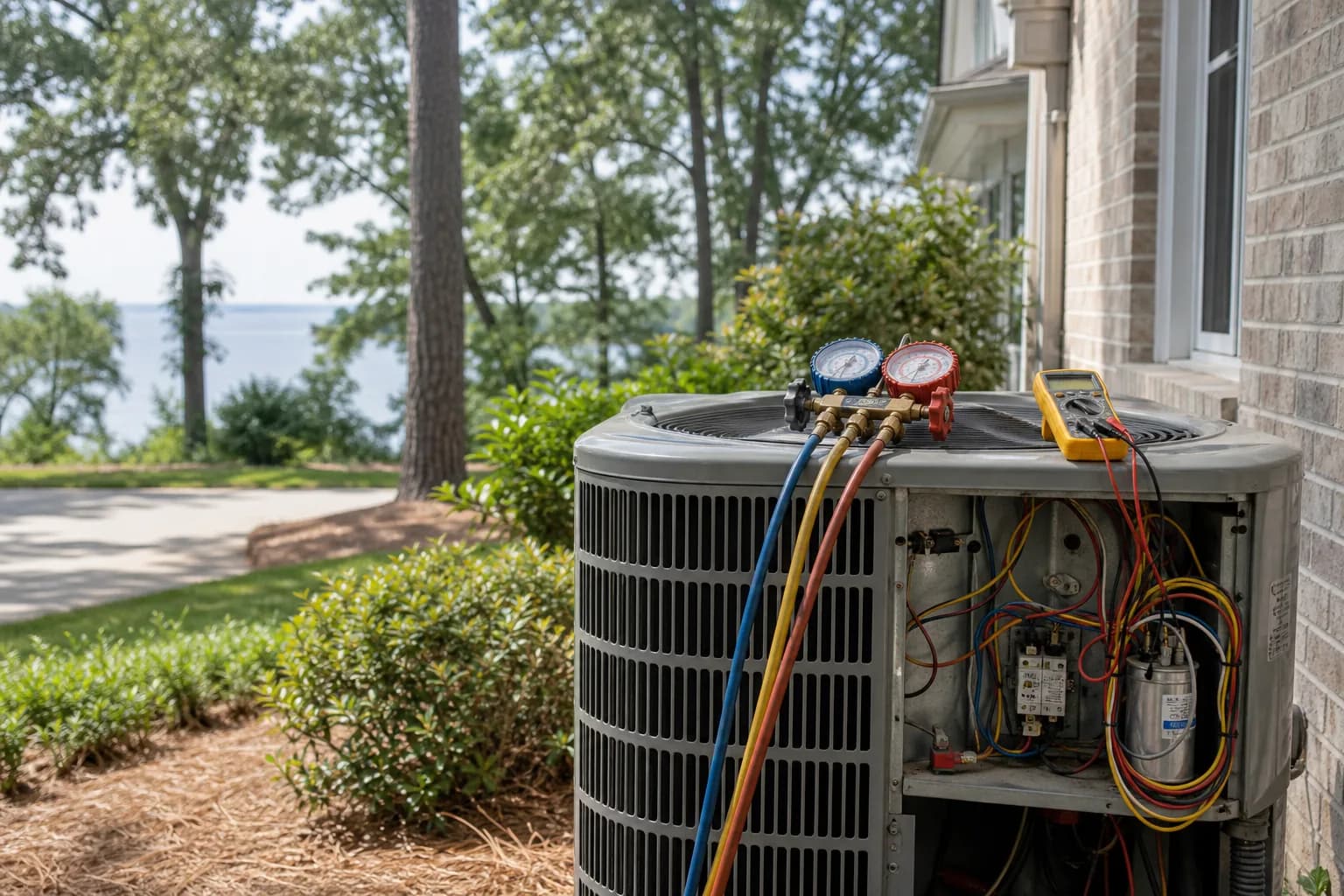
When your Fairhope AC starts cooling poorly and a tech says "it's low on refrigerant," the lazy fix is to add more and call it done. The right fix is to find the leak, repair it, and recharge to spec. Here's why the difference matters.
AC systems are sealed circuits
Your AC contains a fixed refrigerant charge — typically R-410A in 2010-2025 systems, or R-32/R-454B in newer installs. The refrigerant cycles through the compressor, condenser, expansion valve, and evaporator coil continuously without consumption.
If your system is low on refrigerant, you have a leak. There's no other way for refrigerant to disappear. Top-offs without leak repair just delay the inevitable repair while the customer pays for refrigerant that leaks back out.
Why "top-off" became standard practice (and why it's wrong)
Three reasons many shops sell top-offs:
- It's billable labor + materials. Refrigerant carries a real per-pound cost, and the markup on it is significant.
- Customers don't know systems are sealed. They accept the recommendation.
- It "fixes" symptoms temporarily. Cooling returns for a few months until the system loses charge again.
The result: many Fairhope homeowners pay for top-offs over years that masked actual leaks until catastrophic compressor failure.
What real leak detection involves
A legitimate Fairhope leak search uses one or more of:
Electronic refrigerant detector — handheld device that sniffs for refrigerant gas escaping the system. Tech walks every joint, lineset section, and coil surface.
UV dye injection — a small amount of fluorescent dye is added to the refrigerant. The system runs for a few days, then the tech returns with a UV light to check every connection. Leak sites glow yellow-green.
Pressure test with nitrogen — system is drained of refrigerant, pressurized with nitrogen to manufacturer spec, and held. Pressure drop indicates leak; tech listens for hiss at suspect joints.
Soap-bubble test — diluted soap solution applied to suspect joints. Bubbles form at leak sites.
A real leak search adds 1-2 hours to a service call. It's worth the time.
Common leak locations in Fairhope systems
Fairhope spans a wide range of homes — historic places near the Pier and the Fruit and Nut District, established neighborhoods off Greeno Road, and newer builds out toward Point Clear and Scenic 98 — but salt-air proximity to Mobile Bay drives a consistent pattern. Eastern Shore equipment leaks most commonly at these points, roughly in order from least to most involved to fix:
1. Schrader valves (service ports). The easiest to find and the cheapest to repair, often just a valve core or cap.
2. Brazed joints at coil connections. A mid-level repair: re-brazing or replacing fittings.
3. Lineset where it enters the unit casing. Vibration wear over years; a moderate repair.
4. Evaporator coil tubing. One of the more expensive locations. Often means coil replacement, which on aging systems triggers a replace-vs-repair conversation.
5. Outdoor condenser coil corrosion. Especially common in Eastern Shore homes with salt-air drift, and typically the most expensive of the group since it usually means a full coil replacement.
Because the cost swings so widely by location, the only honest number is the one tied to your actual leak. We'll diagnose first and then give you a written quote — and our estimates are free.
What good service looks like
Here's what should happen at your Fairhope service call if low refrigerant is suspected:
Step 1: Verify low refrigerant with gauges. Read suction and head pressures. Calculate superheat and subcooling. Compare to manufacturer spec for the equipment + outdoor temperature. If actually low (not just at the low end of normal), proceed.
Step 2: Inspect for obvious damage. Walk the lineset, look at coil for visible signs (oil stains, corrosion, ice patterns), check around the unit.
Step 3: Recommend leak search. Quote the additional labor. Get authorization before proceeding.
Step 4: Find the leak using methods above.
Step 5: Quote the repair based on leak location.
Step 6: Repair the leak. Recharge the system to manufacturer spec.
If a tech skips steps 3-5 and just adds refrigerant, they're charging you to delay fixing your problem.
When to refuse a top-off
Hard pass on any of these:
- The tech hasn't put gauges on your system
- The tech says "you're a little low" but won't show actual readings
- It's listed as a routine item on a "premium tune-up" package
- You weren't asked to authorize additional work
- Your system has had this same complaint for multiple years
What to ask
If a contractor recommends refrigerant work in Fairhope, ask:
- "What were the actual pressure readings?" Get numbers in writing.
- "What's the superheat / subcooling?" Real diagnostic measurements.
- "Did you find the leak source?" If yes, where. If no, why are we adding refrigerant?
- "What's the cost of repair vs adding refrigerant?" Forces honest math.
Why leak repair vs top-off matters financially
The economics, without the dollar signs:
Top-off without repair looks cheaper on the day of the visit, but you pay for refrigerant again and again — typically every several months as the leak keeps weeping out the charge. Worse, running chronically low strains the compressor, and a failed compressor (or an early full-system replacement) dwarfs the cost of the original repair.
Leak repair + recharge is a single, larger expense up front: diagnostic and leak search, the repair itself (which varies by location), and a proper recharge to spec. In return, the compressor is protected and the system runs at full capacity instead of limping along.
For most Fairhope systems, repairing the leak once beats paying for repeated top-offs — and the only way to know your real numbers is a diagnosis. We give a written quote after we find the leak, and the estimate is free.
When refrigerant work signals "replace instead of repair"
Strong replacement signals:
- System is 12+ years old AND has a coil leak
- Refrigerant is R-22 (phased out — repairs are exorbitant)
- A coil leak whose repair quote approaches the cost of a new system
- Multiple repair history in past 3 years
- Compressor showing strain indicators
If 2+ apply, run the math on replacement.
Ready for honest refrigerant service in Fairhope?
Air Solutions Heating & Cooling does refrigerant work the right way: gauges first, leak search second, repair third, recharge last. No top-offs without diagnosis. Family-run, founded in Daphne, licensed AL#23194.
- Schedule AC Service — pick a time
- Call (251) 300-9817 — same-day available
- AC Repair services — full overview
Related resources
- AC Repair in Fairhope — city-specific service page
- All HVAC services in Fairhope — every service locally
- Service in nearby Daphne — our home base just up Scenic 98
- HVAC Glossary — definitions for refrigerant, superheat, subcooling
Go deeper on leaks, salt air, and the repair-or-replace call:
- Salt air and your AC: how far from Mobile Bay does corrosion matter? — why Eastern Shore coils leak first
- AC repair vs replace: when it's worth fixing in coastal Alabama — running the math on a coil leak
- Replacing your AC on the Eastern Shore: the complete 2026 guide — when a leak tips you into replacement
- What do those AC noises mean — hissing, buzzing, clicking? — the hiss that signals a leak