
Carbon Monoxide and Your Daphne Furnace: A Homeowner's Detection and Prevention Guide
Why aging gas furnaces in Daphne's established neighborhoods deserve a yearly heat exchanger look, plus where to put CO alarms in a two-story bluff-side home.

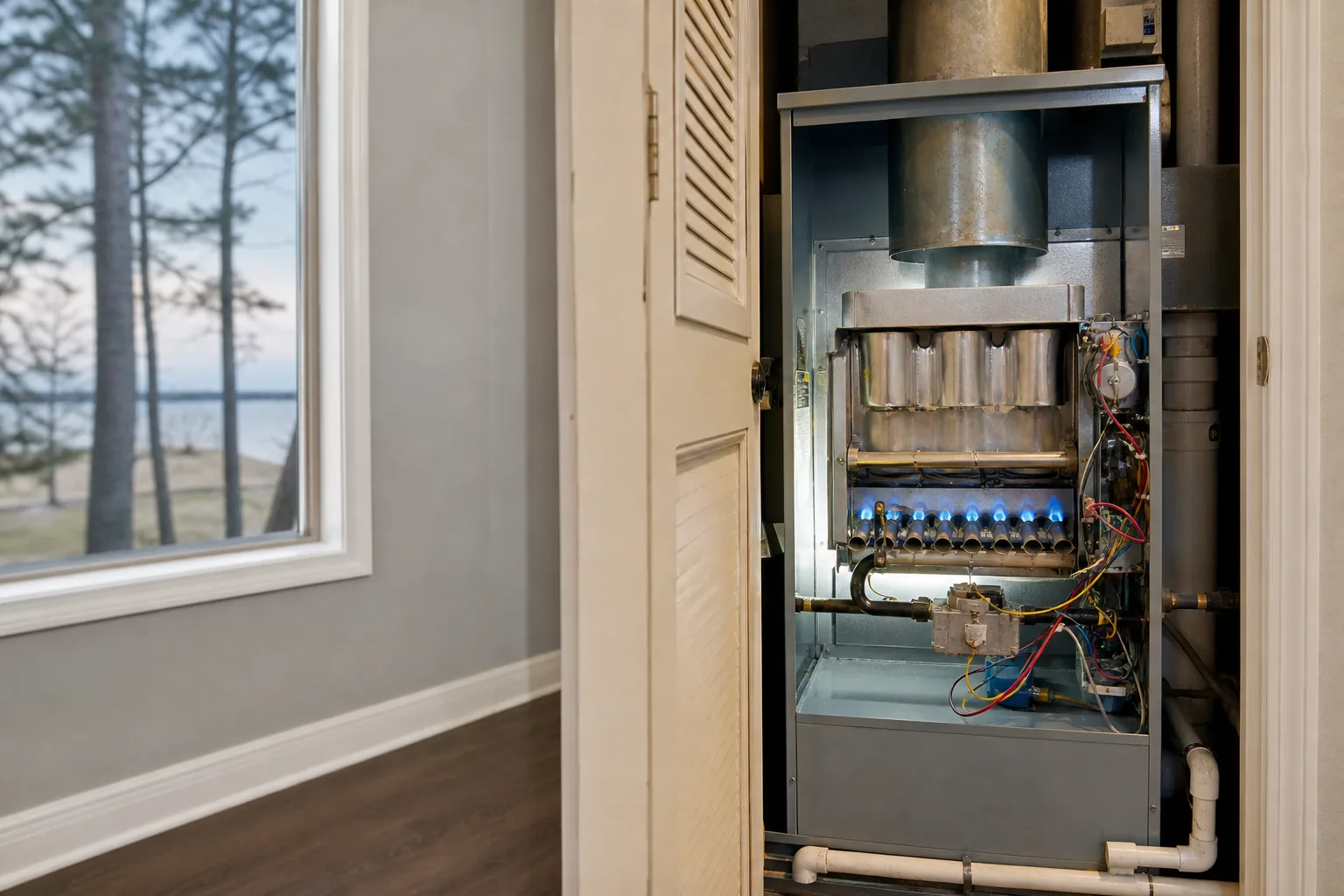
A lot of the homes along the bluff over Mobile Bay in Daphne, and out through the older neighborhoods off Hwy 181, were built when gas heat was the obvious choice, and plenty of those furnaces are still doing the work two and three decades later. That longevity is a credit to how the units were built, but it also means a quiet, invisible risk has been aging right alongside them. Carbon monoxide does not announce itself. The whole reason it deserves a seasonal habit of attention is that the gas itself gives you nothing to react to until the symptoms arrive.
A gas that hides in plain sight
Carbon monoxide is the byproduct of fuel that does not finish burning. When a gas flame gets all the oxygen it needs, it produces water vapor and carbon dioxide, both harmless, and the flue carries them outside. Choke that flame, crack the metal that is supposed to keep the burnt gas separated from your breathing air, or let the venting back up, and you get carbon monoxide instead.
What makes it dangerous for a household is that your body treats it like oxygen and lets it bind to your blood far more readily than oxygen does. You cannot see it. You cannot smell it. It will not set off your nose the way a gas leak would. In a Daphne home with a furnace that has been cycling on cold mornings for twenty winters, that invisibility is exactly why an annual professional look matters more than a homeowner's gut feeling that everything seems fine.
The heat exchanger is the part that matters most
Inside your furnace, the heat exchanger is the metal chamber where combustion happens. Heated air from your blower passes over the outside of it and gets warmed without ever touching the burnt gas inside. That separation is the whole safety design. The flue takes the exhaust outdoors; your ducts take only clean, heated air into the house.
The trouble starts when that metal develops a crack. Decades of expanding hot and contracting cold work the steel the way bending a paperclip back and forth eventually does. A hairline split lets combustion gas seep into the airstream your blower is pushing through every room. Nothing sounds different. The furnace still lights, still blows warm. That is precisely what makes a cracked exchanger so insidious, and why it sits at the top of the list for an older Daphne system.
Cracks come from a few directions. Age and thermal fatigue is the common one on long-lived equipment. A botched original installation, with the wrong gas pressure or not enough combustion air, stresses the metal early. Neglected maintenance, where dirty burners and a clogged filter starve the flame, pushes things along too. And a handful of furnace models simply had manufacturing weaknesses that show up sooner than the rest.
Knowing the symptoms, because they lie
The cruel part of carbon monoxide poisoning is how ordinary it feels. A dull headache. A little dizziness. Tiredness that you blame on the season. Some nausea. It reads as the flu, or a bad night's sleep, or too much going on. Families have explained away weeks of it.
The tell is the pattern, not any single symptom. If more than one person in the house feels off, if it eases when you spend a day away and creeps back when you are home, if even the dog seems sluggish, treat that as a signal rather than a coincidence. As exposure climbs, the headaches sharpen, confusion sets in, and vomiting follows. At high concentrations a person can lose consciousness. You do not want to be diagnosing this from a chair; you want a working alarm doing the noticing for you.
Where should the alarms go in a two-story Daphne home?
Detector placement is where the bigger, established floor plans common in subdivisions like Lake Forest and Jubilee Farms need a little thought. A single unit by the kitchen is not coverage.
One on every level
Each floor of the house gets its own detector, including a finished basement or bonus room over the garage if you have one.Near where everyone sleeps
Put a unit in the hallway outside the bedrooms so an alarm at 3 a.m. is loud enough to wake the household. Bedrooms at opposite ends of an upstairs may need two.Away from the equipment and steam
Keep alarms several feet back from the furnace itself and out of the direct line of a bathroom door or the stove, where humidity and cooking fumes cause nuisance trips.Test and replace on schedule
Press the test button monthly, swap batteries yearly unless it is a sealed ten-year unit, and replace the whole detector by the expiration date printed on the back. The sensor wears out even when the light still glows.
If your house in Daphne sits empty for stretches, a connected detector that pings your phone is worth the extra cost. You find out about a problem from the lake house or a trip, not when you walk back in the door.
What a real inspection covers
When our team looks at a gas furnace, the heat exchanger is the centerpiece, but it is not the only thing. A proper inspection works in layers. There is the visual pass over the exchanger surfaces, sometimes with a mirror or a borescope to reach the spots a flashlight cannot. There is combustion analysis, where an instrument reads the actual carbon monoxide in the flue gas while the furnace runs, so we are measuring reality rather than guessing from appearances. And where there is doubt, a pressure check can flag a leak that the eye misses.
If something turns up, you get it documented with photos and a plain explanation, not a scare tactic. The heat exchanger check is part of our seasonal tune-up, and we will quote it on its own if that is all you need.
When repair gives way to replacement
A failed heat exchanger forces a decision. The part itself can be swapped, but the labor is heavy and components for older models are sometimes hard to source, and you have spent real money on a furnace that is still old everywhere else. On a unit that is fifteen or twenty years in, putting that money toward a full replacement usually buys more.
That is also the moment to ask whether you want to keep burning gas at all. A heat pump has no combustion and therefore no carbon monoxide risk of its own, and it pairs well with Daphne's genuinely mild winters, where the deep freezes a furnace is built for are rare. We make the full case for the swap in our climate in are heat pumps worth it on the Eastern Shore. Some folks still prefer the feel of gas heat, and a dual-fuel setup keeps both options. Worth knowing on the money side: the federal 25C tax credit that used to help offset a qualifying heat pump expired at the end of 2025 and is gone for any 2026 install, but utility incentives through Alabama Power, TVA EnergyRight, and local co-ops may still apply — we track the current ones in HVAC rebates and incentives for Baldwin County homeowners, and you should run anything tax-related past your CPA. None of that is a hard push; it is just the honest set of choices when an old furnace reaches the end.
A few myths worth retiring
The belief that owning detectors means you are safe gets the order backwards. Detectors are your last line, not your first. Prevention through a yearly look at the equipment is what keeps the alarm from ever needing to do its job. Just as common is the assumption that a running furnace is a safe one, which the cracked-exchanger problem disproves directly. And the idea that you would smell trouble simply is not true of carbon monoxide.
If an alarm ever does sound, the response is not complicated and not optional: get everyone outside right away, do not stop to investigate or grab belongings, call 911 from outdoors, and stay out until the fire department clears the house. Only after that do you call us to find and fix the source.
Air Solutions Heating & Cooling handles gas furnace inspection and carbon monoxide safety across Daphne and the Eastern Shore. We are family-run, founded right here, and licensed AL#23194. Cool Club members get a yearly heat exchanger inspection folded into their visits, along with 15% off all AC repairs and 5% off new systems.
- Schedule service — book a furnace inspection
- Call (251) 300-9817 — emergency HVAC service is available
- Heating repair in Daphne — our local service page
- Cool Club — what membership includes