
Mini-Split (Ductless) AC Systems: When They Make Sense in Baldwin County
When a mini-split or ductless AC system is the right choice for a Baldwin County home, when it isn't, and what drives the installed cost in Daphne, Fairhope, and Gulf Shores.

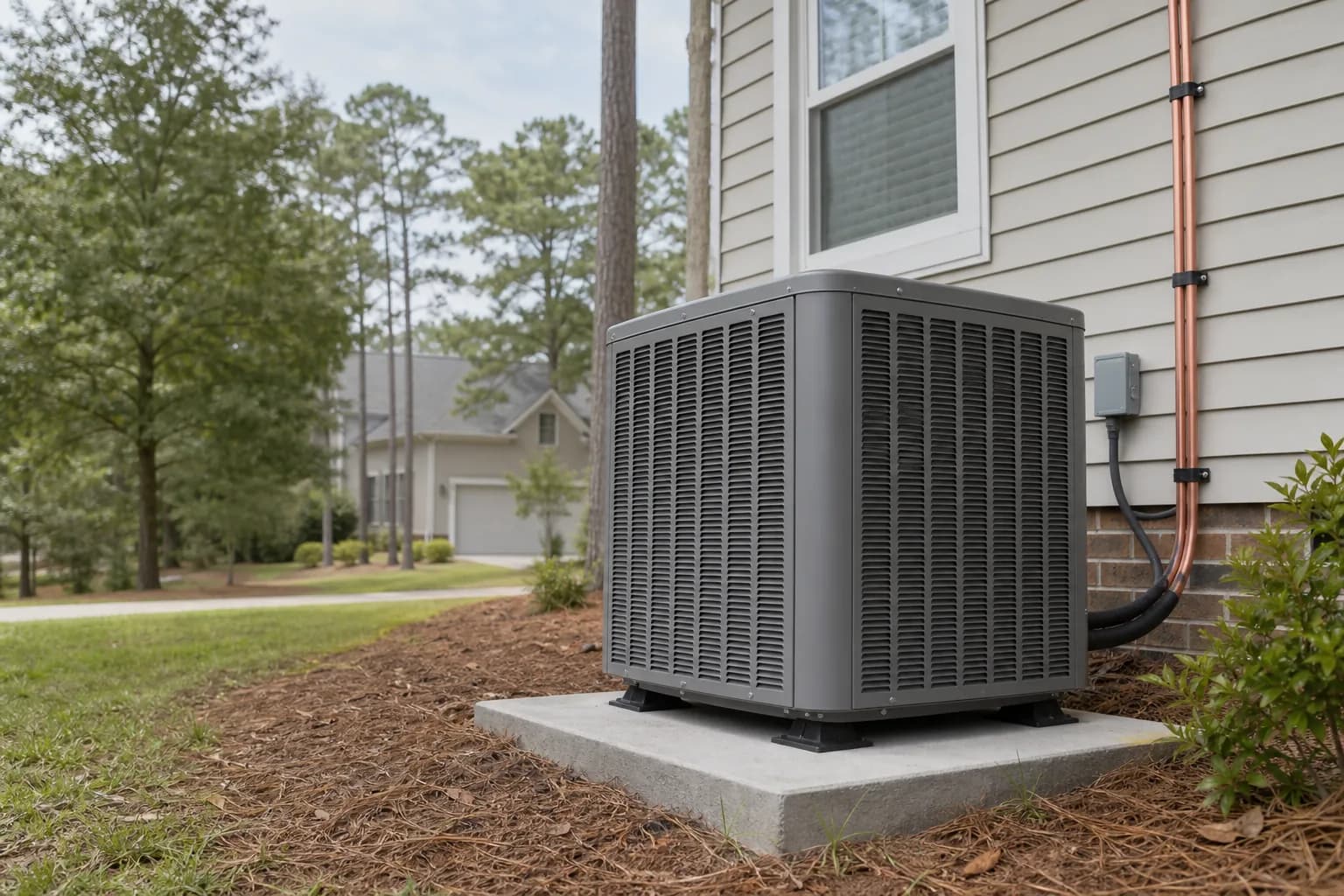
Mini-split (also called ductless) AC systems are the right answer for a specific subset of Baldwin County HVAC problems and the wrong answer for everything else. They get pitched aggressively by some contractors as a universal solution, but the math only works in certain situations. This guide walks through when we actually recommend a mini-split, when we steer customers away, and what drives the installed cost on a real Baldwin County project.
What a mini-split actually is
A mini-split system has two parts: a small outdoor compressor unit (looks similar to a regular AC condenser but typically smaller) and one or more wall-mounted, ceiling-cassette, or floor-mounted indoor units. They're connected by refrigerant lines, a condensate drain, and a low-voltage control wire — running through a ~3-inch hole in the wall. No ductwork.
Each indoor unit has its own thermostat and operates independently. A "single-zone" mini-split has one indoor unit; a "multi-zone" system has 2-8 indoor units sharing one outdoor compressor.
The defining characteristic: no shared ductwork between rooms. Each conditioned space has its own dedicated indoor unit.
When a mini-split is the right answer
Five clear scenarios where we recommend mini-splits over traditional split systems in Baldwin County:
1. Garage conversion, sunroom, or addition with no existing ductwork
You added 250 sq ft to your house — a converted garage, a sunroom, an enclosed porch, a finished bonus room. Running new ductwork from the existing AC system is expensive, often impractical due to space constraints, and would over-size your existing system in a way that hurts dehumidification in the rest of the house.
A single-zone mini-split handles the new space cleanly without disturbing your existing system, and it's the most cost-effective way to condition one added room. Most Baldwin County addition projects that come to us for HVAC end up with mini-splits. (If you're conditioning a brand-new build rather than an addition, the trade-offs shift — our builder-grade HVAC guide for new construction covers when ducted central still wins.)
2. Detached structure: workshop, pool house, mother-in-law suite
A detached structure can't tap into the main house ductwork. A mini-split is the only practical answer (other than a window unit, which is louder, less efficient, and ugly).
Workshop mini-split installs in Daphne, Spanish Fort, Robertsdale — frequent calls. We do these routinely.
3. Older home where retrofitting ductwork would be invasive
Some older Baldwin County homes — especially the cottages around Olde Towne Daphne and French Settlement, historic Fairhope, and Magnolia Springs — have plaster walls, low attic clearance, and no logical path for new ductwork. A traditional split system retrofit means tearing into walls, ceilings, or both. A mini-split system avoids that entirely with multiple wall-mounted indoor units.
When we walk an older Fairhope or Daphne home and the customer wants central air, sometimes mini-split multi-zone is the only sensible answer. It costs more than a single-zone but typically lands below a full ductwork retrofit.
4. One specific room that won't cool properly
You have central AC throughout the house, but one room — often a bonus room over the garage, a sunroom, or a master bedroom suite at the end of a long duct run — never cools to the same temperature as the rest of the house. We see this constantly in the larger Lake Forest and Timbercreek floor plans here in Daphne, where a far bedroom or finished-attic bonus room sits well off the trunk line. The duct system is genuinely undersized for that space.
Two paths: rebalance the ductwork (sometimes works, often not enough), or add a single mini-split dedicated to that room. The mini-split approach is cleaner and more reliable. Worth ruling out a sizing mismatch first, though — if the whole house cools unevenly, the central system itself may be wrong for the load, which our guide on what size AC a home actually needs walks through.
5. Vacation rental with very different vacancy and occupancy needs
A Gulf Shores vacation rental that sits empty most of the week, then full-house occupied for 3 days. Conditioning the entire house at full capacity during vacancy wastes money; conditioning only the parts you need during occupancy is hard with central air.
Multi-zone mini-splits let you turn off the indoor units in unoccupied rooms while keeping common areas comfortable. Some Gulf Shores property owners have moved fully to mini-split systems for exactly this reason. Per-zone control is a real efficiency benefit for irregular occupancy patterns.
When a mini-split is NOT the right answer
This is where the marketing oversells. Five scenarios where a traditional central AC system is genuinely better:
1. Whole-house replacement of a working ducted system
If your house already has ducts and a working central system, replacing it with mini-splits costs significantly more, requires more indoor unit installations, looks worse (visible wall units in every room), and provides limited benefit. Stick with central.
We see mini-split contractors pitch this to Baldwin County customers regularly. The economics don't work.
2. Larger homes (3,000+ sq ft) with many rooms
Multi-zone mini-splits become awkward and expensive at scale. A 5-zone system to cover 3,500 sq ft typically costs well more than a comparable central system, before you account for the visible heads in every room. Not worth it unless one of the "right answer" scenarios above applies.
3. Open floor plans where one indoor unit can't reach the whole space
Mini-split indoor units have limited throw — they cool the room they're in but airflow doesn't reach far. A great-room with 25-foot ceilings open to a kitchen open to a dining area is a single space conceptually but takes 2-3 mini-split heads to actually cool, eliminating the cost advantage.
4. Customers who hate the visible wall units
Wall-mounted mini-split heads aren't ugly, but they're visible. Some customers can't get past it. Ceiling cassettes are a less-visible alternative but cost 30-50% more per indoor unit. If aesthetics drive your decision and the wall units bother you, central air with hidden registers is usually the better path.
5. Houses in tornado / high-wind zones where outdoor mini-split units are exposed
Less of an issue than people think — mini-split outdoor units are mounted similarly to central AC condensers — but worth noting. Both are vulnerable in major weather events.
What drives mini-split cost in Baldwin County
There's no single sticker price — the installed cost of a mini-split swings widely with the configuration. The two biggest levers are zone count and brand tier:
Single-zone systems (one indoor head, one outdoor unit, 9,000-18,000 BTU) are the entry point. A budget brand (Mr. Cool, Senville) sits well below a mid-tier unit (Daikin, Mitsubishi M-Series), and a premium cold-climate model (Mitsubishi Hyper-Heat, Daikin Aurora) sits above that.
Multi-zone systems (one outdoor unit, 2-8 indoor heads) scale up from there. Each indoor head you add raises the installed total, so a 4- or 5-zone system costs substantially more than a 2-zone.
The factors that move your quote up or down:
- Brand (Mitsubishi and Daikin are premium; Mr. Cool and Senville are budget)
- Indoor head type (wall-mounted is cheapest, ceiling cassette adds 30-50%, ducted concealed adds 50-80%)
- Refrigerant line length (longer runs cost more)
- Wall penetrations and access
- Electrical work (some installs need a new dedicated circuit)
- Coastal-grade equipment for properties near the Gulf
Brand recommendations
After installing every major brand in Baldwin County:
Best overall: Mitsubishi M-Series. Reliable, quiet, well-supported parts pipeline, excellent low-temperature heating performance for the rare Baldwin County cold snap.
Best value: Daikin and LG mid-tier. 80% of the Mitsubishi quality at 75% of the price. We install a lot of these.
Best budget: Mr. Cool DIY series gets installed by some homeowners themselves. Quality is decent for the price; the trade-off is shorter warranty and less dealer support if something goes wrong. We can install Mr. Cool but tell customers up front that if it fails outside the warranty, repair parts can be hard to source.
Avoid: Off-brand units sold on Amazon and big-box stores. Failure rates are high, parts are unobtainable, refrigerant line set quality is questionable. We've replaced enough of these to have an opinion.
Will a mini-split heat my house during a Gulf Coast cold snap?
This is the most common worry we hear.
Modern inverter-driven mini-splits handle Baldwin County winters easily. Even basic mid-tier units maintain rated heating capacity down to 17°F outdoor temperature, and "hyper-heat" cold-climate variants maintain capacity to -13°F. Baldwin County rarely sees temperatures below 25°F. The typical mini-split outperforms a heat pump on the rare cold mornings because of how inverter compressors handle low-temperature heating.
The only time we worry about mini-split heating performance: extended sub-25°F days for primary heating in homes north of I-65 (Bay Minette, Stockton). Those scenarios are rare; most Baldwin County addresses have no heating concerns with a properly sized mini-split. The same inverter-heating logic applies to a full ducted system, which is why we usually recommend heat pumps here — see are heat pumps worth it on the Eastern Shore for the central-system version of this question.
Maintenance considerations
Mini-splits need maintenance, but the maintenance is different than central air:
- Indoor unit filter cleaning every 30-60 days during cooling season. Filters are usually washable mesh; pull them out, rinse with water, let dry, reinstall. Two minutes per filter.
- Annual professional service: condensate drain check, refrigerant pressure verification, electrical connection inspection, blower wheel cleaning if accumulated dust is a problem.
- Indoor unit deep cleaning every 2-3 years: blower wheel and fan cage develop biofilm over time, especially in our humidity. Professional cleaning prevents the musty-smell problem that's the #1 mini-split complaint.
Our Cool Club maintenance plan covers mini-splits at the same cadence as central systems.
A note on the federal 25C tax credit
If you read older mini-split guides, you'll see them tout the federal 25C heat pump tax credit for qualifying high-efficiency ductless systems. That credit ended on December 31, 2025 under the 2025 federal budget law. A mini-split installed in 2026 or later does not qualify, no matter how efficient it is. The only remaining use is for a qualifying system that was placed in service on or before that date — claimed on your 2025 federal return via IRS Form 5695. If that's your situation, your tax preparer needs the AHRI certification and equipment specs, which we provide at install. For anything installed now, treat 25C as gone and confirm your own situation with a CPA.
How to decide
If you're considering a mini-split, the in-home consultation answers this question definitively. We measure the spaces you want to condition, look at your existing ductwork, walk through the actual cost comparison for your specific situation, and tell you whether mini-split, central air, or a hybrid is the right answer. No charge for the visit. We run ductless mini-split installs from Daphne across Baldwin County, so book a consultation and we'll size it to the space you actually want conditioned.
We don't push mini-splits when central air is the better answer. We don't push central when mini-split is the better answer. The right answer depends on your house, not our preferences.