
SEER2 Ratings Explained for Baldwin County Homeowners
What SEER2 actually means, how it differs from SEER, and which efficiency rating makes sense for a Gulf Coast Alabama home — without the marketing fluff.

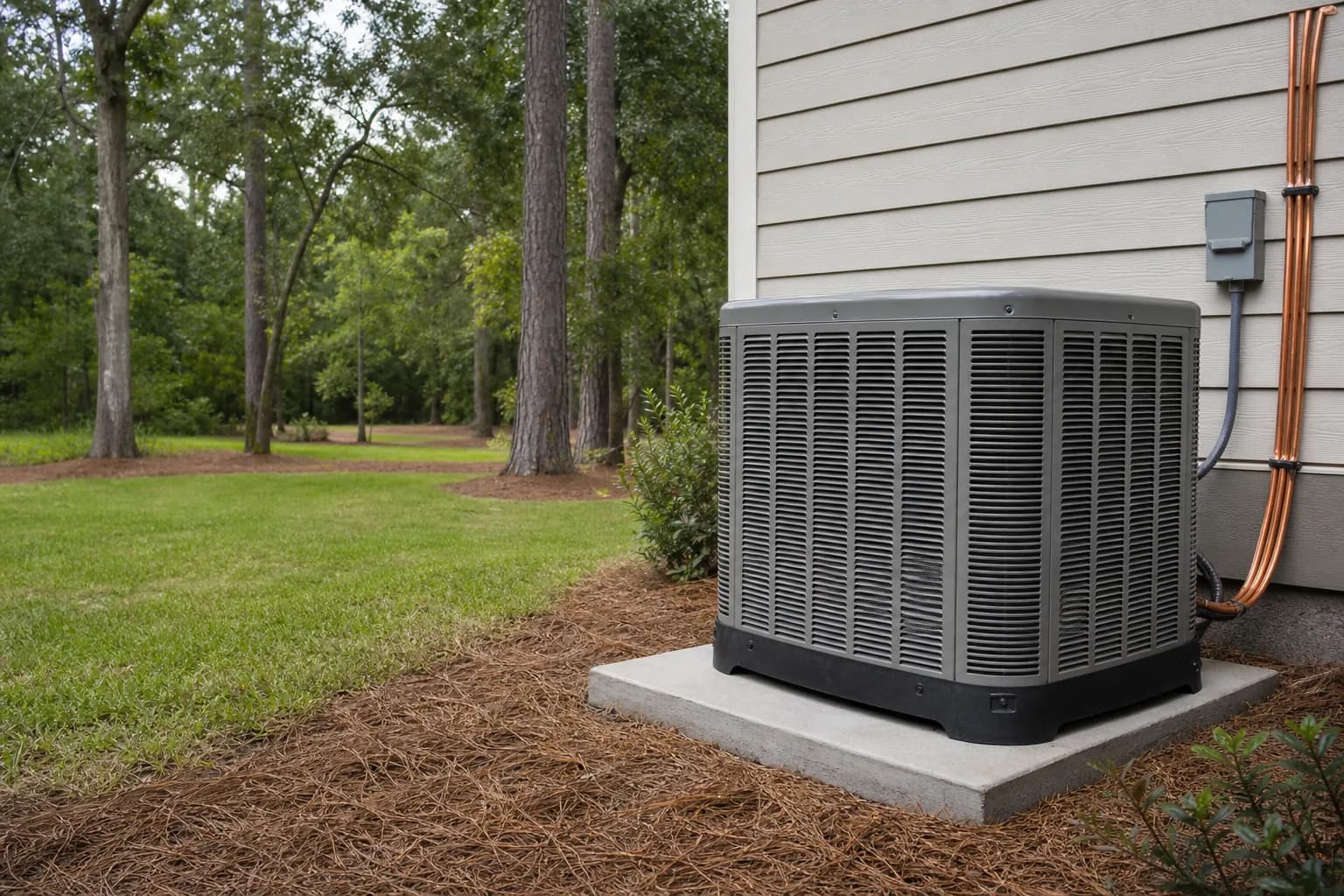
If you've shopped for a new air conditioner or heat pump in Baldwin County in the last two years, you've seen the term SEER2 on equipment specifications and probably wondered what changed. The short answer: SEER became SEER2 in 2023, the testing methodology got more realistic, and the numbers on equipment plates dropped a few points across the board even though the equipment didn't actually get worse.
This guide explains what SEER2 means in practical terms, what minimum rating you can buy in Alabama, what rating actually pays back in our climate, and the marketing claims around high-SEER equipment that don't survive a Manual J load calculation. If you haven't yet decided whether to replace at all, start one step back with AC repair vs. replace in coastal Alabama.
What SEER2 measures
SEER stands for Seasonal Energy Efficiency Ratio. It's a number that approximates how much cooling output (in BTUs) a system delivers per watt-hour of electricity consumed across an entire cooling season. Higher SEER = more cooling per dollar of electricity.
SEER2 is the same fundamental measurement with a more demanding test methodology. Effective January 1, 2023, the U.S. Department of Energy required all new HVAC equipment to be tested under "M1" conditions — which require higher external static pressure during testing, simulating the real-world impact of ductwork resistance. The old SEER test used 0.1 inches of water column external static pressure; SEER2 tests at 0.5 inches of water column. That's a much more realistic representation of how equipment actually performs in installed systems.
The conversion isn't perfect, but a rough rule:
- A 14 SEER unit ≈ 13.4 SEER2
- A 16 SEER unit ≈ 15.2 SEER2
- A 18 SEER unit ≈ 17.0 SEER2
- A 20 SEER unit ≈ 18.9 SEER2
So when you see a "13.4 SEER2" unit advertised today, that's the equivalent of what was sold as "14 SEER" in 2022. The equipment is the same; the number is just calibrated more honestly.
The minimum SEER2 you can legally buy in Alabama
Alabama is in the Southeast region for federal HVAC efficiency standards. Effective January 1, 2023:
- Split-system air conditioner: Minimum 14.3 SEER2
- Split-system heat pump: Minimum 14.3 SEER2 (cooling) and 7.5 HSPF2 (heating)
- Packaged units: Minimum 13.4 SEER2
These are floor numbers. You cannot legally install equipment below these ratings in new installations. (You can repair existing lower-SEER equipment indefinitely; the rule applies to replacement.)
Which SEER2 rating actually pays back in Baldwin County?
Here's where homeowners often overspend. Equipment manufacturers and many contractors push for the highest SEER2 you can afford. The math doesn't always support that.
A real-world Baldwin County example. Take a typical 2,500 sq ft Daphne home — say a Lake Forest or Timbercreek house off Hwy 181 — with a 4-ton system and roughly 6,000 cooling hours per year (long Gulf Coast cooling season) on Alabama Power rates. The useful way to think about this isn't the sticker number — it's how long the efficiency upcharge takes to pay itself back in lower cooling bills:
| Equipment | Efficiency upcharge over baseline | Years to payback | |---|---|---| | 16 SEER2 | Modest add-on | Inside equipment life (roughly 8 years) | | 20+ SEER2 (variable speed) | Substantial add-on | Often beyond 12 years |
The actual payback depends on your home, your utility rates, and how long you'll own the property. But the pattern is consistent: jumping from 14.3 SEER2 to 16 SEER2 usually pays back inside the equipment's lifespan. Jumping from 16 to 20+ SEER2 often does not. For where the efficiency upcharge sits inside the total project, see what AC replacement costs in Baldwin County in 2026.
What's actually worth paying for above the minimum
Three things genuinely matter beyond raw SEER2 number:
1. Variable-speed compressor (vs. single-stage)
A single-stage compressor is on or off. A two-stage compressor has high and low. A variable-speed (sometimes called "inverter" or "modulating") compressor smoothly ramps from ~25% to 100% capacity based on load.
In Baldwin County's humid climate, variable-speed wins for a non-obvious reason: humidity control. A single-stage system cools fast, hits the setpoint, and shuts off — often before it has run long enough to remove much moisture from the air. Indoor humidity stays high; you feel sticky even at 72°F. A variable-speed system runs longer cycles at lower output, removing significantly more moisture per cooling hour.
This is the upgrade that's worth paying for in Baldwin County. Pays back in comfort improvement and slight efficiency gain.
2. Right-sized equipment
The biggest efficiency win isn't a higher SEER2 number — it's correct sizing. Most Baldwin County homes we measure for replacement are over-sized by half a ton to a full ton. That's the result of decades of contractors sizing the new system to match (or exceed) whatever the old one was, without recalculating.
An over-sized 16 SEER2 system performs worse in real-world Baldwin County humidity than a properly-sized 14.3 SEER2 system. The over-sized unit short-cycles, leaves humidity in the air, wears the compressor faster, and uses more electricity per cooling hour despite the higher rated efficiency.
We run Manual J load calculations on every install — and the conclusion is consistent: oversized residential equipment is the rule in Baldwin County, not the exception. Most homes are running more tonnage than the load actually requires.
3. Coastal-grade equipment for coastal properties
If you live within a mile of the Gulf or Mobile Bay — Gulf Shores, Orange Beach, Fort Morgan, the bayfront homes along the Daphne bluffs and through Montrose, parts of Fairhope — spend the money on a coastal-rated outdoor unit. Manufacturers offer "coastal" or "marine" condenser variants with corrosion-resistant fasteners, protective coil coatings (typically Bluefin, Heresite, or similar), and sealed electrical cabinets.
Upcharge: typically 10-15% over standard outdoor unit. Lifespan benefit: 3-5 additional years before salt-air corrosion forces replacement. Easily pays for itself. How far that corrosion risk actually reaches inland is its own question — we mapped it in salt air and your AC: how far from Mobile Bay does corrosion matter.
A 14.3 SEER2 coastal-grade unit is a better Baldwin County investment than a 18 SEER2 standard unit.
The marketing claims that don't survive scrutiny
A few common pitches we hear from customers second-opinion-shopping after another contractor quoted them:
"This 20 SEER2 system will pay for itself in 3 years." Almost never true in Baldwin County. The math above shows real payback timelines. If a contractor quotes 3-year payback on premium equipment, ask to see the actual annual cooling cost calculation they used.
"You need at least 18 SEER2 to qualify for the federal tax credit." This one's doubly outdated. The federal 25C heat pump credit ended December 31, 2025 and is gone for any system installed in 2026 or later — so there's no current federal credit to chase with a higher SEER2 number. And even while it existed, the threshold was based on combined SEER2 + HSPF2 + EER2 ratings, not raw SEER2, so plenty of 16 SEER2 heat pumps cleared the bar. If a contractor is still pushing premium equipment "for the tax credit," that math no longer holds.
"Higher SEER2 is more reliable." No correlation. Reliability is driven by compressor quality, manufacturing, and installation — not efficiency rating. We've replaced 5-year-old 18 SEER2 units that failed early and serviced 12-year-old 14 SEER2 units that ran fine.
"You'll save 40% on your power bill." The savings are real but small in absolute terms. A typical Baldwin County home sees a modest year-over-year reduction in cooling cost going from baseline to 18 SEER2. That adds up over a 12-year equipment life but doesn't always cover the upcharge.
Heat pump-specific ratings: HSPF2 and EER2
If you're buying a heat pump (not just a straight AC), two more numbers matter:
HSPF2 (Heating Seasonal Performance Factor) — the heating-mode equivalent of SEER2. Measures heating output vs. electricity consumed across a heating season. Minimum 7.5 HSPF2 in Alabama. Higher = more heat per dollar. For Baldwin County's mild winters, the HSPF2 difference between equipment is much less impactful than SEER2 because the heating season is short.
EER2 (Energy Efficiency Ratio) — peak efficiency at 95°F outdoor temperature. Useful for comparing how a system performs on the hottest days. For long Gulf Coast summers, EER2 differences matter more than they would in a milder climate.
The Air Solutions sweet-spot recommendation for most Baldwin County heat pump installs: 16 SEER2 / 9.0 HSPF2 / 12 EER2 with a two-stage or variable-speed compressor. It delivers a meaningful efficiency gain over the legal minimum and pays back inside equipment life — and it stands on its own merits now that the federal 25C credit has expired. If you're still deciding between a heat pump and a straight AC plus furnace, our take on whether heat pumps are worth it on the Eastern Shore makes the case for our climate.
What we actually quote
When we run a quote in your home, the SEER2 conversation is usually 5 minutes. We tell you:
- The minimum-efficiency option (qualifies for legal install, lowest equipment cost)
- The mid-tier option (usually 16 SEER2 with two-stage or variable-speed — best value)
- The premium option (18+ SEER2, full variable-speed, only if it actually fits your situation)
We don't push the premium option unless it's actually right for your home. The math has to work, the comfort improvement has to matter to you, and you have to be planning to own the home long enough for payback.
The equipment is part of the conversation. Sizing, ductwork, refrigerant charge, commissioning quality, and ongoing maintenance matter at least as much. A 14.3 SEER2 system installed perfectly will outperform a 20 SEER2 system installed poorly every time.
Schedule a load-calc and quote
If you're shopping replacement and getting confused by SEER2 numbers from different contractors, schedule a free in-home consultation. We measure the house, run the Manual J, walk through equipment options for your actual situation, and put written numbers in your hand for two or three real-world paths. No pressure to pick one on the spot. We handle AC installation and heat pump systems across the county from our base in Daphne — book a load-calc and quote and we'll size it honestly to your home.