

Indoor Air Quality in Spanish Fort.
Local indoor air quality in Spanish Fort, Alabama and surrounding Baldwin County. Dehumidifiers, air scrubbers, UV purification, ventilation. Licensed AL#23194. 353+ five-star reviews. Call (251) 300-9817.
Get a Free Estimate
Name and phone is all we need to call you back. Takes ~20 seconds.
353+ five-star reviews · Same-day · 24/7 · Licensed AL#23194
What indoor air quality looks like in this climate.
Spanish Fort sits at the head of Mobile Bay along the Causeway corridor, and the per-coordinate ERA5 reanalysis puts the local climate load at roughly 3,048 cooling degree days against 1,084 heating degree days for a typical year. The cooling-season length is the headline number for any indoor-air-quality conversation: a system that has to remove sensible heat for eight to nine months of the year is also being asked to remove moisture for the same eight to nine months, and the latent load often exceeds the sensible load on shoulder-season days when the outdoor temperature is mild but the dew point is still in the upper 60s. An air handler running at part-load on a 78°F afternoon may keep the thermostat satisfied while the indoor relative humidity climbs steadily past 60%, which is the regime where mold spores, dust mites, and pollen residue stop being diluted and start accumulating on indoor surfaces.
The temperature columns also explain why the most common IAQ failure mode in Spanish Fort is oversized-AC short-cycling rather than undersized-AC overload. Average July highs around 91.7°F drove the install math on subdivisions built during the 1990s and early 2000s toward outdoor units sized for the peak afternoon hour rather than the average runtime hour, which means a typical Spanish Fort heat pump or split AC satisfies thermostat demand in 8-to-12-minute bursts and then sits idle. Short bursts of compressor runtime are the worst possible operating mode for dehumidification, because the evaporator coil never gets cold enough for long enough to actually wring water out of the air before the unit cycles off. The bay-adjacent geography compounds the problem: sea-breeze cycles push moisture-laden air across the Causeway corridor twice a day from opposite directions, so a Spanish Fort home doesn't get the overnight drying window that an inland Baldwin County address relies on for passive humidity reset.
Every Spanish Fort neighborhood, every zip.
Air Solutions covers all of Spanish Fort — the single 36527 ZIP — from the Daphne shop, and the drive is short enough that it changes how IAQ work gets scheduled. By road the trip is about 5.3 miles up I-10 to the Causeway exits, which OSRM clocks at roughly 10 minutes in normal traffic. That puts Spanish Fort inside our three closest service-area cities alongside Daphne and Montrose, and for indoor-air-quality projects specifically the proximity matters because the typical IAQ engagement is a two-visit sequence rather than a single appointment. The first visit is a diagnostic assessment — indoor RH measurement at multiple locations, coil and condensate-line inspection, filter pressure-drop reading, return-side air-leakage check, and a written recommendation document. The second visit is the install if the homeowner moves forward. Stacking those two visits across a couple of weeks works easily on a 10-minute drive in a way it doesn't on the longer dispatch routes elsewhere in the matrix.
Neighborhood coverage spans the full subdivision footprint of the city — TimberCreek, Spanish Fort Estates, Stonebridge, Churchill, Blakeley Forest, Blakeley Oaks, The Highlands, The Lakes, Shenandoah, and Spanish Village. The newer builds skew toward tight-envelope humidity trapping and oversized-AC short-cycling, while the older Spanish Village and Shenandoah homes carry the deteriorated-ductwork and air-leakage profile. The same diagnostic discipline applies across the entire footprint — measure, document, recommend. Reach the 24/7 emergency line at (251) 300-9817 when an active mold complaint can't wait for a scheduled slot; live pickup happens when conditions allow and a return call follows promptly when they don't. Cool Club membership covers two professional tune-up visits per year plus priority scheduling and 15% off all AC repairs and 5% off new systems, and IAQ accessory installs typically run alongside the spring or fall tune-up window when scheduling is already in motion.
- TimberCreek
- Spanish Fort Estates
- Stonebridge
- Churchill
- Blakeley Forest
- Blakeley Oaks
- The Highlands
- The Lakes
- Shenandoah
- Spanish Village
What we see on calls in Spanish Fort.
The Spanish Fort housing stock has a clear bimodal distribution from an IAQ perspective. The newer subdivisions — TimberCreek, Spanish Fort Estates, Stonebridge, Churchill, Blakeley Forest, Blakeley Oaks, The Highlands, The Lakes — were built tight enough to score well on a blower-door test, which is good for energy bills and bad for indoor air dilution when mechanical ventilation isn't part of the original design. A sealed building envelope traps everything the occupants generate: cooking moisture, shower humidity, off-gassing from cabinetry and flooring, pet dander, and the inevitable buildup of biological growth in any space where the indoor relative humidity drifts above 55% for sustained periods. On a typical TimberCreek or Stonebridge intake call the homeowner describes the symptom — clammy bedrooms, musty smell in a closet, mold spots reappearing on bathroom ceilings within weeks of a repaint — and the mechanical diagnosis almost always points back to a building envelope that's working as designed alongside an HVAC system that's not equipped to handle the latent load by itself.
The older Spanish Village and Shenandoah housing stock tells the other half of the story. Homes built before the 1997 median sit in a different IAQ failure pattern — leakier envelopes paired with original-vintage ductwork that has often degraded in ways that compromise air quality directly. Flex duct that has sagged or crushed in attic spaces, panned floor joists serving as return air pathways, and connection seams that leak conditioned air into unconditioned spaces while pulling unconditioned air back into the return — those are the cases where ductwork sealing becomes a legitimate IAQ intervention rather than a comfort-only upgrade. To be explicit on the service catalog: we install whole-home dehumidifiers, air scrubbers, UV purification, ductwork sealing, and advanced filtration systems, and we don't offer duct cleaning as a standalone service. The duct-cleaning industry has a track record of charging for one-time cleanings that don't measurably improve indoor air quality once the underlying moisture, filtration, and duct-integrity issues are addressed at the source. If your ducts have a documented contamination problem, the right intervention is to find and fix the cause — usually a moisture pathway or a return-side air leak pulling contaminants from the attic — not to vacuum the symptom out once and watch it return within months.
- Mid-life equipment is the common profile in this area. Capacitor and contactor failures dominate the service-call mix.
- Long cooling season means compressors run heavy May through October. Annual maintenance pays for itself in compressor lifespan.
- Mild winters mean heat pumps cover the season comfortably without backup runtime in normal years. Cold-snap weeks expose undersized units.
Indoor Air Quality in Spanish Fort — the questions that come up.
- I have a portable dehumidifier in the bedroom and it still feels clammy in July. Is a whole-house dehumidifier really different?
- Yes, by a meaningful margin. A typical portable rated at 30-to-50 pints per day cannot keep up with the whole-house latent load a Spanish Fort home generates through July and August. A whole-house unit installed downstream of the air handler is sized in the 70-to-150-pint-per-day range and pulls return air through a separate dedicated coil that's cold enough for long enough to actually condense water out. Whole-home dehumidifier installations vary based on system size and installation complexity; the honest range depends on duct geometry, envelope characteristics, and which accessories are bundled with the install.
- My AC keeps the thermostat at 75°F but the house still feels muggy. Is the AC broken or is something else going on?
- On a Spanish Fort subdivision build the most likely answer is that the AC is doing exactly what it was sized to do — satisfy sensible cooling demand fast — and the byproduct is that it never runs long enough to dehumidify properly. The system satisfies the thermostat in 8-to-12-minute bursts, but a coil only starts condensing meaningful water after 12-to-15 minutes of continuous runtime. Diagnosis runs through indoor RH measurement, coil cleanliness check, refrigerant charge verification, and a decision on whether a whole-house dehumidifier or a variable-speed compressor retrofit is the right answer. The AC isn't broken — it's being asked to do a job it wasn't sized for.
- I'm in TimberCreek and someone told me my ducts need cleaning. Do you do that?
- No — we do not offer duct cleaning as a standalone service, and that's a deliberate choice. Our IAQ service catalog is whole-home dehumidifiers, air scrubbers, UV purification, ductwork sealing, and advanced filtration systems. The duct-cleaning industry has a track record of charging for a one-time service that often doesn't measurably improve indoor air quality once the underlying cause of contamination is addressed. If your TimberCreek ducts have a documented problem, the right intervention is to diagnose why — usually return-side air leakage pulling unconditioned attic air through the system, condensation inside an uninsulated duct chase, or biological growth at the coil from chronic high indoor RH. Ductwork sealing addresses the air-leakage cause directly; UV-C addresses biological growth at the source; a dehumidifier addresses the chronic RH driver. Cleaning the ducts without addressing the cause typically just resets the clock on the same problem.
- What MERV filter rating should I be running on an Eastern Shore home?
- There's no single right answer, but the working range is MERV 8 at the low end and MERV 13 at the upper end. A higher MERV captures more particulate (pollen, dust, mold spores) but produces a higher pressure drop across the filter, which reduces airflow through the system. A blower designed for a MERV 8 return is being asked to push air through a denser obstruction at MERV 13, and the consequences are reduced dehumidification capacity and the risk of air handler overheating on older equipment. The Eastern Shore pollen seasons argue for MERV 11 or MERV 13 if the system can handle the static pressure. We measure the actual return-side static pressure during an IAQ assessment and recommend a filter type and cadence that puts the system inside spec. A 4-inch media cabinet is often the right answer when a 1-inch filter at the necessary MERV produces too much static drop.
- Does UV-C purification actually help with spring pollen, or only with mold?
- UV-C does both, but the mechanism is different. UV-C on the evaporator coil sterilizes biological contaminants in the air stream and on the coil surface — mold spores, bacteria, viruses — and it's the strongest argument for UV-C on a coil that's seen chronic high RH and biofilm regrowth. UV-C does not capture pollen particles directly. The right spring-pollen strategy is layered: MERV filtration at the right cadence handles particulate load; UV-C keeps biological growth under control; a whole-house dehumidifier makes both interventions more effective. Most UV-C lamps are rated for 9,000 to 12,000 hours of effective output (roughly one year of continuous duty), and the practical maintenance commitment is an annual bulb swap at the spring tune-up.
What Spanish Fort customers can claim.
- Spanish Fort residential electric service is split across three providers — Riviera Utilities (Daphne branch), Alabama Power, and Baldwin EMC — depending on the specific parcel. For an IAQ project the provider on the bill matters because each utility runs a different rebate program and a different list of qualifying equipment. The quickest way to confirm provider for a specific address is the most recent electric bill.
- Baldwin EMC has historically offered residential rebate programs tied to high-efficiency heat-pump installations and, in some program cycles, weatherization-adjacent measures including duct sealing on qualifying air-leakage thresholds. Verify current eligibility directly with Baldwin EMC before factoring a specific rebate into the project budget.
- Riviera Utilities and Alabama Power run their own programs with different equipment lists and calendars. IAQ accessories on their own — a standalone dehumidifier, UV-C lamp, or media filtration cabinet — are typically not on the utility rebate menu, because the rebate framework targets system-level efficiency rather than indoor-air-quality outcomes. The exception is when the IAQ work is bundled into a qualifying heat-pump replacement at install time.
- Sewer service across the city is divided across three operators as well — the Baldwin County Sewer Service covers a portion of the map while the remainder splits between Daphne Utilities and North Baldwin Utilities. The sewer provider doesn't affect rebate math, but condensate-discharge planning for a whole-house dehumidifier install does need to match local code on the specific parcel.
- The federal 25C credit expired December 31, 2025 and is not available on installations in 2026 or later. Pure IAQ accessories would not have qualified on their own in any case — ask your CPA if a qualifying bundled replacement was placed in service before that date.
Weather events that shape the Spanish Fort indoor-air-quality call mix.
- Sep 16, 2020 — Hurricane Sally (Cat-2 landfall, Mobile Bay and Causeway impact): Sally's track produced sustained high-wind and heavy-rain exposure across the Causeway corridor and the bayfront edge of Spanish Fort. The IAQ aftermath ran much longer than the equipment-damage aftermath: wall cavities and attic insulation that took on moisture during the storm continued to release humidity into living spaces for many months. A documented post-storm IAQ assessment — wall-cavity moisture measurement, attic dew-point reading, and a baseline indoor RH check — separates a system that recovers cleanly from one that becomes a multi-year mold problem.
- Mid-Jan 2024 — Multi-night hard-freeze stretch (sub-30°F sustained): The mid-January freeze produced an unusual IAQ failure mode. Standalone whole-house dehumidifiers and humidistat controllers in unconditioned spaces cycled through repeated power interruptions and ambient temperature drops below their operating spec. The slower-to-emerge consequence was envelope contraction: building materials cooled in patterns that opened new air-leakage pathways around windows, attic hatches, and rim joists, increasing the unconditioned-air infiltration load on the IAQ side once normal weather returned.
- Summer 2023 — Multi-week high-dew-point stretch with AC at capacity: A run of weeks across mid-summer 2023 where overnight low temperatures and dew points stayed close enough together that no overnight drying window opened up. Spanish Fort properties without supplemental dehumidification capacity saw indoor RH climb above 60% even with the AC running essentially continuously — the regime that produces musty smells in closets and the comfort-but-clammy complaint pattern in subdivision builds with tight envelopes.
- Annual (mid-March through mid-May) — Eastern Shore oak pollen season: Heavy oak pollen across the Eastern Shore reaches Spanish Fort every spring, and the return-side filter load increases two-to-three-fold compared to baseline weeks. A loaded filter drops system airflow, which reduces the AC's dehumidification capacity precisely when the spring transition into cooling season needs that capacity most. A documented filter-change cadence and a UV-C lamp on the evaporator coil are the two interventions that prevent the cascade.
Indoor Air Quality Coverage Map — Spanish Fort, Alabama
Centered near Spanish Fort for orientation. Air Solutions Heating & Cooling provides indoor air quality throughout every Spanish Fort neighborhood and zip code, plus the surrounding Baldwin County area. Same crew, same number — we travel the whole county.
353+ Five-Star Reviews. And Counting.
“Jacob arrived as scheduled and completed the service quickly and efficiently despite the severely adverse conditions working in the attic in extreme heat and humidity.”
Schedule Indoor Air Quality in Spanish Fort.
Dehumidifiers, air scrubbers, UV purification, ventilation. Same-day appointments most weekdays in Spanish Fort and surrounding Baldwin County. Tell us when works for you — we'll confirm by phone during weekday office hours (8 AM-4 PM).
Need someone right now? Call (251) 300-9817 — our 24/7 emergency line is answered live when we can and returned quickly when we can't.
Indoor Air Quality in Spanish Fort — FAQs
Why is indoor air quality such a big deal on the Gulf Coast?
Baldwin County's outdoor humidity averages 75% annually and peaks above 90% on summer mornings. Indoor humidity tracks outdoor humidity, and at 60%+ indoor RH, problems start: dust mite populations explode, mold can germinate on indoor surfaces, wood furniture warps, and that distinctive 'musty house' smell appears. Getting indoor RH into the 40-55% range solves most indoor air quality complaints — and that's primarily an HVAC engineering problem, not just a 'buy an air purifier' problem.Do I need a whole-house dehumidifier in Baldwin County?
Probably not if your AC is properly sized and maintained — a right-sized AC removes plenty of moisture during normal cooling cycles. You DO benefit from a whole-house dehumidifier if: (1) your home is tight new construction where AC doesn't run long enough to dehumidify, (2) you have a vacation rental that sits at higher setpoints during vacancy, (3) you have chronic mold complaints despite good cooling, or (4) you have indoor pools/spas/large fish tanks adding moisture continuously. We provide a written estimate before any work begins.Are UV-C lights worth installing on my HVAC system?
Coil-mounted UV-C lights are genuinely useful in Baldwin County's humidity — they keep evaporator coils and drain pans biologically sterile, preventing the musty smell that humid climates produce. Worth considering for homes with chronic supply-vent odor or vacation rentals. We provide a written estimate before installation. The marketing claims about UV killing airborne pathogens are overstated; airflow is too fast for meaningful kill rates. For air sterilization, better filtration is more cost-effective.Do you service all of Spanish Fort, AL?
Yes — Air Solutions Heating & Cooling covers every neighborhood and zip code in Spanish Fort, Alabama — including TimberCreek, Spanish Fort Estates, Stonebridge, plus the surrounding subdivisions and rural roads. We handle AC repair, AC installation, AC maintenance, emergency HVAC, and commercial HVAC. Standard service hours weekdays, 24/7 emergency response, and same-day appointments most of the year. Call (251) 300-9817 to schedule.What HVAC issues are most common in Spanish Fort?
Homes around the Causeway most commonly call us for refrigerant leaks (often salt-air or coil corrosion related on the Gulf Coast), undersized air conditioning systems struggling with Baldwin County summer humidity, and capacitor failures during peak load between June and September. A Cool Club bi-annual maintenance plan catches most of these issues before they cause a breakdown.
Indoor Air Quality Near Spanish Fort.
Right at the Spanish Fort city limit? We service the surrounding Baldwin County communities on the same routes — same crew, same response times.
Related HVAC Guides.
Long-form articles about indoor air quality and Baldwin County HVAC, with practical advice from our team.
 Indoor Air Quality
Why Your AC Smells Musty in Summer: A Spanish Fort Humidity-Mold Diagnostic
Diagnosing musty AC smells in Spanish Fort, AL during summer — three causes, DIY first-pass, and when professional remediation is needed.
September 3, 20264 min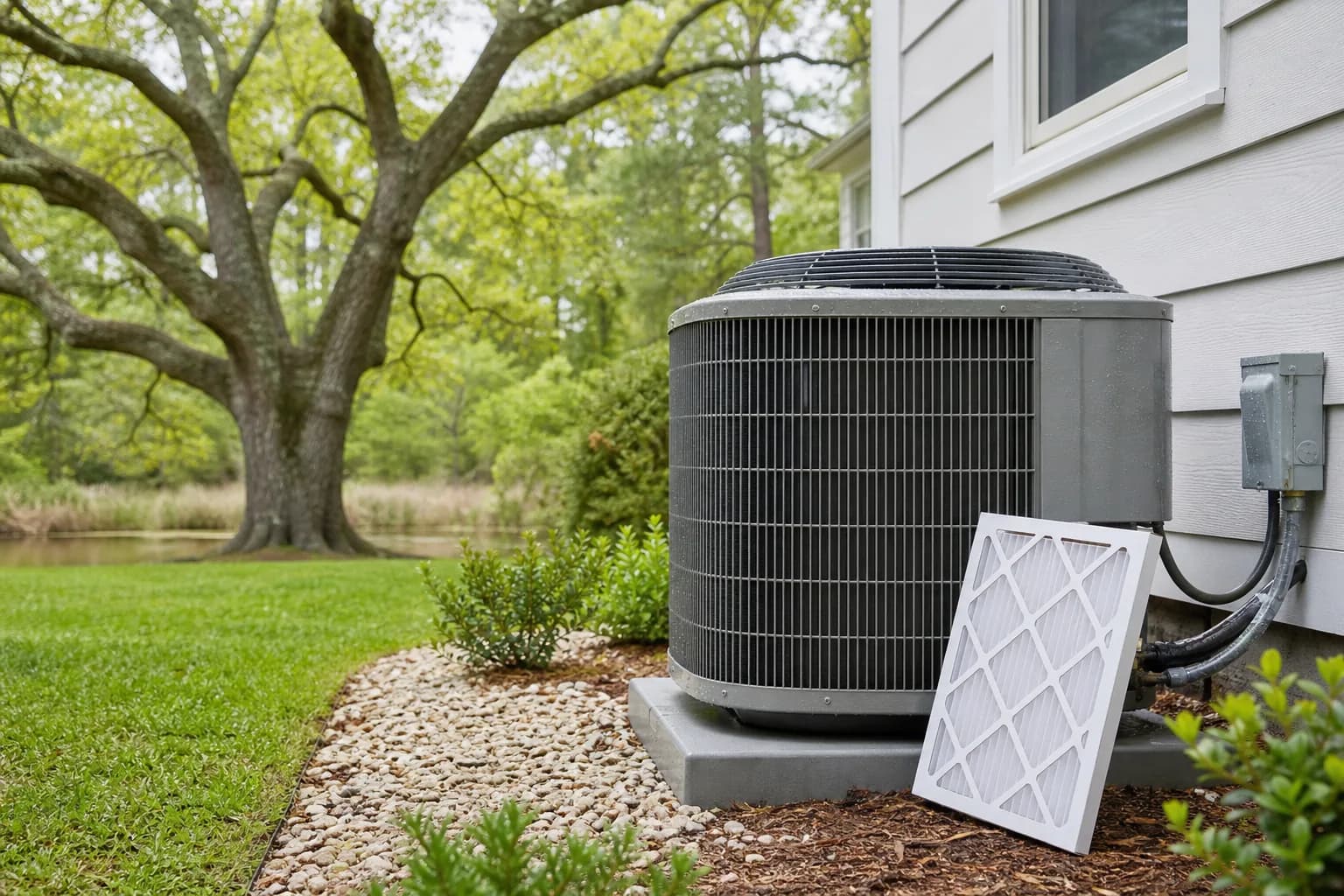 Indoor Air Quality
Oak Pollen and Bay Air: A Spring Indoor-Air Guide for the Eastern Shore
Spring on Mobile Bay means oak pollen, rising humidity, and stuffy houses. Here is how Spanish Fort homeowners actually fix indoor air this season.
June 25, 20267 min Indoor Air Quality
Mold in Your AC Ducts? A Gulf Coast Indoor-Air Guide
Musty AC smell in your Spanish Fort home? Here is why Eastern Shore humidity grows mold in ducts, coils, and drain pans — and how to stop it for good.
June 24, 20267 min
Other services in Spanish Fort & this service across Baldwin County.
- All HVAC services in Spanish Fort, AL
- Indoor Air Quality across Baldwin County
- AC Repair in Spanish Fort
- AC Installation in Spanish Fort
- AC Maintenance in Spanish Fort
- Commercial HVAC in Spanish Fort
- Emergency HVAC in Spanish Fort
- Heating Repair in Spanish Fort
- Heat Pump Services in Spanish Fort
- Ductless Mini-Splits in Spanish Fort
- Heating Installation in Spanish Fort
Indoor Air Quality in Spanish Fort — Schedule Today.
Same-day appointments most weekdays. Cool Club members get prioritized scheduling.