
Oak Pollen and Bay Air: A Spring Indoor-Air Guide for the Eastern Shore
Spring on Mobile Bay means oak pollen, rising humidity, and stuffy houses. Here is how Spanish Fort homeowners actually fix indoor air this season.

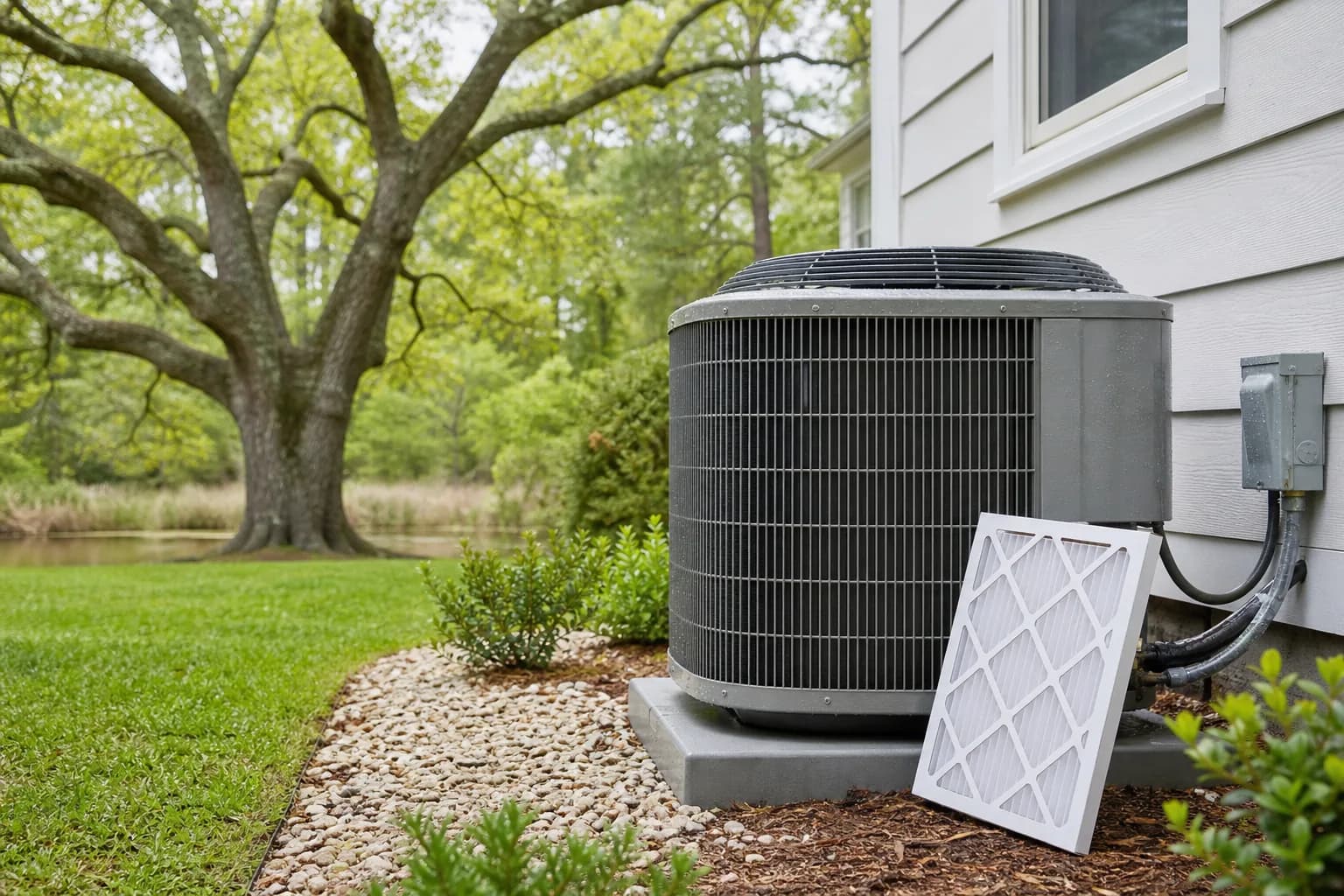
If you live anywhere from Stonebridge to TimberCreek and your eyes start itching the second the live oaks go yellow, your HVAC is doing more of the work than you think. A solid spring indoor-air setup on the Eastern Shore is four things: a real filter at MERV 11 to 13, humidity held between 45 and 55 percent, a sealed duct system so attic air is not getting pulled in, and a clean, dry coil — often helped by a UV lamp. Get those four right and the house stops feeling like the Causeway in July.
Why spring is the hardest IAQ season on the Eastern Shore
Most folks think summer is the rough one. It is hot, sure, but the AC runs long enough to actually dehumidify. Spring is sneakier. From mid-March through April, the live oaks dump pollen across Spanish Fort, the wind comes off Mobile Bay loaded with moisture, and the outside temperature swings from 58 in the morning to 82 in the afternoon. Your system short-cycles. That means the air gets cooled but the humidity barely drops, and every time the blower kicks on it shoves pollen-loaded attic air through whatever gaps your return has.
We service homes across Spanish Fort, Daphne, Malbis, and out toward Highway 225, and the spring call pattern is almost always the same: "house feels sticky, allergies are killing us, filter looks gray after two weeks." That is not a coincidence. It is the same three problems showing up in different houses.
Oak pollen, bay humidity, and what your filter is actually doing
Walk outside in early April in Blakeley Forest or Blakeley Oaks and you can write your name in the yellow dust on the hood of a truck. Oak pollen is fine — fine enough that the cheap fiberglass filter at the big-box store catches almost none of it. A MERV 8 pleated filter does better. A MERV 11 to 13 pleated filter is where you actually start grabbing pollen, mold spores, and the fine particulates that ride in off the bay.
Two cautions, because this is where people get into trouble:
- Do not jump to MERV 16 in a standard one-inch filter slot. You will starve the blower, freeze the coil, and burn up a motor. If you want hospital-grade filtration, you need a four- or five-inch media cabinet sized for your equipment.
- Change it every 30 to 60 days in spring. Not 90. Pollen loads up a filter fast on the Eastern Shore, and a loaded filter is the same problem as a too-tight filter — restricted airflow, longer runtimes, worse dehumidification. We break down the full cadence in our guide to how often you should change your AC filter on the Gulf Coast.
If you are not sure what your system can handle, that is exactly what our indoor air quality walkthrough is for. We measure static pressure before recommending a filter upgrade, because guessing on a 20-year-old air handler in Churchill or The Highlands is a fast way to kill it.
How humid should the inside of your house actually be?
Forty-five to fifty-five percent relative humidity. That is the band where wood floors stay put, your sinuses are happy, dust mites struggle, and mold does not get a foothold on the coil or in the wall cavities.
Here is the problem. Spanish Fort sits muggy or oppressive about six months of the year, with peak humidity around 79 percent in August. By the time you hit June, your AC is running enough hours that humidity tends to take care of itself if the system is sized right. But in April and May? The thermostat is satisfied in 8-minute cycles. Eight minutes is not enough to pull moisture out of the air. You end up at 72 degrees and 62 percent RH, which feels clammy and triggers every allergy in the house.
Fixes, in the order we usually recommend them:
- Set the fan to AUTO, not ON. Running the fan continuously re-evaporates moisture off the coil right back into your house.
- Check that the thermostat has a dehumidification or "comfort" mode and use it.
- If the house is over about 2,400 square feet or has a lot of glass facing the bay, look at a whole-home dehumidifier tied into the return. We install them all over Spanish Fort Estates and Shenandoah for exactly this reason.
Humidity is the thread running through every spring complaint we hear, and it deserves its own deep dive — our Eastern Shore home comfort guide to beating Gulf Coast humidity covers sizing, blower speed, and dehumidification in one place.
Why is my house dusty two days after I clean?
If you dust the mantel on Saturday and it is gray again by Monday, the duct system is leaking. This is the single most common finding in homes built in the late 1990s and early 2000s, which is most of the Eastern Shore — the median Spanish Fort home was built around 1999, so a lot of the housing stock is sitting in that 20-to-25-year window where original flex duct, mastic, and boot connections have given up.
Leaky returns are the bigger culprit than leaky supplies. A return that pulls from the attic is pulling 130-degree air, insulation fibers, and whatever pollen blew in through the soffit vents — and pushing it straight through your filter into the bedrooms. Sealing those returns at the boots and the plenum, and making sure the filter grille is actually gasketed, cuts indoor pollen more than any filter upgrade alone.
After Hurricane Sally in September 2020, we saw a lot of attic damage across Baldwin County that nobody ever connected to their HVAC. Shifted ductwork, crushed flex runs, popped boots — all of it shows up as "the house just feels different now." If your home took a hit during Sally and the IAQ has been off since, the attic is the first place to look.
UV lights, coil hygiene, and the coastal mold question
A wet evaporator coil sitting in 75-degree air is a perfect petri dish. In our climate, that coil is wet most of the cooling season. UV-C lamps mounted to shine on the coil and the drain pan keep biological growth from setting up shop, which matters more on the Eastern Shore than almost anywhere inland because we just do not get a hard dry season.
UV is not a filter. It will not catch a single grain of oak pollen. But paired with MERV 11 to 13 filtration, it handles the part of the IAQ problem that filters miss — the mold and bacteria that grow inside the equipment itself and aerosolize every time the blower starts.
A practical spring checklist for Spanish Fort homes
Run this list in March, before the oaks let go:
- Replace the filter with MERV 11 to 13, sized correctly for your system.
- Set the thermostat fan to AUTO and the target humidity to 50 percent if your thermostat supports it.
- Have someone inspect the return plenum and filter grille for leaks. If you have not had it done since you moved into a Stonebridge or Truland-built home, it is overdue.
- Pull the panel off the indoor unit and look at the coil. If it is fuzzy, gray, or smells musty, get it cleaned and consider UV.
- Walk the attic if you can do it safely. Look for crushed or disconnected duct runs, especially anything that shifted during Sally.
If you are not the climb-in-the-attic type — and most folks in Audubon, The Lakes, or out near Eastern Shore Centre are not — that is the kind of spring tune-up we do every day. You can schedule a visit online or call. We work all over the Spanish Fort service area, from the neighborhoods off US-98 and Hwy 181 down to homes near Historic Blakeley State Park and Battleship Memorial Park.
Bottom line
Spring allergies on the Eastern Shore are not just an outdoor problem. They are a filter problem, a humidity problem, a duct problem, and a coil problem, all at once. Fix the four together and the house feels different by the next pollen wave.
If your spring has been rough this year, let us take a look. We can spec the right filter, check your duct system, and tell you straight whether a UV light or a whole-home dehumidifier is worth it for your house.
- See our indoor air quality services
- Browse our other Spanish Fort HVAC resources
- Read up on seasonal HVAC maintenance
- Schedule service online or call (251) 300-9817