
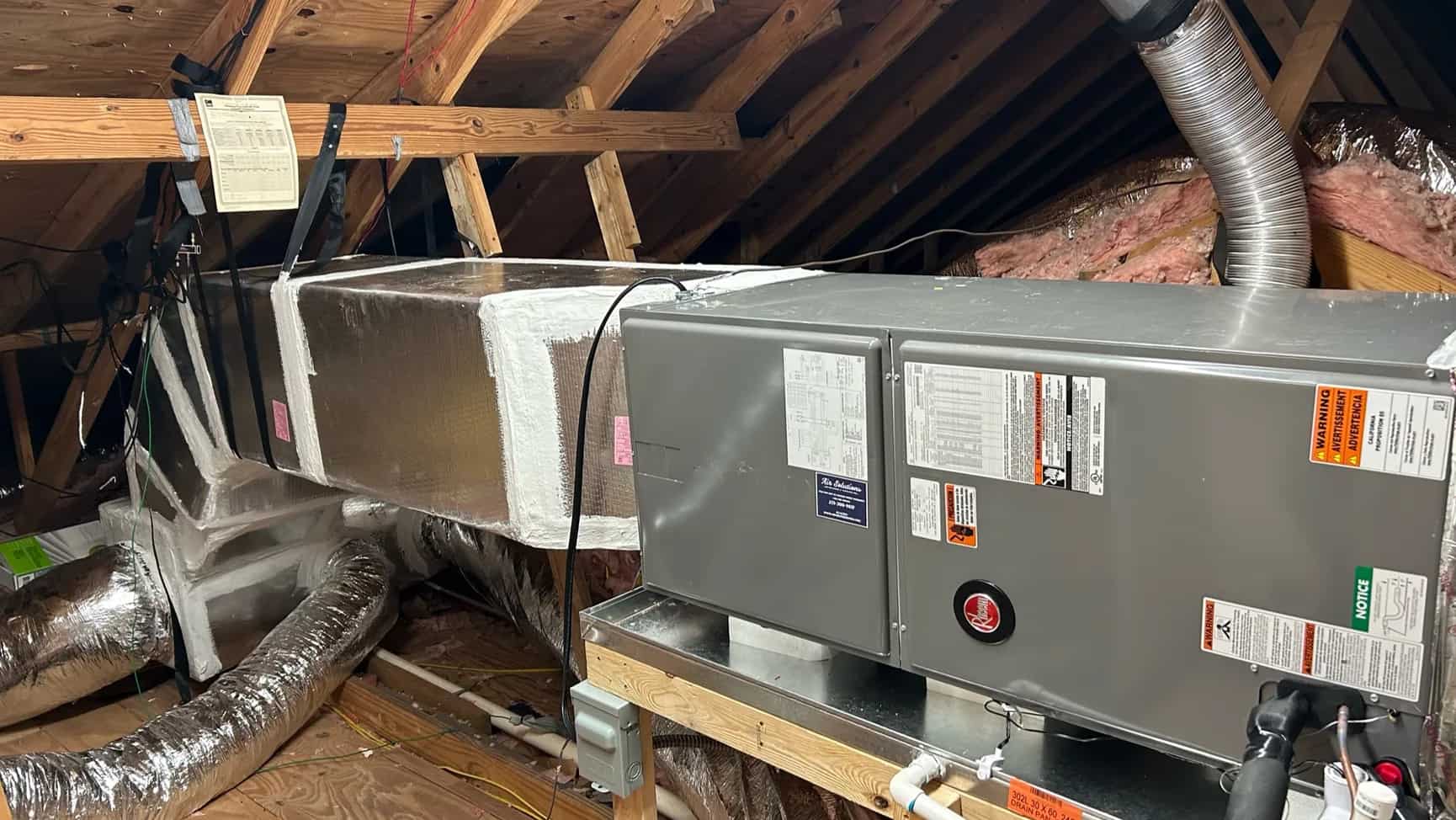
Indoor Air Quality in Lillian.
Local indoor air quality in Lillian, Alabama and surrounding Baldwin County. Dehumidifiers, air scrubbers, UV purification, ventilation. Licensed AL#23194. 353+ five-star reviews. Call (251) 300-9817.
Get a Free Estimate
Name and phone is all we need to call you back. Takes ~20 seconds.
353+ five-star reviews · Same-day · 24/7 · Licensed AL#23194
What indoor air quality looks like in this climate.
Lillian sits at the western edge of Perdido Bay at roughly 22 meters of elevation, and a per-coordinate ERA5 climate readout for 2023 lands near 2,931 cooling degree days against 1,002 heating degree days — both noticeably lower than the inland north-Baldwin cells a few miles up the map. The driver is the bay itself. Perdido Bay carries enough thermal mass to trim late-afternoon summer peaks and to hold overnight winter lows higher than rural inland acreage would otherwise produce; the January average overnight low at the Lillian coordinate is 51.5°F, which is one of the warmer values in the matrix and a direct read of how much winter the bay water buffers. For an IAQ conversation that combination matters more than the headline numbers imply, because the lower seasonal-peak intensity is paid back through a much longer shoulder season where the latent moisture load is still present.
What a Perdido Bay-facing home actually has to manage day to day is the overnight dew point rather than the July afternoon temperature. The open bay holds humidity propped up through the overnight return-flow hours that an inland envelope would already see fall off, and on a typical August or September night the dew point at the shoreline still reads in the mid-70s well past midnight. For a sensible-cooling-only system without dedicated dehumidification capacity, the day-to-day translation is an indoor humidity baseline that sits above the 55-to-60-percent comfort band for long stretches even with the thermostat satisfied on temperature. That bayfront overnight latent load is the central engineering reality behind almost every IAQ complaint we field from a 36549 address — well ahead of the more visible afternoon humidity that draws the homeowner's attention first.
What we see on calls in Lillian.
The recurring IAQ failure mode at a Perdido Bay-facing Lillian address is overnight latent drift on a system that's holding its temperature target without trouble. Spanish Cove, the bay-shoreline lots, and the parcels strung along the Hwy 98 corridor close to the water all share one envelope challenge: open-water exposure keeps overnight dew points propped up for hours past when an inland home would already see them fall, and a cooling system sized cleanly for sensible load will satisfy the thermostat long before it pulls indoor moisture down to a comfortable 50-to-55-percent band. What the homeowner notices is a house that reads cool on the wall but feels slightly heavy on the skin, with condensation appearing at window edges in the morning and a return-side filter that loads ahead of its expected schedule. The fix here is rarely a larger AC. It is almost always a supplemental whole-house dehumidifier sized against the actually-measured latent load on that specific envelope, with humidistat-aware programming wired into the existing thermostat so the dehumidifier and the cooling system stop working against each other. Brackish aerosol off the bay also accelerates media loading on the return side relative to what the inland Baldwin cells experience, and that shows up in the replacement-cadence guidance we leave behind after an assessment visit.
Other patterns layer on top of that bayfront baseline. The 2022 ACS records the Lillian CDP median age at 46.8 — elevated for the matrix — paired with an 81.5 percent owner-occupancy rate across 650 occupied units, which together describe a stable, long-tenure community typical of an established Gulf-coast retirement-adjacent waterfront. In day-to-day IAQ conversation that demographic anchor changes which questions get asked. A meaningful share of Lillian IAQ visits open with the homeowner already focused on filtration upgrades for a household member managing respiratory sensitivity, and the technical reply has to be sized to the system at hand rather than aspirational. On the typical Lillian return-side static-pressure budget, a 1-inch slot will sustain MERV 11 without choking the air handler; reaching MERV 13 reliably means retrofitting a 4-inch media cabinet that drops the pressure penalty back into spec. For homeowners who want particulate capture above what an in-line geometry can support, the defensible add-on is a HEPA-grade bypass loop wired in parallel with the main return, which carries only a fraction of the system airflow and never burdens the blower. We measure before we recommend, because pushing too much filter through too small a slot drops the airflow, drops the dehumidification work at the coil, and ends up making the air worse for the very household member the upgrade was meant to help. The 1997 median build year across the CDP yields a coherent mid-life equipment landscape — most original ductwork is still intact and seals well rather than needing wholesale replacement, but the systems have aged into the band where biofilm management at the indoor coil and drain pan becomes a meaningful piece of the IAQ stack. The published IAQ work we offer includes whole-home dehumidifiers, air scrubbers, UV purification, ductwork sealing, and advanced filtration systems. One deliberate exclusion stated plainly: we don't offer duct cleaning as a standalone service.
- Mid-life equipment is the common profile in this area. Capacitor and contactor failures dominate the service-call mix.
- Long cooling season means compressors run heavy May through October. Annual maintenance pays for itself in compressor lifespan.
- Mild winters mean heat pumps cover the season comfortably without backup runtime in normal years. Cold-snap weeks expose undersized units.
Indoor Air Quality in Lillian — the questions that come up.
- We have a home on the Perdido Bay shoreline in Spanish Cove. What size whole-house dehumidifier makes sense for a waterfront house in Lillian?
- Sizing for a Perdido Bay-facing home comes from actually measuring the latent moisture load on that specific envelope, not from a per-square-foot multiplier on a chart. The overnight dew-point persistence on the bay shifts the math meaningfully versus an inland house of the same floor area. On the assessment visit we pull four inputs: morning, afternoon, and overnight indoor humidity readings taken at multiple stations across the floor plan; the existing AC's measured dehumidification performance under live cooling load (suction-line conditions, coil saturation behavior, return-side delta-T); envelope observations on the bayfront facade including air-leakage at window and door frames; and a walkthrough of moisture-intrusion sources in the crawl space and attic. Plugging those numbers into the load math, a typical Spanish Cove or shoreline home in the 2,000-to-2,800 square-foot range usually wants a unit in the 80-to-110 pints-per-day capacity band to hold the interior at the 50-to-55-percent humidity target through the worst summer overnights. The figure moves either direction on a specific address — tighter envelope or smaller plan pulls it lower; leakier bayfront construction or larger plan pushes it up — which is exactly why we take readings before quoting a unit rather than working backwards from tonnage tables.
- A household member has COPD and we need the best filtration we can get without overloading the system. What HEPA or MERV approach actually works on a typical Lillian house?
- The honest engineering answer is that the best filtration the system can sustain mechanically is almost always different from the best filtration the package on the shelf is rated for, and a household-member sensitivity makes getting the match right more important rather than less. On a typical Lillian return-side static-pressure budget the working sweet spot is MERV 11 in a 1-inch slot or MERV 13 in a 4-inch media cabinet retrofit; pushing MERV 13 through a 1-inch geometry chokes the air handler, drops the airflow, and drops the dehumidification work at the coil — which leaves the indoor air worse for a respiratory-sensitive occupant rather than better. For households wanting particulate capture beyond what the in-line geometry will support, a HEPA-grade bypass loop wired in parallel with the main return is the defensible add-on, since the bypass carries only a fraction of the main airflow and never burdens the blower. We don't make medical claims about what any particular filtration setup does for any specific condition; what we document is the measured airflow, the particle-count change at multiple indoor stations before and after install, and the replacement cadence the chosen approach actually demands.
- Does UV-C purification do anything on a typical Lillian system, or is it mostly marketing?
- When deployed for what it actually does, it earns its place; when sold as a whole-air disinfection device, it overpromises. UV-C functions as a localized sterilizer aimed at the cold side of the air handler — a lamp mounted to keep continuous shortwave exposure on the evaporator face and the drain pan beneath it, both of which serve as the wet biological substrate in any Gulf-coast cooling system. On a Lillian system aged into the mid-vintage band, that substrate has had years to develop, and a properly aimed UV-C install can show up as both fewer clog-related drain-pan service calls and a noticeable reduction in the musty supply-vent smell that high-humidity bayfront envelopes produce. The bayfront moisture profile keeps the regrowth pressure on the lamp's target year-round, which justifies leaving the lamp powered continuously rather than seasonally. What UV-C will not do is sterilize air during its brief passage through the duct system, capture airborne pollen or dust particles, or substitute for the work that filtration upgrades and duct sealing perform on the other IAQ failure modes a particular house has. Treat it as one layer in a stack, not as the stack. The lamp itself rates at roughly 9,000 to 12,000 hours of effective germicidal output, so swapping it once a year on a calendar cadence — most cleanly handled at the spring preventive visit — prevents the silent-failure mode where the visible glow continues long after the useful biological output has dropped below the meaningful threshold.
- How often does the air filter need to be changed on a bayfront home in Lillian, given the salt-air exposure?
- Faster than the inland Baldwin baseline, in practical terms. The brackish aerosol off the open bay reaches a bayfront return-side intake through window-frame and door-frame leakage and through any positive-pressure ventilation pathway, and it loads media on a measurably quicker cadence than an equivalent inland Lillian address. For a 1-inch slot running MERV 8 we typically suggest a monthly check with the actual swap landing somewhere in a 30-to-45-day window on a bayfront property, versus the more common 60-to-90-day cadence on an inland home. With a MERV 11 or MERV 13 media cabinet retrofit the absolute interval stretches because the cabinet holds more media area, but the relative shortening still holds — bayfront wants a quarterly check where inland can ride out a six-month interval cleanly. Pollen weeks in March and April are the cue to inspect on the shorter end of the range regardless of where the property sits relative to the shoreline. We set the cadence against the actual loading observed on the first post-install swap, not against a generic calendar number.
- Your shop is in Daphne and we're an hour away in Lillian. How does that affect an IAQ project — is it worth it for us to use you versus a Pensacola contractor?
- Honest answer: the dispatch reality is what it is, and we own it. The OSRM-verified road time from our shop is 38.7 miles and right around an hour on Hwy 98; on shoulder traffic it lands closer to 50 minutes, on a peak summer Saturday it can stretch longer. For IAQ work specifically that drive math matters less than it would for an emergency no-cool call, because indoor-air-quality projects run on a planned cadence rather than an emergency clock. Our Lillian IAQ flow is a scheduled assessment plus a scheduled install, both bookable into windows where we stack adjacent Elberta and Perdido-corridor jobs onto the same routing — that keeps the cost honest instead of padding for the drive. The choice between us and a Pensacola-side contractor depends on what you want from the engagement. If you want measurement-first diagnostic work, a written recommendation specific to your house, and ongoing maintenance folded into the Cool Club annual cycle, we're a good fit. If you want a same-day install on a one-product recommendation, a closer contractor will beat us on dispatch and we'll say so up front rather than pretend otherwise.
Weather events that have shaped the Lillian indoor-air-quality call mix.
- Sep 2020 — Hurricane Sally — bayfront wall-cavity moisture and a long humidity tail: Sally made landfall a few miles south of Lillian with the eyewall passing directly over Perdido Bay, and the sustained wind and surge field drove brackish water onto bayfront equipment pads and into structural cavities along the western shoreline. The IAQ tail outlasted the visible damage by months. Wall cavities and crawl spaces throughout Spanish Cove and the Hwy 98 corridor that absorbed water during the storm kept releasing moisture into living areas through the following winter and into spring 2021, and properties restored to service without an explicit drying protocol produced chronic mold-odor complaints that bookend that recovery window. Homes where moisture mapping and a temporary dehumidification campaign were part of restoration largely cleared the smell complaints inside the first 90 days. A meaningful share of the working IAQ accessory equipment we read off Lillian nameplates today is dated to that post-Sally recommissioning period.
- Jan 2024 — Multi-night sub-freezing stretch and grid-cycling damage: Lillian rarely sees a genuine hard freeze because of the bay-thermal moderation, but the January 2024 event held sub-32°F overnight temperatures across multiple consecutive nights — long enough to surface IAQ failures driven by grid behavior rather than by the cold itself. Brief restoration cycles across the SE-Baldwin grid that week drove a noticeable uptick in dehumidifier control-board faults and humidistat-controller damage at addresses where the unit had been actively cycling when its power dropped. At homes where the dehumidifier sat idle through the recovery, indoor moisture levels drifted back above the biological-growth threshold even with heat running. The takeaway we have been recommending since is straightforward: wire the dehumidifier and the rest of the IAQ accessory stack behind the same surge-protected branch the main HVAC equipment is on, rather than leaving it as a stand-alone appliance that has to ride out whatever the cooperative throws at it.
- Summer 2023 — Long heat stretch — indoor humidity rising despite uninterrupted AC: An extended run of above-95°F afternoons pushed Lillian IAQ calls toward homes where the air conditioner was effectively never cycling off and yet the indoor humidity meter was still climbing past 60 percent. The bayfront addresses showed the pattern most sharply, because the overnight dew point never dropped far enough to give the cooling system any recovery window — the envelope was being refilled with humid bay air every night faster than the AC could remove it during the day. In every diagnosis we ran during that stretch, the mechanical remedy turned out to be supplemental whole-house dehumidification sized to the measured latent load rather than additional cooling tonnage, and that seasonal call pattern remains the most reliable forward indicator of where summer IAQ work in Lillian will concentrate each year.
- Annual (mid-March through April, again in late summer) — Coastal pollen and bay-aerosol seasonal filter loading: Lillian doesn't sit under the heavy live-oak canopy that drives Fairhope's dramatic spring pollen weeks, but SE-Baldwin pine and grass pollen still arrive in March and April and stack on top of the year-round brackish aerosol the open bay produces. IAQ complaints during those weeks cluster around return-side filter loading running ahead of the regular replacement cadence, sharpest on bayfront and shoreline addresses where the saline component reaches return intakes through frame leakage. The practical adjustment is a tighter swap schedule through pollen weeks plus a media-cabinet evaluation when a 1-inch slot can't sustainably hold the MERV level the household actually wants.
Every Lillian neighborhood, every zip.
Lillian sits at the far southeast corner of our Baldwin County coverage area, and the OSRM-verified route from the Daphne shop covers 38.7 miles and lands at right around an hour — the truck runs south through Foley and then turns east on Highway 98 past Elberta until it reaches the Perdido Bay shoreline. On a shoulder-traffic day, especially mid-morning or mid-afternoon outside the Foley summer-rental turnover windows, the actual run usually tightens up nearer to 50 minutes; on a peak July Saturday it can drift longer. We quote the honest range up front when an appointment gets booked instead of trimming the number for marketing copy. The coverage map inside ZIP 36549 reaches every Spanish Cove address, the Perdido Bay shoreline lots, the Hwy 98 corridor heading east toward the Florida line, the Lillian boat launch area, and the open rural lots scattered through the rest of the CDP.
On an IAQ engagement specifically, the long dispatch actually shapes the visit cadence in the homeowner's favor. The Lillian IAQ project flow we use is a scheduled diagnostic assessment first — indoor humidity readings taken at multiple stations across the house, return-side static pressure measured at the air handler, coil and drain-line inspection, and a written recommendation document that spells out what would actually move the needle on this particular home — and then a separate scheduled install visit if you choose to move forward. Splitting the work this way lets us stack adjacent Elberta or Perdido-corridor jobs onto the same routing rather than running the truck twice for the same address in isolation, which keeps the cost math honest for both sides. The natural way to fold the assessment into a Cool Club membership year is to bundle it with a spring or fall preventive-maintenance call (the membership benefit is 15% off all AC repairs and 5% off new systems, with most IAQ accessory installs handled on the new-systems side of that ledger). After-hours, the 24/7 number is (251) 300-9817; in practice though, chronic indoor humidity is not the kind of problem an overnight truck roll can actually solve, so IAQ-flagged voicemails get returned the following business morning to book the assessment for a window where the work can be done properly.
- Spanish Cove
- the Perdido Bay shoreline
- Hwy 98 corridor
- the Lillian boat launch area
- rural Lillian
What Lillian customers can claim.
- Baldwin EMC — the rural-electric cooperative for southeast Baldwin County — carries nearly every residential meter inside ZIP 36549. That includes Spanish Cove, the Perdido Bay shoreline lots, the parcels along the Hwy 98 corridor, and the unincorporated rural lots outside the community core. Pipeline natural-gas distribution doesn't extend to this corner of the county at all, so most homes around Lillian operate fully electric on their HVAC equipment, with a smaller share running propane (LP) tanks for kitchen ranges or for an auxiliary heating source.
- IAQ-only accessory work — adding a whole-house dehumidifier, a UV-C lamp, a MERV media cabinet retrofit, a HEPA bypass loop, or a dedicated outdoor air system on top of an otherwise-unchanged HVAC system — generally sits outside Baldwin EMC's residential rebate envelope. The cooperative builds its program around whole-system kilowatt-hour efficiency thresholds tied to qualifying heat-pump or central-AC replacement tiers; the indoor-air-quality outcomes a standalone accessory delivers aren't a metric the program scores against. The path an IAQ project does take to rebate eligibility is bundling: when the accessory is installed as part of a qualifying heat-pump replacement on the same project, the system-level incentive covers the combined work as a single equipment upgrade.
- Cooperative rebate eligibility and dollar amounts shift annually. Any current-quarter posture is best verified directly with Baldwin EMC before being baked into a project budget; a call to the cooperative's member-service line gives the authoritative answer on what's actually open this quarter, and that beats a stale figure printed on a year-old contractor brochure.
Indoor Air Quality Coverage Map — Lillian, Alabama
Centered near Lillian for orientation. Air Solutions Heating & Cooling provides indoor air quality throughout every Lillian neighborhood and zip code, plus the surrounding Baldwin County area. Same crew, same number — we travel the whole county.
353+ Five-Star Reviews. And Counting.
“Jacob arrived as scheduled and completed the service quickly and efficiently despite the severely adverse conditions working in the attic in extreme heat and humidity.”
Schedule Indoor Air Quality in Lillian.
Dehumidifiers, air scrubbers, UV purification, ventilation. Same-day appointments most weekdays in Lillian and surrounding Baldwin County. Tell us when works for you — we'll confirm by phone during weekday office hours (8 AM-4 PM).
Need someone right now? Call (251) 300-9817 — our 24/7 emergency line is answered live when we can and returned quickly when we can't.
Indoor Air Quality in Lillian — FAQs
Why is indoor air quality such a big deal on the Gulf Coast?
Baldwin County's outdoor humidity averages 75% annually and peaks above 90% on summer mornings. Indoor humidity tracks outdoor humidity, and at 60%+ indoor RH, problems start: dust mite populations explode, mold can germinate on indoor surfaces, wood furniture warps, and that distinctive 'musty house' smell appears. Getting indoor RH into the 40-55% range solves most indoor air quality complaints — and that's primarily an HVAC engineering problem, not just a 'buy an air purifier' problem.Do I need a whole-house dehumidifier in Baldwin County?
Probably not if your AC is properly sized and maintained — a right-sized AC removes plenty of moisture during normal cooling cycles. You DO benefit from a whole-house dehumidifier if: (1) your home is tight new construction where AC doesn't run long enough to dehumidify, (2) you have a vacation rental that sits at higher setpoints during vacancy, (3) you have chronic mold complaints despite good cooling, or (4) you have indoor pools/spas/large fish tanks adding moisture continuously. We provide a written estimate before any work begins.Are UV-C lights worth installing on my HVAC system?
Coil-mounted UV-C lights are genuinely useful in Baldwin County's humidity — they keep evaporator coils and drain pans biologically sterile, preventing the musty smell that humid climates produce. Worth considering for homes with chronic supply-vent odor or vacation rentals. We provide a written estimate before installation. The marketing claims about UV killing airborne pathogens are overstated; airflow is too fast for meaningful kill rates. For air sterilization, better filtration is more cost-effective.Do you service all of Lillian, AL?
Yes — Air Solutions Heating & Cooling covers every neighborhood and zip code in Lillian, Alabama — including Spanish Cove, the Perdido Bay shoreline, Hwy 98 corridor, plus the surrounding subdivisions and rural roads. We handle AC repair, AC installation, AC maintenance, emergency HVAC, and commercial HVAC. Standard service hours weekdays, 24/7 emergency response, and same-day appointments most of the year. Call (251) 300-9817 to schedule.What HVAC issues are most common in Lillian?
Homes around Perdido Bay most commonly call us for refrigerant leaks (often salt-air or coil corrosion related on the Gulf Coast), undersized air conditioning systems struggling with Baldwin County summer humidity, and capacitor failures during peak load between June and September. A Cool Club bi-annual maintenance plan catches most of these issues before they cause a breakdown.
Indoor Air Quality Near Lillian.
Right at the Lillian city limit? We service the surrounding Baldwin County communities on the same routes — same crew, same response times.
Related HVAC Guides.
Long-form articles about indoor air quality and Baldwin County HVAC, with practical advice from our team.
 Seasonal
Back-to-School HVAC Reset: A Lillian Family Schedule
Late-summer HVAC reset for Lillian, AL families heading into the school year — schedule, settings, and quick service to ensure smooth fall operation.
September 22, 20264 min Seasonal
4th of July HVAC Tips: Keeping Your Lillian Vacation Rental Cool for Guests
Independence Day weekend HVAC prep for Lillian, AL vacation rental owners — peak-occupancy load management, monitoring, and emergency response protocols.
September 18, 20264 min Maintenance
Loud AC Noises Decoded: A Lillian Homeowner's Sound Identification Guide
Identifying common AC sounds in Lillian, AL homes — what each noise typically means, what's normal vs urgent, and when to call for service.
September 1, 20265 min
Other services in Lillian & this service across Baldwin County.
- All HVAC services in Lillian, AL
- Indoor Air Quality across Baldwin County
- AC Repair in Lillian
- AC Installation in Lillian
- AC Maintenance in Lillian
- Commercial HVAC in Lillian
- Emergency HVAC in Lillian
- Heating Repair in Lillian
- Heat Pump Services in Lillian
- Ductless Mini-Splits in Lillian
- Heating Installation in Lillian
Indoor Air Quality in Lillian — Schedule Today.
Same-day appointments most weekdays. Cool Club members get prioritized scheduling.