
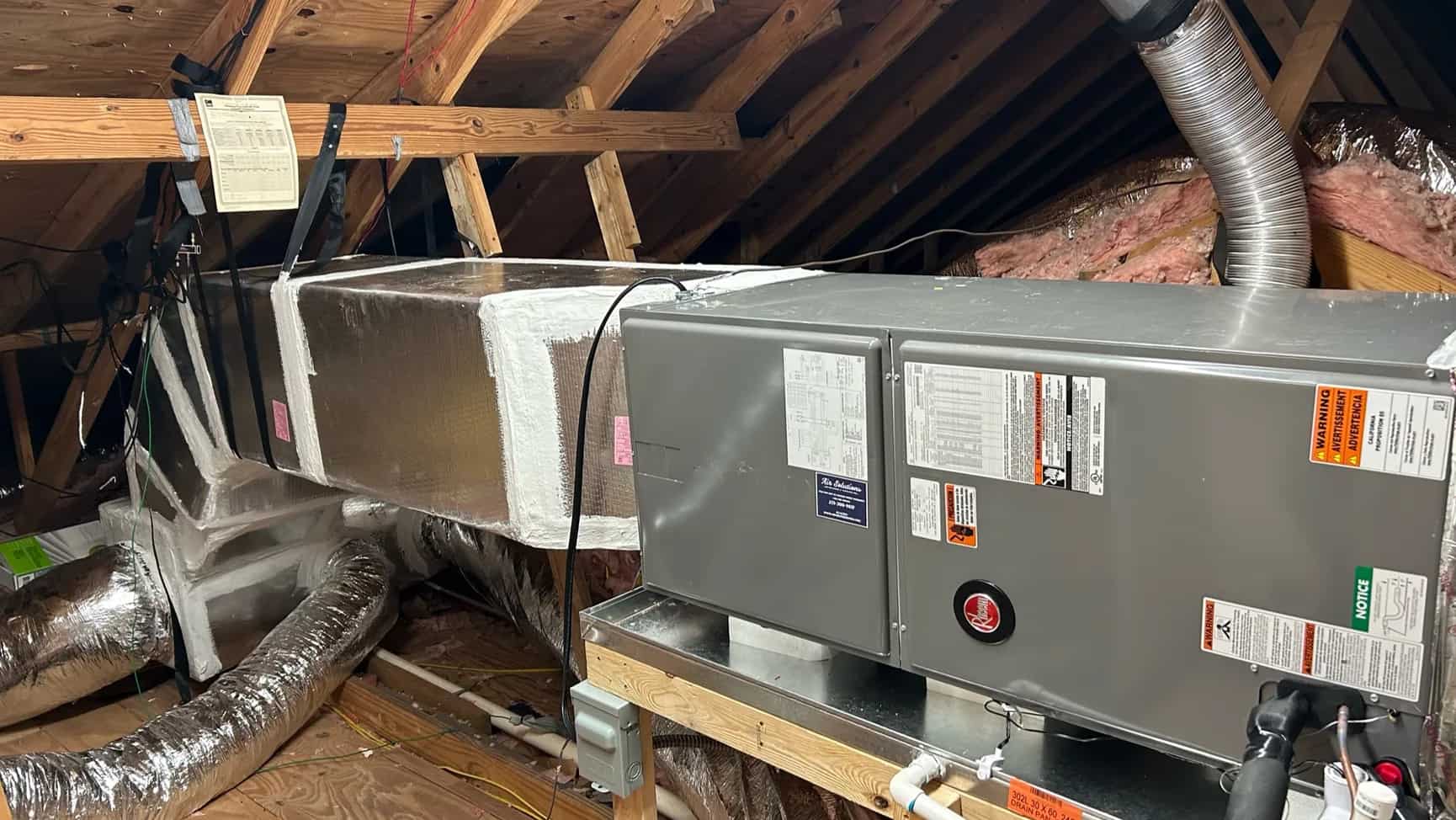
Heat Pump Services in Lillian.
Local heat pump services in Lillian, Alabama and surrounding Baldwin County. Repair, install, maintenance for Baldwin County's #1 system type. Licensed AL#23194. 353+ five-star reviews. Call (251) 300-9817.
Get a Free Estimate
Name and phone is all we need to call you back. Takes ~20 seconds.
353+ five-star reviews · Same-day · 24/7 · Licensed AL#23194
What heat pump services looks like in this climate.
Lillian sits on a stretch of the Baldwin County climate map that is genuinely friendly to a residential heat pump. Per-coordinate ERA5 reanalysis at the community's grid cell returns about 2,931 cooling degree days for 2023 against roughly 1,002 heating degree days, with average July highs of 90.5°F and an average January low at 51.5°F. Both ends of that range are pulled down by direct open-water exposure to Perdido Bay — the bay buffers overnight lows in winter and trims the peak afternoon highs in summer more aggressively than the Mobile Bay frontage does for the Eastern Shore. What that produces in equipment terms is a heat pump operating in the efficient middle of its capacity curve for nearly the entire calendar — neither pushed against its low-ambient capacity limit on winter mornings nor running flat-out against the latent-load ceiling on summer afternoons.
The bay-thermal moderation does not make the system easier to maintain — it makes it run longer. A Lillian heat pump is cycling on a humid 75-degree afternoon in March or October when an inland north-Baldwin unit would already be off, and the compressor-hour accumulation across a full year ends up closer to a coastal-cell figure than the modest CDD number alone would suggest. The reversing valve still sits dormant for the bulk of the year because the heating envelope is short, which means the first genuinely cold morning of December or January is when the reverse-cycle hardware gets exercised after nine or ten months of cooling-only standby. The discipline a Lillian heat pump rewards is service-side: a spring tune-up catching cooling-mode drift across a long humid season, and a fall tune-up that actually puts the reversing valve and the auxiliary heat stage through their paces before the season needs them.
What we see on calls in Lillian.
Lillian's residential heat-pump call mix follows the contours of the community itself. The ACS 2022 figures put the median home build year at 1997 and the owner-occupancy rate at 81.5%, with a median age of 46.8 that runs older than most of the matrix. The picture that paints is a community of long-tenure owners maintaining systems they specified themselves — Spanish Cove is a recognized 55-plus community, the bay-shore second-home subdivisions ringing the area attract owners planning multi-year capital decisions on the property, and the rural acreage along Hwy 98 between Elberta and the Florida line carries detached homes whose owners tend to live with the equipment for the long run rather than turn the property over inside a five-year window. Most of the systems we see in service are second-cycle heat pumps installed during the 2008-to-2018 replacement wave, now in the eight-to-eighteen-year band where capacitor drift, contactor pitting, reversing-valve solenoid wear, and inverter board questions become the working call mix.
The waterfront-but-not-Gulf-front exposure produces a corrosion pattern that does not fit either the open-Gulf or the deep-inland template. Perdido Bay carries genuine brackish air — the open-water exposure runs across the bay before reaching a condenser pad sitting fifty or a hundred yards from the shoreline on a second-row waterfront lot — but the corrosive load is meaningfully lower than the salt-spray exposure an Orange Beach Gulf-front condo's outdoor unit takes. Where it shows: aluminum condenser-coil fin pitting around the field-fastened joints on bay-facing properties, contactor-lug oxidation inside the outdoor disconnect on units installed without sealed boxes, and accelerated corrosion on copper line-set insulation that has cracked open across years of UV exposure. Inland Lillian addresses on the rural acreage away from the bay shoreline see almost none of this pattern — the corrosion conversation is genuinely a lot-by-lot conversation rather than a town-wide one, and we read the property's exposure before recommending coastal-grade coil coatings or sealed-disconnect upgrades.
- Mid-life equipment is the common profile in this area. Capacitor and contactor failures dominate the service-call mix.
- Long cooling season means compressors run heavy May through October. Annual maintenance pays for itself in compressor lifespan.
- Mild winters mean heat pumps cover the season comfortably without backup runtime in normal years. Cold-snap weeks expose undersized units.
Heat Pump Services in Lillian — the questions that come up.
- Our Lillian home is on Perdido Bay but not directly on the Gulf. Does salt-air corrosion really matter for our outdoor heat-pump unit?
- It matters more than people expect and less than the Gulf-front condo conversation in Orange Beach suggests — that intermediate exposure is the honest framing. Perdido Bay carries genuine brackish air, and an outdoor condenser fifty or a hundred yards from the shoreline absorbs that corrosive load year after year even though the property is technically a bay-front rather than a Gulf-front address. Where it shows up first: aluminum condenser-coil fin pitting around the field-fastened joints, contactor-lug oxidation inside the outdoor electrical disconnect, and accelerated wear on copper line-set insulation that has cracked open from UV exposure. The mitigations we discuss for a bay-facing Lillian property typically include coastal-grade coil coatings on new equipment, sealed outdoor disconnect enclosures, and a more frequent rinse-and-inspect cadence on the condenser fins. An inland Lillian address on rural acreage well away from the bay shoreline rarely needs the same package — we read the property's actual exposure before quoting the upgrades rather than treating every Lillian address as if it sits on the water.
- Our Lillian home runs on propane for the kitchen and the water heater. Does it make sense to pair a heat pump with an LP furnace as backup heat?
- If the propane tank is already in the ground and serving other appliances, yes, a dual-fuel arrangement pairing a high-efficiency heat pump with an LP (propane) furnace as backup is a genuinely sensible configuration for a Lillian home, particularly on a larger rural-acreage property where the heating load is meaningful. Natural gas is not available out at the Florida-line corner of Baldwin County, so propane is the only realistic fossil-fuel option for a furnace conversion or pairing here. The way the math works: the heat pump carries the bulk of operating hours through Lillian's mild winter at its efficient COP range, and the LP furnace stages in only on the rare freeze nights when the heat pump's capacity tails off and propane heat becomes the more economical hour. For a home starting fresh with no propane tank already in service, the capital cost of putting in an LP system to back up a heat pump rarely pencils out against a properly sized variable-speed heat pump with an auxiliary electric strip — Lillian's heating-degree-day count is just not high enough to justify the fuel-system capital. We run the operating-cost arithmetic against current LP delivery pricing rather than assume a number.
- We are planning to live in our Spanish Cove home for the long run. How does that change the heat-pump equipment conversation versus what someone planning to move in five years would hear?
- It changes the recommendation substantially, and we welcome that framing on the front end of the conversation. A homeowner with a multi-year-or-longer planning horizon usually gets better long-term economics from variable-speed inverter equipment specified at the upper end of the efficiency tier with a fully matched indoor-outdoor combination, rather than the cheaper fixed-speed equipment that fits the same pad and looks attractive on the install sticker. The reasons translate directly into operating cost across the planning horizon: lower compressor-cycle wear under variable-speed modulation, tighter humidity control across long humid Lillian cooling seasons, and a meaningfully better COP at the moderate ambient temperatures that define most of the year here. We also tend to discuss extended manufacturer parts and labor warranty options more seriously for long-tenure homeowners because the math actually works for them in a way that does not work for a homeowner planning to sell inside a five-year window. The conversation we want to have on a Spanish Cove call is the lifecycle-cost conversation, not the lowest-bid conversation.
- Do we need a cold-climate hyper-heat heat pump (Mitsubishi Hyper-Heat, Daikin Aurora, similar) for a Lillian install?
- For almost every Lillian address, no — the cold-climate hyper-heat tier is genuinely overkill for the local climate and a standard high-efficiency variable-speed heat pump with a correctly sized auxiliary electric heat strip handles a Lillian winter comfortably. The cold-climate-spec equipment lines were engineered to maintain nameplate-rated capacity in single-digit and sub-zero outdoor temperatures that Lillian's bay-thermal-moderated climate does not produce. The community's average January low at 51.5°F and the rare freeze nights that occasionally drop into the high 20s sit well above the threshold where standard variable-speed equipment starts losing meaningful capacity. The hyper-heat tier earns its price premium on the genuinely cold north-Baldwin cells like Bay Minette and Stockton where sustained sub-30 stretches are routine, or for an Eastern Shore or Lillian homeowner who explicitly does not want any auxiliary-strip operation under any condition. For a typical Lillian install the standard tier delivers comparable operating-cost outcomes for a meaningfully lower equipment investment, and the savings can go toward coastal-grade coil coatings or warranty extensions that actually move the needle for a bay-front address.
- Are there utility rebates or federal tax incentives available on a new Lillian heat-pump install?
- The federal Section 25C credit (up to $2,000 on qualifying heat-pump installs) expired December 31, 2025. Installs placed in service in 2026 do not qualify; if your system went in on or before that date, your CPA can advise on the 2025 Form 5695 return. On the utility side, Baldwin EMC has historically run residential efficiency-rebate programs for qualifying high-efficiency heat-pump installations. Dollar amounts and qualifying equipment tiers shift annually, so we pull the current program directly from the cooperative at quote time rather than commit a stale figure to your project budget.
What Lillian customers can claim.
- Baldwin EMC is the dominant residential electricity provider across the SE-Baldwin / Lillian footprint. The 36549 ZIP sits deep inside the cooperative's coverage, with edge-address possibilities for Riviera Utilities depending on the parcel. The fastest way to confirm the actual provider for any specific Lillian address is the provider name printed on the most recent power statement; we ask for it on the booking call when a heat-pump install discussion is in motion and rebate eligibility is part of the conversation.
- Baldwin EMC has historically maintained residential energy-efficiency rebate offerings tied to high-efficiency heat-pump installations clearing qualifying SEER and HSPF tiers. The cooperative's specific dollar amounts and qualifying equipment tiers shift from program year to program year, so we verify the active Baldwin EMC residential program directly at the time a quote is in motion rather than working from a stale figure. For any Lillian parcel that turns out to fall on Riviera Utilities instead, we run the same check against that utility's residential efficiency program in the same conversation.
- Natural-gas distribution is not available at the Florida-line corner of Baldwin County, so a gas-furnace conversion is not a realistic option for Lillian homes. Propane (LP) is the only fossil-fuel backup-heating choice on the table, and a dual-fuel pairing — high-efficiency heat pump plus LP furnace as backup heat below the heat pump's balance point — is a sensible configuration for a home that already has a propane tank in service for other appliances. For a Lillian home starting purely on electric service, the lifecycle math typically favors a properly sized variable-speed heat pump with a correctly specified auxiliary electric strip over a fresh LP-furnace install; the heating-degree-day count here is too low to recover the LP system's capital cost over realistic ownership horizons.
- When the equipment manufacturer is running an active rebate on the specific heat-pump model a Lillian install calls for, the manufacturer rebates available on the equipment we install are applied directly to your quote — that piece is handled on our end rather than left as paperwork the homeowner files after install.
- Cool Club membership on a Lillian heat-pump system pairs a spring cooling-side tune-up and a fall heating-side tune-up with member discounts — the maintenance page publishes those benefits as 15% off all AC repairs and 5% off new systems. Membership runs without long-term contracts, which lets a Lillian homeowner evaluate the value year by year rather than commit to a multi-year arrangement up front.
Every Lillian neighborhood, every zip.
A residential heat-pump install in Lillian is almost never a single-visit project, and the routing geography here pushes that reality to the front of the planning. The OSRM-verified road time from our Daphne shop to Lillian runs right at sixty minutes — south through Foley, east on Highway 98 past Elberta, and then to the Perdido Bay shoreline at the Florida line. That distance is the most honest single fact about how a Lillian heat-pump service relationship actually works: pre-install assessment, the actual install day, commissioning, first-summer cooling-mode verification, and the first-cold-morning heating-mode verification all sit on the schedule as discrete events, and we plan around the drive rather than pretend it does not exist. Coverage spans the 36549 ZIP and includes Spanish Cove, the Perdido Bay shoreline, the Highway 98 corridor between Elberta and the Florida line, the Lillian boat-launch area, and the rural acreage that fans out from the community.
Because the routing math is real, we structure Lillian residential service the way the geography rewards rather than the way a one-mile-from-the-shop city would. Where possible we stack a Lillian heat-pump call with an adjacent Elberta, Perdido, or southeast-Foley job already on the route, which compresses the drive economics for both customers. When a Lillian-only dispatch is what the day calls for, the truck still rolls out Hwy 98 — we say the honest ETA on the booking confirmation and we keep the homeowner posted from the road rather than imply a same-city presence we do not have. For seasonal commissioning visits like the first-cold-morning reverse-cycle verification, we schedule those weeks in advance and route them when the weather pattern actually warrants the check rather than letting them turn into reactive service calls months later.
- Spanish Cove
- the Perdido Bay shoreline
- Hwy 98 corridor
- the Lillian boat launch area
- rural Lillian
Weather events that shape heat-pump-services patterns on Lillian residential addresses.
- Sep 2020 — Hurricane Sally: Sally made landfall just south of Lillian with the eyewall tracking right over Perdido Bay, and the wind and storm-surge exposure across the bay-shore residential blocks ran heavier here than in any other matrix city. Outdoor heat-pump condensers along the Hwy 98 corridor and the bay shoreline absorbed sustained wind, flying debris, and tidal surge that drove brackish water across pads and into low-mounted electrical disconnects. The replacement and recommission wave that followed reshaped a meaningful share of the working Lillian heat-pump population — many of the units in service today are post-Sally installations that are now reaching the five-to-six-year mark in their service lives and aging out of the original equipment manufacturer warranty window. Surge-protector standard scope on every new install in Lillian since traces back to the dirty-power exposure profile this event made undeniable.
- Jan 2024 — Multi-night sub-freezing stretch: Lillian rarely earns a true hard freeze because of the bay-thermal moderation, which is exactly why the 2024 event was the kind of cold snap that exposes weak heating-mode hardware. Three consecutive nights with sub-32°F lows ran heat pumps in reverse cycle for longer continuous stretches than the equipment had seen in years on many addresses, and the failure pattern that surfaced afterward clustered around predictable items: reversing valves stuck mid-cycle on units that had not actuated reverse-mode operation since the previous winter, defrost-board cycling that had drifted out of calibration unnoticed, auxiliary heat strip continuity issues on systems whose strips had never been exercised at full duty, and balance-point thermostat programming that engaged the strip too early on mornings the heat pump alone could have carried. The cluster of Lillian service calls in late January and early February 2024 traced almost entirely back to off-season components that nobody had checked for years.
- Aug 2023 — Heat-advisory stretch: An extended run of above-95°F afternoons stacked the seasonal compressor-stress pattern on the existing Lillian heat-pump population. Capacitor microfarad drift surfaced on systems past the eight-year mark, contactor pitting showed up on units running marginal start torque already, and frozen indoor coils appeared on a handful of systems running low on refrigerant where the latent-load math finally tipped past what the coil could handle. The pattern continued to be a reliable leading indicator of where seasonal residential service load lands each year — Lillian's bay-moderated climate keeps the peaks slightly lower than the inland cells, but the long compressor-hour accumulation across the cooling season produces wear that the next prolonged heat stretch reliably surfaces.
Heat Pump Services Coverage Map — Lillian, Alabama
Centered near Lillian for orientation. Air Solutions Heating & Cooling provides heat pump services throughout every Lillian neighborhood and zip code, plus the surrounding Baldwin County area. Same crew, same number — we travel the whole county.
353+ Five-Star Reviews. And Counting.
“Jacob was friendly, professional and prompt.”
“Jacob was absolutely wonderful. Definitely would recommend him and this company!!”
“⭐⭐⭐⭐⭐ **Outstanding Service from Air Solutions and Jesse!** I can't say enough good things about my experience with **Air Solutions**, especially their technician **Jesse**. After dealing with my 10-year-old HVAC system, I wanted someone who would actually take the time to diagnose and properly service the system rather than simply recommend replacing it. Jesse exceeded my expectations. He was…”
Schedule Heat Pump Services in Lillian.
Repair, install, maintenance for Baldwin County's #1 system type. Same-day appointments most weekdays in Lillian and surrounding Baldwin County. Tell us when works for you — we'll confirm by phone during weekday office hours (8 AM-4 PM).
Need someone right now? Call (251) 300-9817 — our 24/7 emergency line is answered live when we can and returned quickly when we can't.
Heat Pump Services in Lillian — FAQs
Why are heat pumps the most common HVAC system in Baldwin County?
Baldwin County's mild winter climate (Climate Zone 2A) is ideal for heat pump operation. Heat pumps deliver 2-3 units of heat for every unit of electricity consumed in our typical winter conditions, while also providing all the summer cooling. One outdoor unit, both seasons, lower utility bills than separate AC + gas furnace setups in our climate. Alabama Power and TVA EnergyRight rebate programs may apply to qualifying high-efficiency installs.How long do heat pumps last on the Gulf Coast?
Inland Baldwin County heat pumps (Daphne, Fairhope, Spanish Fort, Bay Minette) typically last 12-15 years with bi-annual maintenance. Coastal heat pumps (Gulf Shores, Orange Beach, Fort Morgan) typically last 8-12 years due to salt-air corrosion. Coastal-grade outdoor units with corrosion-resistant coatings extend coastal lifespan to 12-16 years. Cool Club bi-annual maintenance documented for warranty purposes maximizes equipment life.Is the federal 25C tax credit still available for heat pump installations?
No — the federal 25C Energy Efficient Home Improvement Credit expired December 31, 2025. Heat pump systems placed in service in 2026 or later are not eligible. If your system was installed on or before December 31, 2025, the credit may be available on your 2025 federal return — verify with a CPA. For new 2026 installs, ask about Alabama Power, TVA EnergyRight, and manufacturer rebate programs that remain in effect.Do you service all of Lillian, AL?
Yes — Air Solutions Heating & Cooling covers every neighborhood and zip code in Lillian, Alabama — including Spanish Cove, the Perdido Bay shoreline, Hwy 98 corridor, plus the surrounding subdivisions and rural roads. We handle AC repair, AC installation, AC maintenance, emergency HVAC, and commercial HVAC. Standard service hours weekdays, 24/7 emergency response, and same-day appointments most of the year. Call (251) 300-9817 to schedule.What HVAC issues are most common in Lillian?
Homes around Perdido Bay most commonly call us for refrigerant leaks (often salt-air or coil corrosion related on the Gulf Coast), undersized air conditioning systems struggling with Baldwin County summer humidity, and capacitor failures during peak load between June and September. A Cool Club bi-annual maintenance plan catches most of these issues before they cause a breakdown.
Heat Pump Services Near Lillian.
Right at the Lillian city limit? We service the surrounding Baldwin County communities on the same routes — same crew, same response times.
Related HVAC Guides.
Long-form articles about heat pump services and Baldwin County HVAC, with practical advice from our team.
 Seasonal
Back-to-School HVAC Reset: A Lillian Family Schedule
Late-summer HVAC reset for Lillian, AL families heading into the school year — schedule, settings, and quick service to ensure smooth fall operation.
September 22, 20264 min Seasonal
4th of July HVAC Tips: Keeping Your Lillian Vacation Rental Cool for Guests
Independence Day weekend HVAC prep for Lillian, AL vacation rental owners — peak-occupancy load management, monitoring, and emergency response protocols.
September 18, 20264 min Maintenance
Loud AC Noises Decoded: A Lillian Homeowner's Sound Identification Guide
Identifying common AC sounds in Lillian, AL homes — what each noise typically means, what's normal vs urgent, and when to call for service.
September 1, 20265 min
Other services in Lillian & this service across Baldwin County.
- All HVAC services in Lillian, AL
- Heat Pump Services across Baldwin County
- AC Repair in Lillian
- AC Installation in Lillian
- AC Maintenance in Lillian
- Commercial HVAC in Lillian
- Emergency HVAC in Lillian
- Heating Repair in Lillian
- Indoor Air Quality in Lillian
- Ductless Mini-Splits in Lillian
- Heating Installation in Lillian
Heat Pump Services in Lillian — Schedule Today.
Same-day appointments most weekdays. Cool Club members get prioritized scheduling.