
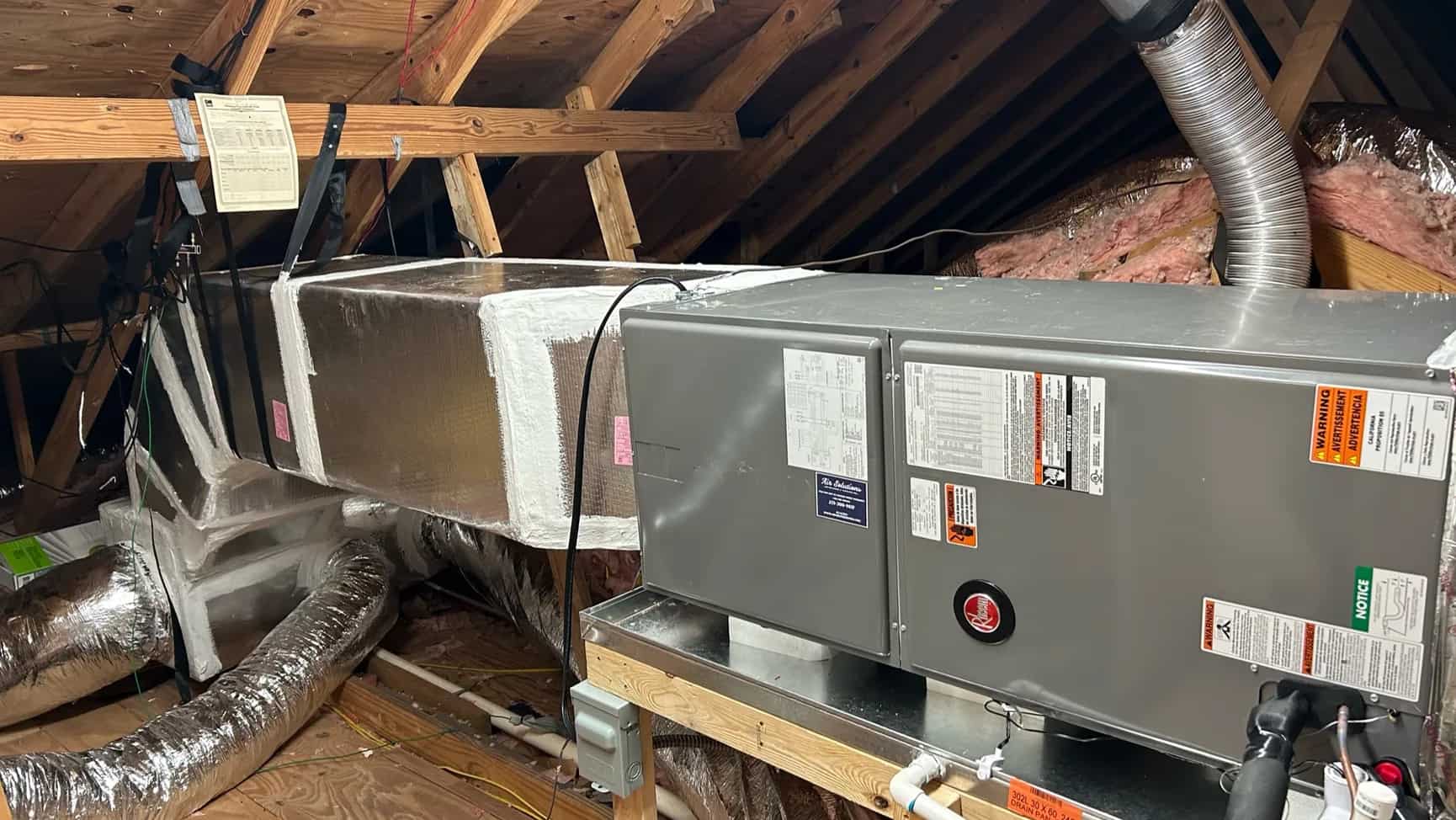
AC Maintenance in Lillian.
Local AC maintenance in Lillian, Alabama and surrounding Baldwin County. Bi-annual tune-ups. Cool Club priority + member savings. Licensed AL#23194. 353+ five-star reviews. Call (251) 300-9817.
Get a Free Estimate
Name and phone is all we need to call you back. Takes ~20 seconds.
353+ five-star reviews · Same-day · 24/7 · Licensed AL#23194
What AC maintenance looks like in this climate.
Preventive maintenance on a Lillian system gets sized against a climate signature that is not what the headline cooling-degree-day number alone would predict. ERA5-Land reanalysis at the community coordinate logs roughly 2,931 cooling degree days for 2023 — one of the lower figures in the Baldwin County matrix — paired with about 1,002 heating degree days, average July highs near 90.5°F, and average January lows holding right at 51.5°F. What pulls both ends toward the middle is Perdido Bay sitting at the back porch of most Hwy 98 addresses: the open water buffers daily temperature swings, lifts winter overnight lows above where the inland north-Baldwin cells land, and trims peak summer afternoon highs a touch by acting as a heat sink at the hottest hour.
The buffering does not lighten the equipment workload — it lengthens it. A Spanish Cove condenser or a Perdido Bay shoreline system cycles on humid 75°F mornings deep into March and again well into October when an inland unit would already be parked for the season, and the latent humidity load coming off the bay keeps the indoor dehumidification cycle working when the sensible cooling demand alone would not call for it. The maintenance-side translation: total compressor hours on a Lillian system run closer to a coastal-cell number than the modest CDD count alone would suggest, and a spring tune-up timed to the right window in late March or April catches the season-opening drift on capacitor microfarad, refrigerant charge, and condensate handling before the long shoulder-into-peak runtime stretch loads the equipment past its working margin.
What we see on calls in Lillian.
The 2022 ACS pegs the median Lillian home at a 1997 build, which puts most addresses on second-cycle equipment now — the original AC retired somewhere in the 2008-to-2012 window, and the system currently in service was installed during the broad 2008-to-2018 replacement wave. That equipment cohort is exactly the band where preventive discoveries are still small-dollar fixes and where the warranty-documentation paperwork still matters. Most major manufacturers (Carrier, Trane, Lennox, Goodman, Rheem) require documented annual professional maintenance as a condition of their equipment warranties, and a system installed in 2014 with a 10-year parts warranty on the compressor and coil is at exactly the vintage where keeping that service trail current protects coverage on the components most expensive to lose.
What the tune-up technician finds on the typical Lillian visit clusters around predictable failure precursors for this equipment age band. Run-capacitor microfarad readings on units past the eight-year mark routinely meter a noticeable percentage below nameplate — still within starting tolerance, but trending toward the no-start ticket that lands on a July Saturday if nobody catches it. Outdoor contactor surfaces show accumulated arc-pitting from years of summer cycling, condensate-drain biofilm builds up on horizontal attic runs where the line geometry favors slow drainage, blower-motor amp draw creeps upward on older PSC motors as bearings dry out, and indoor evaporator coil surfaces accumulate biofilm at a rate that quietly erodes the system's nameplate latent-load handling. On bay-facing properties along the Perdido Bay shoreline and in Spanish Cove the visit additionally walks the outdoor cabinet interior — disconnect-box terminals, service-valve packing, fin-pack joints — because brackish-air exposure accumulates on those surfaces year after year at a faster rate than at inland Lillian addresses. The fix on each discovery during a maintenance visit is a small dollar number on the work order rather than the four-or-five-figure emergency invoice the same failure becomes once it cascades.
- Mid-life equipment is the common profile in this area. Capacitor and contactor failures dominate the service-call mix.
- Long cooling season means compressors run heavy May through October. Annual maintenance pays for itself in compressor lifespan.
- Mild winters mean heat pumps cover the season comfortably without backup runtime in normal years. Cold-snap weeks expose undersized units.
AC Maintenance in Lillian — the questions that come up.
- We plan to stay in our Spanish Cove home for the rest of our retirement. Does the long ownership horizon actually change whether preventive maintenance is worth the spend?
- It changes the math meaningfully in favor of the preventive-spend decision, not against it. A younger owner thinking about a near-term sale has the option to defer a maintenance discovery into the next owner's problem; an owner planning to live with the equipment for the next twelve, fifteen, or twenty years owns every downstream consequence of a missed catch. On a system installed during the 2008-to-2018 Lillian replacement wave that is now sitting in the band where preventive discoveries are still small-dollar fixes, the bi-annual tune-up cadence functions as a cheap insurance premium against the equipment-replacement event being forced into the worst-possible-moment timeline by a missed cooling-season failure. The spring visit catches season-opening drift before peak runtime loads the system past its working margin; the fall visit catches heating-side issues on the workbench in October before the first cold morning. For a long-horizon owner the question is rarely whether the maintenance pays back — it is whether the avoided emergency call would have hit at a moment that was merely inconvenient or one that was genuinely disruptive.
- Our property faces Perdido Bay. Does maintenance on our outdoor unit run on a different cadence than it would on a Gulf-front Orange Beach or Fort Morgan home?
- Yes, and the distinction matters because copying the open-Gulf maintenance template onto a Perdido Bay address either over-services on the chemistry side or, more often, misallocates the inspection focus to the wrong areas of the cabinet. A Gulf-front Orange Beach or Fort Morgan condenser fights a chronic year-round chemical-attack rhythm: continuous salt aerosol in the marine boundary layer slowly etching the fin pack, pitting the cabinet hardware, and weeping every external fastener. The maintenance discipline that preserves equipment life there is sized to that chronic chemical clock — frequent outdoor rinses, sacrificial-anode disconnect hardware, and aggressive cabinet-seal checks at every visit. A Perdido Bay bay-facing condenser fights a different rhythm: brackish air, year-round, gentler in intensity than direct Gulf salt-spray but real and accumulating. The visit-cadence at a bay-shoreline Lillian address stays on the standard bi-annual schedule, but the inspection focus during each visit pays particular attention to disconnect-box interior terminals, service-valve stem packing, fin-pack field-fastened joints, and outdoor low-voltage wire insulation — the surfaces that brackish exposure touches first. Inland Lillian addresses on rural acreage rarely show the bay-influence pattern at all, so the conversation is genuinely lot-by-lot rather than a community-wide default.
- My Lillian AC was installed around 2014 and is still under the manufacturer's parts warranty. Does skipping annual maintenance actually void coverage?
- It usually does not automatically void coverage on the day a visit is missed, but the warranty terms on most major brands are explicit about the requirement. Most major manufacturers (Carrier, Trane, Lennox, Goodman, Rheem) require documented annual professional maintenance as a condition of their equipment warranties. The practical effect on a 2014-vintage Lillian system that still carries an active 10-year parts warranty on the compressor, evaporator coil, and major control assemblies is that the absence of a documented maintenance record gives the manufacturer a clean and defensible reason to deny a four-or-five-figure component claim if a major failure surfaces in the warranty window. For a homeowner sitting on covered equipment, a documented tune-up cadence is in significant part insurance that the bigger coverage stays intact — the written service report that lives in your homeowner records is the artifact a warranty claim eventually depends on. The cost difference between maintaining the service trail and trying to defend a denied compressor claim without one runs in different orders of magnitude.
- We like the idea of a written record of every maintenance visit. What exactly does the service report at the end of the visit contain?
- The written report is the load-bearing artifact of a maintenance visit, not a cosmetic deliverable, and on a Lillian audience that explicitly values long-horizon records we treat it that way. A typical spring tune-up report itemizes the equipment make and model with serial number and install date so the warranty paperwork stays defensible; the refrigerant readings (suction pressure, liquid pressure, superheat, and subcooling) with the ambient conditions at the time of reading; the electrical measurements on the run capacitor (microfarad reading against the nameplate value), the start capacitor where present, the contactor coil voltage, and the outdoor and indoor motor amp draws; the static-pressure reading on the air handler; the condensate-drain treatment performed; the indoor evaporator coil condition with biofilm load noted; the outdoor coil condition with any brackish-air degradation flagged on bay-facing properties; and a list of every part replaced with the part number for any consumable consumed during the visit. The fall heating-system tune-up adds the reverse-cycle exercise, the defrost-board cycle observation, the auxiliary heat-strip continuity check, and the balance-point setting verification. The report is left at the house at the end of the visit and the homeowner's copy lives in the records folder alongside the install paperwork from the original equipment cycle.
- Your shop is in Daphne and we're 60 minutes south on Hwy 98. How does that drive affect when you can actually schedule our bi-annual tune-ups?
- The OSRM-verified road time from the Daphne shop to a Lillian address is 38.7 miles via Hwy 98 — south through Foley, east through Elberta, into the 36549 ZIP — and the run lands right at 60 minutes under normal conditions. The way we manage that on scheduled AC-maintenance visits specifically is by sequencing Lillian tune-ups onto the same truck day rather than dispatching a crew down US-98 for a single address: a typical maintenance day in this part of the county might cover three or four Lillian stops worked through the morning, often paired with an Elberta, Magnolia Springs, or Foley visit along the same routing back. That route-stacking economy is what keeps the per-visit overhead reasonable for a community sixty road minutes from the shop. The practical translation for the booking call is that the scheduler is likely to offer a date window aligned with the next south-central Lillian route day rather than promise a tight individual time slot — the date that lines up with the next route gets you a better-prepared visit at better economics for both sides. The (251) 300-9817 line stays open around the clock for genuine emergencies between scheduled visits; for the spring and fall bookings themselves the cleaner path is a business-hours call so the scheduler can match you to the next Lillian truck day on the board. Cool Club membership covers the bi-annual cadence plus the published 15% off all AC repairs and 5% off new systems, with no long-term contract attached.
Every Lillian neighborhood, every zip.
Bi-annual maintenance coverage for Lillian runs out of the Daphne shop and spans the single 36549 ZIP across every part of the community the cities catalog lists: the Spanish Cove neighborhood and its bay-facing common areas, the Perdido Bay shoreline parcels, the Hwy 98 corridor running between Elberta and the Florida line, the Lillian boat-launch area, and the band of rural acreage that fans east toward the Alabama-Florida state line. The road run measures 38.7 miles on the OSRM-verified routing — south on US-98 through Foley, then east through Elberta and out to the bay community — and clocks just under an hour under normal driving conditions. The same crew that handles a spring tune-up on a Spanish Cove home handles the same checklist on a Perdido Bay shoreline residence or a rural-Lillian acreage farmhouse, with the written service report leaving the house in the homeowner's hand at the end of every visit.
What changes the operational shape of a Lillian maintenance booking is the route-stacking economics on a 60-minute haul. We sequence Lillian tune-up visits onto the same truck day rather than send a crew down US-98 for one address — typically three or four Lillian stops worked through the morning, often paired with an Elberta, Magnolia Springs, or Foley visit along the same routing back to the shop. That stacking is why on the booking conversation the scheduler will frequently offer a date window aligned with the next south-central route day rather than commit a tight individual time slot, especially during peak spring tune-up season when the call book fills up early. For genuine emergencies between scheduled visits the 24/7 number is (251) 300-9817 and reaches the after-hours rotation; for routine spring and fall bookings themselves the cleaner path is a business-hours call so the scheduler can match the visit to the next Lillian truck day on the board. There is no separate rural trip fee bolted onto a standard Lillian maintenance call — the community sits inside the same flat-rate coverage tier as the rest of south-central Baldwin County, and the route-stacking discipline keeps the per-visit economics manageable across the longer haul.
- Spanish Cove
- the Perdido Bay shoreline
- Hwy 98 corridor
- the Lillian boat launch area
- rural Lillian
Events that reset the Lillian maintenance baseline and why a documented post-event tune-up matters.
- Sep 2020 — Hurricane Sally — eyewall over Perdido Bay: Sally made landfall just south of Lillian with the eyewall tracking right over Perdido Bay, and the storm reshaped the working outdoor-equipment population across the Hwy 98 corridor and the Spanish Cove community. Many condensers that survived the wind and the brackish-surge intrusion restarted cleanly when grid power came back and gave their owners a false all-clear; the actual damage emerged a season or two later. Contactor pitting accumulated through the voltage-cycling restoration sequence, capacitor microfractures opened slowly from the restart-inrush stress, low-mounted outdoor disconnect interiors took on slow water-residue corrosion from wind-driven rain that absorbed past unsealed gaskets, and refrigerant-line vibration from sustained wind loading produced TXV and metering-device drift that surfaced only on the following season's first sustained heat. The current installed Lillian equipment population is dominated by 2020-to-2022 post-Sally replacements aging into the first post-warranty maintenance years, and a documented spring tune-up is the cheap window to walk that cohort before any of those slow failure paths cascades into a peak-summer no-cool.
- Summer 2023 — Sustained above-90°F stretch: An extended run of high-heat afternoons through midsummer 2023 stacked the seasonal early-failure pattern on aging Lillian equipment onto a narrow window — capacitor microfarad drift on outdoor units past the eight-year mark, contactor replacements on second-cycle equipment running close to continuous duty across the long shoulder-into-peak runtime stretch, TXV and superheat drift on systems whose maintenance had been deferred, and a wave of replace-versus-repair conversations on equipment that had been limping along on small fixes for several seasons. The lesson the next year's spring-tune-up book carried forward: catching the capacitor drift at $40 during a documented spring visit is a measurably different invoice than letting the same drift take out the compressor it is starting at a four-or-five-figure emergency cost during the next sustained heat event.
- Jan 2024 — Multi-night sub-freezing stretch and grid restoration: Lillian rarely earns a true hard freeze because the bay-thermal moderation keeps overnight lows above where the inland north-Baldwin cells land, which is exactly why the 2024 event surfaced maintenance lessons across both the heating side and the following cooling side. On the heating side, plenty of heat pumps in the community had not actuated the reversing valve in months and the cold snap exposed defrost-board cycling drift, reversing-valve sticking, and auxiliary heat-strip continuity issues that a documented fall tune-up would have caught on the workbench in October or November. On the cooling side, brief restoration cycles across the SE-Baldwin grid drove a wave of capacitor and contactor damage that did not surface on a repair invoice until the following spring's first sustained heat loaded the weakened components past their working threshold — the discovery a spring tune-up walks into routinely and catches before it becomes an emergency call.
What Lillian customers can claim.
- Baldwin EMC is the residential electric provider for nearly every Lillian address inside ZIP 36549 — the Hwy 98 corridor parcels, the Spanish Cove community, the Perdido Bay shoreline, and the rural acreage that fans east toward the Florida line. The provider name printed on the masthead of your most recent electric bill is the cleanest way to confirm the meter assignment before any rebate paperwork attaches to a project quote; on the small number of edge-address parcels that fall on a different provider we walk that program's eligibility in the same conversation.
- An important framing on AC-maintenance specifically: routine tune-up work itself does not qualify for a utility rebate anywhere on the Baldwin County map. Rebate programs at Baldwin EMC and at the neighboring providers attach to qualifying high-efficiency equipment installations at specific SEER and HSPF tiers — replacement projects, not service visits. The Cool Club bi-annual cadence and the spring-and-fall tune-up visits themselves are operating-cost decisions, not rebate-eligible spend; the membership pays for itself by extending equipment service life, protecting manufacturer warranty coverage, and turning what would have been emergency repair invoices into small documented work-order line items.
- When a tune-up surfaces a system that has genuinely crossed the practical repair-versus-replace threshold — typically equipment past the 12-to-15-year band where multiple major components are aging toward end-of-life simultaneously — the conversation pivots into replacement and the rebate landscape becomes relevant on that path. Baldwin EMC has historically operated residential energy-efficiency offerings tied to high-efficiency heat-pump installations clearing qualifying tiers, with dollar amounts and qualifying equipment lists adjusted on the cooperative's own annual cycle. The responsible move at quote time is to verify the current program sheet directly with Baldwin EMC rather than commit a stale dollar figure into the project budget. Manufacturer-side promotions on specific equipment lines are applied directly to the replacement quote when an active promotion lines up with the equipment selected.
- Cool Club membership applied to a Lillian residence covers the bi-annual tune-up cadence sized to the long humid shoulder season the Perdido Bay buffering produces, with the spring AC tune-up timed for late March or April to catch season-opening drift on a 1997-vintage-cohort system before peak runtime loads it and the fall heating-system tune-up timed for late October or November to exercise the reverse-cycle and auxiliary-strip heating side before the first cold snap arrives. The published Cool Club benefits include 15% off all AC repairs and 5% off new systems, with no long-term contracts and no cancellation penalties. The annual membership cost stays a fraction of one standard repair-visit invoice; a $40 capacitor caught and replaced during a documented spring visit is a different and much cheaper invoice than the $1,200 compressor the same drift can take out the following month.
AC Maintenance Coverage Map — Lillian, Alabama
Centered near Lillian for orientation. Air Solutions Heating & Cooling provides AC maintenance throughout every Lillian neighborhood and zip code, plus the surrounding Baldwin County area. Same crew, same number — we travel the whole county.
353+ Five-Star Reviews. And Counting.
“This company is amazing. They are quick to provide service and are just all around great to deal with as a customer. I like them so much I joined their Cool Club (and you should too). The best part about this company is Jesse! He’s been the guy I’ve dealt with every time and he ALWAYS goes above and beyond my expectations for AC maintenance. If you are looking for an honest, trustworthy company…”
“Justin Cobb was excellent with our routine maintenance!! If I could give 10 stars I would, this company goes above and beyond for the customers. I wish I would have found them sooner!!”
Stop Chasing Breakdowns.
Two professional tune-ups a year, priority scheduling when something does go wrong, and member-only savings on every service. The Cool Club pays for itself.
Two seasonal tune-ups
Spring AC + fall heat pump. 8-point check, written report.
Priority scheduling
When something breaks, members move to the front of the queue.
15% off every repair
Every repair, every visit, every part. No exclusions.
5% off new installs
Stacks with Alabama Power and manufacturer rebates on qualifying heat pump installs.
Automatic reminders
We track when your tune-ups are due and reach out to schedule.
Detailed service reports
Every visit produces a written report — your HVAC has a paper trail.
Schedule AC Maintenance in Lillian.
Bi-annual tune-ups. Cool Club priority + member savings. Same-day appointments most weekdays in Lillian and surrounding Baldwin County. Tell us when works for you — we'll confirm by phone during weekday office hours (8 AM-4 PM).
Need someone right now? Call (251) 300-9817 — our 24/7 emergency line is answered live when we can and returned quickly when we can't.
AC Maintenance in Lillian — FAQs
How often should AC be serviced in Baldwin County?
Twice a year — spring tune-up before peak summer load, fall tune-up before heating season (or heat pump heating mode kicks in). The Cool Club membership covers both visits at a flat annual rate.What's included in a Cool Club tune-up?
Refrigerant pressure check, electrical connections inspection, condensate line clearing, evaporator and condenser coil cleaning, blower motor and capacitor test, thermostat calibration, and a written report on what we found.Does the Cool Club really save money?
For most homeowners, yes. Two tune-ups per year prevents the majority of breakdowns we see, the 15%-off-repairs benefit covers most one-off service calls, and prioritized scheduling means we get to you faster when something does go wrong.Do you service all of Lillian, AL?
Yes — Air Solutions Heating & Cooling covers every neighborhood and zip code in Lillian, Alabama — including Spanish Cove, the Perdido Bay shoreline, Hwy 98 corridor, plus the surrounding subdivisions and rural roads. We handle AC repair, AC installation, AC maintenance, emergency HVAC, and commercial HVAC. Standard service hours weekdays, 24/7 emergency response, and same-day appointments most of the year. Call (251) 300-9817 to schedule.What HVAC issues are most common in Lillian?
Homes around Perdido Bay most commonly call us for refrigerant leaks (often salt-air or coil corrosion related on the Gulf Coast), undersized air conditioning systems struggling with Baldwin County summer humidity, and capacitor failures during peak load between June and September. A Cool Club bi-annual maintenance plan catches most of these issues before they cause a breakdown.
AC Maintenance Near Lillian.
Right at the Lillian city limit? We service the surrounding Baldwin County communities on the same routes — same crew, same response times.
Related HVAC Guides.
Long-form articles about AC maintenance and Baldwin County HVAC, with practical advice from our team.
 Seasonal
Back-to-School HVAC Reset: A Lillian Family Schedule
Late-summer HVAC reset for Lillian, AL families heading into the school year — schedule, settings, and quick service to ensure smooth fall operation.
September 22, 20264 min Seasonal
4th of July HVAC Tips: Keeping Your Lillian Vacation Rental Cool for Guests
Independence Day weekend HVAC prep for Lillian, AL vacation rental owners — peak-occupancy load management, monitoring, and emergency response protocols.
September 18, 20264 min Maintenance
Loud AC Noises Decoded: A Lillian Homeowner's Sound Identification Guide
Identifying common AC sounds in Lillian, AL homes — what each noise typically means, what's normal vs urgent, and when to call for service.
September 1, 20265 min
Other services in Lillian & this service across Baldwin County.
- All HVAC services in Lillian, AL
- AC Maintenance across Baldwin County
- AC Repair in Lillian
- AC Installation in Lillian
- Commercial HVAC in Lillian
- Emergency HVAC in Lillian
- Heating Repair in Lillian
- Heat Pump Services in Lillian
- Indoor Air Quality in Lillian
- Ductless Mini-Splits in Lillian
- Heating Installation in Lillian
AC Maintenance in Lillian — Schedule Today.
Same-day appointments most weekdays. Cool Club members get prioritized scheduling.