
AC Blowing Warm Air: Causes & Fixes
Why your AC is blowing warm air, the four most common causes in Baldwin County homes, and what to try before calling for service.

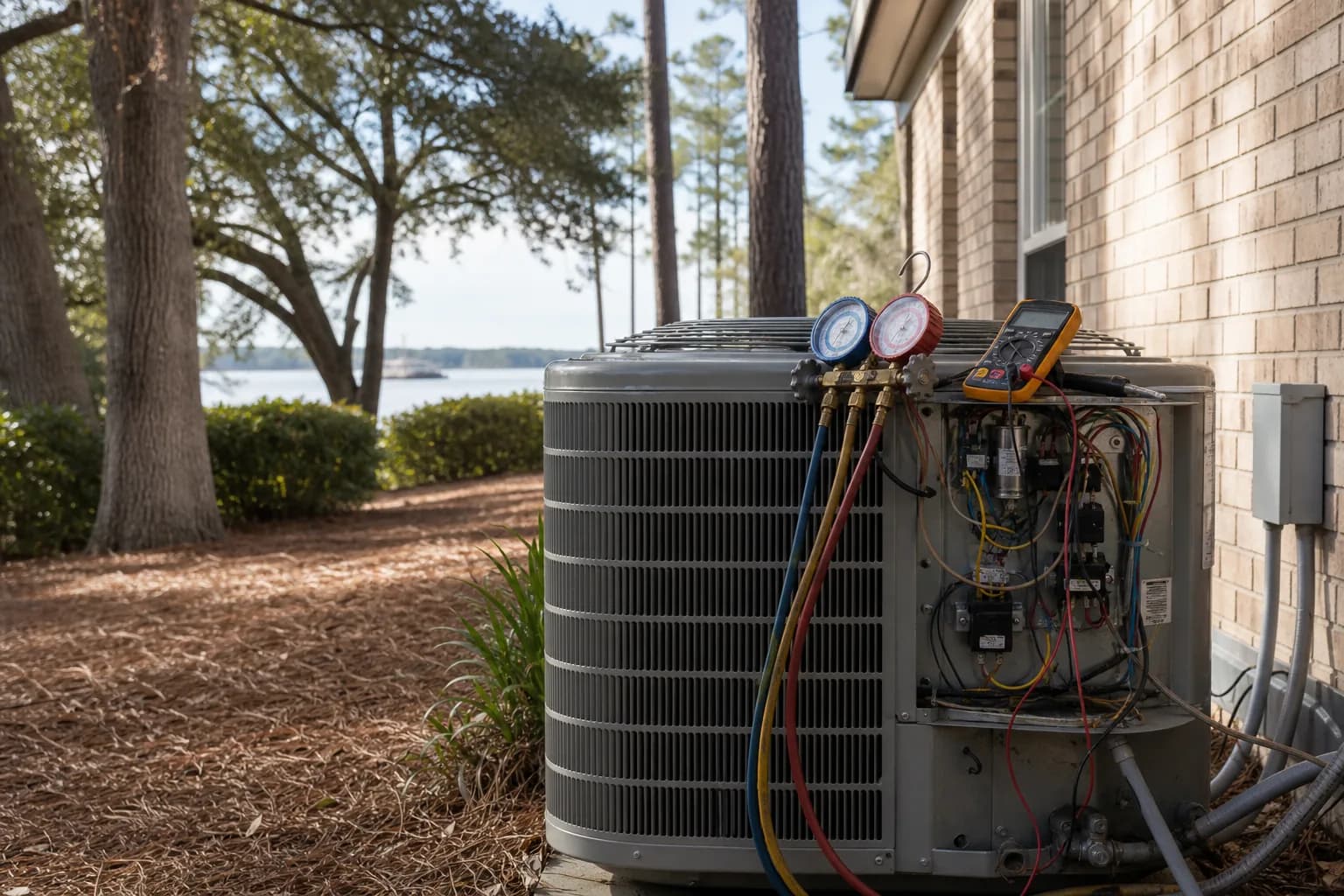
Outdoor unit running. Indoor blower humming. Supply vents open and air moving. But the air coming out feels lukewarm, not cold — and the thermostat is climbing instead of dropping. In a Baldwin County summer that's a problem to diagnose fast, because the longer the system runs without actually cooling, the more wear lands on the compressor. We see it from the bluff-top homes near Mobile Bay to the newer builds along Hwy 181, and the diagnostic path is the same in every Daphne neighborhood from Lake Forest to Olde Towne Daphne.
Here are the four most common causes, the quick checks any homeowner can do, and the symptoms that mean it's time to call. (If the system isn't blowing any air at all, that's a different path — start with our Eastern Shore AC troubleshooting guide instead.)
The four most common causes
1. Thermostat is wrong
The simplest cause and surprisingly common. Walk to the thermostat and verify mode is set to COOL (not HEAT or FAN-ONLY — FAN-ONLY blows ambient duct air with no cooling), setpoint is below current room temperature, fan is on AUTO (not ON — ON runs the blower continuously, so what you feel at the vent is uncooled air during off-cycles), and batteries are fresh if it's battery-powered. A dying thermostat can call for cooling without the call reaching the outdoor unit.
2. Restricted airflow — the most common real cause
An AC system needs a specific airflow across the indoor coil to cool effectively. When airflow drops, the coil gets too cold, ice forms, cooling capacity collapses, and the system blows lukewarm air.
The single most common cause of this is a clogged filter. If you can't remember when you last changed it, change it now. Then check that supply registers in every room are open and unobstructed (furniture, rugs, curtains over registers cause whole-zone problems), return grilles are clear (these are usually the larger grilles in hallways), and the outdoor condenser coil isn't caked with pollen, grass clippings, or pet hair — rinse it from the inside out with a garden hose, never a pressure washer.
If the filter was filthy and the system still isn't cooling 60-90 minutes after a fresh filter, you've likely frozen the evaporator coil. Turn the AC off at the thermostat, set fan to ON, and let the system thaw for 2-4 hours. Then return to AUTO and try again. A coil that keeps icing back over points to a deeper cause — see why an AC freezes up in the summer heat. And if you can't recall your last filter change, our guide on how often to change your AC filter on the Gulf Coast is worth a minute.
3. Refrigerant leak
If the airflow checks come back clean and the system still blows warm, low refrigerant is the next most likely cause. AC systems are sealed circuits — refrigerant doesn't get "used up." When the charge is low, there's a leak.
Signs that point to refrigerant: a hissing or psst sound near the refrigerant lineset, ice on the larger of the two refrigerant lines (the insulated one) near the outdoor unit, the system running forever without reaching setpoint, or noticeably weaker cooling than last season at the same outdoor temperature.
This is not a DIY repair. Adding refrigerant to a leaking system without finding and fixing the leak first is a temporary patch — within weeks you'll be in the same spot, minus the cost of that refrigerant. A real refrigerant repair finds the leak (electronic detection, UV dye, or pressure isolation), repairs the leak point, evacuates the system, recharges to manufacturer spec, and verifies pressures end-to-end.
4. Outdoor unit isn't running at all
Walk outside and listen at the condenser. If the indoor blower is running but the outdoor unit is silent — no compressor hum, no fan spinning — the cooling cycle isn't happening. The indoor blower is just moving room-temperature air through the ducts.
Most common reasons: a tripped breaker (check the disconnect at the outdoor unit and the main panel; reset once — if it trips again immediately, stop and call), a failed capacitor (a common Baldwin County summer failure; symptom is the unit humming for 5-30 seconds when the thermostat calls, then quitting), a failed contactor (clicking sounds with no startup), or a failed condenser fan motor (compressor humming with the fan blade still — turn the system off immediately to prevent overheating).
What to try before calling
For most "AC blowing warm" calls, this five-minute checklist resolves about a third of them without needing a tech:
- Verify thermostat mode, setpoint, fan setting, and batteries
- Change the air filter
- Confirm supply registers and return grilles aren't blocked
- Rinse the outdoor unit coil with a garden hose
- Walk outside — is the outdoor unit running?
If all five check out and the air is still warm, you've narrowed the problem to refrigerant or an electrical component failure — both of which need a tech.
When it's a refrigerant problem
Refrigerant calls are the hardest for homeowners to identify because the symptoms (warm air, system runs forever, weaker cooling than last year) overlap with airflow problems. The differential signal is usually ice. If the larger refrigerant line at the outdoor unit is frosty or iced, refrigerant is low and the remaining charge is over-cooling the line. If the indoor coil is icing instead, airflow is the more likely culprit.
Either way, a refrigerant repair is not a DIY job — it requires recovery equipment, electronic leak detection, brazing, evacuation, and a refrigerant scale calibrated for the type your system uses (R-410A on most existing equipment, R-454B on most new installs). Don't run the system on low refrigerant for long; low-charge operation overheats and damages the compressor.
When to stop trying and call
A few situations where the right move is to stop and call rather than keep troubleshooting:
- Breaker trips immediately on reset
- Burning smell from supply vents or outdoor unit
- Ice visibly building on outdoor refrigerant lines after a full thaw cycle
- Outdoor unit humming with no fan motion
- House is above 85°F and a vulnerable family member is in it
In Baldwin County summer heat, a non-cooling system goes from inconvenient to dangerous fast for kids, elderly residents, and pets. Don't wait until evening to call if you're losing the cooling battle.
Why does warm air seem to strike on the hottest Daphne afternoons?
It's not bad luck — it's load. On a 95-degree afternoon with Mobile Bay humidity pushing thermostats lower, a Daphne system runs the longest, hardest cycles of the year. That's exactly when a marginal capacitor finally gives up, when a slightly low refrigerant charge can no longer keep up, and when a half-clogged filter tips the coil into a freeze. The components were already weak; peak demand is just what exposes them. It's also why the season's first wave of warm-air calls tends to land the same week the first real heat does. Staying ahead of it with a fresh filter and a spring tune-up is what keeps your system off that list. The pattern is the same a few miles north in Spanish Fort, where warm-air calls spike for the same reasons.
Ready for AC repair?
Air Solutions Heating & Cooling provides same-day AC repair across Baldwin County, from our home base in Daphne out to the coast. Family-run, founded in Daphne, licensed AL#23194. 24/7 emergency line at (251) 300-9817.
- Schedule AC Repair — same-day appointments most weekdays
- AC Repair services — full overview
- Cool Club Membership — bi-annual maintenance prevents most of the above