
Snowbird HVAC: Prep Your Baldwin County Vacation Home for Months of Absence
How to prep your Baldwin County vacation home or snowbird property's HVAC for months of vacancy without coming back to mold, sky-high bills, or a dead AC.
If you split time between Baldwin County and somewhere up north, your vacation home spends months at a time without you in it. A historic cottage near the Pier, a build out past Greeno Road, or a bayfront place along Scenic 98 — whatever the Fairhope address, the HVAC system is doing real work the whole time you're gone, or it should be, anyway. Setting it up correctly for vacancy is the difference between coming back to a comfortable house and coming back to a mold problem, a utility bill, or a dead AC system.
This guide walks through what to actually do before you leave, what equipment helps, and what mistakes to avoid. Applies to snowbirds with Baldwin County winter homes, summer-only vacation owners who leave in fall, and anyone with a Gulf Coast property they're away from for stretches of time.
What goes wrong when a Fairhope vacation home sits empty?
Owners come back to one of two scenarios in roughly equal measure:
Scenario 1: "I cranked the thermostat to 85°F to save money." Indoor humidity climbed into the 70%+ range over weeks of vacancy. Mold appeared on baseboards, in supply vents, on the underside of furniture. The musty smell is everywhere. Drywall might have moisture damage. Remediation can run into a major, avoidable expense depending on how far it spread.
Scenario 2: "I left the AC running normally to be safe." AC ran 24/7 for 4 months. Coastal salt air corroded the condenser. The compressor wore out from continuous operation. Utility bills ran high all season. The cost lands as equipment damage plus power bills you didn't need to pay.
Neither extreme is right. The correct approach is somewhere in between, and it requires both the right thermostat setting AND humidity awareness.
The right setpoint strategy
The single most important rule for Baldwin County vacancy: control humidity, not just temperature. (This is the same battle our guide on beating Gulf Coast humidity covers for occupied homes — it's just harder when nobody's there to notice.)
Recommended approach:
- Temperature setpoint: 78-80°F (saves money vs. occupied setpoint, doesn't waste energy cooling unused space)
- Humidity setpoint: Maintain ≤55% relative humidity at all times
That second part is what most people miss. At 80°F with no humidity control, your AC barely runs because the temperature is satisfied — and indoor humidity climbs into the 65-75% range over weeks. Mold has everything it needs.
The fix requires either:
- A humidity-aware thermostat that can extend cooling cycles when indoor RH climbs above setpoint (Ecobee Premium, Honeywell T9/T10, some Nest models with limitations)
- A whole-house dehumidifier that operates independently of the AC and maintains humidity regardless of cooling demand
- Both for properties left vacant for multiple months at a stretch
Without one of those three, the 78-80°F setpoint strategy alone leads to humidity problems.
Equipment recommendations by absence length
What we recommend for Baldwin County vacation homes based on how long the property typically sits empty:
Up to 2 weeks vacancy
A standard humidity-aware thermostat (Ecobee Premium or similar, professionally installed) is enough. Set to 78°F / 55% RH. The AC will cycle as needed to maintain both. Electricity cost stays modest.
2 weeks to 2 months vacancy
Humidity-aware thermostat plus a moderate-capacity whole-house dehumidifier (60-70 pints/day, professionally installed). The dehumidifier handles humidity without needing to over-cool. AC barely runs. Combined utility cost is lower than running AC alone at a lower setpoint.
2+ months continuous vacancy (snowbirds, summer-only owners)
Humidity-aware thermostat, whole-house dehumidifier, AND remote monitoring. The remote monitoring (smart thermostat with cellular backup or property monitoring service) lets you check status from wherever you are and detect problems early.
Some Baldwin County snowbird properties also benefit from:
- Water shutoff with leak detection (because plumbing failures while you're gone are even worse than HVAC failures)
- Smart smoke/CO detectors with notifications
- Generator backup if the property is in a flood-prone or hurricane-prone zone
The upgrades for a snowbird property — humidity-aware thermostat, whole-house dehumidifier, remote monitoring — are a one-time investment in HVAC and monitoring equipment. For a Gulf Coast home you're absent from six months a year, the protection against a mold or flood claim makes that math work easily. We'll quote the package honestly for your specific property.
Pre-departure checklist (do this 1-2 days before leaving)
A practical 30-minute walk-through:
- Replace the air filter. Fresh filter for the months ahead. MERV 8 minimum.
- Test the thermostat at the new setpoint. Set to 78°F, verify humidity setpoint ≤55%, watch the AC cycle on briefly. Make sure the thermostat shows current humidity reading.
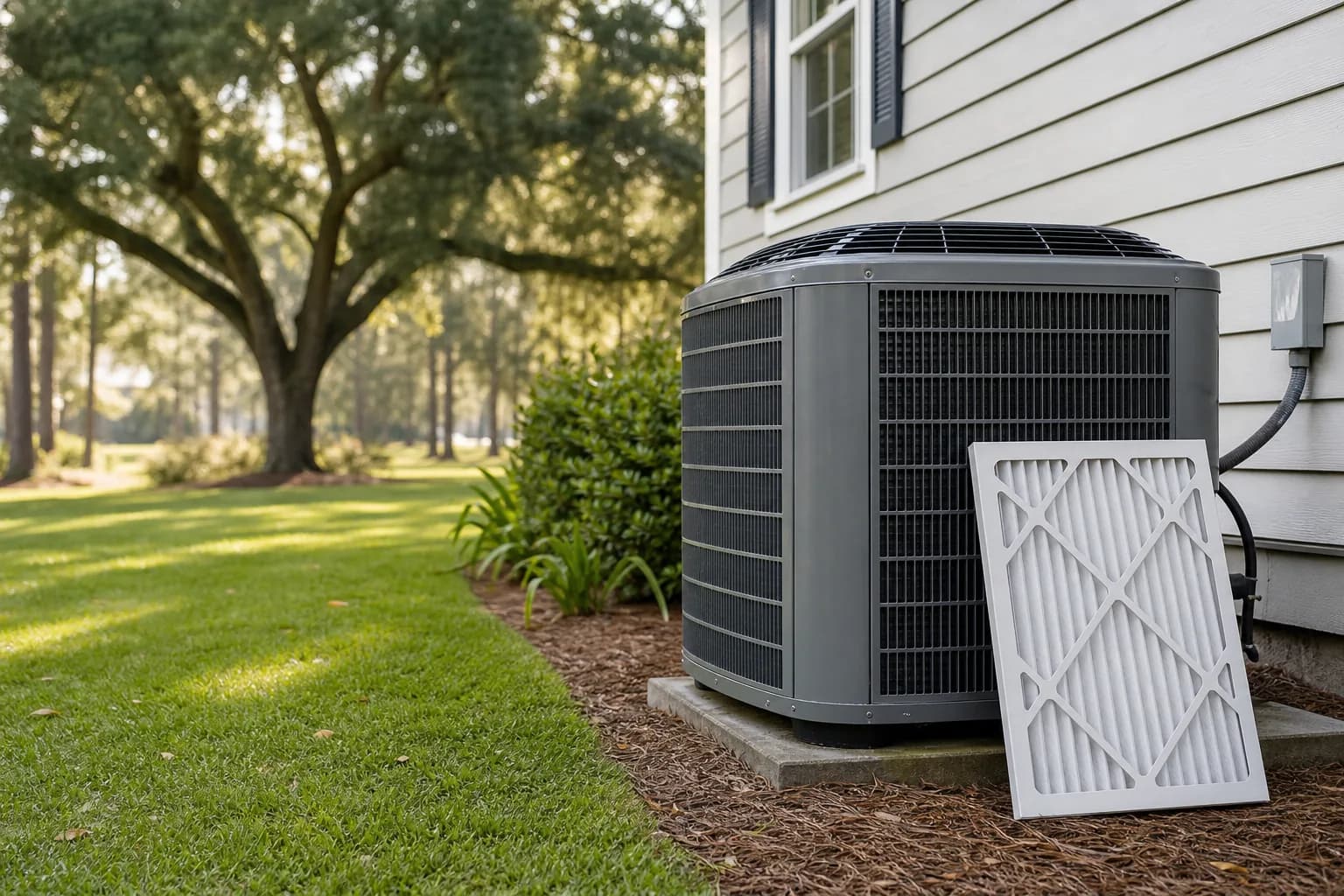
- Inspect the outdoor condenser. Clear leaves and debris from the area. Trim back any overgrowth touching the unit. Take a quick photo for your records.
- Clear and treat the condensate drain. If you can access it, run a small amount of water down the drain to verify it's clear. Pour 1/4 cup white vinegar into the drain access port to inhibit biological growth during your absence.
- Check the outdoor disconnect. Make sure the cover is secured and there's no visible damage.
- Test the dehumidifier (if you have one). Confirm it's running, the drain is clear, and the humidistat is set correctly.
- Confirm smart thermostat connectivity. From your phone, verify you can see current temperature and humidity readings remotely. Note your home's WiFi credentials in case you need to troubleshoot from out of state.
- Tell your property manager / neighbor / friend. Someone local should have a key and the ability to check on the property if you get an alert.
For coastal properties (Gulf Shores, Orange Beach, Fort Morgan): also do a salt-air rinse of the outdoor unit if you haven't recently. Reduces corrosion accumulation during your absence.
What to set the AC to in different scenarios
Quick reference for common Baldwin County scenarios:
| Scenario | Temperature | Humidity | Notes | |---|---|---|---| | Snowbird leaves Oct, returns April (6 months) | 78°F | 55% | Dehumidifier strongly recommended | | Summer-only owner leaves Sept, returns May | 78°F | 55% | Standard humidity-aware thermostat sufficient | | Hurricane season vacancy (Aug-Oct) | 80°F | 55% | Plus storm prep — see how to protect your AC before a hurricane | | Vacation rental between bookings (3-7 days) | 78°F | 55% | Bring down to 72°F 4 hours before guest arrival | | Multi-month renovation vacancy | 75°F | 50% | Lower setpoint helps preserve materials and finish work |
What NOT to do
A few common mistakes:
Don't shut the AC off entirely. A Baldwin County house with no AC for months will hit interior temperatures in the high 90s during summer, and humidity will be at outdoor levels (75%+). Mold is guaranteed. Furniture warps. Wood floors cup. Don't.
Don't set the thermostat above 82°F. Even if your goal is to save money, above 82°F the AC barely runs and humidity control fails. Stay in the 78-82°F band.
Don't forget the bathroom exhaust fans. If you're leaving the house with no occupants, manually run the bathroom exhaust fans for 30 minutes before you leave to clear residual moisture from recent showers. After that, they shouldn't run during vacancy unless they're on a humidistat.
Don't disable smart smoke/CO detectors. Battery and connectivity status matter more during vacancy than during occupancy.
What we do for snowbird customers
From Point Clear and Battles Wharf bayfront homes to the newer builds around The Waters at Fairhope, the snowbird routine is the same. When Air Solutions services these seasonal properties across Fairhope and the rest of Baldwin County, our AC maintenance program includes:
- Pre-departure visit (October typically): full bi-annual tune-up, dehumidifier verification, drain treatment, photo documentation
- Mid-absence check (January or February for winter snowbirds): coordinated with property manager or trusted local contact, brief on-site verification
- Pre-return visit (April typically, if requested): full bi-annual tune-up, system performance check, fresh filter, ready-for-occupancy verification
We also coordinate with property management companies, security/monitoring services, and trusted neighbors when needed. Our approach to snowbird and seasonal-vacancy properties differs from residential service for full-time residents.
When to schedule
If you're heading north for the season and haven't done a pre-departure check, get it on the schedule before you leave. If you're returning to Baldwin County and want a system tune-up before you settle in, schedule that for the week before arrival.
Free in-home consultation if you're considering equipment upgrades (smart thermostat, whole-house dehumidifier, remote monitoring). We walk through what's right for your specific vacancy pattern and quote the upgrades honestly.