
Indoor Air Quality in Perdido.
Local indoor air quality in Perdido, Alabama and surrounding Baldwin County. Dehumidifiers, air scrubbers, UV purification, ventilation. Licensed AL#23194. 357+ five-star reviews. Call (251) 300-9817.
Get a Free Estimate
Name and phone is all we need to call you back. Takes ~20 seconds.
357+ five-star reviews · Same-day · 24/7 · Licensed AL#23194
What indoor air quality looks like in this climate.
A Perdido home runs against the most asymmetric climate envelope in our service area: the per-coordinate ERA5 reanalysis at the local lat/long puts 2023 at roughly 3,059 cooling degree days against 1,236 heating degree days. The drive number behind that asymmetry is geographic — far-northeast Baldwin sits outside the bay-and-Gulf thermal moderation envelope that softens both ends of the year for an Eastern Shore or peninsula address. Summer averages climb to a July daily high near 93.6°F at a 38-meter elevation in the rural Perdido River corridor, and January overnight lows average 47.5°F with multi-night sub-freezing stretches arriving most winters. For an indoor-air-quality conversation, what that means in practical terms is that the IAQ system has to do meaningful work on both sides of the calendar rather than only managing summer humidity the way a coastal-only cell does.
The summer side is the dominant load. Long cooling seasons against high outdoor dew points keep the indoor latent budget elevated from late April into October, and the moisture an aging Perdido system has to remove — through coil condensation, drain-pan handling, and whatever supplemental dehumidification is or isn't in line — runs persistently above what the dry-bulb temperature alone would suggest. The winter side is the quieter story but matters for one specific accessory category: the multi-night cold stretches and the propane-heated dry-air recovery that follows them pull indoor relative humidity down sharply, sometimes far enough to bring a whole-house humidifier conversation onto the table that an Eastern Shore IAQ visit would never reach. The asymmetry shows up directly in how an IAQ stack gets specified at a Perdido address — the cooling-season dehumidification capacity is the headline number, but the heating-season dryness on a propane-heated rural envelope is a real second consideration.
What we see on calls in Perdido.
The Census ACS 2022 records the median Perdido home at a 1977 build year, making Perdido the oldest median-build cell in our coverage area at roughly 45 years of age. That single number drives the dominant IAQ failure pattern: ductwork chases installed in the late 1970s and through the 1980s that have absorbed four decades of summer condensation cycling and intermittent attic-cavity humidity exposure, with biological growth accumulated on the inner liner of any flex-duct segment or fiberglass-lined metal trunk in the run. The lived-in symptom is the chronic musty-supply-register smell that a long-tenure homeowner has lived with so long it reads as background until a visitor names it.
Three patterns layer on top of the aging-ductwork baseline. With no widespread natural-gas distribution in Perdido, any combustion appliance in the house — kitchen range, water heater, supplemental space heater, dual-fuel furnace — runs on propane (LP) from an on-property tank. Combustion inside the envelope generates water vapor, CO2, and trace byproducts the IAQ stack has to manage alongside the cooling-season latent load; the assessment walks the combustion-air supply path on each LP appliance and the kitchen range-hood termination, since a hood that recirculates or discharges into the attic puts the combustion-byproduct pulse straight back into the indoor air. Most Perdido addresses also operate on private well rather than municipal water, which changes accessory engineering in two ways: a whole-house humidifier sees mineral scaling on bypass pads and electrode fouling on steam canisters at a faster cadence than a municipal install, and a whole-house dehumidifier needs its continuous condensate discharge routed to a gravel-bed target a regulated distance from both the foundation and the on-property septic field rather than tied into the septic line. The fourth pattern is the price-sensitive reality of the $37,461 ACS median household income — we walk through which accessories pay back in measured comfort and which are aspirational, rather than default-quoting the premium stack.
- Older housing stock typical here (median build year suggests 45+ year systems are common). Duct leakage and undersized returns are the recurring finds.
- Long cooling season means compressors run heavy May through October. Annual maintenance pays for itself in compressor lifespan.
- Mild winters mean heat pumps cover the season comfortably without backup runtime in normal years. Cold-snap weeks expose undersized units.
Indoor Air Quality in Perdido — the questions that come up.
- Our Perdido home was built in the late 1970s and the supply registers have always had a musty smell. We don't want a one-time duct cleaning sales pitch — what actually fixes this?
- Straight answer: we don't offer duct cleaning as a standalone service, and the reason is the same reason it doesn't fix the smell — one-time cleaning has a poor track record once the underlying chronic-humidity pathway and the deteriorated inner liner on aging flex or fiberglass-lined trunk are left in place. On a 1977-median Perdido house the realistic fix is layered. At the indoor unit, UV-C aimed at the cold side of the air handler suppresses biological regrowth on the evaporator coil and the drain pan, which is where most of the in-system biological growth fueling the supply-register smell originates. At the chase, ductwork sealing closes the return-side leaks letting unconditioned attic and crawl-space humid air into the supply stream that keeps refeeding the biological substrate. On the worst-deteriorated trunk segments where the inner liner has sloughed enough material that sealing alone won't recover them, full replacement is the durable answer.
- Our Perdido house runs propane for the kitchen range and the water heater. Does that combustion inside the house actually affect indoor air quality?
- Yes, and it's worth taking seriously rather than dismissing. Any fossil-fuel combustion inside the building envelope generates water vapor, CO2, and trace combustion byproducts the IAQ system has to manage on top of the cooling-season latent load. On a Perdido LP-served house — and most are LP-served because the community has no widespread natural-gas distribution — the assessment walks three items: the combustion-air supply path on each appliance, because a path seasonally blocked against the cold pushes the appliance toward incomplete combustion and elevated indoor CO2; the kitchen-range hood vent termination, because a hood that recirculates or discharges into the attic puts the combustion-byproduct pulse straight back into the indoor air; and the water-vapor load a propane water heater adds to what the cooling system is already pulling out. The corrective recommendation is usually combustion-ventilation correction first, supplemental whole-house dehumidification sized for the combined latent load if cooling-season RH is still drifting high after the ventilation fix, and a CO-and-smoke combination detector on every level of the house as a non-negotiable baseline.
- We're on a private well out here in rural Perdido. Does that change anything for installing a whole-house humidifier or a whole-house dehumidifier?
- Yes, on both accessory categories, and the differences matter enough to walk them at the assessment rather than discovering them at install time. On a whole-house humidifier (relevant on the dry-winter wing of the operating year for a Perdido LP-heated envelope, not in summer), well-source water often carries mineral content municipal installs do not see — calcium and iron especially scale evaporative bypass pads and clog steam-canister electrodes faster than the manufacturer's service interval anticipates. The two paths through that are either a dedicated softener loop feeding the humidifier supply line or a tightened maintenance interval matched to your specific well chemistry. On a whole-house dehumidifier the engineering question is where the continuous condensate discharge can legally land. On a Perdido property running on-property septic, the dehumidifier output typically cannot tie into the septic line — code and good practice both push the discharge to a gravel-bed target a regulated distance from both the foundation and the septic field.
- We don't have unlimited budget for IAQ upgrades. On a typical Perdido house, which accessories actually pay back in measured comfort and which are aspirational?
- Honest tiering: the highest-payoff IAQ work on a 1977-median Perdido envelope is rarely the most marketed accessory. The interventions that consistently move measured indoor comfort the most on this housing stock are, in roughly this order — return-side air sealing on the leakiest chase points, because that's where unconditioned attic and crawl-space humidity is sneaking past the coil in the first place; supplemental whole-house dehumidification sized to the measured latent load when the cooling system alone cannot pull RH down into the 50-to-55-percent comfort band; and UV-C aimed at the evaporator coil and drain pan, because the coil is the dominant biological substrate in any Gulf-coast cooling system. Accessories that get marketed harder but pay back less reliably on this housing stock without the above three in place are whole-house air scrubbers and high-end electronic air cleaners — both can earn their place in a layered stack, but they work alongside rather than in place of the moisture and biofilm work above. We rank recommendations by measured-comfort lift on your specific house at the assessment and walk the price-versus-payback math plainly.
- Your shop is about 55 minutes away in Daphne. For an indoor-air-quality project, is it worth waiting for you versus using a closer Pensacola or Mobile contractor?
- Honest answer up front: the dispatch math is what it is. The OSRM-verified drive from our Daphne shop runs about 37 miles and 55 minutes north on I-65 with the Bay Minette approach and an eastbound segment on Highway 21 toward the community. For an IAQ project specifically that drive time matters less than for a no-cool emergency call in August, because indoor-air-quality work runs on a planned cadence rather than an emergency clock.
- Do I need a whole-house dehumidifier in Baldwin County?
- Probably not if your AC is properly sized and maintained — a right-sized AC removes plenty of moisture during normal cooling cycles. You DO benefit from a whole-house dehumidifier if: (1) your home is tight new construction where AC doesn't run long enough to dehumidify, (2) you have a vacation rental that sits at higher setpoints during vacancy, (3) you have chronic mold complaints despite good cooling, or (4) you have indoor pools/spas/large fish tanks adding moisture continuously. We provide a written estimate before any work begins.
- Are UV-C lights worth installing on my HVAC system?
- Coil-mounted UV-C lights are genuinely useful in Baldwin County's humidity — they keep evaporator coils and drain pans biologically sterile, preventing the musty smell that humid climates produce. Worth considering for homes with chronic supply-vent odor or vacation rentals. We provide a written estimate before installation. The marketing claims about UV killing airborne pathogens are overstated; airflow is too fast for meaningful kill rates. For air sterilization, better filtration is more cost-effective.
Weather and seasonal events that shape the Perdido indoor-air-quality call mix.
- Sep 2020 — Hurricane Sally — multi-month wall-cavity humidity release in the river corridor: Sally made landfall just south of the Perdido area in September 2020 with the eyewall passing close enough to drive sustained tropical-storm-force winds and heavy rainfall through the rural Perdido River corridor. Visible equipment damage wrapped inside the first twelve months of restoration. The IAQ aftermath ran much longer. Wall cavities, crawl-space framing, and attic insulation across the corridor took on water during the storm and the days of recovery, and properties brought back online without an explicit drying-and-supplemental-dehumidification protocol produced chronic musty-smell complaints stretching into 2021.
- Jan 2024 — Multi-night sub-freezing stretch — LP combustion-ventilation surfacing: Three consecutive nights below 32°F in mid-January 2024, with daytime recovery capped in the upper 30s — meaningful for north-Baldwin where HDD load is already the highest in the matrix. The cold itself wasn't the IAQ story; the appliance behavior was. LP-served Perdido homes saw supplemental space-heater and water-heater run cycles climb sharply, pushing combustion byproducts and water vapor into the indoor air at a rate the IAQ stack was not sized for. The corrective recommendation is a combustion-air supply walk on every LP appliance before the next cold front, plus a CO and smoke detector on every level.
- Aug 2023 — Peak summer heat run — indoor RH drift on continuously-running aging AC: Two stretches of heat-index readings well above 105°F with overnight lows that barely cleared 80°F. The Perdido IAQ pattern during that run concentrated on addresses where the AC was never cycling off and yet indoor humidity was still climbing past the 60-percent biological-growth threshold. On the older 1977-median ductwork, the issue compounded — the equipment was working as hard as it could on the sensible side, but four decades of return-side leakage and deteriorated chase insulation kept pulling humid attic and crawl-space air into the supply stream faster than the coil could dehumidify it.
- Annual (spring tree and pine pollen, brief post-Sally construction-dust years) — Wooded Perdido River corridor pollen and recovery-era particulate: Perdido's pollen pattern is different from the Fairhope live-oak canopy and the Elberta agricultural-field cycle. The rural Perdido River corridor and the wooded acreage surrounding most properties produce a tree- and pine-pollen surge through March and April that loads return-side filters ahead of the calendar cadence, with heavier-canopy lots extending into early May. The practical adjustment is a shorter filter-check cadence through the spring pollen weeks plus a media-cabinet evaluation when a 1-inch return slot cannot sustainably hold the MERV level the household wants.
What Perdido customers can claim.
- Perdido addresses split between Alabama Power and Baldwin EMC for residential electric service, and the dividing line between the two providers does not follow any obvious geographic feature — two properties on the same rural county road can land on different utilities. Pull the provider name off the most recent electric bill before the IAQ assessment if there's any uncertainty.
- Natural-gas distribution is not present in Perdido in any widespread sense. Properties running a burner-side appliance do so off an on-site propane (LP) tank rather than from a municipal main. For an IAQ conversation specifically, that matters in two places: the LP combustion-byproduct load on the IAQ stack (covered above) and the dual-fuel furnace question when an accessory project is considered alongside an equipment replacement. Most Perdido properties land on a heat-pump-only configuration rather than dual-fuel, which keeps the rebate conversation focused on the electric-side utility.
- Standalone IAQ accessory work — adding a whole-house dehumidifier, a UV-C lamp, a MERV media cabinet retrofit, a HEPA bypass loop, or an air scrubber on top of an otherwise-unchanged HVAC system — generally sits outside both Alabama Power's and Baldwin EMC's residential rebate envelopes. The path to rebate eligibility is bundling — when the accessory installs as part of a qualifying heat-pump replacement, the system-level incentive covers the combined work. Rebate program names and dollar amounts shift annually, so confirm the current sheet directly with whichever utility serves your meter.
Every Perdido neighborhood, every zip.
Air Solutions handles indoor-air-quality work across all of Perdido — ZIP 36562 — covering the rural acreage homes fanning out from the Perdido River corridor, the parcels along the Highway 112 area linking the community toward the Florida line, and the longer-tenure households strung along the county roads through this far-northeast corner of Baldwin County. Perdido is a small unincorporated community of about 621 residents per the most recent Census ACS — the smallest Census-tracked footprint in our service area — and we don't pretend to operate inside it the way a Daphne or Fairhope city-limits contractor operates in their home market. What an IAQ engagement up here actually looks like is a planned assessment followed by a separate planned install, with routing designed around the reality that the OSRM-verified run from the Daphne shop covers about 37 miles and right around 55 minutes north on I-65 with the Bay Minette approach and an eastbound segment on Highway 21 toward the community core.
The two-visit cadence matters for both sides of the cost math. The first visit is the diagnostic assessment — indoor RH readings at multiple stations across the floor plan, static-pressure measurement across the return-side filter slot, photographs of the indoor coil and condensate path, an inventory of LP combustion appliances and their ventilation paths, and on private-well addresses a walk of the dehumidifier discharge target against the septic layout. The second visit is the install if the homeowner moves forward.
- the Perdido River corridor
- rural Perdido acreage
- the Highway 112 area
Indoor Air Quality Coverage Map — Perdido, Alabama
Centered near Perdido for orientation. Air Solutions Heating & Cooling provides indoor air quality throughout every Perdido neighborhood and zip code, plus the surrounding Baldwin County area. Same crew, same number — we travel the whole county.
357+ Five-Star Reviews. And Counting.
“Jacob arrived as scheduled and completed the service quickly and efficiently despite the severely adverse conditions working in the attic in extreme heat and humidity.”
Schedule Indoor Air Quality in Perdido.
Dehumidifiers, air scrubbers, UV purification, ventilation. Same-day appointments most weekdays in Perdido and surrounding Baldwin County. Tell us when works for you — we'll confirm by phone during weekday office hours (8 AM-4 PM).
Need someone right now? Call (251) 300-9817 — our 24/7 emergency line is answered live when we can and returned quickly when we can't.
Indoor Air Quality Near Perdido.
Right at the Perdido city limit? We service the surrounding Baldwin County communities on the same routes — same crew, same response times.
Related HVAC Guides.
Long-form articles about indoor air quality and Baldwin County HVAC, with practical advice from our team.
 Buyer Guides
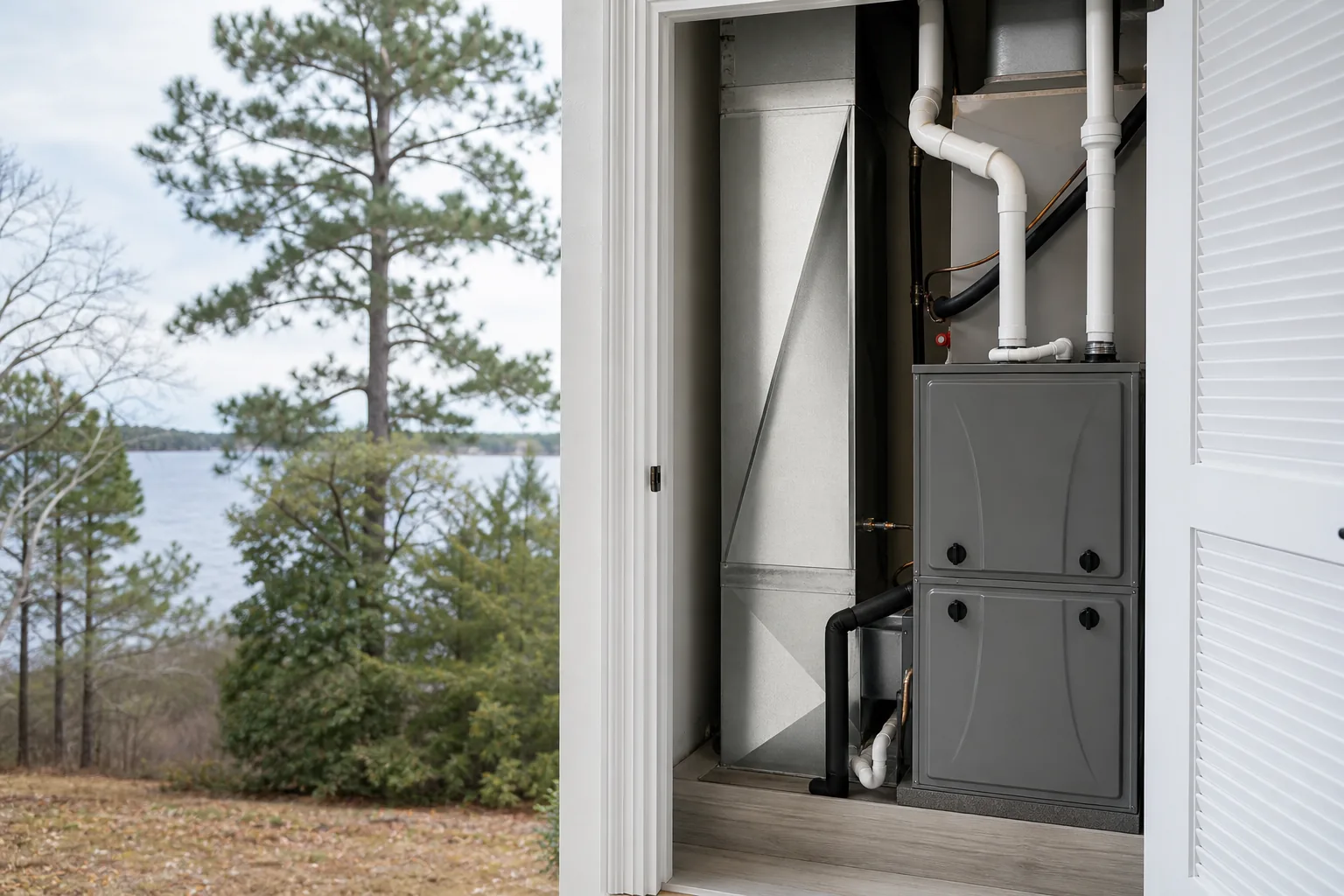
Dual-Fuel Systems for Perdido Homes: Pairing a Heat Pump With a Furnace
How a dual-fuel install works for rural Perdido properties — a heat pump for everyday heat, a furnace for the cold snaps, and the switchover logic between them.
October 12, 20265 min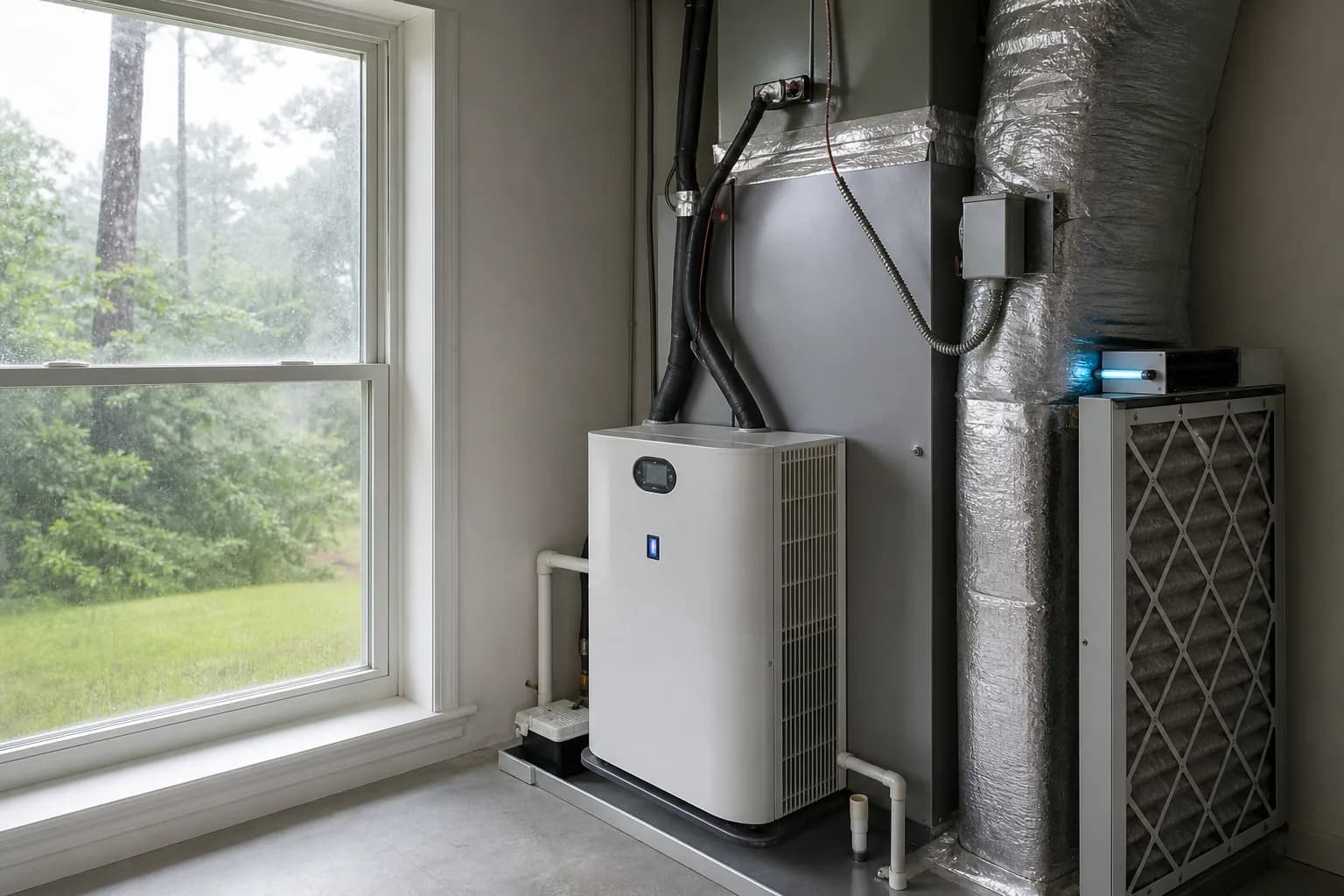 Indoor Air Quality
Why Your HVAC Smells Musty Across Baldwin County
A musty AC smell is your system losing the humidity fight. How to read the pattern, why it differs across Baldwin County, and when it's time to call a pro.
June 8, 20267 min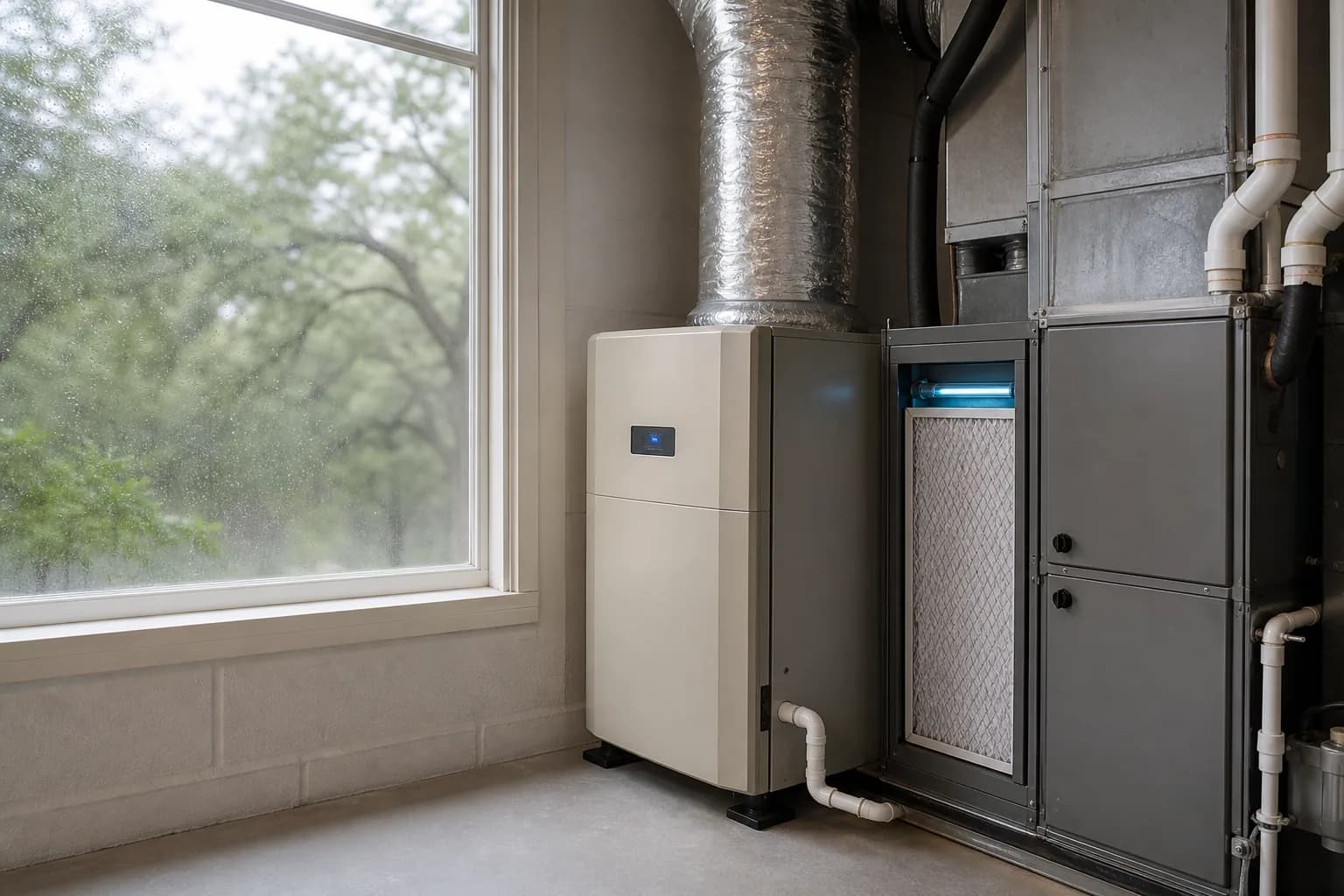 Indoor Air Quality
MERV 11 vs MERV 13 for Bay Minette Spring Pollen: An Honest Comparison
MERV 11 vs MERV 13 filters for spring pollen in Bay Minette, AL — the practical filtration tradeoff, what each catches, and which actually works for your system.
April 17, 20264 min
Other services in Perdido & this service across Baldwin County.
- All HVAC services in Perdido, AL
- Indoor Air Quality across Baldwin County
- AC Repair in Perdido
- AC Installation in Perdido
- AC Maintenance in Perdido
- Commercial HVAC in Perdido
- Emergency HVAC in Perdido
- Heating Repair in Perdido
- Heat Pump Services in Perdido
- Ductless Mini-Splits in Perdido
- Heating Installation in Perdido
Indoor Air Quality in Perdido — Schedule Today.
Same-day appointments most weekdays. Cool Club members get prioritized scheduling.