
MERV 11 vs MERV 13 for Bay Minette Spring Pollen: An Honest Comparison
MERV 11 vs MERV 13 filters for spring pollen in Bay Minette, AL — the practical filtration tradeoff, what each catches, and which actually works for your system.

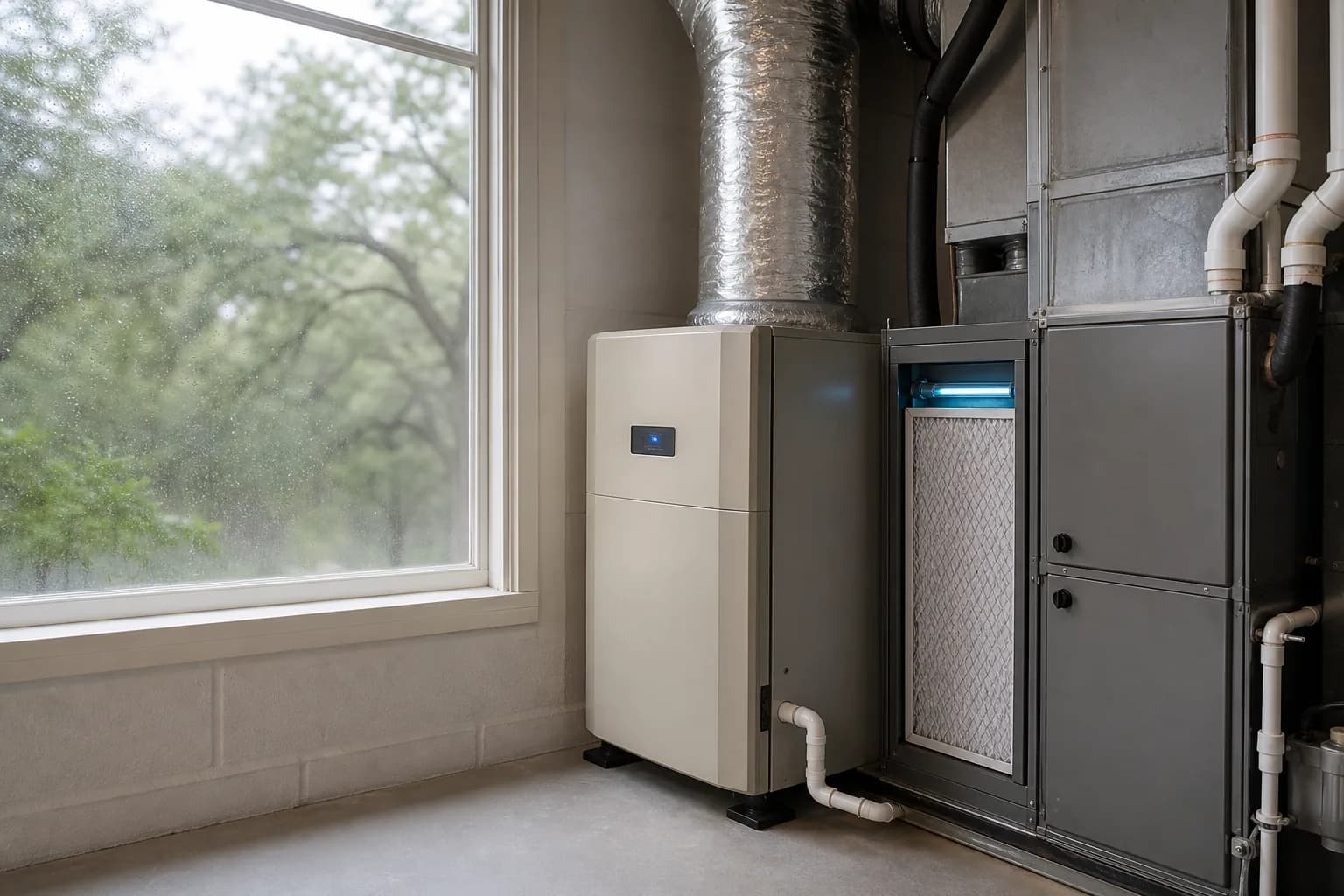
Bay Minette gets serious spring pollen from late March through mid-May — pine, oak, sweetgum, and hardwood species all unloading at once. As north Baldwin County's seat, the tree cover runs heavy from the Courthouse Square out along the Highway 31 corridor and down toward the Tensaw River, so homes here take a real pollen load. If you're upgrading your HVAC filter to handle it, you've probably narrowed to MERV 11 vs MERV 13. Both are real upgrades from the basic MERV 6 most homes ship with. The question is which fits YOUR system.
Here's the honest comparison.
What each rating actually catches
MERV 11 captures roughly 85% of particles 1-3 microns in size. That includes:
- Most pollen (most species are 10-100 microns; everyone catches these)
- Pet dander
- Dust mites and dust mite debris
- Mold spores (most species)
- Auto emissions particles
MERV 13 captures 95%+ of particles 1-3 microns AND 75%+ of particles 0.3-1 micron. That adds:
- Bacterial particles
- Smoke and combustion particles
- Sneeze residue (yes, really)
- Some viruses (the larger ones)
For pollen specifically, both are dramatically better than MERV 6. The MERV 13 advantage shows up most for households dealing with bacteria, smoke, or chronic respiratory conditions.
The airflow tradeoff
This is where most Bay Minette homeowners need to pause.
Higher MERV ratings have higher pressure drop — meaning your HVAC blower has to work harder to push air through them. Specifically:
- MERV 6: ~0.1 inches water column pressure drop
- MERV 11: ~0.25 inches water column pressure drop
- MERV 13: ~0.4-0.5 inches water column pressure drop
Most modern Bay Minette HVAC systems handle MERV 11 without measurable performance loss. MERV 13 is fine for newer systems with variable-speed blowers but can cause issues on:
- Older systems (pre-2015) with single-speed blowers
- Undersized return ductwork (common in builder-grade construction)
- Systems already running near maximum static pressure
- Heat pumps in heating mode (heat pump heating relies on high airflow)
If you put MERV 13 on a system that can't handle it, you'll see:
- Reduced cooling capacity
- Higher utility bills
- Frozen evaporator coils in summer
- Premature blower motor failure
How do you know what your Bay Minette system can handle?
Three indicators:
1. Manufacturer specs. Check your air handler nameplate. Most spec a maximum static pressure (typically 0.5" w.c.). Subtract your filter's pressure drop from that ceiling. If you have 0.4" left, MERV 11 fits comfortably; MERV 13 doesn't.
2. Existing performance. If your system already runs hot, struggles to cool on 95°F days, or shows long cycle times — adding MERV 13 will compound those problems. Stick with MERV 11.
3. Age + design. Systems installed 2018 or later, with variable-speed blowers, in homes with adequately-sized return ducts: MERV 13 is fine. Older systems or known airflow issues: MERV 11 is the ceiling.
What we recommend by household profile
Most Bay Minette homes: MERV 11 pleated, replaced every 60 days during pollen season (March-May), every 90 days the rest of the year. Best balance of filtration and airflow.
Households with chronic respiratory conditions or smokers: MERV 13 IF your system can handle it (verify first), replaced every 60 days year-round. For medical-grade filtration, a whole-house HEPA bypass is the next step up — it installs alongside your existing system on a dedicated plenum. Ask us for a quote sized to your equipment.
Older Bay Minette homes with original ductwork: MERV 11 maximum. Adding MERV 13 will create problems faster than it solves them.
Vacation rentals: MERV 11 with a smart-thermostat humidity setpoint, replaced between every guest turnover (or quarterly minimum). Cheap insurance against guest complaints about air quality.
Filter replacement schedule for Bay Minette
The "every 3 months" generic advice doesn't account for our pollen season. For Bay Minette specifically:
- March-May: Replace every 30-45 days (peak pollen)
- June-September: Replace every 60-90 days (peak AC use)
- October-November: Replace every 60-90 days (fall debris)
- December-February: Replace every 90-120 days (low use)
Set calendar reminders. A loaded filter is worse than a clean cheap one.
What to skip
A few filter-related products that don't move the needle:
- "Anti-allergen" coated filters — the coatings degrade fast and don't add measurable filtration
- Washable / reusable filters — usually MERV 4-6 equivalent at best, plus you have to actually wash them
- HEPA filters in standard slot dimensions — true HEPA needs dedicated bypass plenum; "HEPA-style" filters in standard slots are MERV 13 with marketing copy
- Scented filters — add VOCs to your air; the opposite of better IAQ
Ready to upgrade your Bay Minette filtration?
Air Solutions Heating & Cooling handles IAQ work across Bay Minette and north Baldwin County — filter recommendations sized to your specific system, system static-pressure measurement, whole-house HEPA installation when warranted. Locally owned, family-run, licensed AL#23194.
- Schedule an IAQ Consult — pick a time
- Call (251) 300-9817 — same-day available
- Indoor Air Quality services — full overview
Related resources
- IAQ in Bay Minette — city-specific service page
- All HVAC services in Bay Minette — every service locally
- HVAC Glossary — definitions for MERV, static pressure, HEPA