
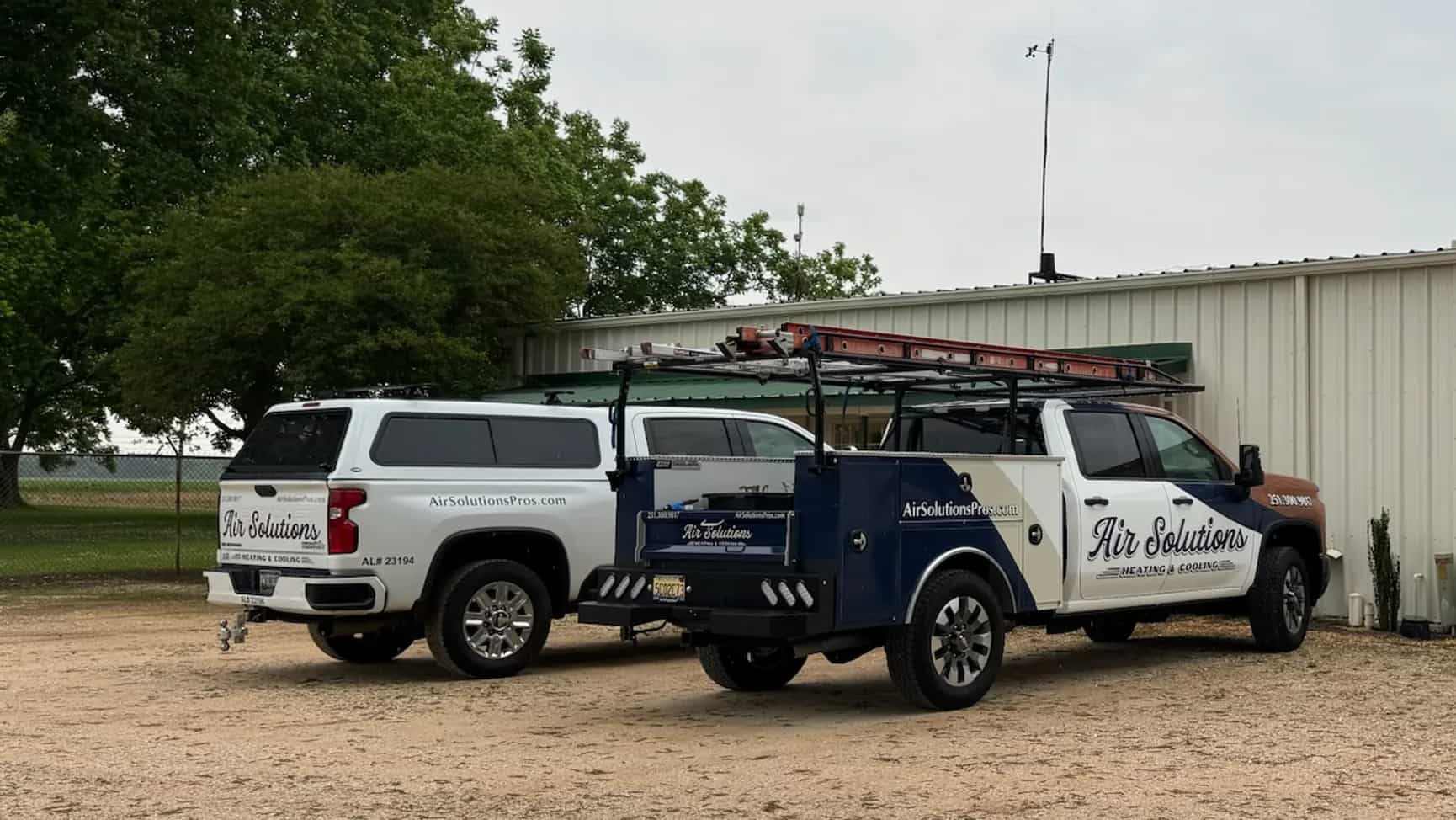
Commercial HVAC in Perdido.
Local commercial HVAC in Perdido, Alabama and surrounding Baldwin County. Restaurants, vacation rentals, property managers. Licensed AL#23194. 357+ five-star reviews. Call (251) 300-9817.
Get a Free Estimate
Name and phone is all we need to call you back. Takes ~20 seconds.
357+ five-star reviews · Same-day · 24/7 · Licensed AL#23194
What we see on calls in Perdido.
Because Perdido is a far-north rural community of about 621 residents on the most recent Census ACS, the commercial inventory in 36562 is genuinely small and structurally different from the courthouse-square footprint a Bay Minette account works inside, the destination-retail spine a Foley account sits on, or the Eastern Shore medical-office corridor a Daphne account anchors to. What commercial inventory does exist tends to cluster around the rural ag-frontage and county-road profile: a general store running combined refrigeration-and-comfort cooling on a packaged RTU, an ag-supply or feed-and-seed counter serving the surrounding row-crop and pasture acreage on packaged commercial equipment, plus the occasional ag-industrial building or county-road fellowship hall on commercial-style HVAC. Recurring service patterns center on condenser-coil fouling from open ag-acreage exposure, refrigerant-circuit work on aging single-stage RTUs reaching the end of their first serviceable-life window, contactor and capacitor service on equipment running heavy duty cycle against the matrix's highest CDD load, and condensate-management on horizontal runs in unconditioned attic or roof-curb installations. A documented per-unit baseline-reading set captured at the first preventive visit becomes the reference the rest of the contract works from.
The single hard fact shaping the heating side across the entire commercial base is that natural-gas distribution does not broadly reach Perdido — every commercial tenant whose process or space-heating runs on a fossil fuel runs it on propane (LP) on a delivered-tank basis. That reshapes parts loadout on a winter no-heat dispatch (the truck carries diagnostic tools and common parts for electric strip-heat and for LP-furnace ignition rather than for the gas-or-heat-pump ambiguity that defines a Foley or Daphne winter commercial dispatch), the dual-fuel-versus-electric-strip decision tree on every replacement proposal in 36562, and the operating-cost arithmetic on any heating-side quote. Add the dual-provider electric reality (Alabama Power on some parcels, Baldwin EMC on others, with no obvious dividing line) and the commercial-account utility-verification step gets done at the first consultation rather than assumed from a neighboring property.
- Older housing stock typical here (median build year suggests 45+ year systems are common). Duct leakage and undersized returns are the recurring finds.
- Long cooling season means compressors run heavy May through October. Annual maintenance pays for itself in compressor lifespan.
- Mild winters mean heat pumps cover the season comfortably without backup runtime in normal years. Cold-snap weeks expose undersized units.
Commercial HVAC in Perdido — the questions that come up.
- How is a service contract scoped for a single-unit rural commercial account in Perdido — say a general store on a packaged RTU that handles both comfort cooling and a walk-in cooler condensing side?
- A single-unit commercial property in Perdido does not fit the residential Cool Club framework — the duty cycle on a packaged RTU that combines comfort cooling with refrigeration condensing-side load is heavier than a residential pair of split systems sees, the cost-of-downtime consequence on a general store is operational rather than comfort-only, and the 55-minute dispatch reality means the service-contract scope has to address response-time expectations in writing. The framework starts with a documented baseline-reading sweep at the first preventive visit: superheat and subcooling, static pressure, amp draw on the comfort side and refrigeration condensing side separately, temperature split, capacitor microfarad readings, contactor condition, economizer-damper response if equipped, and condensate-line condition. The bi-annual cadence then has a reference set to compare against. Emergency response is structured around a named after-hours escalation path documented on the signed contract itself, with the disclosure that after-hours calls carry overtime rates included in writing rather than introduced on the phone at midnight.
- Perdido is about 55 minutes from your Daphne shop with no other commercial buildings of any size nearby. How does that affect emergency response on a commercial account?
- Honestly, and we would rather quote it plainly than dress it up. OSRM puts the route at 37.4 highway miles and 55.9 minutes under normal traffic — tied with Gulf Shores for the longest dispatch by time on our matrix and the longest by mileage outright. There is no commercial spine to pick up route density along the way, no neighbor city of commercial size to co-stack against on a Saturday night, and the rural approach corridor through Highway 21, 31, and 112 absorbs any I-65 lane closure directly. On a contracted account, that geography is why the response-time expectation has to be written into the service-contract scope up front: the named after-hours escalation contact, the realistic ETA window measured against the rural approach, and the prioritization framework the contract specifies are all documented before signing. The actual ETA gets quoted on the dispatch call rather than guessed at.
- Our ag-supply counter sits on rural acreage with the outdoor unit in open exposure to surrounding row-crop fields. How does that change the preventive-maintenance cadence?
- It weights the cadence toward cooling-side outdoor service more than a sheltered suburban subdivision RTU would need. Rural Perdido commercial properties sit in genuinely open ag-acreage exposure — the surrounding row-crop and pasture acreage pushes dust loads onto condenser coils through the spring and into early summer at rates the sheltered south-county commercial inventory does not see. A coil that has not been properly serviced since the previous cooling season runs elevated head pressure all afternoon during operating hours, which on an RTU running near-continuous duty tips marginal compressors into high-pressure lockout earlier than a cleaner-coil unit would. The contracted spring visit's documented coil service — a low-pressure rinse against airflow direction, a fin-comb pass for storm-debris damage, an amp-draw check on the condenser-fan motor under load, and a static-pressure measurement to flag any new filter or duct restriction — is the cheap moment to restore design head pressure before summer-peak runtime exposes the same wear as a midday emergency. On addresses along the more open ag-frontage stretches of 36562 the rinse cadence runs heavier than the standard commercial-maintenance interval the manufacturer documentation assumes.
- Perdido does not have natural gas. How does that change commercial heating service compared to a Foley or Daphne commercial account?
- It changes the heating-side service conversation across the entire commercial base in 36562. Per the Air Solutions service-area documentation Perdido utility service is Alabama Power or Baldwin EMC for electric (split per-parcel) with no widespread natural-gas distribution, meaning every commercial tenant whose process or space-heating runs on a fossil fuel runs it on propane (LP) from an on-site tank rather than from a municipal gas tariff. The practical translation on a winter no-heat dispatch is that the truck carries diagnostic tools and common parts for two configurations — heat-pump-with-electric-strip-backup and heat-pump-with-LP-furnace-dual-fuel — without the gas-or-heat-pump ambiguity that defines a Foley or Daphne winter commercial dispatch. The fall preventive visit weights toward LP-furnace ignition-module condition, flame-sensor cleaning, gas-valve sequence verification on the LP side, and dual-fuel control-board logic rather than natural-gas balancing. On a replacement quote the dual-fuel-versus-electric-strip decision tree gets modeled against actual LP delivery pricing rather than against an assumed natural-gas tariff that does not exist here.
- We run a small business in Perdido. Does Cool Club membership cover our commercial account, or do we need something different?
- Cool Club is the residential maintenance cadence — a single-family home with a typical pair of residential systems, the bi-annual spring-AC-plus-fall-heating pattern, the published member benefit of 15% off all AC repairs and 5% off new systems, and no long-term contract attached. A Perdido commercial tenant on a packaged RTU, a general-store unit with refrigeration-and-comfort load on the same system, or any commercial building with more than one or two pieces of equipment is scoped on a written service contract instead — cadence, per-unit baseline-reading approach, named after-hours escalation path, and prioritization framework all written into the signed scope of work. If you also keep a Perdido residential address, the residential side can run on Cool Club while the commercial side runs on its own service contract; the two structures operate independently.
- Do you offer commercial HVAC service contracts in Baldwin County?
- Yes. We work with restaurants, vacation rental properties, retail, and multi-unit operators across Baldwin County. Service contracts include scheduled preventative maintenance, prioritized response, and per-unit pricing for fleet accounts.
- Can you handle multi-unit vacation rental portfolios?
- Yes. Many of the Gulf Shores and Orange Beach property managers we work with have 8 to 50+ units. We schedule turnover-aligned maintenance, document everything by unit, and bill at fleet rates.
What commercial HVAC looks like in this climate.
The climate a Perdido commercial building works inside is the hardest combined load anywhere in our service area, and on a small rural commercial account that translates directly into operating-cost and continuity consequence. The per-coordinate ERA5-Land reanalysis at the rural Perdido grid cell records roughly 3,059 cooling degree days against 1,236 heating degree days for the 2023 baseline — both the highest in our entire Baldwin County footprint. Far-northeast Perdido sits outside the bay-and-Gulf moderation envelope that softens both extremes for a Daphne or Fairhope address, and the practical translation on a general store running a packaged refrigeration-and-comfort RTU or a county-road church fellowship hall on a packaged unit is that the equipment runs heavier duty cycle on both sides of the year than a coastal-only sibling cell would suggest.
Average July highs hit 93.6°F and August stretches commonly push heat-index readings well above 105°F, which on a small commercial building means the cooling system runs near continuous duty through the open hours of the day. On the winter side, the deepest cold mornings dip into the upper 20s on multi-night cold-snap events that arrive every few winters, and the matrix's heaviest heating-degree-day load arrives on buildings that may sit unoccupied through long stretches and need to recover setpoint quickly at morning open. A single-unit commercial property on aging equipment in this climate envelope has no backup if the unit quits — there is no neighboring commercial building of any size to relocate operations into, and a same-day truck roll is measured against a 55-minute drive rather than an Eastern-Shore-grade arrival window the geography cannot support.
Weather events that have shaped commercial-HVAC service patterns on the small rural Perdido commercial footprint.
- Sep 2020 — Hurricane Sally — rural commercial outdoor-equipment recovery: Sally made direct landfall just south of the Perdido area in September 2020 and the rural ag-frontage commercial inventory in 36562 took a measurable share of the outdoor-equipment damage that defined the post-storm repair queue. The commercial pattern was distinct from the residential one: a small general store or ag-supply counter has no backup building to relocate operations into when an outdoor condenser or roof-mounted RTU takes wind damage, so the immediate priority was getting the unit back online enough to reopen the doors. Outdoor disconnect cabinets that absorbed wind-driven rain often passed the initial restart test and then developed slow-burn corrosion paths that surfaced as repair tickets across the following seasons. Properties sitting in the open-fetch line from surrounding row-crop and pasture acreage took disproportionate debris damage to condenser-fan grilles and line-set insulation.
- Jan 2024 — Multi-night sub-freezing stretch — small-commercial freeze exposure: Three consecutive overnight lows well below freezing with daytime highs that struggled to crack 40°F across rural northeast Baldwin — colder and longer than the Eastern Shore version because far-north Perdido sits outside the bay-and-Gulf moderation envelope. The matrix's heaviest heating-degree-day load arrived on small commercial buildings that may sit unoccupied through long stretches with no surplus heating capacity. The 36562 commercial impact was the stress-test pattern no spring AC tune-up would catch: reversing valves stuck on first cold-weather actuation, electric auxiliary strips reading open at the contactor under continuous load, defrost boards drifted out of timing spec, and on LP-furnace dual-fuel configurations a parallel wave of flame-sensor failures and ignition-module faults on the coldest mornings. Monday-morning opening after the weekend cold-snap drove the heaviest dispatch demand of the week, with the 55-minute drive constraining how fast even a prioritized truck roll could reach a Perdido commercial address.
- Apr 2024 — Spring severe-weather outbreak — rural-commercial open-fetch exposure: A regional severe-weather setup brought tornado watches and warnings to north Baldwin with straight-line wind, hail, and prolonged grid cycling on the rural electric feeders. Far-north Perdido carries genuine open-fetch lightning and convective-storm exposure that the more sheltered south-county commercial cells do not. The dispatch pattern in the 48-to-72 hours after the line cleared concentrated on outdoor units displaced by wind, debris damage to condenser-fan grilles and disconnect cabinets, control-board faults from voltage cycling on the dual-provider Alabama Power and Baldwin EMC feeders (restoration timing on the two providers was not always synchronized), and a slower wave of capacitor failures on units that powered through the storm and quit on the next sustained run.
What Perdido customers can claim.
- Perdido commercial meters split between Alabama Power (investor-owned) and Baldwin EMC (rural electric cooperative) at the parcel level. The dividing line does not follow any obvious geographic feature, and two properties on the same rural county road can land on different utilities. The first step on any commercial proposal in 36562 is pulling the provider name off the building's most recent electric bill so the rebate-eligibility conversation matches the utility that actually serves the meter. The two providers operate on separate commercial program cycles with different qualifying-equipment lists, and rebate figures move year over year on each provider's own schedule.
- Commercial energy-efficiency rebate programs from both providers are typically built around peak-kW demand reduction together with qualifying commercial high-efficiency equipment tiers rather than the residential tax-credit math. Availability and incentive levels shift annually, so before any rebate figure lands in a written commercial quote we pull the current program sheet directly from whichever utility bills the building.
- Federal tax treatment of commercial HVAC capital equipment runs under different IRS sections than the residential 25C credit (which expired December 31, 2025 and was limited to residential property throughout its life) — Section 179 expensing where the business and equipment qualify, the Section 48 investment credit for specific high-efficiency categories, and the Section 179D deduction for certain building-efficiency improvements. Eligibility depends on the building's tax structure, the equipment specification, and the depreciation posture the business is taking — conversations for the building owner's CPA rather than service decisions we direct. We provide the commissioning records and equipment specifications the accountant will reference on any commercial install.
- Natural-gas distribution does not reach broadly across Perdido. Properties that run a burner-side appliance for process load, kitchen equipment, or supplemental space heating do so off an on-site propane (LP) tank. Switching a Perdido commercial address from electric to natural gas is generally not feasible at the meter. A property that already keeps an LP tank can consider a propane furnace as part of a dual-fuel pairing on a future replacement, with LP delivery pricing modeled at the consultation. For greenfield electric-only commercial buildings in 36562 a correctly-sized commercial heat-pump configuration is almost always the cleaner answer at this climate band.
Every Perdido neighborhood, every zip.
Commercial-HVAC coverage at a Perdido address spans the full 36562 ZIP — the rural ag-frontage commercial properties along the county-road network, the Perdido River corridor itself, the Highway 112 stretch heading east toward the Florida line, and the rural-acreage commercial inventory that fans out from the small commercial cluster the community supports. Each contracted preventive visit gets routed as its own truck-day on a far-northeast county run — out the US-98 corridor from the Daphne shop, north on I-65 to the Bay Minette area exit, and east through Highway 21, 31, and 112 into the 36562 footprint. OSRM verifies the route at 37.4 highway miles and 55.9 minutes under normal traffic, which ties Perdido with Gulf Shores for the longest drive by time in our matrix and makes it the longest by mileage outright. The dispatch math is baked into the written service-contract scope up front rather than negotiated case-by-case under emergency pressure.
The dispatch line at (251) 300-9817 stays open every hour of the calendar, but on a contracted commercial account the practical after-hours path is the named escalation contact written into the signed service-contract scope rather than the general intake number, and we document that escalation path on the contract itself before either side signs. The disclosure that after-hours calls carry overtime rates is named on the dispatch call before a truck is committed up I-65, and the realistic ETA gets quoted against the 55-minute drive. There is no separate rural trip fee on Perdido commercial work; the drive is absorbed into the contracted coverage rate. Cool Club is the residential maintenance membership Air Solutions runs — sized for a single-family home with a typical pair of residential systems, the bi-annual spring-AC-plus-fall-heating visit pattern, and the published member benefit of 15% off all AC repairs and 5% off new systems — and a general-store refrigeration RTU, an ag-supply counter on a packaged commercial unit, or a county-road church fellowship hall on a commercial-style package is scoped on a written service contract instead.
- the Perdido River corridor
- rural Perdido acreage
- the Highway 112 area
Commercial HVAC Coverage Map — Perdido, Alabama
Centered near Perdido for orientation. Air Solutions Heating & Cooling provides commercial HVAC throughout every Perdido neighborhood and zip code, plus the surrounding Baldwin County area. Same crew, same number — we travel the whole county.
357+ Five-Star Reviews. And Counting.
“Jessie goes above and beyond, glad my friend referred him to my business.”
“Called at 2:30 this morning. They responded around 6:00 and arrived on time. HVAC repaired quickly. Very professional and polite. Immediately signed up for their maintenance plan. UPDATE! Follow up service and cleaning on time and further improved the system’s performance. Will continue to do business with them.”
Schedule Commercial HVAC in Perdido.
Restaurants, vacation rentals, property managers. Same-day appointments most weekdays in Perdido and surrounding Baldwin County. Tell us when works for you — we'll confirm by phone during weekday office hours (8 AM-4 PM).
Need someone right now? Call (251) 300-9817 — our 24/7 emergency line is answered live when we can and returned quickly when we can't.
Commercial HVAC Near Perdido.
Right at the Perdido city limit? We service the surrounding Baldwin County communities on the same routes — same crew, same response times.
Related HVAC Guides.
Long-form articles about commercial HVAC and Baldwin County HVAC, with practical advice from our team.
Other services in Perdido & this service across Baldwin County.
- All HVAC services in Perdido, AL
- Commercial HVAC across Baldwin County
- AC Repair in Perdido
- AC Installation in Perdido
- AC Maintenance in Perdido
- Emergency HVAC in Perdido
- Heating Repair in Perdido
- Heat Pump Services in Perdido
- Indoor Air Quality in Perdido
- Ductless Mini-Splits in Perdido
- Heating Installation in Perdido
Commercial HVAC in Perdido — Schedule Today.
Same-day appointments most weekdays. Cool Club members get prioritized scheduling.