
The R-410A to R-32 Refrigerant Transition: What It Means for Your Wallet
What the R-410A to R-32 refrigerant transition means for Baldwin County HVAC owners — repair costs, replacement timing, and whether to upgrade now or wait.

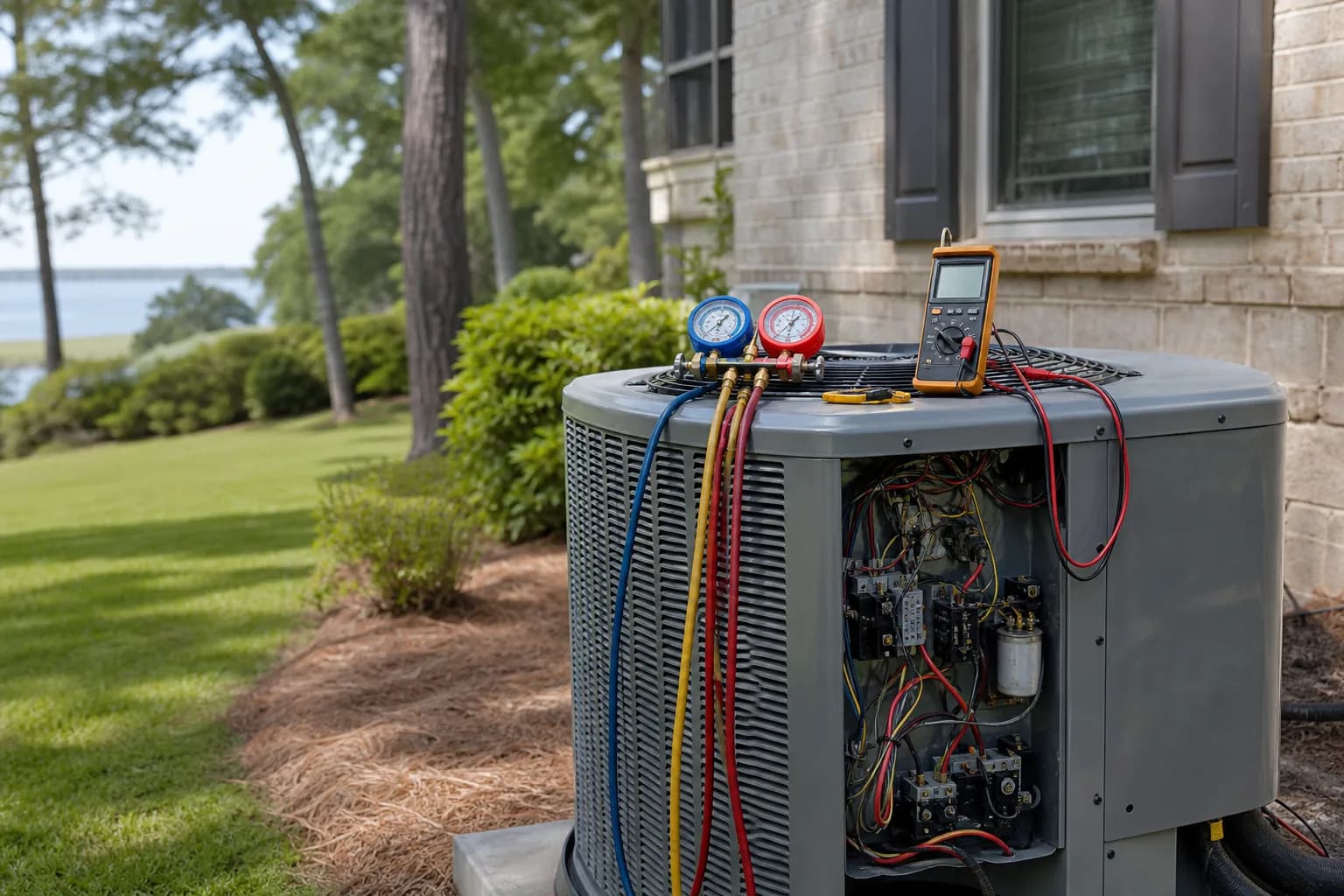
If you own a Baldwin County home with central air installed before 2025 — whether it's a bayfront house off Scenic 98, a Highway 181 build near Lake Forest, or a place up on the Daphne bluffs — your system runs on R-410A refrigerant. New systems installed in 2025 and later increasingly run on R-32 (and a few related refrigerants like R-454B). This is a big deal — the kind of regulatory change that affects what your HVAC will cost to repair and replace for the next decade.
This guide explains what's actually changing, what it means for the system you have right now, and how to plan replacement timing so you don't get caught paying premium prices for refrigerant nobody's making anymore.
The short version
- R-410A is being phased out by EPA regulation due to its high global warming potential
- R-32 (and R-454B) are the main replacement refrigerants — significantly lower environmental impact
- New equipment manufactured for sale in the U.S. as of 2025 must use the new refrigerants
- Existing R-410A systems will continue to work indefinitely
- R-410A refrigerant for repairs is becoming more expensive each year as supply tightens
- For most Baldwin County homeowners, the right move is "use the system you have until it's near end-of-life, then plan for an R-32 replacement"
What's actually changing and why
R-410A (Puron) replaced R-22 (Freon) in the 2000s for the same regulatory reason — R-22 depleted the ozone layer. R-22 was finally banned for new equipment in 2010 and for production in 2020. The per-pound price of R-22 refrigerant for repairs climbed many times over across those two decades as supply dried up. That's the pattern repeating now.
R-410A's problem isn't ozone — it's global warming potential (GWP). R-410A has a GWP of about 2,088, meaning a pound of R-410A leaked into the atmosphere has the warming impact of 2,088 pounds of CO2. R-32 has a GWP of 675 — about 1/3 the impact. R-454B is even lower at about 466.
The EPA's AIM Act (American Innovation and Manufacturing Act) phases down hydrofluorocarbon (HFC) refrigerants over 15 years. New residential AC equipment manufactured for U.S. sale must use refrigerants with GWP below 700 starting January 1, 2025.
What this means if you own R-410A equipment now
If your system was installed any time before 2025 and is working: relax. Your system will continue running on R-410A for the rest of its useful life. The transition affects new equipment manufacturing, not existing equipment operation.
The thing to plan for: as R-410A supply tightens over the next 5-10 years, the per-pound price of refrigerant for repairs will climb. Based on the R-22 phase-out pattern, here's the realistic trajectory:
- 2024 (pre-transition): R-410A wholesale pricing was still low and stable
- 2026 (current): wholesale pricing has already started rising as distributors pivot away
- 2028 (post-major-phase-down): expect a further step up as production tightens
- 2032 (deep phase-down): prices could climb sharply if R-22's pattern repeats
- 2035+ (production banned): scarcity pricing, the way late-stage R-22 went
A typical residential AC repair involving a refrigerant top-off requires 1-3 lbs. So a repair that's modest in refrigerant cost today could become a meaningfully larger line item by 2030 — for current pricing on your specific repair, request a free quote.
Will fixing an R-410A system make sense as the refrigerant gets scarcer?
Here's the practical implication. A 12-year-old R-410A system in Baldwin County today — say in an established Lake Forest, Historic Malbis, or Olde Towne Daphne home up near the bluffs — might be a "repair it" decision when the compressor goes, because you've still got useful life left and the refrigerant cost component is manageable. Our guide on AC repair vs. replace in coastal Alabama walks through exactly how to run that call.
The same 12-year-old system in 2030 might be a "replace it" decision because:
- The R-410A refrigerant cost component has climbed sharply
- New high-efficiency R-32 systems are now meaningfully cheaper to operate
- Utility efficiency programs may help offset a qualifying heat pump install — check current offers for your address (the federal 25C credit, by contrast, expired at the end of 2025 and no longer applies)
- Service contractors increasingly prefer not to work on R-410A systems as parts age
For Baldwin County homeowners with systems older than 10 years, the natural replacement window has just gotten shorter than it would have been without the refrigerant change.
What R-32 equipment costs vs. R-410A equipment
Surprisingly little, and in some cases less. The new refrigerants are cheaper to manufacture than R-410A and the equipment is essentially the same hardware (slightly different metering and seals, but the compressor design is similar).
Here's how the current Baldwin County equipment landscape breaks down:
- R-410A standard split system, 3-ton, 14.3 SEER2: becoming harder to source, since most distributors are pivoting to R-32
- R-32 standard split system, 3-ton, 14.3 SEER2: widely stocked and now the default for new installs
- R-32 high-efficiency heat pump, 3-ton, 16+ SEER2: a properly sized, AHRI-matched system — request a free quote for your home
The marginal equipment-cost difference between R-410A and R-32 is small. The bigger decision factors are still SEER2 rating, single-stage vs. variable-speed compressor, and whether to choose a heat pump vs. straight AC. For a fuller picture of the numbers, see what AC replacement costs in Baldwin County, or request a free quote for an exact figure on your home.
Safety considerations — the A2L flammability question
R-32 and R-454B are classified as "A2L" refrigerants — mildly flammable, in contrast to R-410A which is non-flammable (A1). This raises legitimate questions for some homeowners:
Is R-32 actually dangerous? No, not in the realistic scenarios. A2L means the refrigerant requires a very specific air-to-fuel ratio, an ignition source, AND a confined space to ignite. In typical leak scenarios, the refrigerant disperses faster than it can reach combustible concentration. Decades of R-32 use in Europe, Japan, and Australia (where it's been the standard for years) have shown no meaningful safety issues.
Why is everyone okay with this? The environmental benefit of moving away from high-GWP refrigerants is significant, and the manufactured equipment includes safety features (refrigerant leak detection, automatic shutoff, ventilation interlocks) that mitigate the small flammability risk. EPA, ASHRAE, and the entire HVAC industry consensus is that A2L is safe for residential use.
Are technicians trained for A2L safely? Yes, increasingly. Air Solutions techs are trained on A2L handling, including recovery, charging, and leak diagnosis. The procedures are slightly different than R-410A but not dramatically so.
The four-year planning window
For most Baldwin County homeowners with R-410A systems, here's the practical planning framework:
System age 0-7 years: Don't worry about the transition. Plenty of R-410A refrigerant available; repair cost trajectory is still manageable. Use the system normally; do bi-annual maintenance.
System age 7-12 years: Start watching for major repair triggers (compressor, evaporator coil, condenser fan motor). When one of those hits, run the actual replacement vs. repair math including the refrigerant cost trajectory. Often the right answer is replace.
System age 12-15 years: You're in the natural replacement window regardless of refrigerant transition. Plan for an R-32 install in the next 12-24 months. Note that the federal 25C tax credit is no longer part of the math — it expired December 31, 2025 — but utility efficiency programs may still help, so check current offers for your address if a heat pump fits your situation.
System age 15+ years: Replace at the first major failure, or proactively if you can. Old R-410A systems with aging compressors are increasingly expensive to keep alive, and the refrigerant cost trajectory makes major repairs less attractive each year.
The vacation rental angle
Owners of vacation rental properties in Gulf Shores, Orange Beach, Fort Morgan, and Daphne face this transition more sharply than primary residence owners. Vacation rental AC equipment runs harder (more occupancy hours per year), in a more corrosive environment (salt air), with less owner attention to early warning signs.
For vacation rental owners with R-410A equipment older than 8 years, we increasingly recommend proactive replacement to R-32 high-efficiency heat pump systems before a peak-season failure forces an emergency install — and when you do, size it correctly rather than oversizing it. The residential 25C tax credit is no longer available — it expired at the end of 2025 — though rental operators should ask their CPA whether the property qualifies for business depreciation; coastal-grade equipment availability for R-32 is good.
What we tell customers at the diagnostic visit
When we're at your house diagnosing an R-410A system problem, the conversation now includes the transition timeline. We tell you:
- The actual repair cost today
- The likely repair cost trajectory if you keep this system another 3-5 years
- The replacement cost for an equivalent R-32 system, including any utility program you currently qualify for (the federal 25C credit expired at the end of 2025 and is no longer in the picture)
- The lifetime cost comparison across both paths
Sometimes the math says repair. Sometimes it says replace. The transition shifts the line on a lot of marginal cases toward replace, but it's not automatic. We run the numbers honestly.
Schedule a diagnostic if you're thinking about it
Free in-home visit. Whether it's an AC repair on the system you have or a new AC installation, we serve Daphne and the whole Eastern Shore. Schedule it and we'll assess the current R-410A system, walk through the transition implications for your specific equipment, and give you an honest replacement quote if that's the right call. No pressure either way.