
Foley Office Building Cooling Complaints: A Manager's Triage Guide
Practical triage guide for Foley, AL office building managers handling cooling complaints — separating real HVAC issues from comfort variance, and when to call.

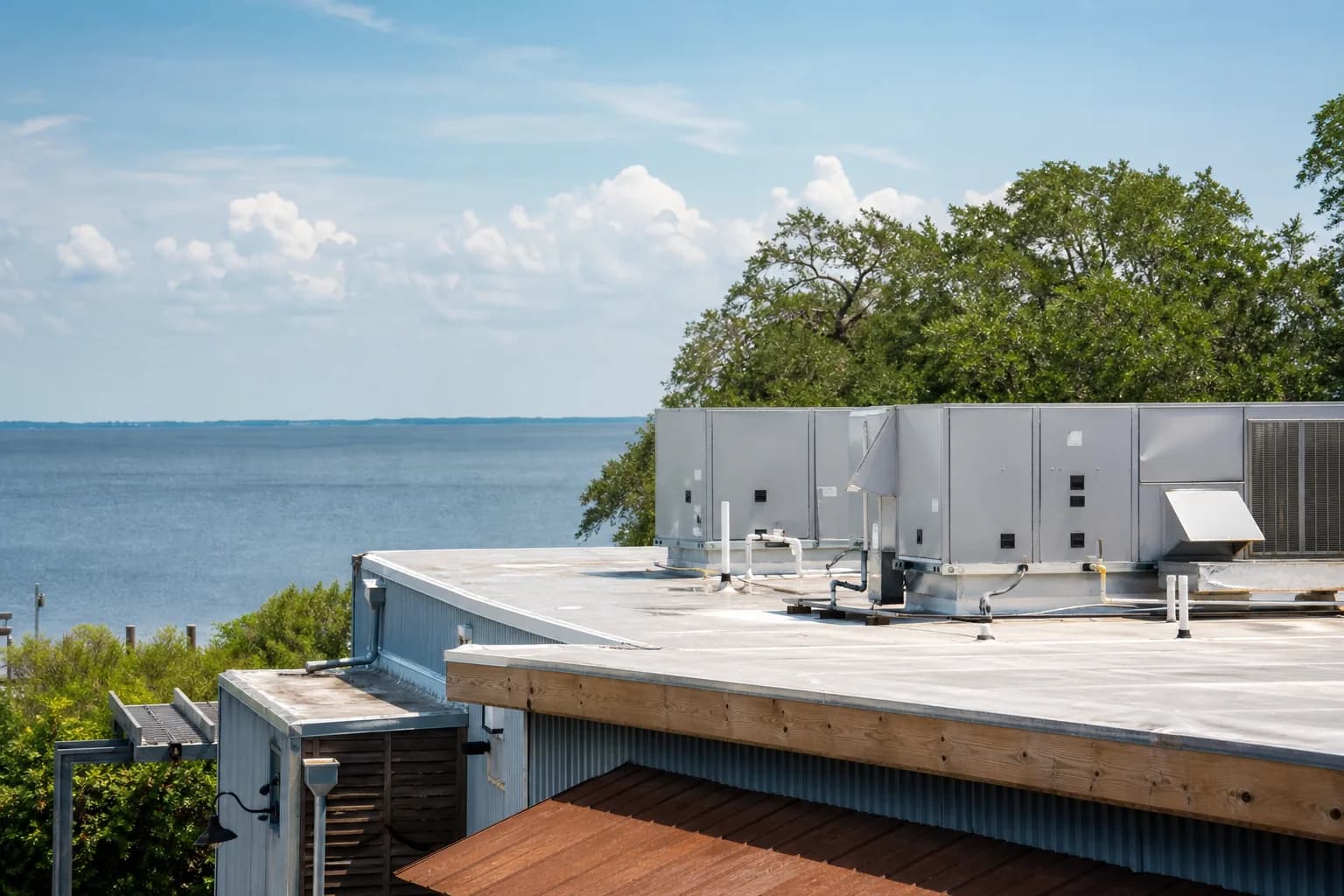
If you manage an office building in Foley, you're getting cooling complaints from tenants this week. Whether your property sits along the Hwy 59 corridor near the Tanger Outlets, out toward OWA, or in one of the mixed-use stretches of central Baldwin County, the pattern is the same: some complaints are real HVAC issues and some are individual comfort variance. Telling the difference quickly saves you service calls AND saves you tenant relationships.
Here's the triage framework.
What's almost always individual variance (don't escalate)
Comfort tolerance varies enormously between people. The CDC's office comfort range is 68-76°F — but individual preferences span 65-78°F easily. Things to recognize as individual rather than building issues:
- One person comfortable, others fine. Usually means individual sensitivity (clothing, position relative to vents, recent activity, medical factors).
- Person near the window in summer. South/west-facing windows add 5-8°F worth of perceived heat regardless of HVAC.
- Person in a small enclosed conference room. Body heat builds quickly; perception of "AC isn't working" often actually about insufficient ventilation.
- Person who just came in from outside. Body needs 10-15 minutes to acclimate; complaint usually disappears.
Response: acknowledge, suggest comfort adjustments (sweater, position change, brief walk), don't dispatch service.
What might be HVAC (verify before escalating)
These could be real HVAC issues OR could be other causes. Verify before calling:
- Single zone consistently warm. Could be HVAC issue OR could be excessive solar load, equipment heat, or zoning damper issue.
- Building feels humid despite cool temperature. Real issue, but may be quick fix (drain line, filter, or thermostat setting).
- Multiple complaints from the same area only. Likely zone-specific HVAC issue.
- Complaints worse in afternoon than morning. Possibly zoning or load issue, or possibly normal solar gain.
Verify by:
- Walking the area with a thermometer
- Checking thermostat readings vs handheld temperature
- Confirming building schedule is correct (not weekend/holiday mode)
- Listening at supply registers for airflow
If verification confirms real issue, escalate to service.
What's definitely HVAC (call now)
These need professional response:
- Multiple zones complaining of warm air. System-wide issue.
- Indoor temperature above 78°F during business hours. Outside acceptable range.
- Complete cooling failure. No air, weak air, warm air system-wide.
- Water leaks from ceiling near HVAC components. Drain pan overflow.
- Visible condensation on supply ducts. Insulation failure or extreme humidity.
- Burning electrical smell from any HVAC area. Safety issue.
Call commercial service line immediately. (251) 300-9817 for Air Solutions; mention "commercial property" for priority routing.
Pre-call diagnostic checklist
Before calling for service, gather this information — saves diagnostic time:
Building info:
- Address + suite numbers affected
- Square footage of affected area
- HVAC equipment type (rooftop unit, split system, package unit)
- Equipment location
Symptom info:
- When did the issue start?
- All zones or specific areas?
- Time-of-day pattern (worse afternoon? worse morning?)
- Water leaks? Unusual sounds? Smells?
Recent changes:
- Any HVAC service in past 30 days?
- New occupancy (more people in space)?
- New equipment generating heat?
- Construction or renovation?
Comfort data:
- Thermostat setpoint vs actual reading
- Independent thermometer reading
- Humidity reading if available
A good pre-call brief turns a 90-minute diagnostic into a 30-minute fix.
Common Foley office building issues
Things we see often in Foley commercial:
1. Rooftop unit (RTU) capacitor failure. Among the least expensive repairs on this list. Most common cause of "no cooling in this zone."
2. Damper actuator failure. A moderate repair. Causes one zone to be over-cooled while others are under-cooled.
3. Drain pan overflow from clogged line. A relatively minor repair — but the ceiling water damage it causes is what gets noticed first.
4. Filter loading on multi-tenant systems. Inexpensive (though commercial filters cost more than residential). Reduces cooling capacity gradually until tenants notice.
5. Refrigerant leak on aging RTUs. A larger repair that scales with how much labor the leak hunt takes. Year 8-12 systems often develop coil leaks.
6. Compressor failure on aging systems. The most expensive item here — often a decision point between repair and RTU replacement. End-of-life event.
Where any one lands depends on equipment size, parts availability, and how many units are affected. We'll quote your specific building free before any work starts.
Service contract benefits for office buildings
For Foley office building managers, a quarterly commercial service contract provides:
- 4 preventive visits per year catching issues before tenant complaints
- Priority dispatch (contracted commercial accounts get priority scheduling)
- Documented service history for insurance + records
- Single account manager + per-unit billing
- Equipment age tracking + replacement consultation
A commercial contract is priced by equipment count and total tonnage, so every building quotes differently. Tell us how many units you run and we'll put a free, fixed number in front of you.
The reason the contract math works is the cost it displaces:
- Multiple emergency calls a year on a typical aging system add up fast.
- A single mid-summer compressor failure can cost more than a full year of preventive coverage.
- Tenant-satisfaction damage — renewal risk, complaints, reputation — is real and hard to price at all.
Spread predictably across planned visits, the contract overwhelmingly beats reactive service.
Tenant communication
When you get cooling complaints, communicate clearly:
Acknowledging: "Got your message. I'll check the temperature in your zone right now."
Investigating: "We're confirming whether this is a building HVAC issue or zone-specific. I'll have an answer within the hour."
Escalated to service: "We've called HVAC service. ETA is [X hours]. I'll update when I have more information."
Resolved: "HVAC service has restored normal cooling. Apologies for the inconvenience. Let me know if you experience any further issues."
Calm, action-oriented communication maintains tenant relationships even during real issues.
What makes Foley commercial HVAC different?
Three local factors:
1. Hot afternoon load. Foley afternoons hit peak heat AND peak office occupancy. Marginal HVAC capacity shows up as 3-5 PM complaints.
2. Salt-air corrosion on rooftop units. Coastal influence off Mobile Bay and Bon Secour reaches Foley. RTU coil cleaning and electrical inspection matter more here than inland — our guide to how far from Mobile Bay corrosion matters explains why your roof is more exposed than you might think.
3. Hurricane prep timing. Service before peak season. Don't wait for September emergencies — the pre-hurricane AC checklist drawn from Sally applies to rooftop commercial equipment too.
Ready for commercial HVAC service in Foley?
Air Solutions Heating & Cooling provides commercial HVAC service contracts, RTU service, and emergency response across Foley and central Baldwin County. Family-run, founded in Daphne, licensed AL#23194.
- Schedule a Commercial Consultation — discuss your building
- Call (251) 300-9817 — emergency line 24/7
- Commercial HVAC services — full overview
Related resources
- Commercial HVAC in Foley — city-specific service page
- Property Manager HVAC details — multi-property management overview
- All HVAC services in Foley — every service locally
- AC repair vs replace in coastal Alabama — the call when an aging RTU compressor fails