
Loxley Restaurant HVAC: Surviving Peak Summer Service Without Failures
Restaurant HVAC priorities for Loxley, AL operators during peak summer — service contracts, makeup air balance, and avoiding the Friday-night failure scenario.

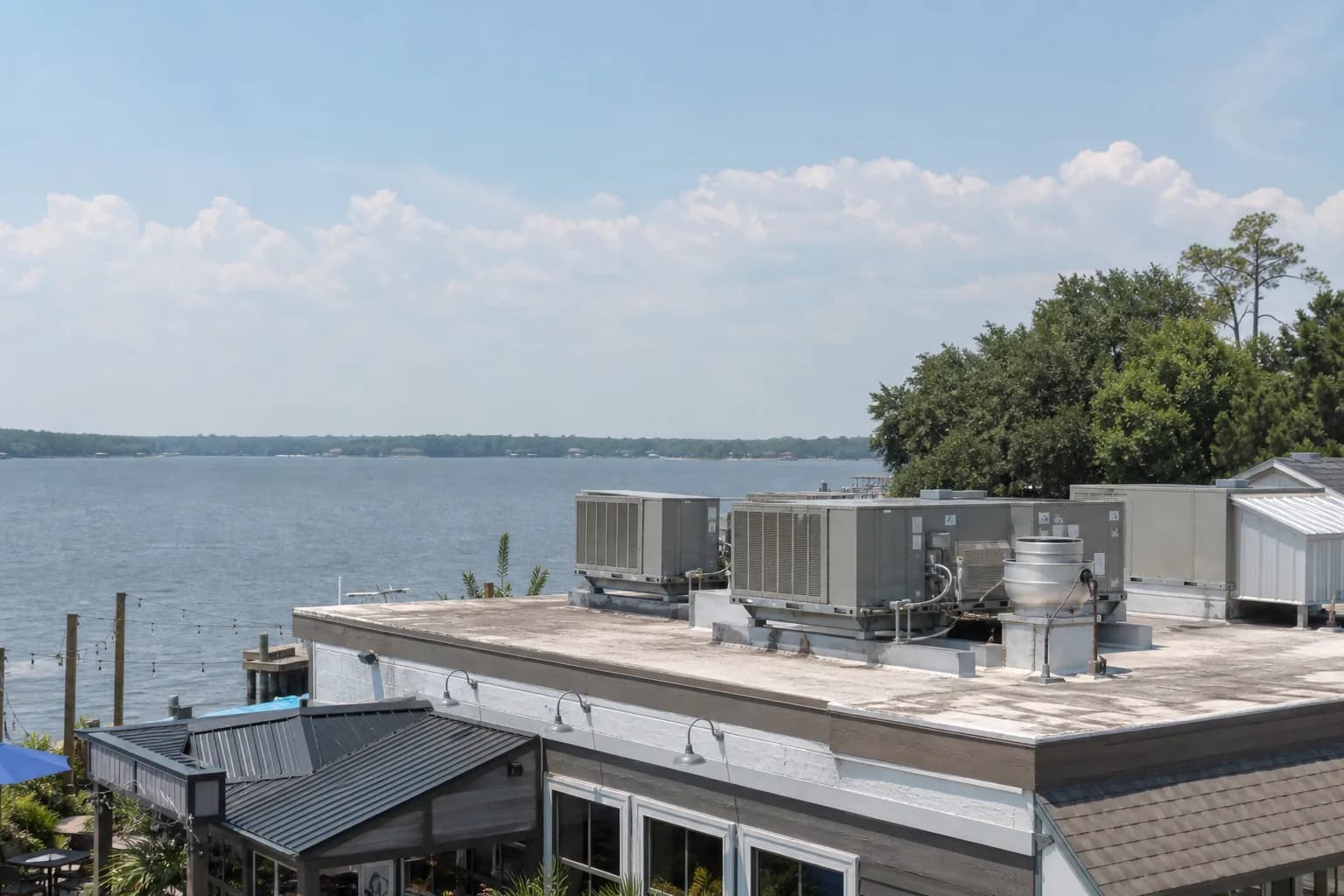
Restaurant HVAC failure during a Friday dinner rush in July is the worst-case scenario for any Loxley operator. Lost revenue, angry customers, social-media damage. The good news: most restaurant HVAC failures are predictable, and a small amount of summer attention prevents almost all of them.
Loxley sits at the I-10 and Hwy 59 crossroads, and the restaurants clustered around that interchange and through Downtown Loxley run their kitchens hard all summer. Here's the playbook for restaurant operators in Loxley and central Baldwin County.
What's different about restaurant HVAC
Compared to residential systems, commercial restaurant HVAC has:
- 6-10× the operating hours (residential: 2,500-3,500 hours/year; restaurant: 5,000-8,000)
- Cooking heat loads (kitchen + dining room comfort fight each other)
- Makeup air balance requirements (hood ventilation must be balanced with fresh-air intake)
- Health-department humidity standards (some food categories have specific humidity caps)
- Per-cover guest expectations (uncomfortable diners don't return)
A residential AC tune-up is "do this annually." A restaurant AC tune-up should be quarterly minimum during operational year.
What goes wrong in Loxley restaurants
Common summer failure modes we see in central Baldwin County restaurants:
1. Kitchen makeup air imbalance. Hood pulls more CFM than makeup air supplies. Front-of-house pressure drops, doors slam open, dining-room temperature climbs, smoke odors leak into dining areas. Often misdiagnosed as "AC failure" when it's actually airflow imbalance.
2. Rooftop unit (RTU) compressor failure. Most Loxley restaurants run rooftop package units. Heat + humidity + grease vapor exposure shortens compressor life. Year 6-8 is common failure window.
3. Drain line clogging. Restaurants have higher humidity loads than residential, and on the Gulf Coast — even an inland spot like Loxley, surrounded by agricultural land — that humidity runs high all summer. Drain lines fill faster with biological growth. Pan overflow into ceiling tiles is a common discovery.
4. Coil fouling from grease aerosols. Even with proper hood capture, some grease ends up in HVAC ductwork over years. Reduces heat transfer; eventually requires professional coil cleaning.
5. Sensor failure on RTUs with sophisticated controls. Modern restaurant HVAC has multiple sensors (return air, supply air, refrigerant pressures, outdoor air). When one fails, the system runs in default mode that's often inadequate.
What a real commercial service contract includes
For Loxley restaurants, a legitimate quarterly service contract should cover:
Per visit (4× per year minimum):
- Refrigerant pressure verification
- Capacitor + electrical testing
- Coil cleaning (rooftop coils + indoor evaporator coils)
- Drain pan + line service with biocide
- Makeup air balance verification (separately if needed)
- Belt + bearing inspection on belt-driven blowers
- Filter replacement (typically more frequent for restaurants)
- Written service report
Plus contract benefits:
- Priority dispatch — contracted restaurant accounts get priority scheduling
- A defined response commitment written into the agreement
- Per-unit billing for multi-unit restaurants
- Single account manager
- Annual replacement consultation tracking equipment age
What you should NOT pay for:
- Vague "premium" tiers without specific deliverables
- Long contract terms (>12 months) without performance guarantees
- "Inspection" visits that don't open the unit
What shapes a Loxley service contract
There's no flat price for restaurant HVAC, because two kitchens rarely run the same equipment. What we scope a contract around:
- How many units and their type. A single small rooftop package unit is a different commitment than a full-service kitchen running several RTUs.
- Square footage and cover count. More dining area and higher volume mean longer run hours and tighter tolerances.
- Whether hood and makeup air balancing is included. This can be bundled into the visit schedule or handled as its own service.
- Visit frequency. Quarterly is the floor; some operations want monthly filter and drain attention during peak.
We walk your kitchen, count the equipment, and build a written quote to match. Off-contract emergency calls are billed at our after-hours rate, with contract customers always routed first.
Pre-summer prep for Loxley restaurants
Action list for May-June:
1. Schedule pre-season RTU service. Before peak demand, verify all rooftop units have:
- Refrigerant pressures correct
- Coils clean
- Drain lines flowing
- Capacitors testing within spec
- Belts properly tensioned
2. Verify makeup air balance. Hood CFM should match makeup air CFM within 5-10%. Imbalance causes compounding problems.
3. Replace all filters. Restaurants need filter discipline. 30-day replacement during peak is common.
4. Check thermostat schedules. Many restaurants use programmable thermostats that may have stale schedules. Update for peak summer hours.
5. Document equipment baselines. Photos, model numbers, install dates. Useful for insurance + future planning.
What to do when something fails during service
If your Loxley restaurant has an HVAC failure during operating hours:
Immediate (first 15 minutes):
- Call your service provider — (251) 300-9817 for Air Solutions
- Identify the symptom clearly (no cooling, no airflow, water leak, etc.)
- Check basics (breaker, thermostat, filter)
- Notify front-of-house staff to manage guest expectations
During dining service (can't shut down):
- Open emergency doors if comfort drops below tolerable
- Use portable fans to move air
- Offer cold water proactively to guests
- Check if dining area has separate HVAC system you can relocate operations
End of service (when staff has left):
- Provide tech access to rooftop or mechanical area
- Have keys for any locked equipment
- Identify the failed unit clearly
Why service contracts pay back
The case for a contract isn't really about the contract price — it's about what an unplanned failure costs a working restaurant.
Going without a contract, a typical operation absorbs a few after-hours emergency calls a year, plus the standing risk that aging rooftop equipment drops a compressor at the worst possible moment. The repair bill on that is real, but it's dwarfed by the lost revenue, comped meals, and reputation hit of shutting down a Friday dinner rush in July. Those costs are unpredictable and arrive when you can least afford them.
With a contract, most of that work gets caught proactively during scheduled visits — a weakening capacitor or a fouling coil handled on a Tuesday morning instead of a Saturday night. The contract spend is a known, budgetable line item, and the probability of a catastrophic peak-season failure drops sharply.
The single prevented Friday-night shutdown usually justifies a full year of service on its own. We'll put together a quote scoped to your equipment so you can see the trade for yourself.
Ready for restaurant HVAC service in Loxley?
Air Solutions Heating & Cooling provides commercial HVAC service contracts, makeup air balancing, and emergency response across Loxley and central Baldwin County. Single account manager, single invoice format. Family-run, founded in Daphne, licensed AL#23194.
- Schedule a Commercial Consultation — discuss your needs
- Call (251) 300-9817 — emergency line 24/7
- Commercial HVAC services — full overview
Related resources
- Commercial HVAC in Loxley — city-specific service page
- Restaurant HVAC details — restaurant-specific service overview
- All HVAC services in Loxley — every service locally
- How to protect your AC before a hurricane: lessons from Sally — protecting rooftop units before a storm
- Salt air and your AC: how far from Mobile Bay does corrosion matter? — why even inland Loxley equipment ages on the coast