
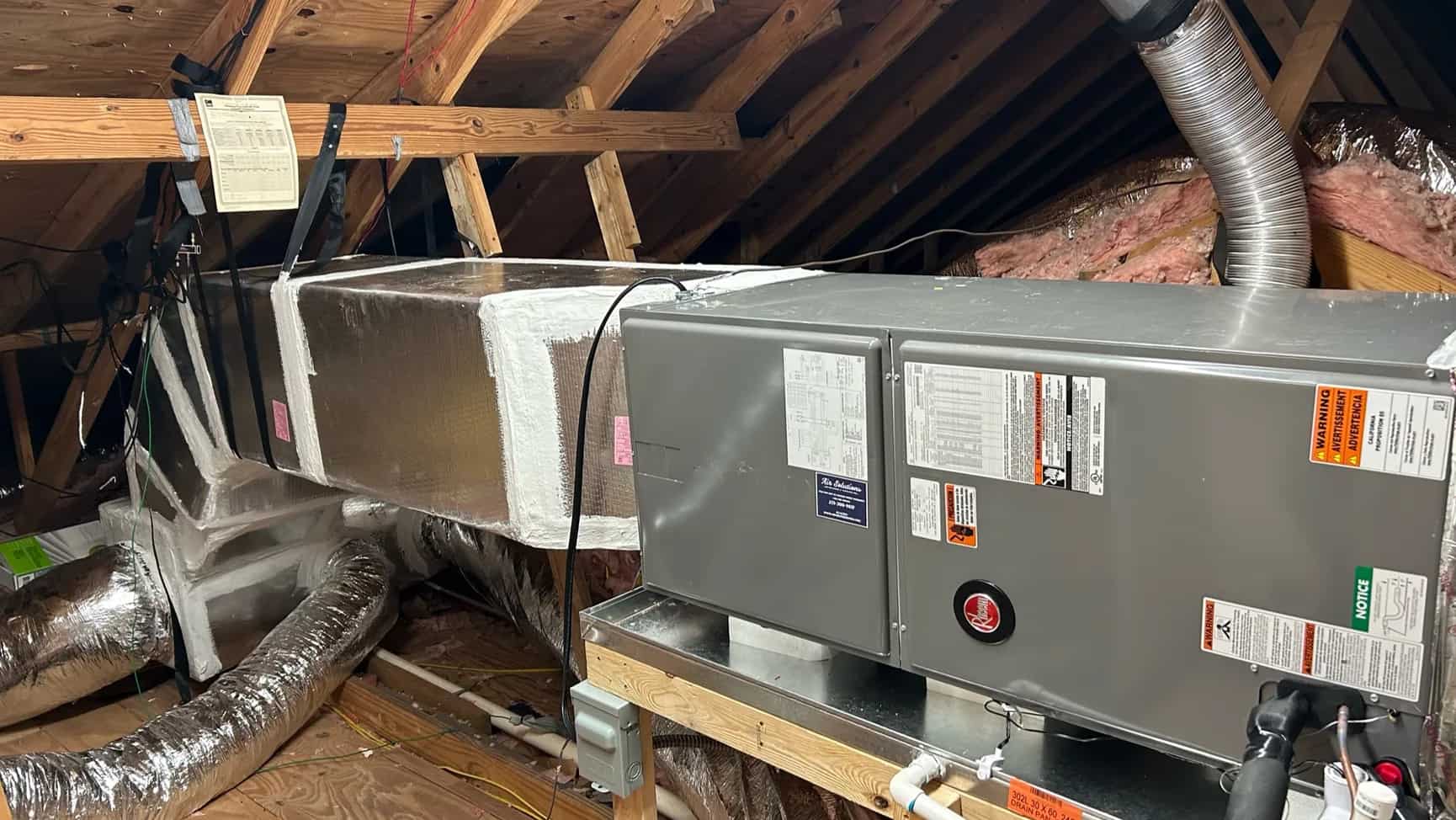
Heating Repair in Elberta.
Local heating repair in Elberta, Alabama and surrounding Baldwin County. Heat pumps, gas + electric furnaces, manufactured home heating. Licensed AL#23194. 353+ five-star reviews. Call (251) 300-9817.
Get a Free Estimate
Name and phone is all we need to call you back. Takes ~20 seconds.
353+ five-star reviews · Same-day · 24/7 · Licensed AL#23194
What heating repair looks like in this climate.
A heating-repair diagnostic in Elberta works against a climate ratio that quietly shapes most of what fails each winter. ERA5-Land reanalysis at the Elberta coordinate puts the local heating season near 1,033 heating degree days against roughly 3,036 cooling degree days — almost three cooling hours for every heating hour over a typical year. Average January overnight lows hover at 50°F, with genuine cold-snap mornings into the 20s arriving a handful of times rather than as a sustained season. The reversing valve, defrost board, and auxiliary strip on a rural Elberta system spend nine months pointed at cooling and are then asked to perform on demand the first morning the thermostat calls for heat in November.
What hides inside the benign-looking January low is the dormancy problem. A heat-side component that has not actuated under load in eight or nine months is not the same component that closed cleanly during the previous March tune-up. Solenoid coils oxidize. Defrost-board timing drifts. Aux-strip contactor faces accumulate slow corrosion that does not change a continuity reading but does change real-world current carrying. The Elberta winter is mild enough to mask all of that through October and demanding enough to expose every bit of it through January. The diagnostic question is rarely whether the heat is on — it is whether the system is running but blowing room-temperature air, whether ice is sheeting on the outdoor coil, or whether setpoint is being chased but never reached.
Cold-snap and storm events that drive the heating-repair call book on rural Elberta acreage.
- Jan 2024 — Multi-night sub-freezing stretch: Three consecutive nights well below freezing with daytime highs that struggled to clear 40°F — rare enough at the Elberta latitude that the components that fail during a stretch like this are precisely the ones that never get exercised in a milder winter. The failure pattern across the rural acreage stock broke down predictably: reversing valves that would not seat cleanly on changeover, defrost boards drifted out of timing spec, aux strip elements that read fine on the previous fall tune-up's static check and failed open under cold-snap-morning load, plus a parallel wave of ignition-module and flame-sensor failures across the propane-furnace stock. The post-event repair window stretched for weeks.
- Jan 2018 — Hard freeze, lows into the low 20s: The reference cold-event for the current Elberta installed base. Heat pumps from the 1995-to-2010 install wave that had drifted out of tune surfaced as no-heat calls during the freeze itself, and a noticeable fraction of the equipment we see today dates to repair-or-replace decisions homeowners made the spring after. Systems from that 2018 install wave now sit around the seven-to-eight-year mark; older systems are increasingly in the conversation where diagnostic findings shape a repair-versus-replace decision rather than a simple part-swap visit.
- Sep 2020 — Hurricane Sally (Category 2 landfall at Gulf Shores): Sally tracked north through Elberta after landfall and produced extended outages plus voltage-cycling stress on the long rural feeders serving the community on both Riviera Utilities and Baldwin EMC sides of the split. The heating-mode consequences were not immediately visible — Sally hit in September when nothing was running in heat mode — but they surfaced the following winters: outdoor disconnect boxes that took wind-driven rain corroded internally, contactor surfaces arced on the first cold-morning actuation, and heat pumps with wind-stressed line-set connections produced slow refrigerant losses that did not surface as heat-side capacity complaints until November. Slow-burn equipment cost from that storm is still visible in the diagnostic mix on aging Elberta systems today.
- Aug 2023 — Sustained heat-advisory stretch: An extended run of above-95°F afternoons clustered the seasonal cooling-side early-failure pattern, but the heat-mode consequence surfaced the following winter. Outdoor units that ran near continuous duty through August with ag-pollen and harvest-dust loaded onto their coils accumulated cumulative wear that compounds quietly on the heating side. The systems that came into the November 2023 changeover with the heaviest summer-side wear were disproportionately represented in the early heat-mode failure call book that winter.
What we see on calls in Elberta.
Census ACS 2022 places Elberta's median year of construction at 1990, which puts the typical heating-repair call on a roughly 32-year-old residence whose current equipment was installed somewhere between 2005 and 2018. That cohort is exactly where heat-mode failures cluster, and three of them account for the bulk of the November-through-February repair book. First, reversing valves that sat dormant from March through October stick mid-actuation on the first cool-front call: the system runs, the compressor cycles, but indoor air blows room-temperature. Second, defrost boards drift out of timing spec during the long warm season and either fail to enter defrost or strand the outdoor coil mid-melt — a sheet of ice that does not clear within ninety minutes on a humid cold morning. Third, aux heat strip elements that read continuous on a static multimeter fail open under genuine current draw on a cold-snap morning. The strip runs maybe a dozen real load-bearing hours in a typical Elberta winter, which is the exact duty cycle that lets a marginal element hide all year.
Where the call book diverges from city-scale heating-repair cells is the diagnostic fork at the meter. Most of the rural Elberta footprint outside the Highway 98 corridor itself has no natural-gas distribution, which means a no-heat call out here is almost always one of three configurations: an electric heat pump with or without a strip-heat aux stage, a propane (LP) furnace running off a yard tank, or a dual-fuel hybrid. Phone-side triage matters because the diagnostic vocabulary and the parts list on the truck differ for each. For propane the first question is the tank gauge — an empty or vapor-pressure-starved tank is a different fix than a failed ignition module. For an electric heat pump the threads are reversing-valve actuation, defrost-board timing, aux-strip continuity under load, and contactor health. Ag-pollen and harvest-dust coil loading from the surrounding farming country compounds cooling-mode wear all summer, which is why the heat-side failure on a 12-to-18-year-old rural Elberta system often surfaces against a backdrop of head-pressure readings that have been drifting since June.
- Mid-life equipment is the common profile in this area. Capacitor and contactor failures dominate the service-call mix.
- Long cooling season means compressors run heavy May through October. Annual maintenance pays for itself in compressor lifespan.
- Mild winters mean heat pumps cover the season comfortably without backup runtime in normal years. Cold-snap weeks expose undersized units.
Heating Repair in Elberta — the questions that come up.
- Our Elberta heat pump worked all summer but on the first cold morning of November the system is running and the air coming out of the vents is room-temperature. What's wrong?
- This is the most common heating-repair call we run on rural Elberta addresses each fall, and the likely cause is that the reversing valve did not actuate cleanly on the changeover from cooling to heating. A reversing valve physically swaps the direction the system runs. In Elberta's cooling-dominant climate the valve spends roughly nine months pointed at cooling and is then asked to shift on demand. When the slide sticks mid-position the system runs and the compressor cycles, but indoor air stays room-temperature because the refrigerant is not flowing in the heating direction. Diagnostic: refrigerant pressures under both attempted modes plus a current draw check on the reversing-valve solenoid coil. Repair is a solenoid swap, a slide adjustment, or a full valve replacement, with warranty status driving a meaningful share of the conversation on equipment less than about twelve years old.
- There's a sheet of ice on the outdoor unit of our Elberta home during a cold humid morning and it isn't clearing. Should we be worried, and what should we do until you get there?
- A small amount of frost on the outdoor coil during cold humid weather is normal — heat-pump physics produce condensation that freezes when the coil surface drops below 32°F. What is not normal is a sheet of solid ice that does not clear within about ninety minutes. The defrost board times a brief reverse-to-cooling cycle that melts the coil clear and returns the system to heating. On a rural Elberta system that board sits idle through a long warm season and frequently drifts out of timing spec by the time the first real cold humid morning arrives. While the truck is on its way, switching the thermostat to emergency heat runs the auxiliary strip and skips the heat-pump cycle, which keeps the house from getting cold. Do not chip the ice off manually — the fin pack and the tubing behind it are fragile, and a well-meaning chip can turn a board-replacement into a refrigerant-leak repair.
- Our Elberta heat pump shows 'auxiliary heat on' but the house never quite reaches setpoint on the coldest mornings. Is that something that needs repair, or is that just how heat pumps work in cold weather?
- Both, depending on what you measure. Some aux-heat runtime on Elberta's coldest mornings is normal — the strip engages when the heat pump alone cannot keep up, typically below the programmed balance-point in the 30-to-40°F range. What is not normal is the strip running and the house still not reaching setpoint, which almost always traces back to an aux-strip continuity fault. Because the Elberta climate puts the strip into real load-bearing duty for only a handful of mornings each winter, an element with a degraded connection or partial-burnout frequently reads fine on a static multimeter and fails open under the real amp draw. Diagnostic: measure actual current under load against nameplate; a strip drawing forty percent of nameplate delivers forty percent of rated heat. Repair is usually an element replacement, manageable when the rest of the system is healthy. A fall tune-up that exercises the strip catches this fault before a cold-snap morning turns it into a no-heat call.
- Our rural Elberta farmhouse runs heat on a propane tank, not natural gas. What is different about a no-heat repair on a propane furnace versus a heat pump, and what should we check before calling?
- The diagnostic vocabulary differs on the propane side. Most of the rural Elberta footprint outside the Highway 98 corridor has no natural-gas distribution, so a propane (LP) furnace running off a yard tank is the realistic fossil-fuel configuration out here. The first thing to verify is the tank gauge — an empty tank is a different problem than a failed ignition module, and a tank below about 20 percent in cold weather can produce a vapor-pressure-starvation symptom that presents like an equipment fault but is a supply-side issue the propane company needs to address. After tank status the diagnostic threads run through ignition control, flame-sensor oxidation, gas-valve operation, draft-inducer and pressure switch, and heat-exchanger condition (always a safety inspection). We carry common universal control modules and major sensor parts on the truck. For a dual-fuel hybrid both sides have to work AND thermostat balance-point programming has to swing them at the correct outdoor temperature — a repair that fixes only one side will fail again on the next swing.
- Our Elberta heat pump is in its second decade and the repair quote is getting big. The same crew installed it years ago. How do we decide between fixing it again and replacing it?
- Honest math rather than a sales pitch, and the install history actually helps. The repair-vs-replace conversation on a fifteen-year-old rural Elberta system usually hinges on three numbers: the specific repair cost, the realistic remaining life of the rest of the equipment given diagnostic readings, and the efficiency delta between holding the current unit and stepping up to current-generation variable-speed. We put both numbers on paper — repair scope and replacement quote — rather than let the calendar decide. If the system was on a documented tune-up cadence and the rest of the equipment looks clean, fixing for another two or three seasons is often the right answer. On the replacement path we confirm which electric provider serves your meter (Elberta is split between Baldwin EMC and Riviera Utilities with separate rebate menus) before quoting any specific incentive figure. Note: the federal Section 25C heat-pump credit expired December 31, 2025; new replacements do not qualify, so the utility programs are the active rebate pathway.
What Elberta customers can claim.
- Heating-repair work itself — reversing-valve service, defrost-board replacement, aux-strip swaps, capacitor and contactor work, ignition-module or flame-sensor repair on a propane furnace, refrigerant leak diagnostics — does not generally qualify for utility rebates from either Riviera Utilities or Baldwin EMC. Both cooperatives target rebate menus at qualifying full-system installations at specific high-efficiency tiers, not parts-and-labor repair tickets.
- Where provider identity matters is the replacement-side conversation that sometimes follows a major failure. Riviera and BEMC run separate efficiency programs with non-interchangeable paperwork, and the dividing line inside the 36530 ZIP does not follow a clean geographic boundary. We read the actual provider directly off a recent electric bill before quoting any specific rebate path.
- The federal Section 25C heat-pump credit expired December 31, 2025 and does not apply to new replacement installs in 2026. If the system was placed in service before that cutoff, your CPA can advise on the 2025 return. AHRI-matched indoor-and-outdoor pairing is the industry standard for manufacturer warranty integrity on a new install, and we install to that standard on any replacement we quote.
- Cool Club membership covers the bi-annual tune-up cadence that catches the failure modes most likely to develop into a January no-heat call — a fall visit exercises the reversing-valve actuation check and the aux-strip continuity test while the technician has the cabinet open. The published member benefit reads 15% off all AC repairs and 5% off new systems; the discount applies to heating work the same as AC, with no long-term contract.
Every Elberta neighborhood, every zip.
On a no-heat call from an Elberta address the most honest answer about ETA is the drive time itself, named on the dispatch call rather than rounded. OSRM clocks the run from the Daphne shop at 31.2 miles and just over 48 minutes under normal conditions; the drive-time table displays a flat 50 minutes for planning, which is the figure we plan and quote against. That is meaningfully longer than a Daphne or Fairhope call, and it changes how we work the phone triage before a truck rolls. We ask whether the system is a heat pump, a propane furnace, or a dual-fuel hybrid; whether the symptom is no heat at all or cold-blow-while-running or ice on the outdoor coil; whether a propane tank gauge has been checked recently. Trucks roll with parts for both heat-pump and LP-furnace common failures because a 50-minute backtrack for the wrong part is a bad customer outcome.
ZIP 36530 covers the entire footprint we service: the small downtown blocks anchored by the Baldwin County Heritage Museum, the Highway 98 corridor frontage, and the rural acreage fanning outward toward Loxley and Summerdale on the north side and toward Lillian and the Wolf Bay drainage on the south. After-hours emergency calls reach us at (251) 300-9817 around the clock; when nobody can pick up live, the missed call goes into the on-call return queue, and the realistic Elberta ETA on a true emergency is dispatch time plus the 50-minute haul named honestly on the call. For a scheduled diagnostic, we coordinate Elberta calls onto the same truck day as other south-central county work in Foley, Magnolia Springs, or Lillian when the schedule lines up — we do not bolt a separate rural trip fee onto Elberta heating-repair work.
- Downtown Elberta
- the Highway 98 corridor
- the Baldwin County Heritage Museum area
- rural Elberta
Heating Repair Coverage Map — Elberta, Alabama
Centered near Elberta for orientation. Air Solutions Heating & Cooling provides heating repair throughout every Elberta neighborhood and zip code, plus the surrounding Baldwin County area. Same crew, same number — we travel the whole county.
353+ Five-Star Reviews. And Counting.
“Jacob was friendly, professional and prompt.”
“Jacob was absolutely wonderful. Definitely would recommend him and this company!!”
“⭐⭐⭐⭐⭐ **Outstanding Service from Air Solutions and Jesse!** I can't say enough good things about my experience with **Air Solutions**, especially their technician **Jesse**. After dealing with my 10-year-old HVAC system, I wanted someone who would actually take the time to diagnose and properly service the system rather than simply recommend replacing it. Jesse exceeded my expectations. He was…”
Schedule Heating Repair in Elberta.
Heat pumps, gas + electric furnaces, manufactured home heating. Same-day appointments most weekdays in Elberta and surrounding Baldwin County. Tell us when works for you — we'll confirm by phone during weekday office hours (8 AM-4 PM).
Need someone right now? Call (251) 300-9817 — our 24/7 emergency line is answered live when we can and returned quickly when we can't.
Heating Repair in Elberta — FAQs
Do you repair heat pumps, gas furnaces, AND electric furnaces in Baldwin County?
Yes — Air Solutions Heating & Cooling repairs every common heating system type in Baldwin County: heat pumps in heating mode (the most common system in Elberta, Foley, Lillian, Magnolia Springs, and surrounding cities), gas furnaces, electric furnaces, and manufactured home heating systems. Same-day service most weekdays; 24/7 emergency line at (251) 300-9817 for cold-snap nights.Why does my heat pump blow cool air in winter?
Three common causes in Baldwin County heat pumps: (1) the system is in defrost mode (briefly normal — check again in 10-15 minutes), (2) the auxiliary heat strips aren't engaging when outdoor temps drop below balance point, or (3) the reversing valve isn't switching from cooling to heating mode. We diagnose all three on the same visit and most heat pump heating issues are repaired same-day.How much does heating repair cost in Baldwin County?
Most heat pump heating repairs fall between $150 and $600 (capacitor, contactor, defrost board, reversing valve solenoid). Gas furnace repairs typically run $200 to $700 (igniter, flame sensor, gas valve, control board). Major component failures (compressor, heat exchanger crack) run higher. We diagnose first, give a written estimate before any work starts, and never start without your approval.Do you service all of Elberta, AL?
Yes — Air Solutions Heating & Cooling covers every neighborhood and zip code in Elberta, Alabama — including Downtown Elberta, the Highway 98 corridor, the Baldwin County Heritage Museum area, plus the surrounding subdivisions and rural roads. We handle AC repair, AC installation, AC maintenance, emergency HVAC, and commercial HVAC. Standard service hours weekdays, 24/7 emergency response, and same-day appointments most of the year. Call (251) 300-9817 to schedule.What HVAC issues are most common in Elberta?
Homes around Hwy 98 most commonly call us for refrigerant leaks (often salt-air or coil corrosion related on the Gulf Coast), undersized air conditioning systems struggling with Baldwin County summer humidity, and capacitor failures during peak load between June and September. A Cool Club bi-annual maintenance plan catches most of these issues before they cause a breakdown.
Heating Repair Near Elberta.
Right at the Elberta city limit? We service the surrounding Baldwin County communities on the same routes — same crew, same response times.
Related HVAC Guides.
Long-form articles about heating repair and Baldwin County HVAC, with practical advice from our team.
 Homeowner Resources
Selling Your Elberta Home in Summer? HVAC Questions Buyers Always Ask
HVAC questions Elberta, AL home buyers ask sellers — what records to prepare, what fixes to make pre-listing, and what disclosures matter most in the inspection period.
September 16, 20264 min Buyer Guides
SEER2 Ratings for Elberta Homeowners: What's Worth Paying For
SEER2 efficiency ratings explained for Elberta, AL homeowners — what each tier costs upfront, what it saves long-term, and where the breakeven sits in our climate.
September 9, 20264 min Maintenance
Frozen Evaporator Coil in Elberta: Why It Happens in 95° Weather
How an Elberta, AL AC evaporator coil freezes during 95°F summer days — three causes, what to do when it happens, and why it indicates other problems.
August 27, 20264 min
Other services in Elberta & this service across Baldwin County.
- All HVAC services in Elberta, AL
- Heating Repair across Baldwin County
- AC Repair in Elberta
- AC Installation in Elberta
- AC Maintenance in Elberta
- Commercial HVAC in Elberta
- Emergency HVAC in Elberta
- Heat Pump Services in Elberta
- Indoor Air Quality in Elberta
- Ductless Mini-Splits in Elberta
- Heating Installation in Elberta
Heating Repair in Elberta — Schedule Today.
Same-day appointments most weekdays. Cool Club members get prioritized scheduling.