
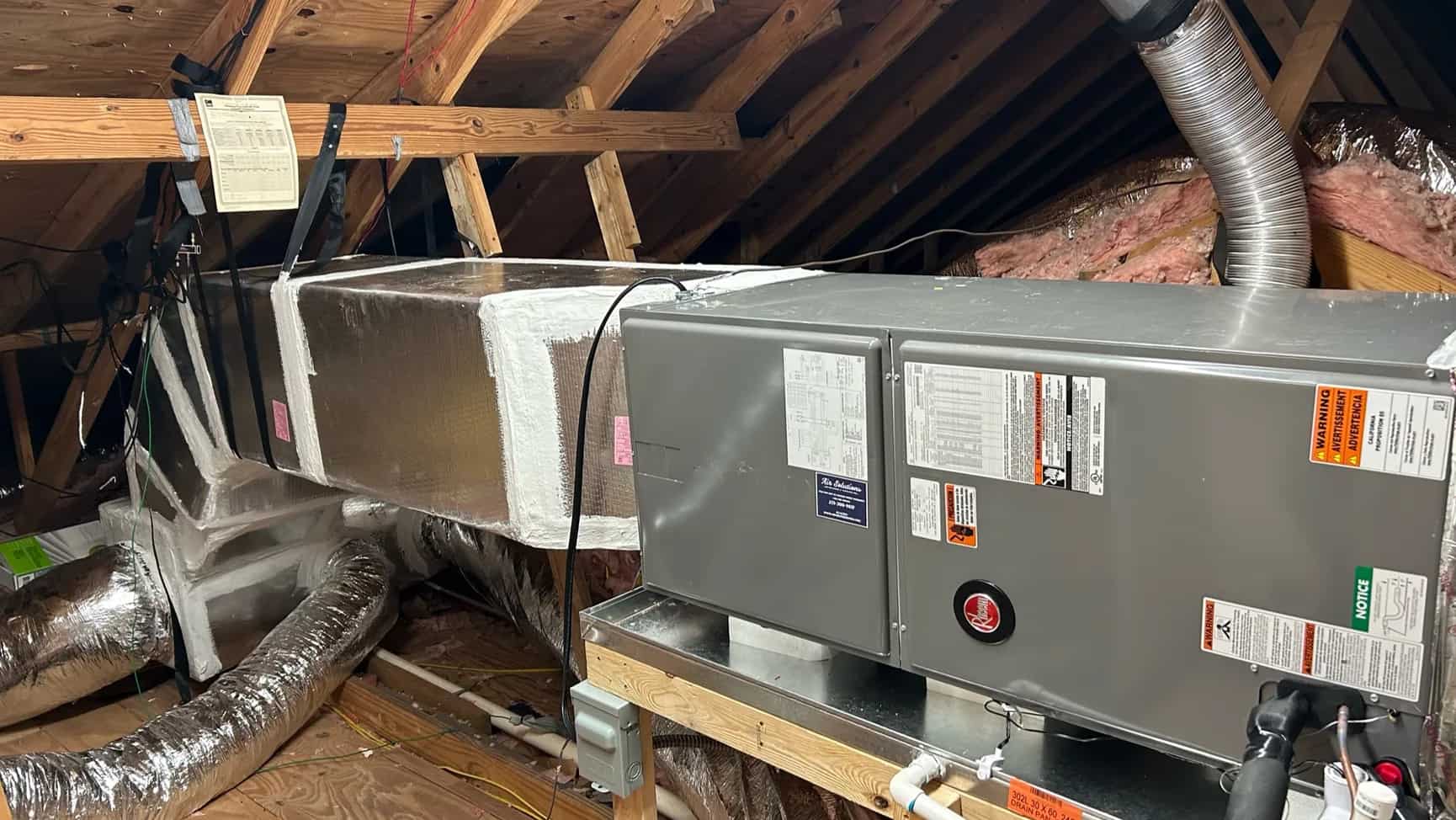
Heating Installation in Elberta.
Local heating installation in Elberta, Alabama and surrounding Baldwin County. Heat pumps, gas + electric furnaces, manufactured home heating — sized for Baldwin County winters. Licensed AL#23194. 353+ five-star reviews. Call (251) 300-9817.
Get a Free Estimate
Name and phone is all we need to call you back. Takes ~20 seconds.
353+ five-star reviews · Same-day · 24/7 · Licensed AL#23194
What heating installation looks like in this climate.
A heating installation in Elberta has to take the inland-rural winter seriously without overcorrecting for a Gulf Coast climate that does not actually justify cold-climate-tier hardware on most addresses. ERA5-Land reanalysis run against the Elberta coordinates returns roughly 1,033 heating degree days for 2023 alongside about 3,036 cooling degree days, with average January lows holding right at 50°F and the occasional January overnight dropping into the 20s during a multi-night cold front. That ratio puts the install conversation in the band where a properly sized variable-speed unit paired with a correctly staged auxiliary strip handles the season comfortably — heating mode runs real hours through December, January, and into February, but the equipment is not asked to sustain capacity below 25°F for days at a time the way a Bay Minette install at the top of the county has to be designed for.
What sets the heating-installation worksheet apart in Elberta from the equivalent worksheet on a Daphne or Fairhope address twenty-five miles to the northwest is the open-sun acreage exposure most rural-Elberta outdoor pads sit in. The Eastern Shore towns have mature tree canopy and bay-influence morning temperatures that soften both seasons; Elberta acreage lots run colder through clear winter overnights when there is no canopy to slow the radiative loss. The sizing math has to honor that reality rather than average it away into a coastal-southern climate assumption.
What we see on calls in Elberta.
The 2022 ACS gives Elberta a median home built in 1990, which lands the typical address right around 32 years old on a 2026 install quote. That single number frames most of what we expect to find on a heating-installation site visit: the original system from the early 1990s is long gone, the second-cycle replacement that went in somewhere between 2005 and 2018 is what is being replaced today, and the existing ductwork was almost always specified around a heat-pump-plus-strip-heat package from the original construction. What that means for the install scope is that a like-for-like central system swap on the residence rarely opens up a separate duct-remediation project the way a 1976 Bay Minette home does — the bones are usually workable. Static-pressure readings on the existing air-handler return get logged before we put a quote on paper, a fresh Manual J load calculation runs against the actual building envelope rather than against the outgoing equipment's nameplate as a proxy, and the existing 200-amp service gets a headroom check for whatever modern variable-speed condenser ends up specified.
Where the install conversation diverges from the city-scale heating-installation cells in the matrix is the outbuilding question. Owner-occupancy here runs about 64.5 percent on 961 occupied housing units, and the addresses skew rural-acreage rather than subdivision — which means a meaningful share of Elberta install quotes are not just about the residence. Detached shops, pole barns turned hobby workshops, woodworking buildings, and tractor sheds that the homeowner wants conditioned year-round all surface on the same site visit. The honest scope on those is almost never to extend the residential central system into the outbuilding through buried line sets and a tacked-on duct trunk — the load profiles do not match and the duct losses on that arrangement do not pencil out. The cleaner answer is usually a separately scoped second system for the outbuilding (a ductless mini-split heat pump on structures up to about 1,500 square feet, a small central unit on larger workshops), quoted as its own line item rather than folded silently into the residential install. We walk through the math against both buildings rather than treat the outbuilding as a residential afterthought.
- Mid-life equipment is the common profile in this area. Capacitor and contactor failures dominate the service-call mix.
- Long cooling season means compressors run heavy May through October. Annual maintenance pays for itself in compressor lifespan.
- Mild winters mean heat pumps cover the season comfortably without backup runtime in normal years. Cold-snap weeks expose undersized units.
Heating Installation in Elberta — the questions that come up.
- We have a farmhouse plus a detached shop on our Elberta acreage. Should the new heating install try to cover both buildings with one system?
- Almost never the right answer mechanically, even when the buildings sit close enough that a single system looks tempting on paper. Two separate envelopes with different occupancy patterns, different insulation profiles, and different setpoint preferences push a single air handler into compromises it was not designed for — the comfort suffers in the residence whenever the shop calls for capacity, and the equipment runs at static pressures it was never sized against. The cleaner install scope for a rural Elberta property with both a residence and an outbuilding to condition is a dedicated system sized to each building's actual load. A correctly sized variable-speed heat pump handles the residence; a separately quoted ductless mini-split heat pump (often the right answer up to about 1,500 sq ft) or a small central system (above that) handles the outbuilding on its own thermostat and its own outdoor unit. The two projects get quoted as two line items so the homeowner sees the full picture rather than a single-figure surprise when the second pass starts.
- Our Elberta farm already keeps a propane tank for the kitchen and the water heater. Does that change which heating system makes sense to install?
- It opens a legitimate dual-fuel install path that is not really available to most rural Elberta addresses. A property already plumbed for propane at the meter — kitchen range, water heater, fireplace, or all three — can pair a heat pump with a propane furnace in a hybrid configuration where the heat pump carries the bulk of the heating hours through the milder shoulders and the LP furnace stages in only on the genuinely cold mornings when ambient drops below the system's programmed crossover threshold. The configuration earns its keep on the small share of winter hours when ambient drops into the 20s, because LP combustion delivers higher capacity in that band than a non-hyper-heat heat pump running at low ambient. For a home with no existing tank in the ground, the cost of running new LP infrastructure rarely justifies switching off an all-electric heat-pump install for a heating season as mild as Elberta's.
- Will a modern variable-speed condenser fit on our existing electrical service, or do we need a panel upgrade as part of the install?
- Usually yes on the existing service, sometimes no on the available breaker slots — and we run the calculation honestly before we quote rather than discovering it the day of the install. The typical Elberta residence built in the 1990 vintage carries a 200-amp main panel, which is generally enough headroom to add a variable-speed condenser, a properly sized auxiliary heat strip, and the indoor air handler without a service upgrade. The constraint we see more often is breaker-slot availability on a panel that has already absorbed a couple of additions over the years — well pumps, secondary electrical loads in an outbuilding, a hot tub or a workshop sub-panel feed. We measure the actual load on the existing service, count the available slots, and surface a sub-panel or service upgrade in the quote as a separate line item if the install genuinely needs one. We do not bury that decision in the project total.
- Is the cold-climate hyper-heat tier of heat pump worth the install premium on a rural Elberta address?
- Honestly, usually not — standard-tier variable-speed equipment delivers the right answer for the Elberta climate baseline. The cold-climate hyper-heat tier (Mitsubishi Hyper-Heat, Daikin Aurora, Lennox SL25XPV class) is engineered to preserve nameplate capacity down into the single digits, which matters where heating-degree-day load runs heavy and ambient stays below 25°F for sustained stretches. Elberta's baseline is roughly 1,033 heating degree days a year with average January lows right at 50°F — a properly sized standard unit paired with a correctly staged auxiliary strip handles that comfortably and keeps the install budget where it should be. The cases where the cold-climate premium genuinely earns its keep here: a homeowner whose system ran in continuous aux-heat mode through the January 2024 freeze and wants a different outcome next time, an electrical service with no real headroom for a larger aux stage, or a homeowner who values nameplate capacity preservation on principle. Standard-tier is the default; hyper-heat is the exception we walk through honestly when the situation actually calls for it.
- Did the federal 25C heat-pump tax credit apply to heating installations in Elberta, and is it still available?
- The federal Section 25C Energy Efficient Home Improvement Credit expired December 31, 2025 under the One Big Beautiful Bill (PL 119-21). New installations in 2026 do not qualify. If equipment was placed in service on or before December 31, 2025, the homeowner may still be able to claim the credit on the 2025 federal return — confirm specifics with a tax preparer. For new Elberta installs today, the relevant financial levers are the Baldwin EMC and Riviera Utilities residential efficiency programs — verify which provider serves your meter and the current program details directly with that utility.
Cold-weather and storm events that shape heating-installation decisions on rural Elberta acreage.
- Jan 2024 — Multi-night sub-freezing stretch: The cold snap that put the heating-mode sizing argument back into the install conversation for the Highway 98 corridor. Elberta sits in a heating-degree-day band where a multi-night freeze of this severity is rare enough to expose the equipment that was sized only for the cooling load — systems that had never been asked to satisfy setpoint at low ambient surfaced as continuous-aux-heat performers across that week, and the install quotes we have written in Elberta since often anchor on the homeowner not wanting a repeat of that month's electric bill. The right install-side answer on most addresses is honest Manual J sizing on both seasons and a properly staged auxiliary heat strip rather than reaching for the cold-climate hyper-heat premium.
- Jan 2018 — Hard freeze, lows into the low 20s: The reference cold-event for the current Elberta installed base. First-generation heat pumps from the late 1990s and early 2000s that had drifted out of tune surfaced as no-heat calls during the event, and a noticeable fraction of the Elberta equipment from the 2018-2020 install wave dates to repair-or-replace decisions homeowners made the spring after. Systems from that install wave now sit around the seven-year mark, and current heating-installation quotes are often shaped by the visible service history of equipment that has already weathered one comparable winter event.
- Sep 2020 — Hurricane Sally (Category 2 landfall at Gulf Shores): Sally tracked north through Elberta after landfall and produced extended outages plus repeated voltage-cycling stress across the rural electric feeders that serve the community on both the Riviera and Baldwin EMC sides of the split. The replacement-and-recommission wave that followed reshaped the local installed-base age distribution. A noticeable fraction of working systems in Elberta today are post-Sally installations that are now aging through the back end of their initial manufacturer warranty window, and that vintage is what most current heating-installation quotes are replacing.
What Elberta customers can claim.
- We pull which electric provider actually serves your address from a recent bill before any rebate line item gets quoted, because Riviera Utilities and Baldwin EMC each run their own residential efficiency menu and the qualifying paperwork does not transfer between them. Assuming the wrong one wastes the homeowner's time on an eligibility path that will not actually fund.
- Residential efficiency programs from both Riviera Utilities and Baldwin EMC have historically applied to qualifying heat-pump install work, but the published tier thresholds and the dollar amounts adjust on each cooperative's own calendar. Active program details get pulled fresh against the bid date so the figure on the quote matches what will actually pay out — relying on a stale number from last season is a way to disappoint the homeowner at closing.
- Cool Club membership on a fresh Elberta install is most useful for the maintenance cadence it locks in: a fall visit to verify the reversing valve actuates and the aux heat strip stages cleanly before the first real cold front, a spring visit to clear the seasonal pollen and ag-dust accumulation off the outdoor coil before the cooling load ramps. Per the published member terms the discount runs 15% off all AC repairs and 5% off new systems, and Cool Club carries no long-term commitment.
- The federal Section 25C heat-pump credit expired December 31, 2025 and no longer applies to new installs. For work placed in service before that date, a CPA can advise on the 2025 return. Manufacturer rebates active on the specified equipment land directly in the project quote rather than as a separate post-install reimbursement loop, and the utility programs and manufacturer rebates still stack for addresses that clear each program's threshold.
Every Elberta neighborhood, every zip.
The run down to Elberta from the Daphne shop is one of the longer haul-out routes on our service map — call it a 50-minute door-to-door under normal traffic, which is the OSRM-verified routing number we plan dispatch against rather than a rounded marketing figure. The route works southbound through Loxley and past Foley before crossing into the German-heritage farming country that defines the community, and ZIP 36530 covers the entire Elberta footprint we service: the small downtown blocks along the Highway 98 corridor, the Baldwin County Heritage Museum area, and the rural acreage that fans outward toward Lillian on the south side and toward Summerdale and Robertsdale on the north.
A heating-installation project in Elberta gets booked as a morning-start install slot so the crew arrives with the daylight, sets the equipment cleanly, and finishes the commissioning paperwork before the road time becomes a constraint. When the schedule lines up with other work in Foley, Magnolia Springs, or Lillian we run the trip on a stacked-route basis to keep the dispatch math honest; when it does not, we plan a dedicated truck for the day and book the install date with the 50-minute haul already factored into the morning start. A two-system project covering a residence plus an outbuilding is a multi-day install rather than a same-day promise — refrigerant line sets routed independently, dual commissioning passes, separate electrical work — and the schedule reflects that reality rather than overselling a single-day window.
- Downtown Elberta
- the Highway 98 corridor
- the Baldwin County Heritage Museum area
- rural Elberta
Heating Installation Coverage Map — Elberta, Alabama
Centered near Elberta for orientation. Air Solutions Heating & Cooling provides heating installation throughout every Elberta neighborhood and zip code, plus the surrounding Baldwin County area. Same crew, same number — we travel the whole county.
353+ Five-Star Reviews. And Counting.
“Jacob was friendly, professional and prompt.”
“Jacob was absolutely wonderful. Definitely would recommend him and this company!!”
“⭐⭐⭐⭐⭐ **Outstanding Service from Air Solutions and Jesse!** I can't say enough good things about my experience with **Air Solutions**, especially their technician **Jesse**. After dealing with my 10-year-old HVAC system, I wanted someone who would actually take the time to diagnose and properly service the system rather than simply recommend replacing it. Jesse exceeded my expectations. He was…”
Schedule Heating Installation in Elberta.
Heat pumps, gas + electric furnaces, manufactured home heating — sized for Baldwin County winters. Same-day appointments most weekdays in Elberta and surrounding Baldwin County. Tell us when works for you — we'll confirm by phone during weekday office hours (8 AM-4 PM).
Need someone right now? Call (251) 300-9817 — our 24/7 emergency line is answered live when we can and returned quickly when we can't.
Heating Installation in Elberta — FAQs
How much does a new heating system cost installed in Baldwin County?
Heat pump replacements (which double as your AC) typically run $7,500 to $14,000 installed depending on capacity, efficiency tier, and any ductwork modifications. Standalone gas furnace replacements run $4,500 to $9,000 (less if you're keeping the existing AC). Manufactured home heating systems start around $3,500. Air Solutions provides a written load calculation, AHRI match documentation, and itemized pricing — no salesperson math, no surprise add-ons. Cool Club members receive 5% off new system installations.Heat pump vs. gas furnace — which makes sense in Baldwin County?
For most homes, heat pumps win. Baldwin County is Climate Zone 2A: a properly-sized heat pump runs efficiently in our winter conditions, delivers 2-3 units of heat per unit of electricity consumed, and pulls double duty as the air conditioner all summer. Gas still pencils when natural gas is already at the meter and the home has a heavier-than-typical heating load — common for older inland houses with poor insulation. If you don't already have gas service, the cost of running a new line plus a gas furnace plus a separate AC almost always exceeds the cost of a single high-efficiency heat pump installation.What size heating system do I need for my home?
Right-sized — not bigger. Baldwin County's mild winters mean an oversized heating system short-cycles, wastes electricity, and wears out faster. Air Solutions runs a Manual J load calculation that accounts for square footage, insulation quality, window orientation, ceiling height, ductwork condition, and the actual design heating temperature for your zip code. The result is usually smaller than the system being replaced — and cheaper to operate. Oversizing is the most common mistake we see on heating installs in Baldwin County, and it shows up as humidity complaints in summer, not warmth in winter.Do you service all of Elberta, AL?
Yes — Air Solutions Heating & Cooling covers every neighborhood and zip code in Elberta, Alabama — including Downtown Elberta, the Highway 98 corridor, the Baldwin County Heritage Museum area, plus the surrounding subdivisions and rural roads. We handle AC repair, AC installation, AC maintenance, emergency HVAC, and commercial HVAC. Standard service hours weekdays, 24/7 emergency response, and same-day appointments most of the year. Call (251) 300-9817 to schedule.What HVAC issues are most common in Elberta?
Homes around Hwy 98 most commonly call us for refrigerant leaks (often salt-air or coil corrosion related on the Gulf Coast), undersized air conditioning systems struggling with Baldwin County summer humidity, and capacitor failures during peak load between June and September. A Cool Club bi-annual maintenance plan catches most of these issues before they cause a breakdown.
Heating Installation Near Elberta.
Right at the Elberta city limit? We service the surrounding Baldwin County communities on the same routes — same crew, same response times.
Related HVAC Guides.
Long-form articles about heating installation and Baldwin County HVAC, with practical advice from our team.
 Homeowner Resources
Selling Your Elberta Home in Summer? HVAC Questions Buyers Always Ask
HVAC questions Elberta, AL home buyers ask sellers — what records to prepare, what fixes to make pre-listing, and what disclosures matter most in the inspection period.
September 16, 20264 min Buyer Guides
SEER2 Ratings for Elberta Homeowners: What's Worth Paying For
SEER2 efficiency ratings explained for Elberta, AL homeowners — what each tier costs upfront, what it saves long-term, and where the breakeven sits in our climate.
September 9, 20264 min Maintenance
Frozen Evaporator Coil in Elberta: Why It Happens in 95° Weather
How an Elberta, AL AC evaporator coil freezes during 95°F summer days — three causes, what to do when it happens, and why it indicates other problems.
August 27, 20264 min
Other services in Elberta & this service across Baldwin County.
- All HVAC services in Elberta, AL
- Heating Installation across Baldwin County
- AC Repair in Elberta
- AC Installation in Elberta
- AC Maintenance in Elberta
- Commercial HVAC in Elberta
- Emergency HVAC in Elberta
- Heating Repair in Elberta
- Heat Pump Services in Elberta
- Indoor Air Quality in Elberta
- Ductless Mini-Splits in Elberta
Heating Installation in Elberta — Schedule Today.
Same-day appointments most weekdays. Cool Club members get prioritized scheduling.