
Water Around Your Air Handler in Fairhope: Clogged Drain or Worse?
Puddle near your indoor AC unit in Fairhope, AL? Telling a clogged condensate drain from a cracked pan or a melting frozen coil, the float-switch safety, and steps before water spreads.

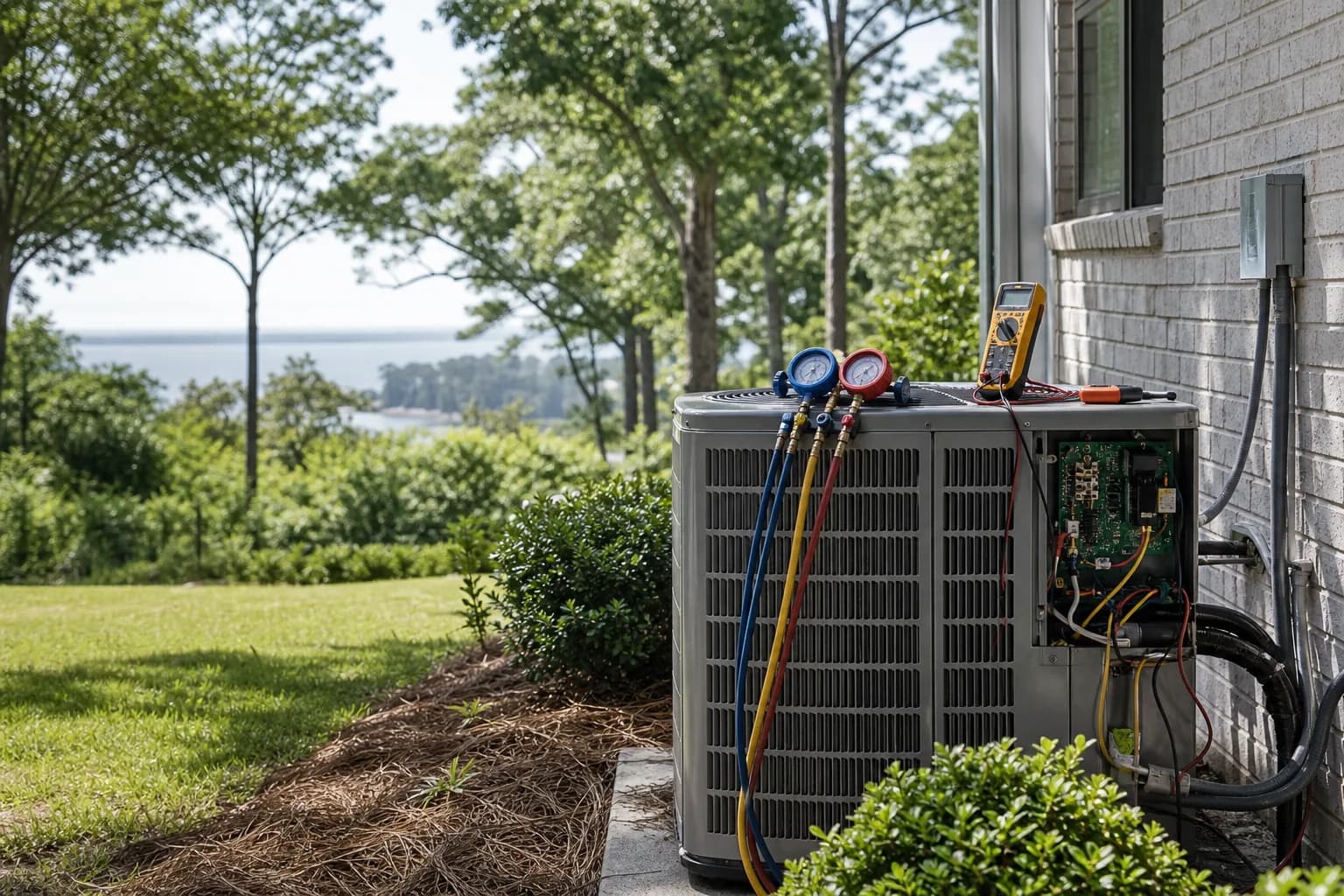
You go to swap the laundry or grab something from the hall closet and there it is — a damp ring on the floor around the indoor AC unit, or a slow drip from the pan beneath it. In a Fairhope summer, that puddle is one of the most common calls we take, and there's a simple reason for it: your air conditioner pulls an astonishing amount of moisture out of our humid Gulf air every day, and all of that water has to go somewhere. When the path it normally takes gets blocked, the water finds your floor instead.
The good news is that the most common cause is also the most benign and the most preventable. The reason to act quickly isn't usually that your AC is in peril — it's that standing water near an air handler can reach flooring, baseboards, and subfloor faster than you'd think, and water damage is the expensive part of this story. Here's how to tell what you're looking at and what to do about it.
Where does all that water come from?
When your evaporator coil chills the warm, muggy air from your house, the moisture in that air condenses on the coil exactly like beads on a cold glass of tea in July. In our climate that adds up to gallons a day. It drips off the coil into a drain pan, and from there it's supposed to run out through a condensate drain line — a small PVC pipe that carries the water outside or to a drain.
That whole system is gravity-fed and quiet, and you never think about it until it stops working. When it does, the water has nowhere to go but up and over the pan, onto whatever is below. Understanding that path is the key to reading which of three problems you have.
The three things that cause the puddle
Nearly every "water by the indoor unit" call comes down to one of these, and they're worth telling apart.
A clogged condensate drain line — by far the most common. That little PVC line is the perfect environment for algae and slime to grow in our heat and humidity, and over a season it can sludge up and block completely. Dust and debris add to it. Once the line clogs, the pan fills and overflows. This is the cause in the large majority of Fairhope cases — from the older homes in the Fruit and Nut District near downtown and the Pier to the newer builds out past Greeno Road and along Scenic 98 toward Point Clear — and it's also the most preventable. For the full picture on why these clogs form in our humidity and how to keep them from coming back, see our guide to drain-line clogs in humid Baldwin County.
A cracked or rusted-through drain pan. Pans don't last forever. An older metal pan can rust through; a plastic one can crack or warp. In that case the line may be perfectly clear, but the pan itself is leaking water out the bottom before it ever reaches the drain.
A frozen coil that's now melting. If the coil iced over earlier — from a dirty filter or low refrigerant — and then began to thaw, the volume of meltwater can overwhelm the pan and drain all at once and spill over. The tell here is that the water shows up after a period of weak or no cooling, and you may find or have found ice on the unit. If that's your situation, the water is a downstream symptom and the freeze is the real problem to solve — and our breakdown of why a coil freezes over in peak heat covers what to fix.
Safe steps before the water spreads
These are all things you can do safely right now to limit damage and possibly clear the simplest cause. None of them require opening the sealed parts of the unit.
Turn the system OFF at the thermostat
Switch it to OFF, not just up a few degrees. With cooling off, the coil stops producing condensate, which stops adding to the puddle while you sort out the cause. This also protects the system if a float switch hasn't already cut it.Soak up the water and protect the floor
Towels and a wet/dry vac on the standing water now. Get it away from baseboards, wood flooring, and anything that can wick or warp. This is the step that actually saves you money — water damage is the costly outcome here, not the AC repair.Check and empty the drain pan
If you can see a pan under the unit holding water, that confirms a drain or pan problem. Carefully sponge or vacuum it out so it isn't poised to overflow again the moment the system runs.Try clearing the drain line if you can reach it
Many systems have a capped access tee on the PVC drain line near the unit, and an outdoor end where the line exits. A wet/dry vac held to the outdoor end can pull a clog free in some cases. This is the one homeowner fix that often works — but if you can't find the line or it stays blocked, leave it for a tech rather than forcing anything.
When to stop and call
A wet/dry vac on the drain line clears a fair share of these. Call a tech when:
- You can't locate the drain line, or it stays clogged after you've tried clearing it.
- The pan is cracked, rusted, or visibly leaking from the bottom rather than overflowing the top.
- The water followed a stretch of weak cooling or you found ice — that's a frozen-coil cause that needs its root fixed.
- The float switch has shut the system down, or it keeps shutting down after you restart it.
- Water has already reached flooring or walls, or the leak is faster than you can keep up with.
There's no benefit to running a system that's pushing water onto your floor while you figure it out. Shut it off, dry the area, and let a tech clear the line, flush it, check the pan, and confirm the float switch is doing its job. We quote whatever the repair is in writing before any work begins.
An ounce of prevention in this climate
Because the clogged-drain version is so common and so preventable here, it's worth a word. A seasonal tune-up includes flushing and treating the condensate line so the algae that thrives in Fairhope humidity never gets the chance to block it — which is a big part of why we nudge folks to get the system looked at each spring before the heavy cooling season loads that drain up. A clear drain line is a small thing that prevents a wet floor. For more on what that visit catches, see what a spring AC tune-up includes on the coast, and if the leak is the only symptom, why your AC leaks water — the drain-line culprit goes deeper on the most likely cause.
Ready to dry it out for good in Fairhope?
Air Solutions is a family-run company founded in Daphne in 2023, licensed in Alabama as AL#23194 and BBB A-rated, serving Fairhope and the Eastern Shore. If there's water at your air handler, let's find the source.
- Schedule AC repair — same-day when we can; we'll confirm by phone.
- Call (251) 300-9817 — 24/7 emergency dispatch.
- AC repair services — full overview.
Related resources
- AC repair in Fairhope — our local service page.
- All HVAC services in Fairhope — every service we offer in town.
- Cool Club membership — seasonal tune-ups that flush the condensate line before it clogs.
- Post-storm coil cleaning and why salt-water damage compounds — when water and the coast combine after a storm.
- AC not working? An Eastern Shore troubleshooting guide — if the float switch cut your cooling, start here.
- The Field Guide — more plain-spoken HVAC help for Baldwin County.