
Spring Pollen + Your HVAC in Fairhope: April Action List for Allergy Sufferers
Practical guide for Fairhope, AL homeowners with seasonal allergies — six HVAC steps that actually reduce indoor pollen during peak Eastern Shore pollen season.

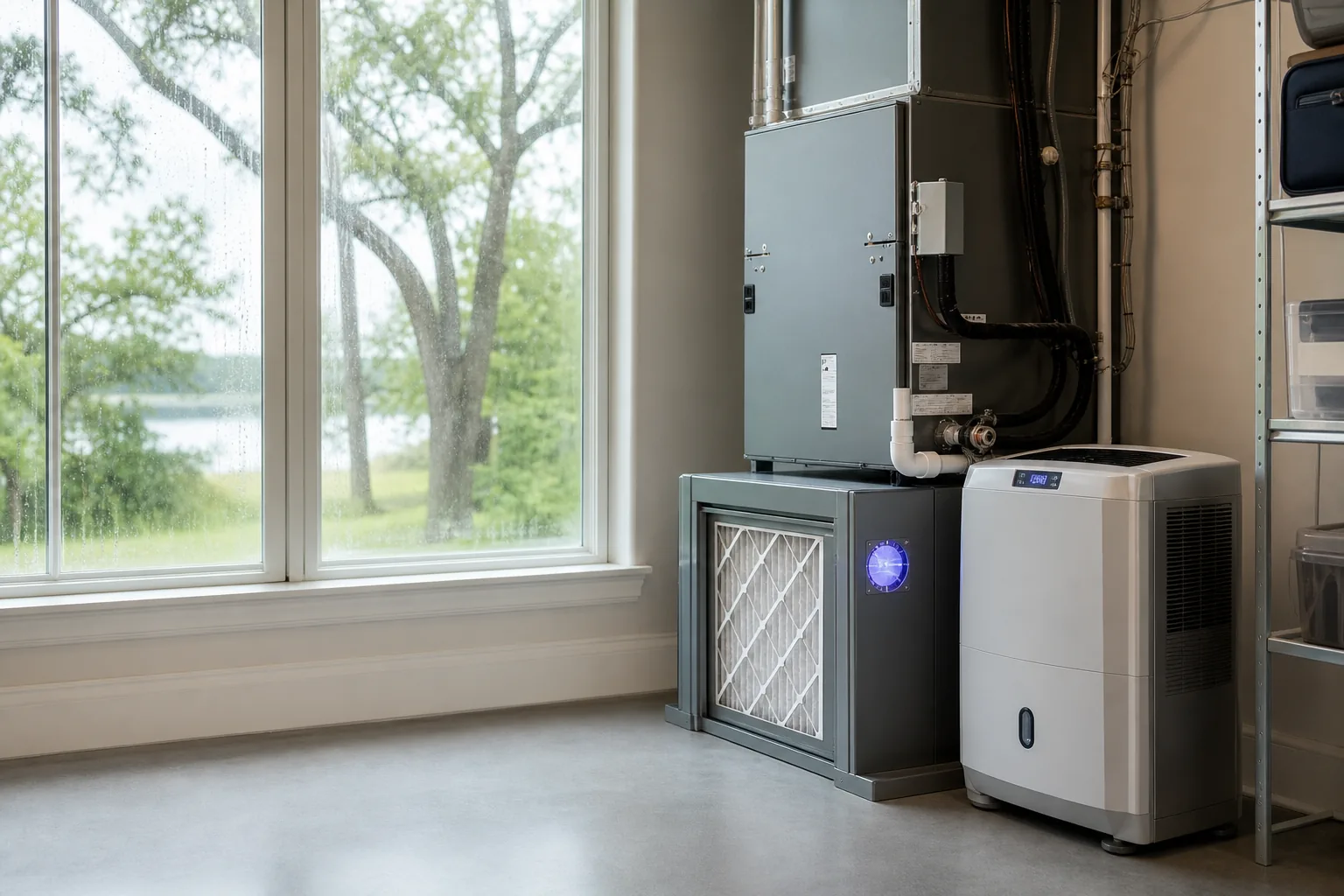
If you live in Fairhope and you've noticed your car has been yellow for three weeks, your indoor air is also worse than usual. Spring pollen counts in Baldwin County are among the highest in the Southeast — pine, oak, and grass species all unloading at once from late March through mid-May. For allergy-sufferers in Fairhope, this stretch of the calendar is when HVAC choices stop being optional and start being medical.
Here's the practical playbook: six things you can do to your HVAC system that actually reduce indoor pollen, ranked roughly by impact-per-dollar.
1. Upgrade your filter to MERV 11 or 13 (right now)
The biggest single move is also the cheapest. Most Fairhope homes ship with MERV 4–6 filters that catch large dust but let pollen, mold spores, and pet dander pass through unaffected — and under the mature live oaks of the Fruit and Nut District, that's a lot of pollen getting a free pass. Upgrading to a MERV 11 pleated filter catches roughly 85% of pollen-sized particles. MERV 13 catches 95%+.
Two caveats:
Verify your blower can handle it. Higher-MERV filters add airflow restriction. Most modern Fairhope HVAC systems handle MERV 11 without issue; some older units struggle with MERV 13. If your system already runs hot or short-cycles, stick with MERV 11 and replace it every 60 days during pollen season.
Don't skip the actual change. A loaded MERV 13 is worse than a clean MERV 6 — restricted airflow lowers your evaporator coil temperature and freezes it. Set a 60-day reminder during pollen season.
Cost: a pleated MERV 11 is an inexpensive, off-the-shelf item — one of the lowest-cost moves on this whole list, with a material change in indoor air quality during pollen weeks.
2. Run the system "fan only" for 30 minutes after coming in from outside
This sounds counterintuitive but it works. When you and your family come home from outdoor time during pollen season, you bring pollen in on clothes, hair, and shoes. The pollen settles on indoor surfaces over the next hour.
Running your HVAC fan in "ON" (not "AUTO") for 30 minutes pulls that settling pollen through your filter and removes it before it embeds in carpet and upholstery. Then switch fan back to AUTO so you're not running it continuously.
Cost: free. Effect: noticeable for households with chronic spring allergies.
3. Seal the duct leaks (especially returns)
This is the silent IAQ killer in Fairhope homes. Every Eastern Shore house we work on with chronic spring allergy complaints has at least one significant return-duct leak — usually in the attic or crawlspace. It turns up in the older homes near downtown and the Pier as often as in the newer builds out past Greeno Road. Air gets pulled into the return from unconditioned, unfiltered space, completely bypassing your filter.
Symptoms of leaky returns:
- HVAC system runs longer than it should to satisfy thermostat
- Dust accumulates faster than expected on intake registers
- Spring allergy symptoms don't improve even after filter upgrades
- Energy bills creep up year over year despite no equipment changes
Fix: have an HVAC contractor pressure-test the duct system. Sealing leaky returns is a targeted, mid-range job for a Fairhope home, and it pays back through both lower energy bills and meaningfully better indoor air. Ask for a quote once the leaks are located.
4. Address the humidity (because pollen sticks better in dry air. wait, in our case the opposite)
Indoor humidity in Fairhope sits at 60–70% during spring even with the AC running — and the closer you are to Mobile Bay along Scenic 98, the more relentless that moisture load is. That high humidity actually helps pollen — settled particles stay damp and embedded rather than getting pulled into your return airflow.
Lowering indoor humidity to 45–50% with a whole-house dehumidifier does two things: it makes pollen lighter and easier to capture in your filter, AND it reduces mold spore generation (which is its own allergy trigger this time of year).
A whole-house dehumidifier integrates into your existing Fairhope HVAC system rather than running as a separate appliance. For households with chronic spring respiratory issues, the comfort and air-quality payoff makes the case — request an installed quote sized to your home.
5. Add UV coil sterilization (especially if you smell anything off)
Pollen isn't the only spring allergen — mold spores ramp up at the same time. Your AC's evaporator coil is the perfect mold-growing environment in our climate: warm, dark, constantly damp from condensation. A UV-C light installed in the air handler kills mold spores and bacteria as air passes through, which keeps the coil clean and prevents biological aerosols from circulating.
A UV-C install is a comparatively small add-on in a typical Fairhope home, with an inexpensive bulb replacement every 18–24 months. Most useful for households where someone notices a "mildewy" smell from vents or where coils have shown biological growth on prior service visits. We'll quote it as part of any IAQ visit.
6. Schedule an IAQ assessment if symptoms persist
If you do all five of the above and someone in your Fairhope household still has unmanaged spring respiratory symptoms, the issue is probably specific to your home rather than generic.
An IAQ assessment is an affordable, flat-fee visit for Fairhope homes and includes:
- Humidity readings throughout the home (not just one thermostat reading)
- Ductwork inspection with camera where access permits
- Coil inspection for biological growth
- Filter pressure-drop measurement
- A written report with prioritized recommendations
About half of these turn into a hands-on intervention (UV install or duct seal); the other half are simpler filter or schedule fixes. Either way you'll have actionable data instead of guesswork.
What to skip
A few things that get marketed during pollen season but don't move the needle for most Fairhope homes:
- Whole-house aromatherapy diffusers — these add particles to the air, not remove them
- Standalone HEPA room units — fine in a bedroom, but they don't address whole-home circulation
- "Anti-allergen" duct cleaning sprays — most have no IAQ data behind them
- Generic "air freshener" approaches — these mask, they don't filter
The interventions that work are mechanical: better filtration, controlled humidity, sealed ducts, clean coils.
Ready to address spring allergies in your Fairhope home?
Air Solutions Heating & Cooling handles indoor air quality work across Fairhope and the Eastern Shore — IAQ assessments, filter upgrades, dehumidifier installs, UV coil sterilization, duct sealing. We're a locally owned, family-run shop founded in Daphne by Reaves Nelson; licensed Alabama HVAC contractor (AL#23194), with a strong five-star reputation among Baldwin County homeowners.
- Schedule an IAQ Assessment — pick a time and we'll confirm by phone
- Call (251) 300-9817 — for same-day or after-hours service
- All Indoor Air Quality services — full IAQ overview
Related resources
- Indoor Air Quality in Fairhope — city-specific service page
- All HVAC services in Fairhope — every service we offer locally
- The Air Solutions Field Guide — searchable HVAC library